
Acurx Pharmaceuticals’ Transition from Development Losses to Phase 3 Clinical Promise
Acurx advances its novel antibiotic pipeline with Phase 3 trials for ibezapolstat while facing critical funding challenges.
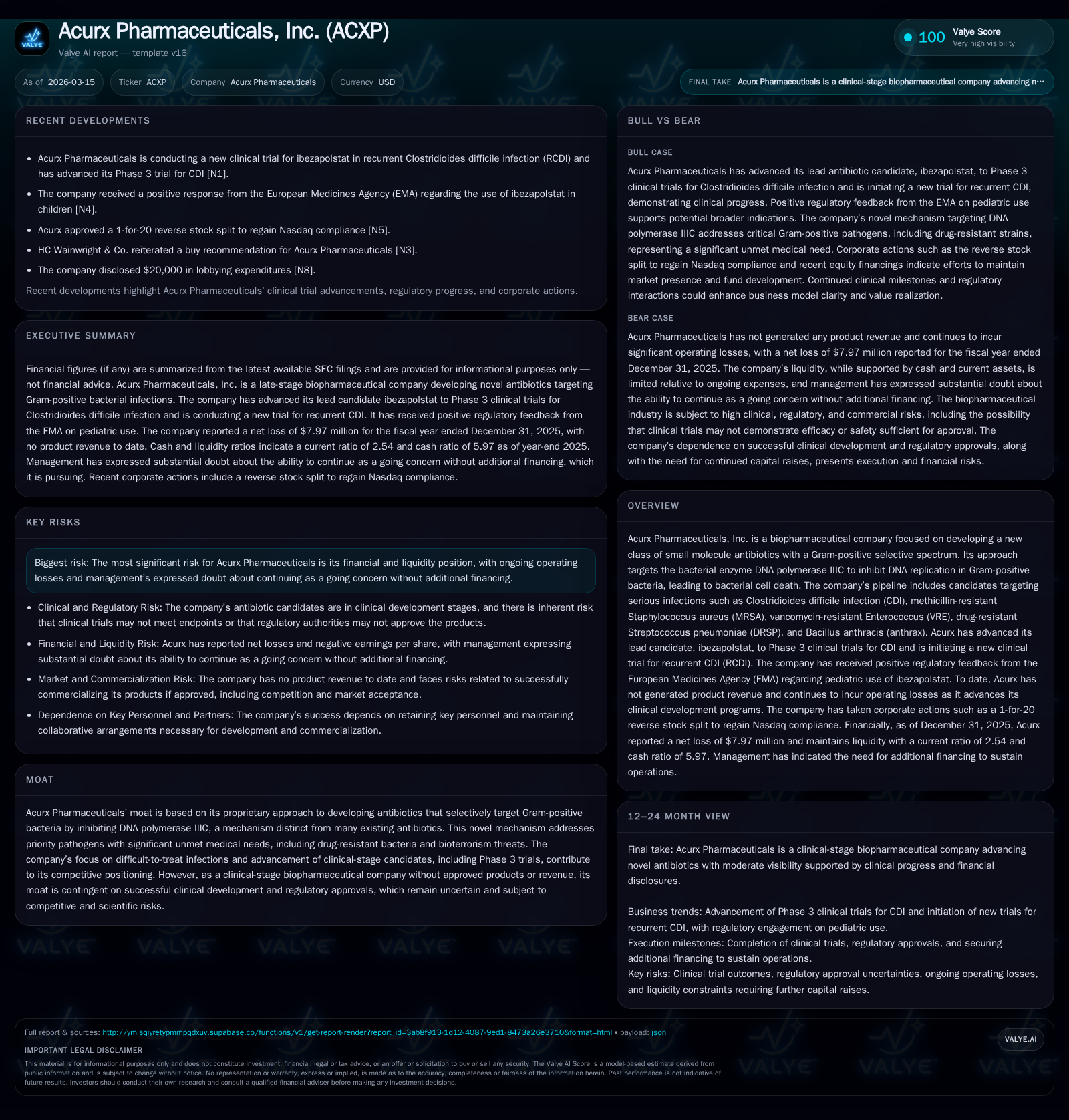
Acurx Pharmaceuticals, engaged in pioneering Gram-positive targeted antibiotics through inhibition of DNA polymerase IIIC, has improved its financial performance with a 43.5% year-over-year net loss reduction in 2025. The company's lead candidate, ibezapolstat, is progressing in Phase 3 clinical trials targeting Clostridioides difficile infection (CDI) and recurrent CDI, with regulatory feedback including EMA pediatric guidance. Despite this clinical momentum, Acurx faces liquidity risks requiring additional capital amid ongoing operating losses and negative cash flows. Upcoming clinical data readouts and financing efforts will be pivotal for its runway and market prospects.
Track Record of Clinical Development and Financial Performance
Since inception, Acurx Pharmaceuticals (ticker: ACXP) has focused on developing a novel class of antibiotics aimed at Gram-positive bacterial infections through selective inhibition of DNA polymerase IIIC — an enzyme critical for bacterial DNA replication []. Its lead candidate, ibezapolstat, is advancing through Phase 3 trials targeting Clostridioides difficile infection (CDI), a serious intestinal infection prevalent in healthcare settings.
Financially, Acurx remains a clinical-stage biopharmaceutical company without approved products or revenue streams [[S1]]. The company has consistently reported operating losses due to heavy investments in R&D. Notably, net loss improved by about 43.5% from approximately -$14.1 million in fiscal year (FY) 2024 to -$7.97 million in FY2025 [F1], reflecting operational discipline amid late-stage clinical scaling.
Operating cash flow follows this trend with significant outflows typical for R&D-intensive firms but improved by roughly 34.6% year-over-year to nearly -$6.8 million in FY2025 [F1], underscoring reliance on external funding.
The equity base expanded substantially to $5.27 million at the end of 2025 after multiple equity raises, including registered direct offerings and warrant exercises since the June 2021 IPO [[S16],[S17],[S19]].
Financial Performance Summary FY2022–FY2025
Historical performance (annual)
| FY | Net ($mm) | CFO ($mm) | Net YoY |
|---|---|---|---|
| 2025 | -8 | -7 | +43.5% |
| 2024 | -14 | -10 | +3.3% |
| 2023 | -15 | -10 | -20.5% |
| 2022 | -12 | -8 |
Source: SEC companyfacts cache [F1].
Capital returns and efficiency (annual)
| FY | ROE% |
|---|---|
| 2025 | -151.2 |
| 2024 | -2292.7 |
| 2023 | -312.4 |
| 2022 | -165.3 |
Source: SEC companyfacts cache [F1].
Note: ROE calculated as net income divided by equity for FY2025.
Innovative Antibiotic Approach Targeting DNA Polymerase IIIC
Acurx’s proprietary approach selectively targets DNA polymerase IIIC — an enzyme essential for DNA synthesis specifically in Gram-positive bacteria []. This mechanism differs from many existing antibiotics that target other pathways such as cell wall or protein synthesis.
This selectivity offers potential efficacy against priority resistant pathogens including MRSA (methicillin-resistant Staphylococcus aureus), VRE (vancomycin-resistant Enterococcus), drug-resistant Streptococcus pneumoniae (DRSP), and Clostridioides difficile — the primary target of ibezapolstat []. Pipeline candidates also address biodefense concerns like Bacillus anthracis (anthrax).
By focusing on DNA polymerase IIIC inhibition rather than conventional mechanisms subject to resistance worldwide, Acurx aims to meet critical unmet needs amid rising infectious disease challenges.
Development Milestones and Regulatory Feedback on Ibezapolstat
In March 2026 news releases confirm Acurx has advanced Phase 3 trials for ibezapolstat addressing primary CDI cases while initiating new studies targeting recurrent CDI (RCDI), patients suffering repeated infections requiring novel treatments [[N1]]. This expansion signals strategic broadening beyond initial indications.
Regulatory interactions include positive feedback from the European Medicines Agency (EMA) concerning pediatric use of ibezapolstat [], indicating potential label extension to younger populations vulnerable to CDI.
These developments enhance Acurx’s competitive positioning within antibiotic innovation markets where regulatory endorsement is crucial for commercialization.
Capital Structure, Liquidity Position, and Financing Risks
Acurx’s balance sheet reflects typical clinical-stage biotech characteristics reliant on capital markets funding due to absence of product revenues [[F1],[S4],[S8]]. As of June 30, 2025 the current ratio was approximately 2.54 indicating adequate short-term liquidity relative to liabilities [F1]. However, cash balances around $6 million raise concerns about sufficiency given ongoing negative cash flows projecting limited runway [[S4],[S19]].
The company has raised capital through multiple equity offerings post-IPO including registered direct sales and an equity line of credit purchase agreement (ELOC) with Lincoln Park Capital Fund permitting flexible share issuance up to $12 million [[S16],[S17],[S19]].
Warrant inducement agreements lowered exercise prices encouraging conversions that provided additional liquidity during fiscal transitions [[S22]]. Dilution risk remains material given continuous share issuances necessary to fund operations.
No dividend payments or share repurchases exist; capital allocation prioritizes R&D investment over shareholder returns until profitability is achieved.
Despite successful fundraising totaling tens of millions since IPO [[S16]], management disclosed substantial doubt about continuing as a going concern beyond one year without new financing [[S4],[S8],[S19]], emphasizing critical liquidity risks.
Outlook: Upcoming Trials and Investment Considerations
Key near-term milestones include completion of patient enrollment and top-line data readouts from Phase 3 studies evaluating ibezapolstat’s effectiveness against both initial and recurrent CDI cases [[N1]]. These outcomes will influence regulatory filing timelines globally.
Further regulatory advances building on EMA pediatric endorsements could expand labeling opportunities enhancing addressable markets beyond adult hospitalized patients.
CDI therapies remain underserved with few novel oral options recently approved amid rising resistance; successful registrational data could position Acurx advantageously.
Investors should monitor updates on trial progress alongside announcements regarding financing transactions or changes to liquidity arrangements that will clarify sustainability prospects [[N1],[S3],[S8]].
Additional partnership or licensing developments may emerge but are presently unconfirmed.
Together these scientific and financial indicators frame Acurx’s trajectory from development losses toward potential first-in-class antibiotic approvals addressing urgent Gram-positive infections.
This analysis is based exclusively on publicly available information as of March 15, 2026. It does not constitute investment advice or recommendations.
Disclaimer: This is research-only, informational analysis and not investment advice. It may include AI-generated interpretation and general industry context. Always verify important details using primary sources.

Comments