
Grayscale Stellar Lumens Trust Reports Sharp Net Income Decline Amid Market and Regulatory Pressures
Volatility in XLM prices and regulatory uncertainty weigh on GXLM’s performance, with growth constrained by structural trading limits and SEC classification risks.
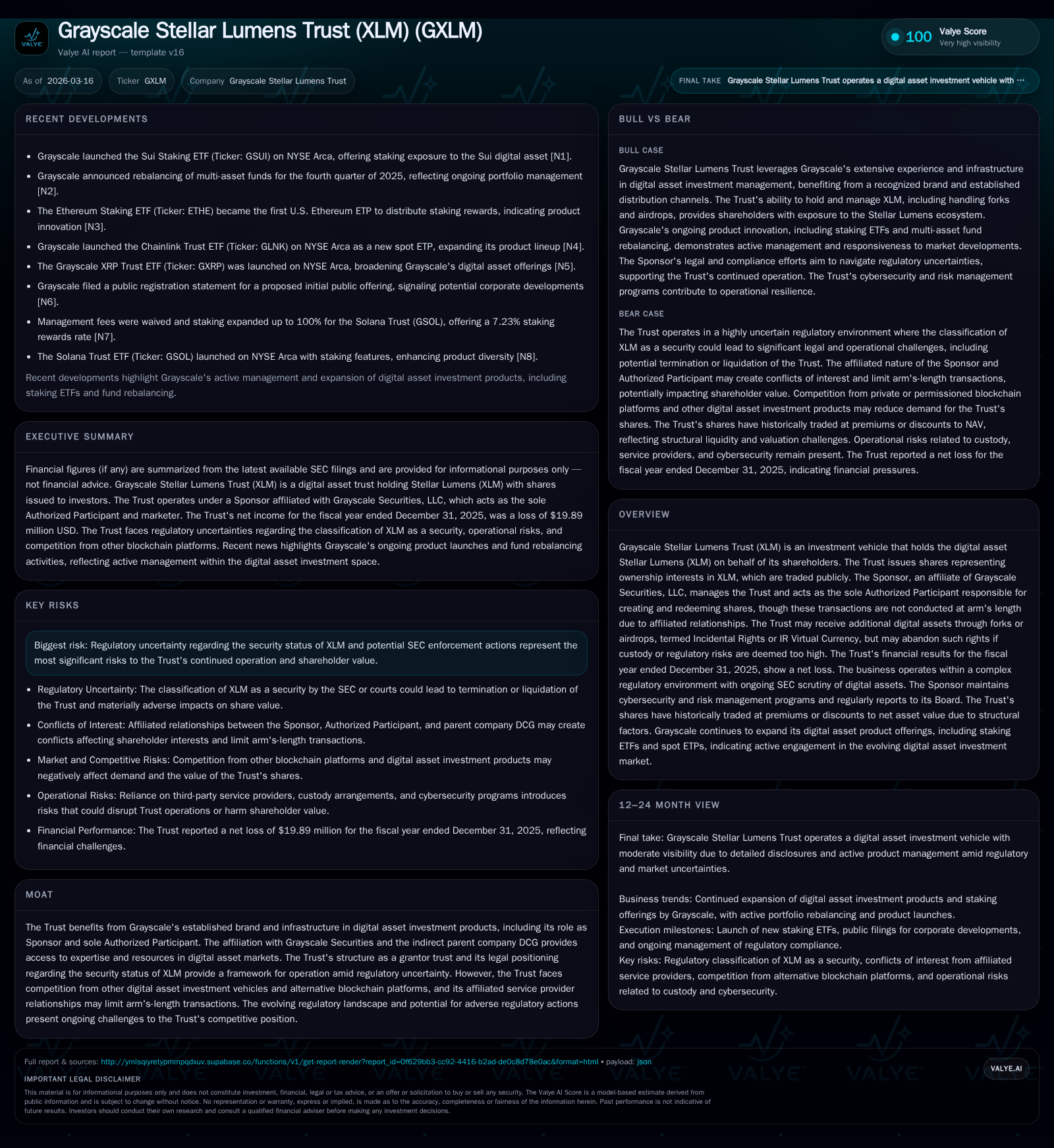
Grayscale Stellar Lumens Trust (GXLM) offers exposure to the digital asset Stellar Lumens (XLM) amid a volatile market and ongoing regulatory uncertainties. The Trust has experienced substantial net income declines, reflecting broad digital asset price swings and structural trading constraints inherent to its grantor trust status. Growth prospects depend on XLM adoption and market acceptance but remain constrained by regulatory scrutiny, including potential SEC classification risks. Capital returns have been limited with no dividends or buybacks, and share price efficiency is affected by holding period restrictions and affiliated Sponsor relationships.
Historical Financial Performance
Grayscale Stellar Lumens Trust (GXLM) has experienced significant financial volatility paralleling the price fluctuations of its underlying asset, Stellar Lumens (XLM). Net income deteriorated from a loss of approximately $417,000 in FY2023 to nearly $20 million in FY2025—a decline exceeding 1150% year-over-year—reflecting both market turbulence and structural factors related to the Trust’s grantor trust status [F1].
As a grantor trust, GXLM issues shares representing beneficial ownership interests in XLM held in custody. Share prices can trade at substantial premiums or discounts relative to NAV due to the absence of an effective arbitrage mechanism. Constraints such as Rule 144 holding periods prevent timely redemption, while the affiliated status of the Sponsor and sole Authorized Participant role limit arm’s-length market making, resulting in amplified premium-discount spreads [S1].
Historical performance (annual)
| FY | Net ($mm) | Net YoY |
|---|---|---|
| 2025 | -20 | -1154.9% |
| 2024 | -2 | -280.1% |
| 2023 | 0 |
Source: SEC companyfacts cache [F1].
Market Dynamics Influencing GXLM
XLM underpins the Stellar network, facilitating cross-currency transactions within a competitive blockchain landscape that includes permissioned platforms favored by some institutions [S26]. The Trust holds primarily XLM tokens but may also receive incidental rights through forks or airdrops — termed IR Virtual Currency — which are evaluated individually for retention based on custody feasibility and regulatory considerations [S1].
Broader Grayscale product innovation includes staking ETFs on Avalanche (GAVA) and Sui (GSUI), reflecting interest in Proof-of-Stake protocols [N1][N2]; however, GXLM has not announced staking-related strategies.
Regulatory Environment
Regulatory uncertainty remains a significant risk for GXLM due to ambiguity over whether XLM constitutes a security under U.S. federal laws. Tests like Howey present interpretative challenges, with precedents such as SEC actions against XRP illustrating potential adverse impacts on valuation and liquidity [S4][S7][S9].
A definitive security classification could necessitate forced redemption or liquidation due to incompatibility with securities regulations [S9][S13]. Additional regulatory requirements might include registration under commodity futures laws if classified accordingly, increasing compliance costs [S6]. Agencies are also exploring money transmitter licensing and AML obligations that could raise operational expenses [S11][S15].
Internationally, regulations such as MiCA in the EU and bans in jurisdictions like China add complexity affecting digital asset utility and shareholder value [S19]. Grayscale maintains cybersecurity controls to mitigate operational risks [S20].
Growth Outlook
While no explicit guidance is provided in filings, growth drivers include expanded network adoption of XLM and enhanced index coverage incorporating new trading venues like Binance added recently for index calculations [S3].
However, affiliated structures limit arm’s-length trading opportunities, constraining share price efficiency. Regulatory uncertainties continue to restrict institutional participation and product enhancements compared with newer staking ETFs.
Strategic focus on indexing improvements or potential staking mechanisms could support medium-term growth but require navigating regulatory compliance carefully.
Capital Structure and Shareholder Returns
Operating losses persist with significant negative net income reported; no dividends or share repurchases have been declared [F1][S24]. Liquidity constraints due to Rule 144 holding periods create challenges for arbitrage between market price and NAV.
The Sponsor’s affiliation limits independent negotiation capacity potentially affecting shareholder value. Capital returns rely largely on secondary market demand amid volatile premium/discount spreads rather than internal cash flow distributions.
Recent Developments
CoinDesk Indices added Binance’s XLM-U.S. Dollar Coin trading pair effective January 2026 to improve index pricing for GXLM shares [S3]. Meanwhile, Grayscale expanded its crypto offerings with Avalanche (GAVA) and Sui (GSUI) staking ETFs launched on NASDAQ and NYSE Arca respectively, illustrating diversification beyond single-asset trusts like GXLM [N1][N2].
Legal Proceedings
Although GXLM itself is not named directly in legal actions, affiliated entities within Digital Currency Group face lawsuits related to bankruptcy proceedings involving preference claims by Genesis Global Capital. Current disclosures do not anticipate material adverse effects for GXLM but indicate ongoing legal uncertainty risks within affiliate structures [S5]. Intellectual property claims related to Trust mechanics remain potential risk factors though none are presently identified [S1].
Outlook for Investors
Key considerations include monitoring regulatory clarifications around XLM’s security status impacting Trust continuity risks. Premium-discount spread trends reflect investor sentiment given lack of redemption mechanisms.
Custody compliance evolution and competitive pressures from alternative blockchain platforms will also influence long-term adoption of Stellar network utilities.
Observing Grayscale’s strategic moves toward staking products may signal future innovations relevant to GXLM exposure.
In summary, investment perspectives balance cautious optimism about technology progress against pronounced financial volatility exacerbated by regulatory ambiguity.
This analysis synthesizes publicly available information without providing investment advice. Continuous vigilance regarding evolving legal frameworks is essential for stakeholders assessing the Trust's operation and valuation.
Disclaimer: This is research-only, informational analysis and not investment advice. It may include AI-generated interpretation and general industry context. Always verify important details using primary sources.

Comments