
Grayscale Zcash Trust’s Earnings Surge Highlights Digital Asset Exposure Challenges
A striking net income growth in 2025 underscores the complexities of passive investment in volatile crypto assets amid regulatory uncertainties.
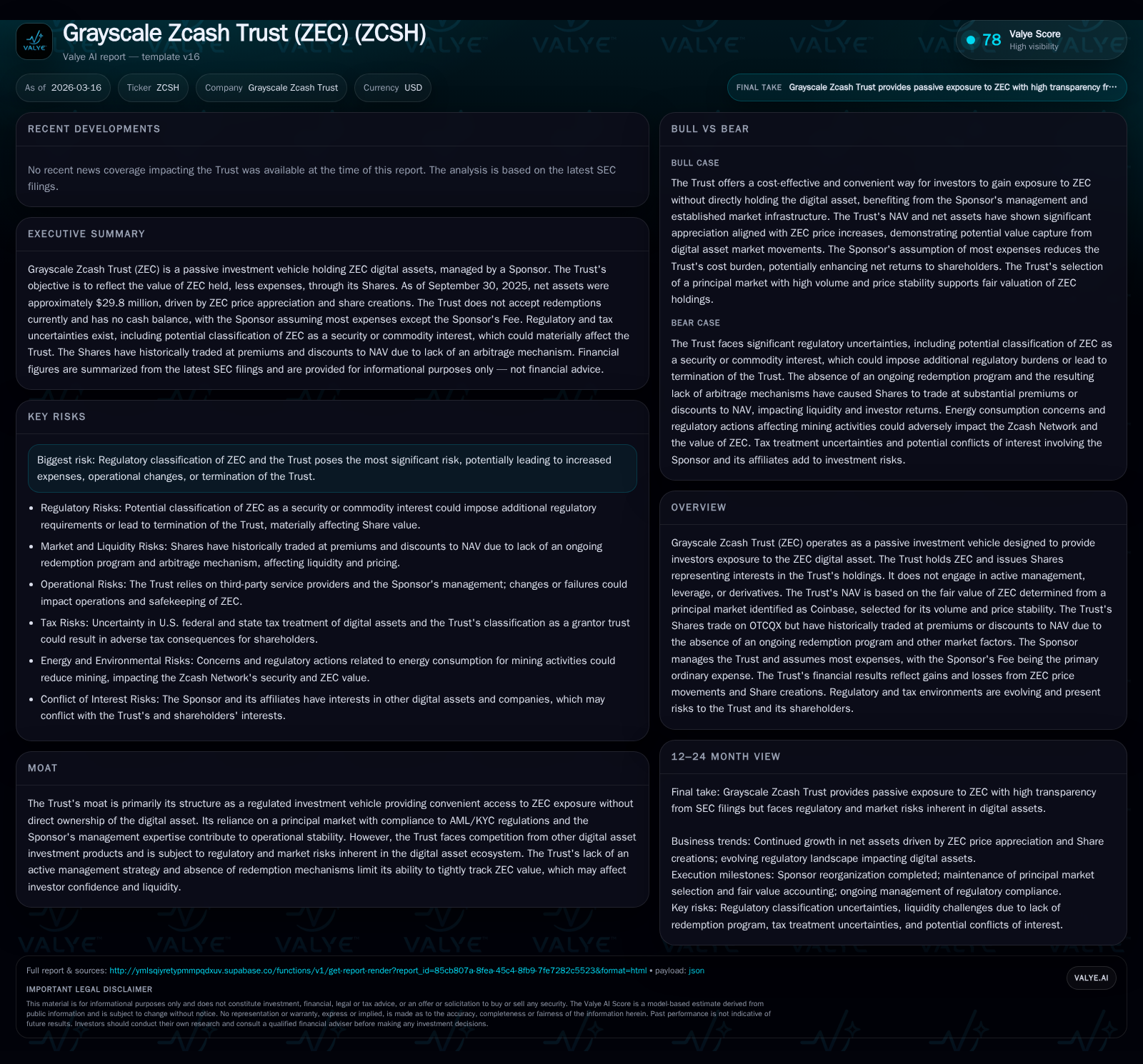
Grayscale Zcash Trust (ZCSH) experienced an extraordinary net income leap in 2025 driven primarily by the sharp appreciation of its underlying digital asset, ZEC. Despite these gains, the Trust's passive structure, absence of redemption mechanisms, and predilection to trade at premiums or discounts complicate its price alignment with NAV. Regulatory risks, especially concerning asset classification and mining restrictions, pose significant operational threats. With no dividend or buyback programs and a fee model that largely absorbs expenses by its Sponsor, shareholder returns remain indirect and heavily influenced by ZEC market behavior.
Earnings Growth Trajectory Driven by ZEC Price Movements
Grayscale Zcash Trust reported an exceptional net income jump in fiscal year 2025, with net earnings reaching $170.5 million compared to $10.8 million in 2024—a staggering increase of approximately 1482% as per official company facts [F1]. This gain is attributable primarily to the marked appreciation of the underlying Zcash (ZEC) digital asset price. The Trust maintains a wholly passive portfolio composed solely of ZEC holdings without leverage or derivative usage.[S2] Consequently, its financial results mirror net changes in unrealized appreciation or depreciation tied strictly to ZEC's market valuation movements.
This performance contrasts sharply with prior years where income was negligible: $119 thousand in 2023. The rise in ZEC prices—from approximately $28 at December 31, 2024 to over $75 by late 2025—directly propelled unrealized gains reported by the Trust.[S19]
Historical performance (annual)
| FY | Net ($mm) | Net YoY |
|---|---|---|
| 2025 | 170 | +1482.3% |
| 2024 | 11 | +8954.6% |
| 2023 | 0 |
Source: SEC companyfacts cache [F1].
Table: Grayscale Zcash Trust historical net income illustrates extreme earnings amplification driven by underlying asset price volatility.
As a passive investment vehicle, operational cash flows do not contribute materially to earnings; rather they reflect fair value movements on ZEC valuations at each reporting period end.[S16] Investors should therefore view earnings swings as reflections of underlying asset market fluctuations rather than recurring revenue streams.
Structural Features and Market Mechanisms Behind NAV Premiums and Discounts
The Trust’s structure imposes notable constraints on share liquidity and alignment between trading prices and net asset value (NAV). Shares trade exclusively over-the-counter on OTCQX without an active redemption mechanism,[S4] limiting shareholders’ ability to convert shares back into the underlying digital assets directly.
Creation baskets are issued when authorized participants deposit a specified number of ZEC tokens; however, redemptions remain unavailable currently.[S2][S15] This leads to persistent premiums or discounts because arbitrage opportunities that typically align traded share prices with NAV are muted or non-existent due to:
- Holding periods imposed under Rule 144 restricting immediate resale,
- Absence of concurrent trading hours with principal digital asset markets,
- Sole Authorized Participant being affiliated with the Sponsor,[S18] potentially limiting arm’s-length transactions.
"Authorized Participants" refers to select entities empowered by the Sponsor to create shares via basket deposits—currently only Grayscale Securities.[S18] The combination of creation basket issuance without redemption availability plus limited authorized participant diversity naturally causes non-arbitrageable premium-discount spreads.
While this design simplifies operations and regulatory compliance,[S4] it complicates investor confidence in price discovery as evidenced by historical fluctuations between substantial premia and discounts relative to NAV.[S13]
Regulatory and Operational Challenges Affecting Trust Performance
Regulatory uncertainty remains a pronounced risk for Grayscale Zcash Trust. The classification of ZEC lies between potential "commodity" or "security" status.[S4][S10] Should authorities deem ZEC a security under federal law, compliance costs could rise significantly—including possible registration as an investment company or adviser—and might even compel termination of the Trust.[S11]
Energy consumption debates surrounding proof-of-work mining protocols add operational vulnerability. Regional moratoria—such as New York State’s two-year ban on new fossil fuel-powered mining permits enacted in late 2022—threaten sustained mining activity essential for network security.[S1][S20]
A decline in mining vigor can reduce overall hash rate security on the network exposing it to manipulation risks through majority control—a “51% attack.” Such scenarios would erode investor confidence substantially and adversely affect Share value.[S1]
Additionally, evolving regulations targeting anti-money laundering (AML) compliance may impose licensing requirements on both the Sponsor and Authorized Participant,[S8] increasing operating expenses and potentially constraining liquidity if parties choose withdrawal over added burdens.
Legal proceedings involving related parties such as Genesis Global Capital’s claims against DCG affiliates exist but currently are not expected to materially impact Trust operations.[S9]
Capital Allocation: Sponsor Fees, Cash Flows, and Shareholder Returns
The Grayscale Zcash Trust operates with minimal cash balances at all times,[S5] reflecting its nature as a passive holding vehicle managing assets digitally without traditional corporate cash flows or financing activities.[F1]
Ordinary expenses consist mainly of a Sponsor Fee paid in-kind via transfers of ZEC tokens rather than cash payments,[S5] allowing cost management efficiency but imposing dilution effects borne indirectly by shareholders through asset withdrawals offsetting net gains.
No dividends have been distributed historically nor are share repurchase programs employed.[S6][S13] The absence of ongoing redemption means capital returns depend almost entirely on capital appreciation within the underlying digital asset.
Potential conflicts arise from interlocking roles among DCG (the parent), Grayscale Securities (sole Authorized Participant), and the Sponsor itself—each influencing management decisions potentially skewed toward affiliated interests rather than independent shareholder benefit.[S25]
These governance nuances underscore careful investor consideration regarding fee transparency and affiliated-party relationships inherent within this niche investment vehicle.[S18]
Future Outlook: Adoption Drivers Versus Regulatory Constraints
Growth prospects hinge chiefly on regulatory developments affecting digital assets generally and specifically how U.S. authorities classify cryptocurrencies like ZEC.[S1][S4]
Regulatory clarity could unlock wider capital inflows by reassuring institutional investors who demand compliance assurance before exposure to complex digital instruments.
Conversely, tightening regulations or enforced registration requirements could raise expense burdens materially or threaten outright termination scenarios where compliance costs become prohibitive for passive trusts like this one.[S11]
Broader adoption drivers include increased mainstream acceptance of privacy-centric coins like Zcash for their zero-knowledge proof technology enhancing transactional confidentiality; however, such features also attract scrutiny regarding illicit use potential impacting legislative attitudes.
Currently there are no explicit forecasts provided by management regarding future growth or structural changes such as redemption programs.[S1]
In sum, future returns remain highly correlated with underlying ZEC market performance tempered by structural constraints that mute direct shareholder liquidity options.
Critical Factors for Investors Monitoring Passive Digital Asset Vehicles
Investors seeking exposure through Grayscale’s digital trusts should vigilantly track factors influencing risk-reward profiles:
- Activity level and commitment status of Authorized Participants since voluntary cessation could impair creation liquidity or worsen premium/discount extremes.[S4]
- Regulatory pronouncements at federal/state levels impacting classification frameworks for digital assets broadly—and privacy coins specifically—that affect operating costs or permissible activities for trust sponsors.[S4][S8]
- Price volatility trends exhibited by underlying digital assets like ZEC within global crypto markets affecting NAV fluctuations given passive accounting treatment.[F1]
- Integrity measures around principal market pricing feeds used for NAV calculations factoring any incidence of pricing anomalies caused by wash trading or thin liquidity conditions on less-regulated platforms.[S15]
- Legal developments impacting related entities such as parent company litigation outcomes or third-party service provider changes that might disrupt continuity.[S9]
- Evolving energy policy shifts affecting mining activity sustainability critical for proof-of-work networks’ security strength linked directly to asset valuation reliability.[S20]
These realities underscore that while convenient access via passive trusts reduces direct custody burden for investors, the unique characteristics impose complexity necessitating active risk oversight even absent traditional management interventions.
This analysis is based solely on publicly available data from SEC filings relating specifically to Grayscale Zcash Trust as of March 16, 2026. It does not constitute investment advice but serves informational purposes grounded in factual reporting.
Disclaimer: This is research-only, informational analysis and not investment advice. It may include AI-generated interpretation and general industry context. Always verify important details using primary sources.

Comments