
Sonida Senior Living’s Growth Stretched by Debt Burden and Operating Losses
Sonida's expansion through acquisitions and enhanced operations contrasts with persistent net losses and significant leverage.
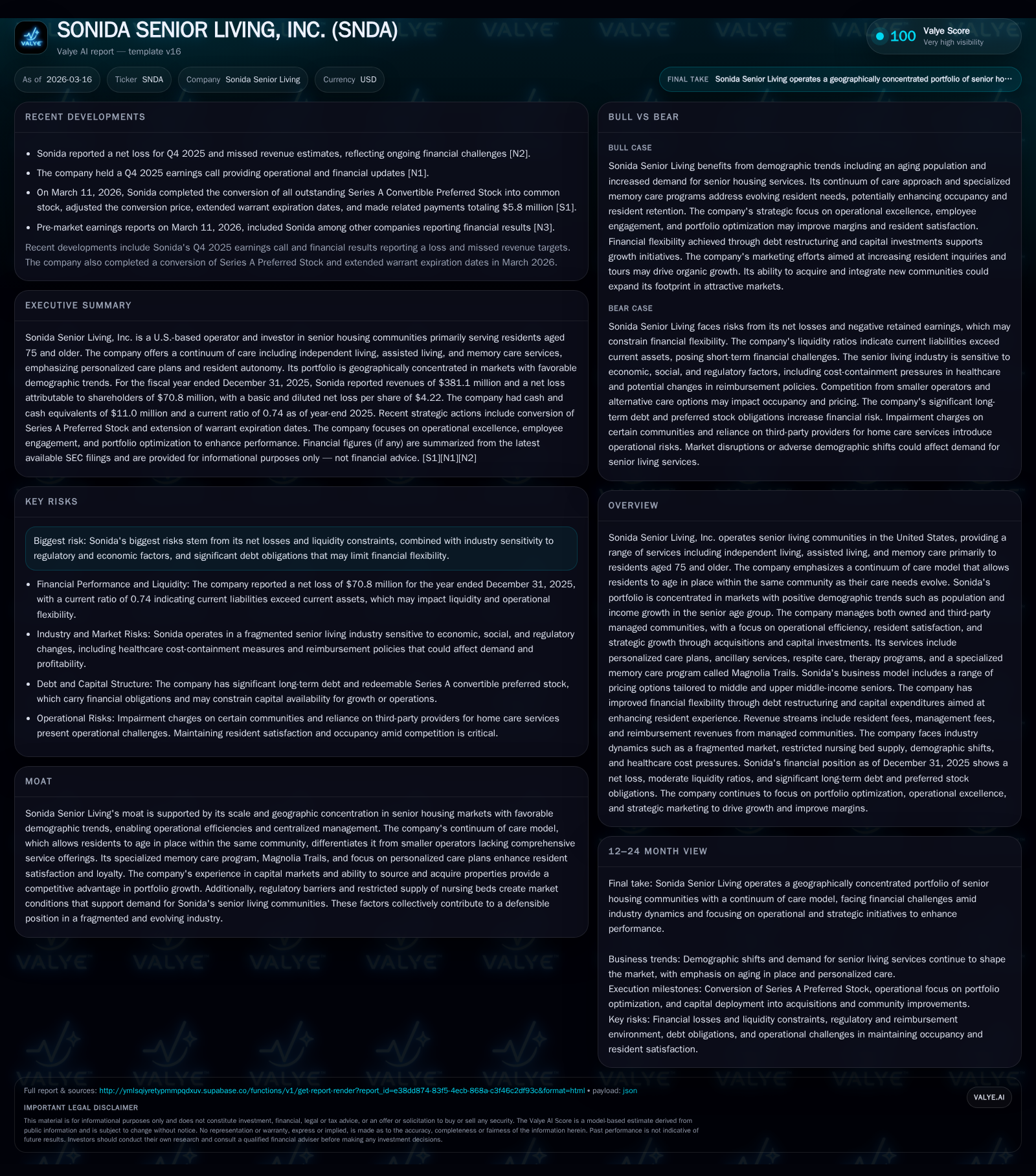
Sonida Senior Living, Inc. demonstrated strong revenue growth in 2025, increasing revenues by over 25% to $381 million driven by acquisitions and organic expansions. Despite improved operating cash flow of $24.4 million, the company reported a significant net loss of nearly $71 million, pressured by elevated interest expenses tied to heavy debt financing including the CHP merger. Liquidity remains constrained with a current ratio below 1 and negative shareholders’ equity at year-end 2025. The company's strategy focuses on operational excellence and accretive acquisitions while navigating refinancing risks and regulatory challenges inherent in senior living.
Historical Financial Performance
Sonida Senior Living has exhibited robust revenue growth over recent years, with annual revenues rising from approximately $238 million in 2022 to $381 million in 2025—a compound increase driven by both acquisitions and organic expansion within its senior living communities [F1]. Operating income data reveals variability; a notable positive operating income of nearly $69 million was recorded in 2024, contrasting with prior years that included losses or modest profits.
Despite topline gains, net income figures consistently reflect substantial losses, culminating in an almost $71 million net loss for fiscal 2025—an increase from a modest loss of about $2.1 million in 2024 [F1]. This deterioration is largely attributable to elevated interest expenses stemming from increased leverage and one-time costs related to merger activities.
Operating cash flow (CFO) improved markedly in 2025 to a positive $24.4 million from a negative outflow the previous year. However, free cash flow remains negative as capital expenditures rose to over $33 million, supporting new acquisitions and ongoing capital improvements [F1].
Historical performance (annual)
| FY | Rev ($mm) | Net ($mm) | CFO ($mm) | Capex ($mm) | Rev YoY | Net YoY |
|---|---|---|---|---|---|---|
| 2025 | 381 | -71 | 24 | 33 | +25.2% | -3337.5% |
| 2024 | 304 | -2 | -2 | 25 | +19.2% | +90.2% |
| 2023 | 255 | -21 | 11 | 18 | +7.1% | +61.2% |
| 2022 | 238 | -54 | -3 | 25 |
Source: SEC companyfacts cache [F1].
Capital returns and efficiency (annual)
| FY | FCF ($mm) | ROE% |
|---|---|---|
| 2025 | -9 | 643445.5 |
| 2024 | -27 | -2.9 |
| 2023 | -7 | 18.3 |
| 2022 | -27 | 53.5 |
Source: SEC companyfacts cache [F1].
Note: Operating income not available for all years; dividends primarily pertain to Series A preferred stock.
Growth Drivers and Business Model
Sonida operates senior living communities offering a continuum of care—from independent living through assisted living to memory care—with specialized programs like the Magnolia Trails memory care suite enhancing resident retention by enabling aging-in-place within the same community [S29][S1]. The company’s portfolio growth results from acquisitions such as the Tarpon Springs community acquired in May 2025 and ongoing capital refurbishments aimed at enhancing the resident experience [S13][S19].
Operational strategies emphasize employee engagement including leadership development and training, resident satisfaction through improved programming and safety measures, and operational excellence via process optimization—all designed to support margin expansion despite industry challenges [S1].
Capital Structure and Liquidity Constraints
Rapid expansion has been primarily debt-financed, leading to significant leverage escalation. At December 31, 2025, mortgage and other indebtedness totaled approximately $693 million excluding deferred loan costs [F1], augmented by about $945 million incurred to finance the CHP Merger completed in March 2026 via term loans, bridge facilities, and revolver increases [S4][S5][S6]. Key financing details include:
- An amended revolving credit facility totaling up to $405 million maturing March 2030 with reduced margins linked to SOFR.
- A $270 million senior secured bridge loan maturing March 9, 2027.
- Term loan facilities totaling $525 million with maturities staggered between March 2029 and March 2031.
Interest rate caps have been employed on roughly $262 million notional amount to mitigate variable rate exposure [S8][S16].
Liquidity remains pressured as current liabilities ($105 million) exceed current assets ($78 million), resulting in a current ratio around 0.74 [F1]. Shareholders’ equity turned slightly negative (-$11 thousand), indicative of accumulated losses eroding book value [F1]. Although currently compliant with debt covenants, Sonida faces refinancing risks alongside obligations for minimum tangible net worth levels [S7][S9].
Equity financing efforts included a private placement raising approximately $100 million prior to the CHP Merger [S23][S25], alongside increases in authorized common shares from originally15 million up to now30 million shares pre-merger (with further increases possible post-merger) [S23]. In March ‘26, all outstanding Series A Preferred Stock was converted into common shares following revised conversion terms favorable to holders; warrant expirations were also extended supporting investor alignment during consolidation [S3].
Future Prospects and Risks
Growth prospects depend on effective integration of CHP properties alongside leveraging Sonida’s continuum care model that differentiates it within fragmented senior living markets characterized by regulatory barriers limiting supply expansion [N1][S29]. Favorable demographic trends among aging populations across key states such as Texas, Indiana, Ohio, and Florida underpin demand stability [S22].
Challenges persist including:
- Continued net losses despite revenue growth indicate operational leverage is not fully realized post-merger.
- Heavy debt servicing constrains financial flexibility; bridge loan maturity in early 2027 presents refinancing risk.
- Regulatory complexities related to licensure, Medicaid participation, ADA compliance pose operational risks potentially affecting revenues or triggering penalties [S15][S28].
- Macroeconomic pressures such as labor market tightness impact staffing costs critical for quality care delivery.
- Equity dilution risk remains given historical share issuances aimed at bolstering liquidity but diluting existing holders.
Key performance indicators such as margin improvements on same-store communities, realization of cost synergies from acquisitions including CHP assets post-March ’26 closing[N1][S3], and cash flow trends relative to debt amortization schedules will be pivotal metrics going forward.
Returns & Capital Allocation
The company does not generate net profits attributable to shareholders; return on equity metrics are distorted by near-zero or negative book value combined with large net losses nearing $71 million for fiscal year ending December ‘25 [F1]. Dividends paid relate mainly to cumulative distributions on Series A preferred stock totaling about $5.6 million during ‘25 compared with smaller previous amounts; no dividends were declared on common stock reflecting prioritization of liquidity preservation for debt reduction and reinvestment purposes [F1][S23].
Capital expenditures remain substantial at over $33 million annually focused on upgrading existing communities alongside selective acquisitions costing approximately $38 million in ‘25 supporting long-term asset value despite short-term cash burn dynamics [F1][S19]. Share repurchases have been minimal or absent recently given capital needs described above.
Conclusion
Sonida Senior Living pursues growth through acquisition supported by operational initiatives centered on improving care quality via its continuum-of-care model while expanding footprint notably through the CHP merger closed early ’26. The company’s topline trajectory reflects solid momentum underpinned by demographic drivers fueling seniors housing demand.
Nonetheless, persistent net losses coupled with high leverage pose ongoing risks: liquidity constraints evident from suboptimal current ratios; equity erosion signaling balance sheet stress; near-term refinancing obligations create financial hurdles; regulatory compliance remains an ever-present challenge affecting operations.
Stakeholders should monitor how Sonida manages post-merger integration synergies against debt servicing demands while maintaining resident satisfaction crucial for occupancy stability historically linked closely with revenue generation.
This analysis is based solely on publicly available data as of March 16, 2026 and does not constitute investment advice or recommendations.
Disclaimer: This is research-only, informational analysis and not investment advice. It may include AI-generated interpretation and general industry context. Always verify important details using primary sources.

Comments