
Resolute Holdings’ Surge in Operating Income Masks Lingering Net Losses and Governance Risks
Despite a remarkable operating income increase in 2025, Resolute Holdings Management faces persistent net losses and structural governance challenges tied to its management company model.
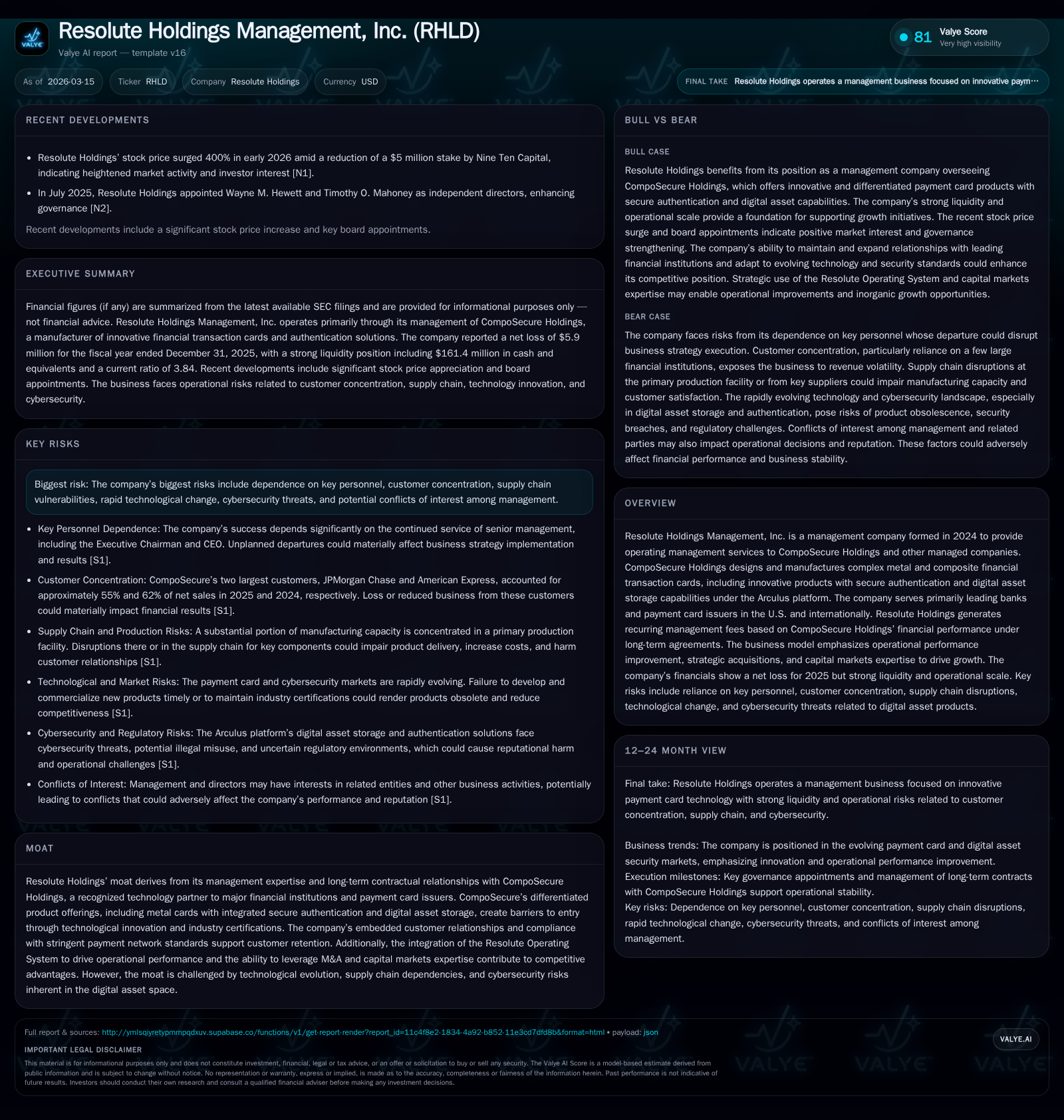
Resolute Holdings Management, Inc. experienced an extraordinary leap in operating income in 2025 driven by its recurring fee agreement with CompoSecure Holdings. However, net losses remain stubbornly negative due to underlying expenses and non-operating costs. The company’s robust operating cash flows highlight potential for cash generation even as governance complexities and customer concentration pose risks. Monitoring operational execution, capital allocation, and management continuity will be critical to assessing future value creation.
Operating Income Breakout Masks Ongoing Net Losses: Analyzing 2025 Performance
Resolute Holdings Management emerged dramatically from its inaugural full year since formation in 2024 with operating income leaping to $143.3 million in 2025 from a loss of approximately $2.4 million the prior year—a staggering +6175% change [F1]. This leap stems almost entirely from the recurring management fees it earns via long-term contractual arrangements with CompoSecure Holdings tied to that entity's adjusted EBITDA performance.
While the operating line reflects strong leverage embedded in the management fee model, the bottom line tells a different story: Resolute reported a net loss of $5.9 million in 2025 versus a smaller loss of $2.3 million in 2024 [F1]. This continued net deficit highlights substantial non-operating costs such as interest expenses and possibly share-based compensation or restructuring charges intrinsic to a growth-phase entity.
A crucial counterpoint is the company’s substantial positive swing in operating cash flow—from a slight outflow ($498k) in 2024 to a robust inflow of $196.1 million in 2025 (+39,490%)—indicating that underlying operations are generating strong cash despite accounting-level losses [F1]. This suggests resolute operational control over working capital and possibly conservative revenue recognition or delayed non-cash charges influencing net results.
Historical performance (annual)
| FY | Net ($mm) | CFO ($mm) | OpInc ($mm) | Net YoY |
|---|---|---|---|---|
| 2025 | -6 | 196 | 143 | -153.8% |
| 2024 | -2 | 0 | -2 |
Source: SEC companyfacts cache [F1].
Capital returns and efficiency (annual)
| FY | ROE% |
|---|---|
| 2025 | -90.8 |
| 2024 | 295.6 |
Source: SEC companyfacts cache [F1].
Table: Resolute Holdings Management annual financial summary highlighting key profitability and cash flow metrics [F1]
The Recurring Fee Structure Anchored by CompoSecure Holdings: Growth Engines and Dependencies
Resolute’s core business model revolves around providing day-to-day operational management services under long-duration agreements predominantly with CompoSecure Holdings—a designer/manufacturer specializing in complex metal/composite financial transaction cards featuring secure authentication and digital asset storage capabilities [N1][S26].
The contractual arrangement specifies quarterly fees equal to 2.5% of CompoSecure’s trailing twelve months’ adjusted EBITDA—a formulaic alignment that ties Resolute’s revenues directly to CompoSecure’s operational profitability rather than sales alone [S21][F1]. Such recurring fees create predictable revenue streams while incentivizing Resolute to drive performance improvements.
CompoSecure serves leading banks and payment card issuers primarily within the U.S., including marquee clients like JPMorgan Chase and American Express that together comprised over half of CompoSecure’s sales volume as of FY2025 [S28]. These large relationships afford scale but contribute significant customer concentration risk.
Notably, CompoSecure’s metal cards integrate proprietary technology platforms requiring compliance with stringent payment network certifications—features that erect barriers to entry against commoditized plastic card suppliers . Technological differentiation supports client retention yet mandates ongoing innovation and supply chain resilience.
Despite the strategic mooring this provides Resolute’s fees and revenue visibility, it simultaneously concentrates risk: any disruption or competitive displacement impacting CompoSecure could cascade directly onto Resolute's financials given its lack of diversified managed entities presently [S9][S27].
Operational Excellence Through the Resolute Operating System: Driving Value Added Services
Resolute distinguishes itself through deployment of its proprietary Resolute Operating System—a patented methodology emphasizing operational cadence through standardized processes and real-time performance metrics monitoring at managed entities like CompoSecure Holdings [N1].
This system facilitates rigorous oversight improving efficiency across manufacturing operations, quality control, supply chain coordination, and customer service responsiveness—each critical in the fintech payment card space where time-to-market and product reliability underpin client satisfaction.
Operational cadence enables tight integration between corporate strategy and day-to-day execution; continuous data-driven feedback loops enhance margin expansion potential by identifying bottlenecks or cost overruns promptly.
Moreover, Resolute leverages its capital markets know-how alongside its operational model to pursue strategic acquisitions aimed at expanding its footprint beyond current managed companies. This combination offers a pathway for inorganic growth that complements organic operational improvements .
Risks Among Key Personnel and Conflict of Interest Dynamics in Management Structure
Risk factors enveloping Resolute include critical dependence on key personnel—most notably Executive Chairman David Cote and CEO Tom Knott—whose extensive experience underpins business strategy implementation [S1]. The unexpected loss or departure of these individuals could materially impair capacity to execute operational plans.
Conflict of interest concerns arise from overlapping roles within various entities managed by Resolute executives who may hold direct or indirect interests across related companies leading to competing time allocation or priority conflicts [S1]. While measures are reportedly in place to mitigate these conflicts through transparent governance protocols, the complexity inherent in such arrangements presents ongoing challenges.
Escalating competition for executive talent might necessitate increased compensation expenses adversely impacting margins if retention efforts intensify amid industry talent scarcity [S6]. Such dynamics heighten governance risk especially given Resolute's relatively nascent public company status characterized by emerging growth classification.
Balance Sheet Strength and Liquidity Profile Amid Capital Allocation Priorities
Resolute maintains a solid liquidity position with $161.4 million held as cash and equivalents at December 31, 2025 alongside $297.7 million in total current assets versus $77.5 million current liabilities delivering a robust current ratio near 3.84x—indicative of strong near-term solvency [F1][S4].
Equity remains modest at approximately $6.5 million after absorbing cumulative losses though showing an improvement over negative equity reported a year earlier owing largely to positive retained earnings movements accompanying strong cash flows despite continuing net losses [F1].
Return on equity remains negative at about -90.8%, reflecting early-stage growth investiture and accrued non-operating charges outweighing operating profits currently [F1]. Free cash flow after estimated capital expenditures is healthy (~$189 million), supporting reinvestment capacity absent explicit dividend or buyback policies yet approved credit access adds flexibility for M&A or working capital needs [F1][S18].
Capital allocations have so far prioritized scaling operational capabilities through technology development aligned with the proprietary Operating System framework plus cautious expansion funded primarily through internal cash generation rather than external dilution or leverage increases.
Market Concentration and Customer/Supply Chain Dependencies: Implications for Resilience
CompoSecure is dependent on a narrow customer base wherein JPMorgan Chase and American Express alone accounted for roughly 55% of sales during FY2025 fostering a pronounced customer concentration risk profile for Resolute’s fee streams as well due to alignment via contracts [S28][S9]. Loss or contraction from either client could severely impact revenues.
Supply chain dependencies further complicate outlook; CompoSecure relies on sourcing specialized metals along with EMV chips and NFC-enabled components from select suppliers whose reliability impacts production throughput adversely if disrupted amid wider macroeconomic or geopolitical turmoil affecting logistics lanes or component availability [S27][S24].
Cybersecurity represents another material risk given Arculus platform’s integration of digital asset storage functionalities—a high sensitivity area under rigorous regulatory scrutiny worldwide where breaches could cause reputational damage and regulatory penalties potentially disrupting operations or diminishing customer confidence substantially [S29].
While mitigating actions include supplier diversification strategies and compliance program enhancements there is no absolute immunity from escalating cyber threats or commodity price inflation pressures inherent to their sector.
What To Watch Next: Catalysts and Milestones on the 2026 Horizon
Moving forward into 2026 investors should focus on quarterly earnings updates outlining traction on fee recognition corresponding to CompoSecure’s adjusted EBITDA trajectories plus transparency around margin development driven by ongoing Operational System deployment efficacy [N1][S3]. Changes or renegotiations of management contracts could alter revenue visibility impacting valuation fundamentals.
Monitoring regulatory actions affecting fintech security standards alongside announcements regarding new managed companies – potentially diversifying Resolute’s business beyond CompoSecure – will serve as key milestones informing growth sustainability perspectives.
Additionally, shifts in governance structures addressing conflicts of interest or executive staffing transitions will merit attention due to their outsized influence on company stability amidst market concentration headwinds.
Overall capital markets activity reflected recently by volatile stock behavior post shareholder stake adjustments underscores heightened investor sensitivity toward balancing promising operational metrics against residual losses coupled with governance complexities ahead of proving consistent profitability paths.
This analysis synthesizes publicly filed disclosures including SEC filings ([S1]-[S29]), recent news reports ([N1]), company-provided excerpts from Valye research profiles, and hard quantitative data retrieved from SEC CompanyFacts ([F1]). All numeric values are reported figures exclusive of extrapolation or estimation beyond available evidence.
Disclaimer: This is research-only, informational analysis and not investment advice. It may include AI-generated interpretation and general industry context. Always verify important details using primary sources.

Comments