
OptimizeRx's Transformation from Losses to Profitable Digital Healthcare Innovation
OptimizeRx shifted from multi-year losses to profitability by leveraging proprietary AI-powered platforms and a strategic subscription revenue pivot.
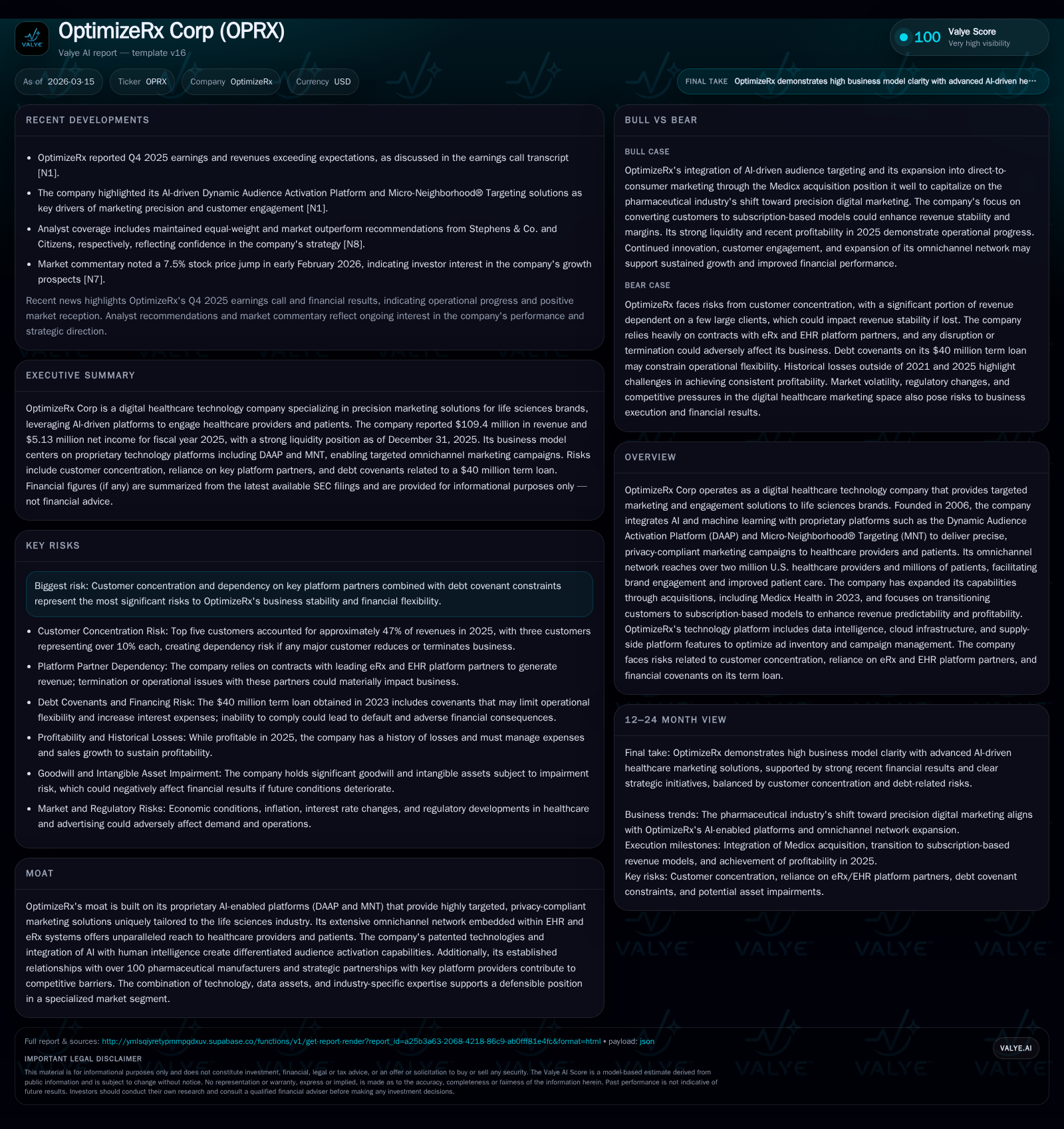
After several years of operating losses, OptimizeRx achieved a notable financial turnaround in FY2025, posting positive operating and net income accompanied by strong cash flow generation. This improvement is tightly linked to its innovative Dynamic Audience Activation Platform (DAAP) and Micro-Neighborhood® Targeting (MNT), which power highly targeted, privacy-conscious life sciences marketing campaigns. The company's focused transition from transactional advertising sales to subscription-based models enhances revenue predictability and scalability but remains tempered by customer concentration and debt covenant constraints. Regulatory pressures and shifting pharma marketing dynamics also present ongoing challenges that could influence future growth trajectories.
From Losses to Profit: Tracing OptimizeRx’s Recent Financial Turnaround
OptimizeRx Corp’s financial performance over the past four years charts a compelling transformation narrative underscored by deliberate operational focus and strategic innovation investment. After prolonged periods of net losses driven primarily by upfront technology development costs and expansion efforts, the company posted full-year revenue of approximately $109.4 million in FY2025 — an 18.8% increase from $92.1 million in FY2024 [F1]. This top-line expansion was matched by a remarkable swing in profitability metrics: operating income improved from a negative $13.7 million in FY2024 to a positive $11.7 million in FY2025, representing a 185.3% increase year over year [F1]. Net income also reversed course significantly — from a loss of about $20.1 million to a net profit of around $5.1 million [F1].
Notably, operating cash flow exhibited even stronger momentum, leaping nearly threefold from roughly $4.9 million to $18.7 million across the same period [F1]. Capital expenditure requirements remained modest at just under $60,000 annually, reflecting optimization around platform sustainment rather than expansion spend [F1]. The preservation of liquidity alongside positive free cash flow generation supports expanding strategic initiatives without necessitating immediate external capital raises.
Historical performance (annual)
| FY | Rev ($mm) | Net ($mm) | CFO ($mm) | OpInc ($mm) | Rev YoY | Net YoY |
|---|---|---|---|---|---|---|
| 2025 | 109 | 5 | 19 | 12 | +18.8% | +125.5% |
| 2024 | 92 | -20 | 5 | -14 | +28.8% | -14.5% |
| 2023 | 72 | -18 | -7 | -26 | +14.5% | -53.6% |
| 2022 | 62 | -11 | 11 | -12 |
Source: SEC companyfacts cache [F1].
Capital returns and efficiency (annual)
| FY | Buybacks ($mm) | FCF ($mm) | ROE% |
|---|---|---|---|
| 2025 | 19 | 4.0 | |
| 2024 | 8 | 5 | -17.2 |
| 2023 | 8 | -7 | -13.9 |
| 2022 | 20 | 11 | -9.1 |
Source: SEC companyfacts cache [F1].
The table above highlights OptimizeRx's financial recovery arc through FY2022–FY2025.
Precision Targeting Platforms: The Core of OptimizeRx’s Competitive Moat
At the heart of OptimizeRx’s revival lies its differentiated technological infrastructure featuring the Dynamic Audience Activation Platform (DAAP) and the Micro-Neighborhood® Targeting (MNT) system [S4][S7]. These platforms combine cutting-edge artificial intelligence with proprietary machine learning algorithms to deliver precision audience activation uniquely tailored for life sciences brands’ marketing campaigns.
DAAP excels in identifying healthcare providers (HCPs) who are likely to encounter patients eligible for particular branded therapies within defined care windows—enabling timely point-of-care interventions through embedded messaging within electronic health record (EHR) and e-prescribing (eRx) systems [S7]. Meanwhile, MNT capitalizes on de-identified claims data aggregated across granular geographic clusters — down to nine-digit postal codes — enabling compliance-safe direct-to-consumer advertising that respects HIPAA while optimizing patient reach via digital omnichannel channels such as programmatic demand-side platforms (DSPs), connected TV (CTV/OTT), addressable TV (ATV), out-of-home ads (OOH), programmatic audio (podcasts/apps/radio), social media, and more [S7][S8].
This intersection of HCP-targeted point-of-care messaging with consumer-focused micro-geolocation marketing augments brand engagement precision across patient care journeys — a rarity among digital healthcare marketing providers whose networks often lack such comprehensive integration.
The platform architecture includes scalable cloud-based data warehousing and supply-side platform capabilities allowing real-time campaign optimization as well as seamless inventory management across publisher partnerships [S8]. The combination creates what sector specialists call an "intelligent point-of-care network" empowered by orchestrated AI-human hybrid intelligence ensuring relevance and timeliness uncommon in legacy pharma promotion techniques .
Subscription-Based Transition: A New Chapter for Revenue Predictability
A defining pillar underpinning OptimizeRx's recent results is its strategic shift toward subscription-based monetization models for DAAP and MNT service components [S4][S5]. Historically reliant on transactional campaign spending models vulnerable to client budget fluctuations — especially amid regulatory-driven cuts — the company now prioritizes converting existing customers into recurring revenue arrangements focused on data access subscriptions.
Management articulates a "land-and-expand" approach whereby initial product deployments spearhead long-term client engagements supplemented by escalating data-driven service layers enhancing EBITDA margins and cash flow stability [S4][S5]. This transition aligns with their ambition to achieve sustainable rule-of-40 performance metrics balancing growth with profitability — critical in attracting less volatile pharma commercial spend funding.
This strategic evolution empowers OptimizeRx to forecast revenues more confidently while scaling technology infrastructure cost-effectively.
Customer and Partner Ecosystem Dynamics Impacting Growth Trajectory
Despite broadening relationships spanning over one hundred pharmaceutical manufacturers globally [S11], customer concentration intensifies risk exposure — evidenced by top five customers contributing roughly 47% of total revenues in FY2025 [F1][S19]. Any consolidation or budget reallocation within these major clients could materially affect revenue flows.
Further complexity arises from reliance on key channel partners embedding OptimizeRx’s platforms into EHR and eRx ecosystems whose operational continuity and strategic priorities can influence data availability and delivery capabilities [S11][S19].
The acquisition of Medicx Health in late-2023 notably expanded capabilities into DTC avenues through patent-protected MNT technologies, enabling enhanced geographic audience creation methods critical for brand efficacy while respecting stringent privacy standards [N1]. However integration costs accompanying such acquisitions pose near-term expense pressures potentially tempering margin expansion until platform harmonization completes.
Navigating Regulatory and Market Risks in Life Sciences Marketing Technology
Industry-wide regulatory pressures loom large over OptimizeRx’s operating environment [S6]. At the federal level, Medicare Most Favored Nation (MFN) drug pricing demonstration models under Parts B & D threaten to compress pharmaceutical pricing structures which historically fund substantial brand marketing budgets utilized by OptimizeRx’s clients [S6][S15].
Simultaneously heightened FDA scrutiny—especially following recent regulatory reforms targeting transparency and accuracy mandates for direct-to-consumer pharmaceutical advertisements—introduces compliance risk that could lead clients to curtail DTC spend abruptly or reallocate promotional budgets away from digital channels [S14][S15].
State-level enactments impose additional price controls and marketing restrictions compounding uncertainties facing pharma marketers who represent the majority clientele for OptimizeRx.
Non-compliance risks cascade via business partners or customers that could trigger reputational or financial damage indirectly affecting contractual longevity or new sales velocities [S18].[N2]
Capital Deployment: Returns, Buybacks, and Liquidity Management
From a capital structure standpoint OptimizeRx maintains solid liquidity fundamentals highlighted by a current ratio approximating 3.04 at fiscal year-end December 2025 supported by about $23.4 million in cash reserves versus current liabilities near $21.3 million [F1][S9]. Operating cash inflows significantly outpaced minimal capex investments leading to estimated free cash flow north of $18.6 million in FY2025 underpinning controlled reinvestment capability.
A recent financing amendment extended its term loan maturity from October 2027 until October 2029 while permitting up to $10 million aggregated share repurchases before March 15th, 2027 within stipulated covenant limits— providing flexibility for capital return albeit constrained relative to overall balance sheet size [S3][S9].
Return on equity hovers near +4%, indicative of emerging profitable scale yet pointing toward ongoing opportunities for enhanced capital efficiency as subscription model adoption deepens organically reducing costly customer acquisition needs seen historically [F1].[N1]
Buyback activity saw moderate reduction compared with prior years consistent with conserving liquidity amid integration expenditures related to Medicx Health acquisition executed two years ago [F1].
What to Watch: Key Milestones and Forward-Looking Drivers
Explicit forward guidance remains limited as OptimizeRx navigates evolving client spend patterns and regulatory developments impacting pharmaceutical commercial strategy cadence [N1][N2][S3]. Nonetheless several observable indicators merit attention:
- Subscription conversion rates across DAAP/MNT cohorts post-Medicx integration provide crucial insight into recurring revenue base firmness.
- Client retention levels against increasing competitive pressure within digital pharma marketing space spotlight effectiveness of platform differentiation.
- Debt covenant compliance milestones including adjusted EBITDA thresholds necessary for sustaining flexible capital management capacity.
- Pipeline velocity for product innovation especially AI-driven enhancements augmenting predictive audience capabilities expanding TAM beyond traditional point-of-care networks.
- Market response towards evolving Medicare Part D & B pricing demos influencing brand marketing allocations impacting platform usage volumes. Monitoring these vectors offers non-speculative gauges triangulating trajectory amidst opaque macro-industry factors.
Synthesizing Growth Potential Amid Industry Shifts
OptimizeRx operates at the intersection of accelerating digital pharma ad spend—which surpassed $20 billion annually per internal eMarketer data—and increasing HCP time scarcity complicated by EHR silo fragmentations limiting prescriber attention opportunities [S4]. Its AI-enabled platforms harness proprietary data intelligence stacks embedding dynamic human-machine decision layering uncommon among competitors increasingly pressured by commoditizing programmatic DSP channels lacking healthcare specificity.
The 'micro-neighborhood' privacy-centric geo-targeting approach uniquely positions clients to circumvent direct patient identification risks amplified under contemporary HIPAA/CCPA/CPRA regimes while still achieving high-impact consumer engagement—a critical necessity as pharma marketers seek granular ROI measurement tied directly to real-world prescribing outcomes.
Balancing robust growth ambition against regulatory headwinds places OptimizeRx on an aspirational "Rule of 40" track marrying double-digit growth with advancing EBITDA margins fueled by subscription expansion rather than solely incremental contract wins or transaction volume increases -- providing sustainable financial hygiene rare among mid-tier digital health tech entities [S4].
Continued channel partner collaboration stability coupled with disciplined expense control will be essential as competitive intensity rises alongside evolving pharmaceutical commercial paradigms reshaping digital promotional strategy demands.
Disclaimer: The information presented herein reflects published filings including SEC registered reports and publicly available materials as of early March 2026. This analysis does not constitute investment advice but aims to provide detailed company-specific insights referencing factual disclosures only.
Disclaimer: This is research-only, informational analysis and not investment advice. It may include AI-generated interpretation and general industry context. Always verify important details using primary sources.

Comments