
United Homes Group Confronts Acute Financial and Operational Pressures Ahead of Stanley Martin Acquisition
UHG's recent earnings slump, operational hurdles, and capital constraints culminate in a pending takeover by Stanley Martin Homes.
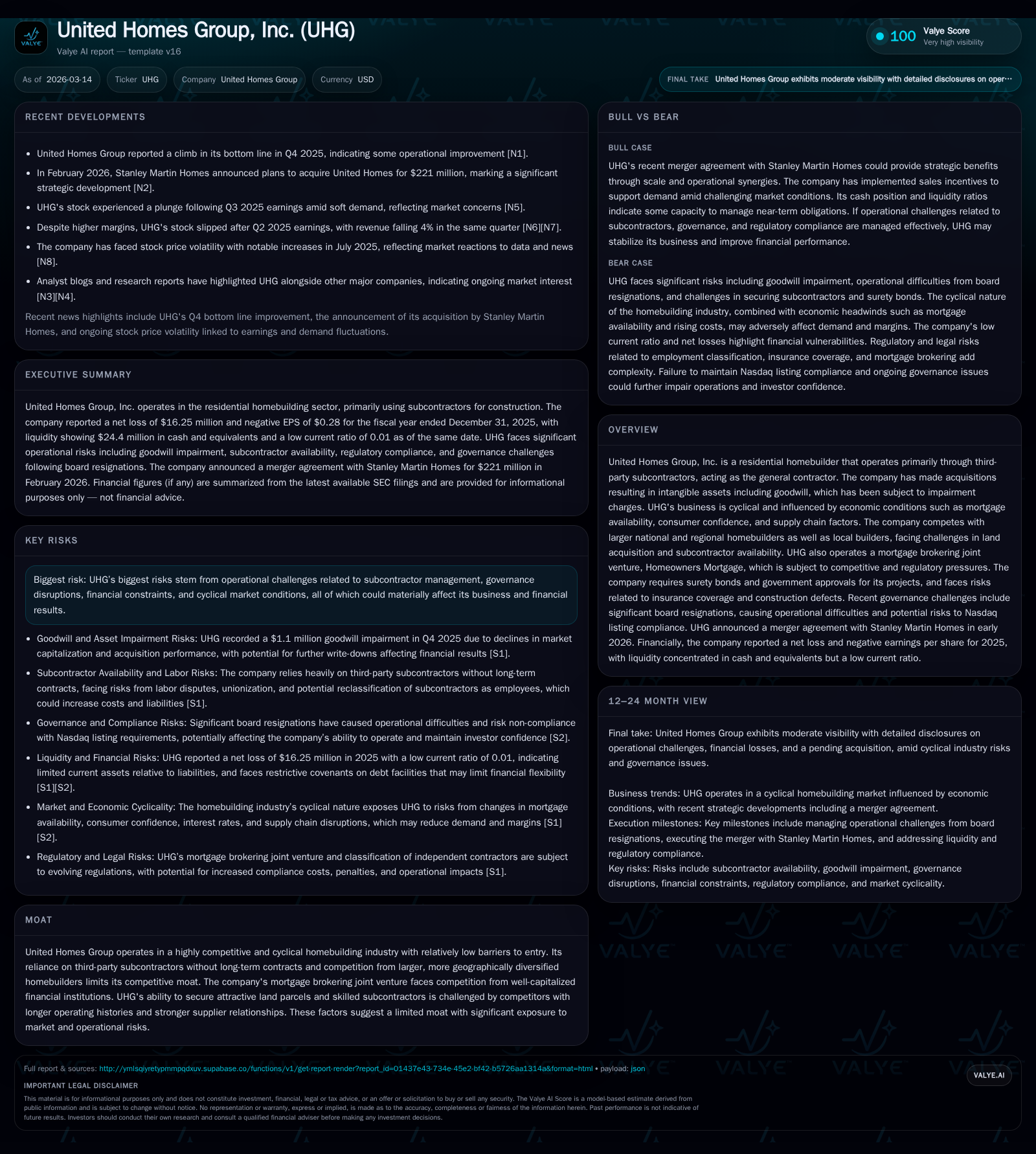
United Homes Group, Inc. operates as a residential homebuilder relying on subcontractors and a land-light model, competing in a cyclical and competitive industry. Recently, it reported a sharp downturn in profitability with negative operating income and net losses in 2025, attributed to goodwill impairments and challenging market conditions. UHG faces significant liquidity pressures amid restrictive debt covenants and heavy capital expenditure needs, highlighting financing risks ahead of its announced acquisition by Stanley Martin Homes for $221 million. The company’s future growth is constrained by industry cyclicality, land acquisition difficulties, and regulatory complexities influencing both its homebuilding and mortgage brokering segments.
Historical Performance Analysis
United Homes Group (UHG) has experienced volatile financial results over the last four fiscal years, marked by a strong profit phase followed by sharp reversals. In FY2023 and FY2024, UHG posted operating incomes of approximately $14.6 million and $5.1 million respectively, demonstrating positive but declining profitability pre-impairment charges. However, FY2025 saw operating income flattened nearly to breakeven (-$29K) alongside a substantial net loss of $16.25 million — a dramatic swing from previous periods where net income peaked above $125 million in FY2023 before falling to roughly $47 million in FY2024 [F1].
The free cash flow picture deteriorated commensurately: operational cash flow plunged from $15.44 million positive in 2024 to an outflow of nearly $19.6 million in 2025 amid rising capital expenditures spiking over sixty-fold year-over-year to roughly $2.05 million — indicative of increased spending potentially tied to development activity or project completion costs [F1]. These financial strains contribute to tight liquidity evidenced by an outdated current ratio of roughly 0.01 (using the last public snapshot), underscoring near-term working capital challenges despite sizeable equity on the balance sheet ($57.4 million at year-end 2025) [F1].
A management-identified goodwill impairment charge of $1.1 million booked in Q4 2025 highlights difficulties in meeting original acquisition projections and reflects underlying softness across key markets as reflected in stock price declines and overall market cap deterioration [S1]. This impairment relates primarily to prior acquisitions including Herring Homes LLC and Rosewood Communities Inc., with intangible assets valued at $10.7 million being subject to write-down risk.
Historical performance (annual)
| FY | Net ($mm) | CFO ($mm) | OpInc ($mm) | Capex ($mm) | Net YoY |
|---|---|---|---|---|---|
| 2025 | -16 | -20 | 0 | 2 | -134.6% |
| 2024 | 47 | 15 | 5 | 0 | -62.5% |
| 2023 | 125 | 28 | 15 | 0 | +1668.1% |
| 2022 | 7 | -1 | -5 |
Source: SEC companyfacts cache [F1].
Capital returns and efficiency (annual)
| FY | FCF ($mm) | ROE% |
|---|---|---|
| 2025 | -22 | -28.3 |
| 2024 | 15 | 70.1 |
| 2023 | 28 | -401.1 |
| 2022 | -132.1 |
Source: SEC companyfacts cache [F1].
Note: Revenue figures were not available for review; percentage comparisons are primarily based on operating income and net income.
Industry Context and Business Model Nuances
UHG operates primarily as a general contractor reliant on third-party subcontractors engaged on non-long-term contractual terms — this exposes the company to significant execution risks amid labor scarcity or cost inflation cycles common within residential construction markets [S14]. Its land-light operating model implies fewer owned lots compared to competitors who may own or control significant land parcels outright allowing greater margin control; this intensifies reliance on favorable option-to-purchase agreements for lots at competitive prices which can be scarce amid tightening supply especially during cyclical downturns when developers reduce activity or face financing constraints themselves [S24].
The homebuilding sector's intrinsic cyclicality is magnified within UHG's customer base composed largely of first-time buyers and move-up purchasers whose buying decisions are contingent upon resale market dynamics — downturns here dry out demand leading to slower sales velocity impacting UHG’s revenue recognition and cash flows [S2]. Additional headwinds include elevated interest rates increasing mortgage costs depressing affordability; commodity price inflation affecting material costs; supply chain disruptions skewing construction timelines; and regulatory tightening affecting mortgage brokers like UHG’s Homeowners Mortgage joint venture which must navigate complex licensing regimes alongside competition from well-capitalized lenders offering broader product suites often under less regulatory burden [S14][S21].
Capital Structure and Liquidity Considerations
UHG services substantial debt facilities including the Syndicated Line with Wells Fargo and an additional credit agreement with Kennedy Lewis secured against subsidiary stock holdings including Great Southern Homes Inc., carrying an average interest rate near 7.48% as of late 2025 [S9][F1]. Both facilities impose strict financial covenants requiring minimum tangible net worth thresholds (~$70 million plus add-ons), maximum leverage ratios generally capped at circa 2.25x with transient allowances up to ~2.50x through end-2025 periods reflecting loan extensions or covenant recalibrations detailed across filings from S4 through S13.
Liquidity restrictions mandate maintaining unrestricted cash balances ranging from $10-$20 million plus minimum liquidity floors scaled relative to debt service coverage ratios which must also remain robust (minimums approximating between 1.35x forecast coverage up through near 2x beyond mid-2025). These constraints leave limited maneuverability for aggressive growth investments without risking covenant breaches potentially triggering acceleration clauses forcing premature repayments or lender interventions [S7][S8][S10][S11].
There is explicit refinancing risk associated with the Wells Fargo Facility maturing in 2027 which UHG must either extend with lender consents or replace through new financing options — failure here could precipitate dramatic deleveraging steps including asset disposals or capital raises likely dilutive at distressed terms given recent financial performance volatility [S4][S8]. Indeed changes in market conditions including credit tightening following banking sector stress events pose a real threat to maintaining these credit lines intact through cyclical troughs.
Future Growth Prospects and Risks
Explicit guidance is unavailable due to impending acquisition discussions; however certain growth enablers are identifiable:
- Enhanced scale post-merger integration with Stanley Martin Homes could leverage broader geographic diversification mitigating localized market shocks [N1].
- Potential rationalization of subcontractor networks under new ownership may improve cost control given currently limited long-term contractor arrangements.
- The continued recovery or stabilization of the housing resale market would support transactional volumes given linkage upstream through contingent purchase flows among first-time buyers.
- Regulatory developments favorable to mortgage brokers could ease capital burdens for Homeowners Mortgage joint venture enhancing competitive positioning.
Significant downside constraints remain:
- Persistent macroeconomic uncertainty affecting mortgage rates and lending appetites could curtail demand.
- Competition for land parcels remains fierce particularly against builders owning inventory outright who can spread holding costs over time.
- Execution risks deriving from subcontractor availability issues coupled with potential cost overruns threaten margin sustainability.
- Compliance obligations increasingly complex around construction defect claims insurance coverage requirements expose UHG to litigation and indemnity costs [S14][S22].
Investors will closely watch progress on the Stanley Martin acquisition completion scheduled within defined contractual parameters culminating potentially by August 22nd, 2026 — any failure there could prolong operational distractions related to transaction expenses alongside governance uncertainties limiting strategic initiatives clarity through the transition period [S1][N1].
Returns and Capital Allocation Profile
ROE calculated from latest available data reveals a negative return near -28%, primarily attributable to large net losses in most recent fiscal year reflecting impairment charges offsetting past profitability spikes [F1]. Dividend distributions have not been indicated given continuing cash flow shortfalls exacerbated by high capital intensity related to land options acquisition costs paired with build-out financing demands.
No evidence exists regarding share repurchases; indeed restrictive covenants explicitly limit dividend payments and share repurchase actions absent lender approvals constraining traditional shareholder return mechanisms during refinancing tenor durations [S12][S13][S15].
Free cash flow was deeply negative around -$21.6 million (operating cash flow minus capex) highlighting urgent need for operational turnaround or infusion of capital resources pending merger execution or refinancing alternatives available post-acquisition closure [F1].
Conclusion
United Homes Group presents as a deeply cyclical residential builder grappling with harsh operating losses following goodwill impairments tied to prior acquisitions alongside severe liquidity pressure due to financing arrangements embedding restrictive covenants tightly calibrated against its tangible net worth position amidst sector volatility.
Its dependence on a subcontractor-based model coupled with a land-light approach limits pricing power relative to more vertically integrated competitors possessing higher lot ownership control — compounding challenges during tightening housing market conditions impacted by macroeconomic headwinds such as rising mortgage rates and diminished buyer confidence.
Pending acquisition by Stanley Martin Homes offers potential strategic consolidation benefits but execution risks persist including timing uncertainty and possible shareholder legal actions delaying closure or impacting deal terms fixed at $1.18 per share despite ongoing business fluctuations.
Stakeholders should monitor incremental financial updates as well as milestone announcements relating both to merger consummation status plus prevailing domestic housing market dynamics that will ultimately shape United Homes’ longer-term viability under new ownership.
This analysis is based exclusively on publicly available information obtained from SEC filings and recent news reports as of March 14th, 2026 ([F1],[N1],[N2],[S1]-[S29]). It does not constitute investment advice or recommendation.
Disclaimer: This is research-only, informational analysis and not investment advice. It may include AI-generated interpretation and general industry context. Always verify important details using primary sources.

Comments