
Princeton Bancorp: Earnings Surge Backed by Community Banking and Strategic Acquisitions
The bank’s significant net income rebound in 2025 reflects its entrenched community focus and acquisition-driven growth, tempered by careful risk management.
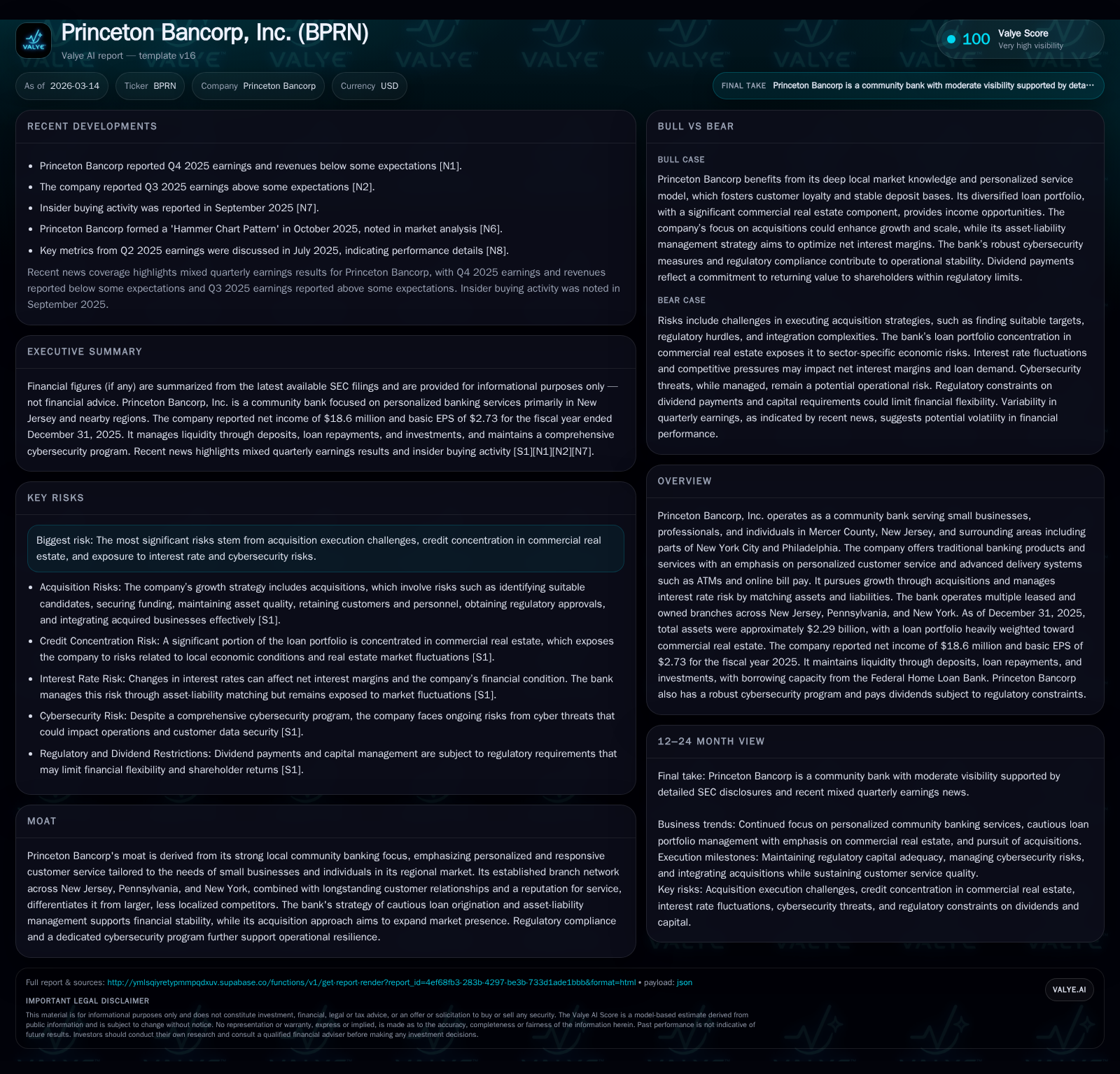
Princeton Bancorp, serving Mercer County and nearby metro areas, achieved a remarkable 81.7% jump in net income in fiscal 2025 to $18.6 million, reversing prior declines largely due to its disciplined commercial real estate lending and acquisition strategy. The bank balances local personalization with advanced delivery capabilities, while maintaining robust capital adequacy and managing concentration risks. Its capital allocation blends dividends and share buybacks with measured investment, priming it for potential growth ahead despite macroeconomic pressures.
Solid Growth Backed by Community Banking Principles
Historical performance (annual)
| FY | Net ($mm) | CFO ($mm) | Capex ($) | Net YoY |
|---|---|---|---|---|
| 2025 | 19 | 21 | 889000 | +81.7% |
| 2024 | 10 | 15 | 1525000 | -60.2% |
| 2023 | 26 | 23 | 1712000 | -2.8% |
| 2022 | 26 | 24 | 607000 |
Source: SEC companyfacts cache [F1].
Capital returns and efficiency (annual)
| FY | Div ($mm) | Buybacks ($mm) | FCF ($mm) |
|---|---|---|---|
| 2025 | 9 | 8 | 21 |
| 2024 | 8 | 1 | 13 |
| 2023 | 8 | 0 | 21 |
| 2022 | 6 | 9 | 23 |
Source: SEC companyfacts cache [F1].
Princeton Bancorp operates as a community-focused financial institution delivering personalized services across Mercer County, New Jersey, extending reach into parts of New York City and Philadelphia. With total assets around $2.29 billion at the end of 2025 [F1], it maintains a network of both leased and owned branches strategically dispersed throughout these regions [S1]. This footprint supports its goal of serving local businesses and individuals with competitive banking products wrapped in responsive customer care.
The bank’s roots emphasize long-term relationship-building and local market expertise as core competitive advantages. Its tailored approach contrasts with larger banks’ standardized offerings, driving customer loyalty especially among small business clients who demand customized credit solutions [N1][S6]. The branch network reinforces these ties by providing physical access while concurrently supporting digital tools such as ATM networks and online bill pay to blend convenience with personal attention.
Drivers Behind the Net Income Recovery in 2025
Fiscal year 2025 saw Princeton Bancorp deliver a strong financial rebound with net income rising by approximately 81.7% year-over-year from $10.2 million to $18.6 million [F1]. This gain was accompanied by a substantial increase in operating cash flow (+45.9%) reaching about $21.5 million [F1]. Key contributing factors included enhanced loan portfolio performance after stringent underwriting adjustments and a cautious stance on new commercial real estate originations.
The bank’s focus on quality is evident as commercial loan balances decreased slightly overall due to selectivity, even as residential mortgages saw meaningful growth (+$95.8 million) [S11]. Fee income streams stabilized while expense management prevented margin erosion [N1][S3]. Asset-liability matching ensured that interest rate volatility did not erode net interest margins materially.
Non-performing assets shrank by over $10 million during the year owing in part to charge-offs executed primarily in Q2 2025 [S18]. This cleanup improved credit quality metrics, underpinning earnings stability amid a challenging lending environment for CRE loans.
Strategic Acquisition Footprint and Integration Challenges
Princeton Bancorp pursues regional growth through acquisitions that expand its presence along the densely populated New Jersey–Pennsylvania–New York corridor [S6][N1]. Its recent mergers with Noah Bank (May 2023) and Cornerstone Financial Corporation (August 2024) illustrate this strategy aimed at gaining client bases and economies of scale within proximate markets [S16][S6].
These acquisitions bring inherent risks including regulatory approval hurdles, operating system consolidations, cultural integration of staff, retention of acquired customers, and preservation of asset quality standards. Merger-related expenses totaling about $7.8 million in severance, lease terminations, contract buyouts, legal fees, and advisory services were recorded reflecting these costs [S13]. While acquisitions add to franchise value—evidenced by goodwill assets near $14.4 million—they require disciplined execution to avoid dilutive effects or operational distractions.
Competition for suitable targets is fierce given the regional banking consolidation trend; Princeton Bancorp must therefore balance aggressive pursuit with prudent evaluation to protect capital ratios [S12].
Navigating Industry-Specific Risks: CRE Concentration and Interest Rate Exposure
A defining challenge for Princeton Bancorp lies in its commercial real estate loan concentration amounting to $1.34 billion or roughly 74% of its total loan portfolio at year-end 2025 [S11][S18]. This concentration exposes the bank to sector-specific cycles and borrower credit risks tied to property values and local economic conditions.
Risk mitigation involves comprehensive underwriting standards—including loan-to-value ratios mostly under 70%—and ongoing portfolio monitoring via ALCO policies designed to adjust interest sensitivity profiles proactively [S6][S18]. The bank also maintains an allowance for credit losses aligned with regulatory scrutiny [S14].
Cybersecurity stands out as an operational risk area addressed through an extensive internal program led by an experienced Chief Information Officer with three decades in financial services technology risk management [S1]. This program encompasses continuous threat detection tools, third-party vendor audits, penetration testing collaborations with outside experts, contractual cybersecurity requirements for partners, plus regular staff training ensuring vigilance against evolving attack vectors.
Capital Structure and Liquidity Management Supporting Stability
Princeton Bancorp remains securely capitalized meeting "well-capitalized" regulatory thresholds as of December 31, 2025 [S4][F1]. Stockholders' equity expanded by over $8.7 million year-over-year reaching $270.7 million [F1][S19], supported partly by retained earnings accumulation from improved profitability.
Liquidity sources are anchored predominantly in customer deposits totaling approximately $2 billion at year-end albeit down roughly 2.8% from prior year-end levels reflecting modest shifts among deposit types including certificate maturities [S21][S18]. Available borrowing capacity at the Federal Home Loan Bank (FHLB-NY) stands robust at over $548 million with no outstanding borrowings as of year-end indicating untapped contingency funding options [S5][S7].
Long-term lease obligations for branches and operations centers aggregate near $28 million extending beyond 2030 representing fixed commitments factored into capital planning models [S4]. The bank manages liquidity prudently balancing loan demand funding needs while preserving buffer assets invested largely in short-term government agency securities or overnight deposits yielding stable returns [S7].
Capital Allocation: Balancing Dividends, Buybacks, and Investment
In 2025 Princeton Bancorp declared dividends totaling approximately $8.7 million ($1.25 per share), continuing a steady distribution policy rewarding shareholders without compromising capital flexibility [F1][S9]. Concurrently it undertook nearly $7.9 million in share repurchases reflecting renewed confidence in intrinsic value capture amid industry-wide volatility.
Capital expenditures declined substantially from previous years (down over 40% YoY), driven by completion or deferral of select branch infrastructure investments [F1], indicating efficient reinvestment discipline.
Return on equity measured roughly at 6.9% for the latest fiscal year translates these allocations into effective shareholder return metrics within a conservative risk tolerance framework typical of community banks managing CRE exposure [F1]. The balance between tangible returns via dividends/buybacks versus reinvestments into systems or growth initiatives illustrates thoughtful stewardship amidst ongoing integration efforts.
Growth Outlook: Opportunities and Constraints Ahead
Looking forward, Princeton Bancorp’s growth trajectory hinges on successful absorption of recent acquisitions alongside organic expansion within core markets leveraging its deep local customer engagement model [N1][S6]. Expanding residential mortgage offerings demonstrated positive momentum; further diversification could alleviate concentrated CRE risks.
External conditions remain mixed: elevated interest rates provide margin tailwinds but also temper loan demand; macro-economic uncertainties may strain borrower repayment capacity impacting credit quality dynamics especially within CRE segments.
The competitive landscape tightens both for deposit gathering—essential for liquidity—and identifying accretive acquisitions worth pursuing without overextending capital buffers highlights strategic balancing acts necessary going forward [N1][S12] .
What to Watch: Key Milestones and Market Indicators
Investors should monitor several pivotal indicators including future quarterly earnings releases that might clarify ongoing acquisition cost trajectories or synergy realization pace [N1][S3]. Regulatory examination outcomes could influence provisioning levels or capital charges considering CRE concentration.
Loan portfolio health metrics like non-performing loan ratios or charge-off rates alongside deposit inflow/outflow patterns serve as early signs of stability or stress within key markets.
Operational execution on integrating diverse legacy IT platforms from merged entities coupled with cyber defense enhancements remain underlying factors critical to sustaining trust among customers sensitive to service continuity concerns [S1].[N1]
This analysis synthesizes public SEC filings and reported financial data without offering investment advice or price targets. It aims to provide comprehensive insight respecting the company’s disclosed facts as of early 2026.
Disclaimer: This is research-only, informational analysis and not investment advice. It may include AI-generated interpretation and general industry context. Always verify important details using primary sources.

Comments