
Alto Ingredients Recovers Profitability in 2025 Amid Operational Adjustments and Market Challenges
In 2025, Alto Ingredients returned to profitability driven by improved operations and strategic production decisions despite ongoing commodity price volatility.
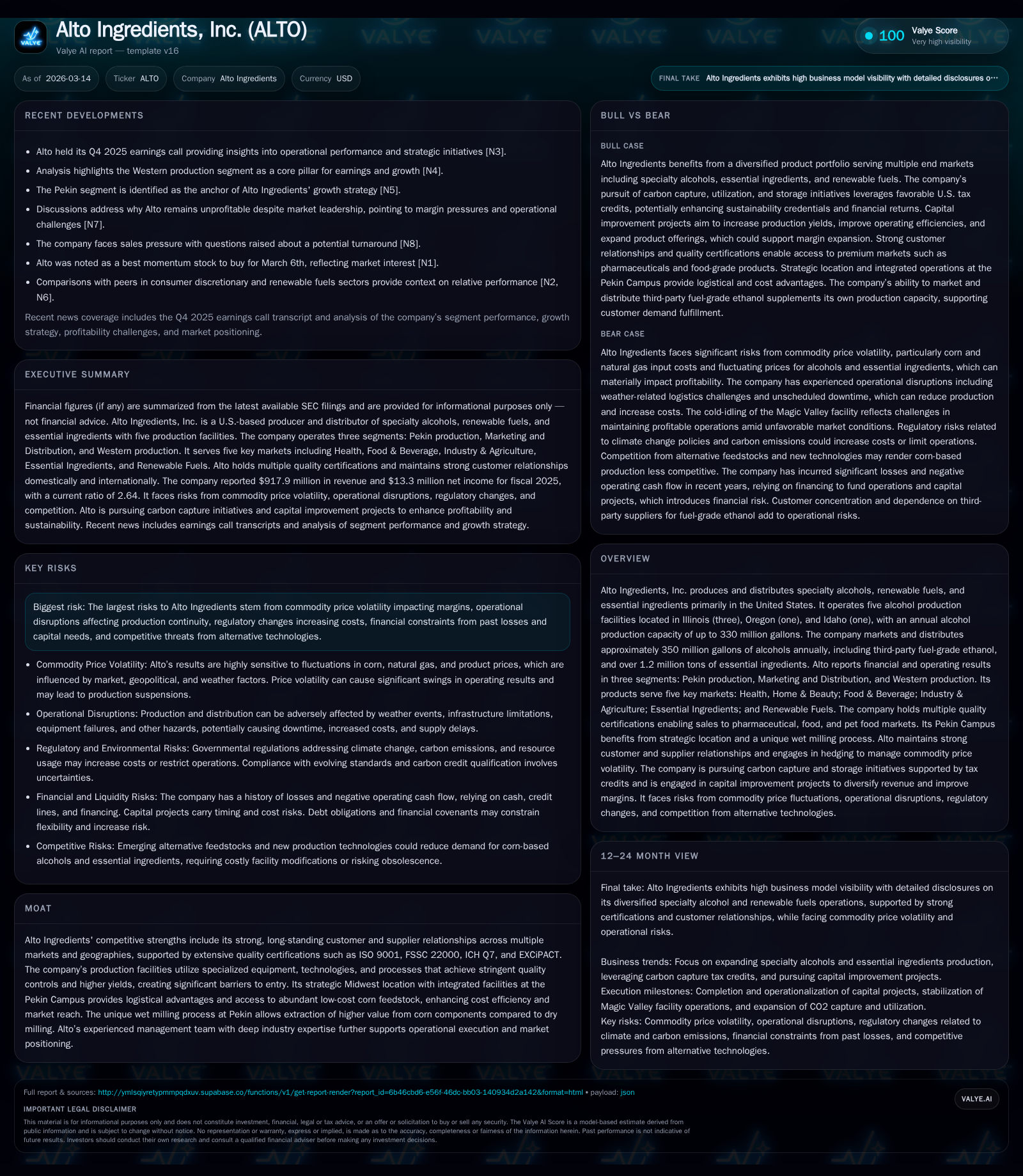
Alto Ingredients, a U.S. producer and distributor of specialty alcohols, renewable fuels, and essential ingredients, reported a revenue decline to $917.9 million in 2025 but achieved positive operating income of $7.4 million and net income of $13.3 million, reversing losses from previous years [F1]. The Magic Valley facility remained idled throughout 2025 due to unfavorable market conditions [S17]. The company leverages its Midwest production capabilities and certifications to serve diverse markets while managing risks related to commodity inputs and regulatory developments [S1], [S9]. Operating cash flow rebounded to $13.2 million with capital expenditures reduced to $4.6 million, supporting positive free cash flow and modest buybacks [F1]. Growth prospects focus on specialty alcohols expansion, essential ingredients markets, and regulatory support for renewable fuels [N2], [S18].
Company Overview
Alto Ingredients is a vertically integrated U.S.-based producer and distributor of specialty alcohols, renewable fuels (notably fuel-grade ethanol), and essential ingredients derived mainly from corn processing. The company operates five manufacturing sites: three at its Pekin Campus in Illinois—benefiting from abundant Midwest corn supply and river barge logistics—and one each in Oregon and Idaho (Magic Valley) [S1], [S17]. With an annual total alcohol production capacity of approximately 330 million gallons including up to 110 million gallons of high-specification specialty grades (pharmaceutical-, beverage-, industrial-grade), Alto serves diverse end-markets spanning Health & Beauty products such as hand sanitizers and cosmetics; Food & Beverage including grain neutral spirits for alcoholic beverages; Industry & Agriculture applications; Essential Ingredients like yeast for pet/human food; as well as Renewable Fuels primarily through ethanol blending mandates [S1], [S18].
Alto reports financial results across three segments: Pekin production segment focusing on the Midwest industrial core with integrated wet milling technology; Marketing & Distribution segment aggregating sales of both company-produced alcohols plus procured third-party fuel ethanol largely for resale; and Western production segment covering the two western plants including liquid CO2 operations ancillary to Oregon production [S1], [S22].
Historical Financial Performance
Alto experienced multiple years of operational challenges driven by volatile commodity input costs—particularly corn—and fluctuating fuel ethanol prices that compressed margins below breakeven levels through at least 2024. However, fiscal year 2025 marked a return to positive operating income and net profits.
Historical performance (annual)
| FY | Rev ($mm) | Net ($mm) | CFO ($mm) | OpInc ($mm) | Rev YoY | Net YoY |
|---|---|---|---|---|---|---|
| 2025 | 918 | 13 | 13 | 7 | -4.9% | +122.6% |
| 2024 | 965 | -59 | -4 | -52 | -21.1% | -110.6% |
| 2023 | 1223 | -28 | 22 | -24 | -8.4% | +32.7% |
| 2022 | 1336 | -42 | 6 | -61 |
Source: SEC companyfacts cache [F1].
Capital returns and efficiency (annual)
| FY | Buybacks ($mm) | FCF ($mm) | ROE% |
|---|---|---|---|
| 2025 | 4 | 9 | 5.4 |
| 2024 | 4 | -15 | -26.2 |
| 2023 | 4 | -8 | -10.0 |
| 2022 | 1 | -32 | -13.5 |
Source: SEC companyfacts cache [F1].
Table: Alto Ingredients' financial performance summary showing recovery signs in FY2025 after sustained losses.
The rebound was supported by idling underperforming assets—especially the Magic Valley plant—lower capital expenditures reflecting a shift from heavy investment cycles toward maintenance spending, operational improvements at Pekin leveraging advanced wet milling technology that extracts greater value per bushel than traditional dry mills [S15], and product mix shifts favoring higher-margin specialty alcohol products supported by certifications commanding premium pricing.
Operating cash flow returned to positive territory near $13 million compared with negative cash flows previously while capex dropped significantly year-over-year enabling free cash flow near $8-9 million last year after capital spending [F1]. Although modest share repurchases have been sustained over recent years totaling about $3.7 million cumulatively through FY2023 reflecting cautious capital allocation amid restructuring efforts, Alto maintains liquidity with a current ratio of approximately 2.64x as of fiscal year-end supported by cash balances exceeding current liabilities more than twofold despite elevated leverage exposure noted in filings [F1], [S11].
Growth Prospects
Alto’s growth strategy focuses on:
- Product Mix Enhancement: Expanding penetration into the higher-margin specialty alcohol segment particularly pharmaceutical excipients (ICH Q7 certification), food-grade neutral spirits, and personal care ingredient markets leveraging EXCiPACT accreditation aligns with rising demand for certified sustainable ingredients requiring traceability.
- Operational Efficiency: Utilizing Pekin Campus’ unique wet milling capability enables extraction not only of alcohols but also premium essential ingredients such as corn protein meal enhancing revenue per bushel versus competitors reliant solely on dry milling.
- Regulatory Support: Federal Renewable Fuel Standard mandates continue influencing ethanol demand positively though remain subject to political uncertainty; strengthening or reinstatement could drive volumes especially if vehicle compatibility with higher ethanol blends expands.
Challenges include continued volatility in corn prices causing margin compression or forced shutdowns like Magic Valley’s cold idle since early 2025 due partly to unfavorable regional crush margins despite prior yield optimization investments; regulatory developments potentially increasing environmental compliance costs including evolving carbon capture standards impacting CO2 pipeline infrastructure projects; competitive pressures among numerous U.S.-based fuel ethanol producers limiting pricing power especially against low-cost imports such as from Brazil; plus risks related to FDA compliance for ingredients regulated under strict safety standards affecting certain health/home sectors served by Alto’s audited facilities [S17], [S25], [S26].
Capital Allocation & Returns
Capital spending sharply declined from nearly $37 million in FY2022 to about $4.6 million in FY2025 indicating a shift toward maintenance rather than expansion-focused investments during this recovery phase supporting leaner fixed costs structures [F1].
Free cash flow turned positive driven by strong operating cash flow recovery alongside margin improvements enabling modest but consistent share repurchases totaling roughly $3.7 million over recent reported years indicative of management’s balanced approach between shareholder returns and investment prudence amid industry cyclicality plus debt servicing needs incurred during earlier loss periods.
Return on equity improved materially swinging into positive territory with an approximate ROE near mid-single digits (~5.4%) relative to equity base signaling financial turnaround though still below typical peer benchmarks achievable during stable economic cycles when volumes expand sustainably coupled with favorable margin dynamics absent cost inflation or supply shocks typical within agricultural-bioproduct sectors exposed across this vertically integrated supply chain model [F1].
Risks Overview
Key risks include:
- Volatility in commodity input prices notably corn impacting cost structures forcing periodic shutdowns like Magic Valley’s cold idle reflecting negative spreads between input costs and product values.
- Production disruptions or unplanned downtime potentially affecting supply commitments harming customer relationships and incurring incremental costs.
- Regulatory changes detrimental to ethanol blending mandates or tightening FDA/product safety regulations constraining sales volumes/pricing power further exacerbated by evolving carbon capture/storage legislation requiring costly infrastructure adaptations.
- Financial constraints given past losses amplifying refinancing risk especially if economic slowdowns impair cash flows threatening covenant compliance limiting strategic flexibility.
- Competition from fragmented domestic producers alongside imports challenging pricing discipline eroding margin resilience.
Conclusion
After several years of earnings pressure driven by commodity price volatility impacting feedstock economics coupled with strategic operational adjustments including idling underperforming assets such as the Magic Valley plant—Alto Ingredients achieved a financial turnaround marked by profitability in FY2025.[F1],[S17],[N1] Its competitive strengths lie in integrated Midwest wet milling platforms supported by rigorous quality certifications allowing premium product offerings across multiple end-markets anchored by solid customer relationships enabling navigation through ongoing regulatory reforms affecting emissions/carbon footprints plus fuel blending requirements shaping future commercial dynamics.[S15],[S25]
Going forward, key indicators will include sustainable margin expansions via specialty product growth combined with prudent balance sheet management maintaining liquidity amidst fluctuating input prices characteristic of biofuels/agrochemical sectors alongside disciplined capital investment targeting selective growth initiatives optimizing asset utilization without exacerbating leverage vulnerabilities.[F1],[N2]
This analysis synthesizes publicly available information without providing investment recommendations or forecasts.
Disclaimer: This is research-only, informational analysis and not investment advice. It may include AI-generated interpretation and general industry context. Always verify important details using primary sources.

Comments