
Weyco Group Weathers Tariffs and Soft Demand with Price Hikes and Sourcing Diversification
Weyco Group’s 2025 results reflect tariff-driven margin compression and a cautious market, but strategic actions underscore resilient brand equity.
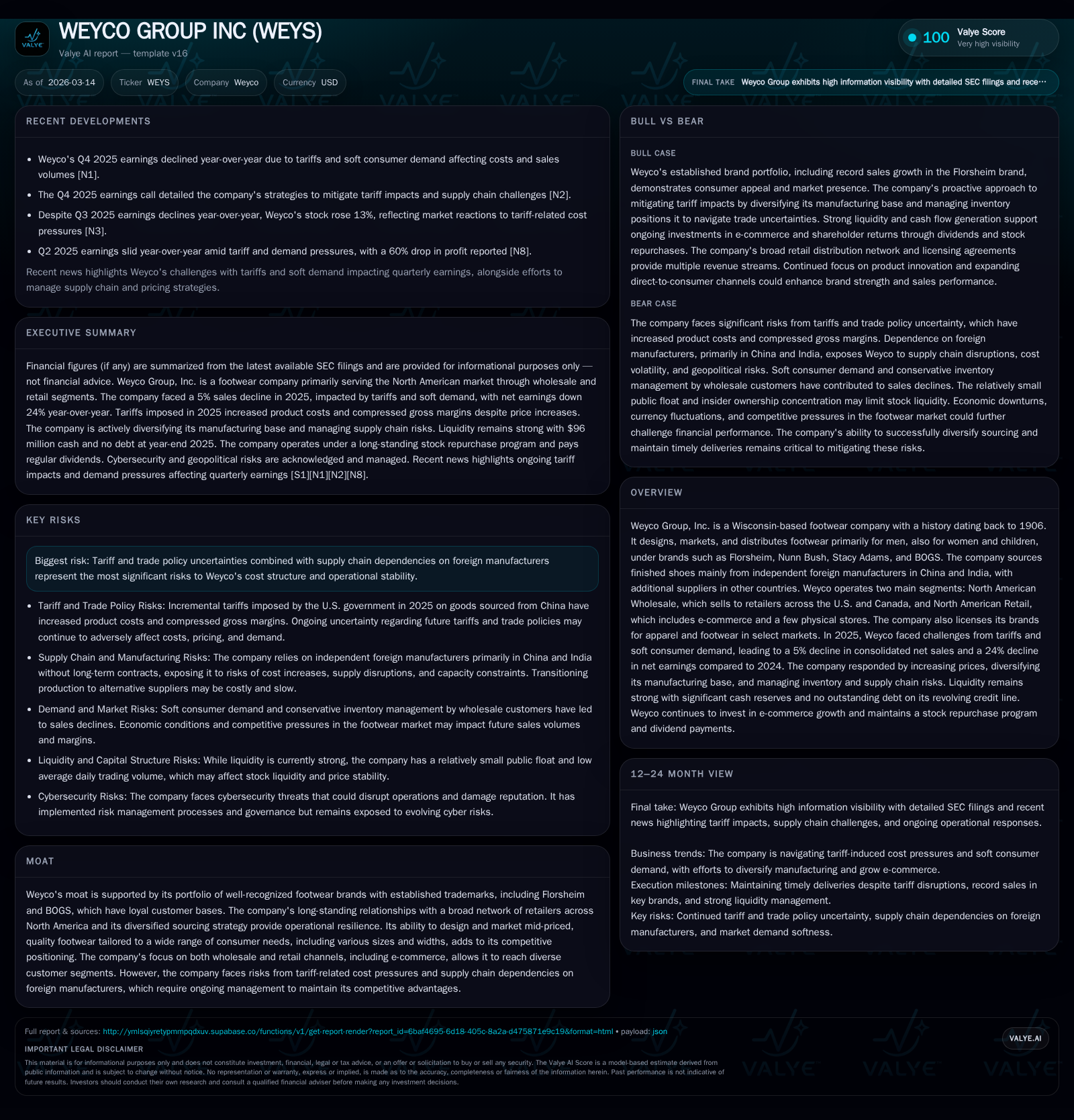
Weyco Group suffered a 5% revenue decline and nearly 24% net income drop in 2025 primarily due to tariff impacts and weak consumer demand. The company increased prices about 10% midyear and diversified its supplier base beyond China to partially offset cost pressures. Its North American Wholesale segment, the dominant revenue driver, experienced volume declines, while legacy brands showed mixed performance. Capital allocation remained shareholder-friendly with dividends and opportunistic buybacks. Near-term growth depends on tariff developments and consumer confidence amid ongoing geopolitical and supply chain uncertainties.
Company Overview
Weyco Group, Inc., founded in 1906 and headquartered in Wisconsin, designs, markets, and distributes footwear principally for men under brands including Florsheim, Nunn Bush, Stacy Adams, and BOGS [S17]. Its portfolio includes mid-priced leather dress shoes, casual footwear, and outdoor boots/sandals targeting men, women, and children. Finished products are primarily sourced from independent foreign manufacturers based in China and India, with growing diversification across Asia to mitigate trade-related risks [S17][S22].
The company operates two main segments: North American Wholesale (approximately 78% of net sales), selling through over 10,000 retailers including department stores and specialty shops across the U.S. and Canada; and North American Retail (about 13% of net sales), focused on direct-to-consumer e-commerce plus four physical U.S. stores [S5]. An "Other" segment includes wholesale/retail operations in Australia and South Africa under Florsheim Australia, which exited Asia-Pacific activities post-2024 restructuring [S10].
Historical Performance
Weyco’s financials over the last four fiscal years show a declining revenue trend influenced by macroeconomic headwinds:
Historical performance (annual)
| FY | Rev ($mm) | Net ($mm) | CFO ($mm) | OpInc ($mm) | Rev YoY | Net YoY |
|---|---|---|---|---|---|---|
| 2025 | 276 | 23 | 37 | 29 | -4.9% | -23.9% |
| 2024 | 290 | 30 | 38 | 37 | -8.7% | +0.4% |
| 2023 | 318 | 30 | 99 | 41 | -9.6% | +2.2% |
| 2022 | 352 | 30 | -30 | 40 |
Source: SEC companyfacts cache [F1].
Capital returns and efficiency (annual)
| FY | Buybacks ($mm) | FCF ($mm) |
|---|---|---|
| 2025 | 5 | 36 |
| 2024 | 1 | 36 |
| 2023 | 4 | 95 |
| 2022 | 4 | -32 |
Source: SEC companyfacts cache [F1].
The accelerated revenue decline in recent years corresponds with the imposition of incremental tariffs on imports from China starting early-2025 that increased product costs and compressed gross margins despite Weyco's approximate mid-year price increase of about 10% [F1][S13][N1]. Operating income dropped over one-fifth year-over-year as volume softness hit the Wholesale segment amid cautious retailer inventory management tied to weaker consumer demand in mid-tier trade channels [F1][S13]. Net income declined nearly one-quarter for similar reasons.
Operating cash flows stabilized near $37 million in FY24-25 after an unusual spike in FY23 likely related to working capital effects; capital expenditures remained modest below $2 million annually focusing on distribution center upkeep—primarily in Glendale, Wisconsin—and IT systems investments [F1][S15].
Business Segments
North American Wholesale
This segment drives most revenue (~78%) through established retail partners plus licensing revenues domestically and select international markets like Mexico [S5][S12]. Seasonal style launches twice yearly maintain product relevance.
Challenges included volume declines due to conservative inventory policies from wholesale customers amid softer end-consumer spending patterns, particularly impacting Nunn Bush which declined roughly 10% amid intensified competition from private-label footwear programs [S13]. Conversely, Florsheim achieved record sales of approximately $92 million (+2%) supported by strong demand for traditional dress shoes and expanding offerings in hybrid sneaker categories blending casual comfort with refined aesthetics [S13].
North American Retail
Representing about one-eighth of net sales (~13%), this segment emphasizes e-commerce growth alongside four brick-and-mortar stores in the U.S., aligning with shifting consumer buying behavior favoring online channels [S5].
Other Operations
Florsheim Australia covers wholesale/retail markets in Australia and South Africa but has scaled back following exit from Asia-Pacific activities after restructuring completed by end-2024 [S10].
Tariff Impact & Margin Pressure
In calendar year 2025, Weyco paid approximately $16 million related to incremental tariffs imposed on Chinese imports under U.S government trade policies that led to higher landed costs amid geopolitical tensions and retaliatory measures internationally [S13][S14][N1]. A March '26 Supreme Court ruling invalidated the statutory basis for these tariffs under IEEPA authority; Weyco has filed suit seeking refunds for amounts paid [S13].
Despite implementing an average ~10% price increase mid-2025 to offset inflationary pressures, gross margins contracted from around mid-45%-levels down to low-43%-levels due to constrained price elasticity among target consumers within competitive moderate-priced footwear segments [F1][S13]. These factors contributed materially to operating income pressure.
Supply Chain & Sourcing Strategy
Weyco sources finished footwear from over eighty third-party manufacturers primarily located in China and India—with smaller contributions from Vietnam, Cambodia, and the Dominican Republic—and is dependent on two major Chinese suppliers each accounting for more than ten percent of total purchases during FY25 without long-term contracts governing these relationships [S17][S22].
Lead times average about five months ahead of shipment due to offshore manufacturing cycles requiring forecasting demand well in advance; this complicates inventory management amid volatile market conditions or tariff-induced disruptions risking potential lost sales or markdowns if forecasts miss mark [S22][S24]. The company has accelerated efforts to diversify away from China-centric sourcing while managing transition complexities.
Logistics reliance on ocean freight exposes Weyco to risks like port congestion seen during pandemic-related bottlenecks alongside inflation-driven shipping cost increases—a common challenge across the industry today [S24].
Capital Allocation & Financial Position
Weyco maintains a disciplined capital allocation approach balancing shareholder returns with prudent liquidity management.
In Q4’25 alone, the company paid total dividends of approximately $21.6 million combining regular quarterly dividends ($0.27 per share) plus a special cash dividend ($2 per share), disbursed January ’26; regular quarterly dividends resumed in Q1 ’26 reflecting board confidence pending market conditions [F1][S4][S11]. Share repurchases totaled about $5.3 million at an average price near $29 per share during FY25 reflecting opportunistic use of liquidity given low public float dominated by family insider ownership exceeding fifty percent stake—impacting stock liquidity dynamics relative to peers [F1][S19][S26].
At year-end FY25, cash & equivalents stood at approximately $96 million with a strong current ratio around 4.2x underscoring solid short-term financial flexibility despite external uncertainties; overall debt levels remain moderate consistent with conservative capital structure typical of family-controlled branded apparel companies aiming for low leverage volatility exposure [F1].[
Outlook Considerations
Future performance will depend heavily on outcomes related to tariff refund claims as well as evolving U.S trade policy frameworks amid ongoing geopolitical uncertainty impacting landed costs.
Product innovation focused on expanding Florsheim’s hybrid sneaker offerings alongside efforts to revitalize Nunn Bush via targeted merchandising could drive volume recovery absent further external shocks.
Continued supply chain diversification remains critical not only for cost control but also operational agility against potential future disruptions—from geopolitical events or pandemic-related challenges—that have exposed vulnerabilities industry-wide.
Enhancing e-commerce penetration aligns with secular retail trends though intensifying competition among online pure-play brands may pressure margins.
Effective inventory management balancing retailer expectations will be pivotal given typical five-month forecast horizons complicated by volatile macroeconomic sentiment.
Conclusion
Weyco Group demonstrated resilience through fiscal year ’25 navigating substantial tariff-driven margin pressures coupled with softened end-market demand causing volume declines especially within wholesale channels. Strategic responses including pricing adjustments, supplier diversification initiatives, legal actions pursuing tariff refunds alongside consistent shareholder returns illustrate prudent stewardship aimed at stabilizing earnings quality while preparing for eventual market normalization. Ongoing focus on supply chain execution excellence paired with evolving product innovation tailored to shifting consumer preferences will be key determinants shaping future financial outcomes.
Disclaimer: This analysis is based solely on publicly available information as of the report date without any projections or investment recommendations related to Weyco Group Inc.
Disclaimer: This is research-only, informational analysis and not investment advice. It may include AI-generated interpretation and general industry context. Always verify important details using primary sources.

Comments