
How OP Bancorp Leverages Cultural Ties and Capital Strength in the Los Angeles Market
OP Bancorp’s focused community banking model and robust capital position underpin its financial stability and growth amid localized real estate market challenges.
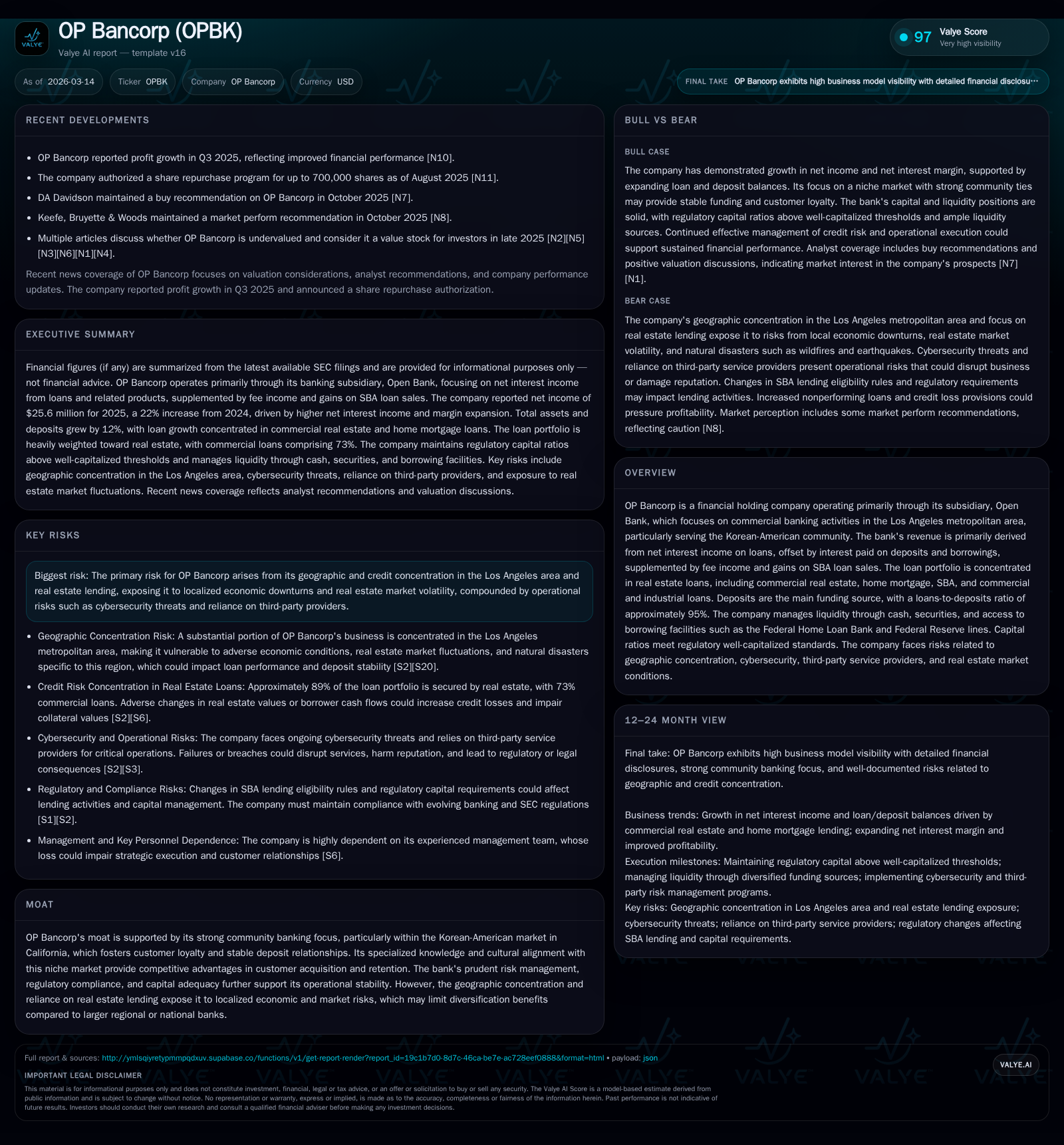
OP Bancorp has demonstrated solid financial growth driven primarily by its strong ties to the Korean-American community in Los Angeles and concentrated real estate lending. Its 12% year-over-year loan and deposit growth maintain a healthy loans-to-deposits ratio near 95%, supporting net interest income expansion. However, rising nonperforming loans, especially in SBA-related real estate segments, have prompted higher credit loss reserves, reflecting prudence amidst market concentration risks. The bank’s ample liquidity sources and stable capital ratios—supported by modest buybacks and consistent dividends—highlight disciplined capital allocation. Key developments include recent SBA lending eligibility rule changes, which management currently views as non-material but are closely monitored for future impacts.
Growth Patterns: Momentum and Market Drivers From Recent Years
OP Bancorp’s financial trajectory is closely linked to its role as a community bank serving the niche Korean-American market in Los Angeles. This cultural affinity fosters stable customer relationships that support steady deposit inflows and loan origination efforts. In FY2025, net income grew significantly by 21.7% to $25.6 million [F1], reversing prior years’ volatility (down nearly 12% in 2024). This improvement was driven largely by a 12% increase in both loan balances (to $2.19 billion) and deposits ($2.28 billion) maintaining a loans-to-deposits ratio near 95%, indicative of prudent balance sheet management [S1][S4].
Core revenue stems from net interest income on a primarily real estate-backed loan book complemented by fee income and gains from SBA loan sales [S1]. These factors combined with moderate expense control underpin the reported ROE of approximately 11.2% for FY2025 [F1].
Historical performance (annual)
| FY | Net ($mm) | CFO ($mm) | Capex ($mm) | Net YoY |
|---|---|---|---|---|
| 2025 | 26 | 26 | 3 | +21.7% |
| 2024 | 21 | 31 | 2 | -11.9% |
| 2023 | 24 | 68 | 2 | -28.2% |
| 2022 | 33 | 84 | 1 |
Source: SEC companyfacts cache [F1].
Capital returns and efficiency (annual)
| FY | Div ($mm) | Buybacks ($mm) | FCF ($mm) |
|---|---|---|---|
| 2025 | 7 | 1 | 23 |
| 2024 | 7 | 3 | 30 |
| 2023 | 7 | 4 | 66 |
| 2022 | 7 | 0 | 82 |
Source: SEC companyfacts cache [F1]. Net income momentum aligns with commercial banking specialization within a cultural niche market.
Loan Portfolio Dynamics and Emerging Credit Risks
The company’s loan book is heavily weighted towards commercial real estate (CRE), including SBA-backed real estate loans which together constitute nearly nine-tenths of gross loans [S14]. Despite geographic and sector concentration limits being adhered to, the nature of collateralization increases sensitivity to local economic conditions.
Notably, nonperforming loans surged by approximately 80% year-over-year to $14.1 million as of end-2025 from $7.8 million a year prior [S1][S13]. This rise was primarily due to reclassification of significant exposures within SBA real estate ($5.9 million) and commercial & industrial (C&I) segments ($1.8 million) into non-accrual status reflecting emerging credit issues [S13]. Concurrently, the allowance for credit losses increased by over $3 million (13%) to $28 million to expand provisioning against risk-rating downgrades, rising net charge-offs especially within the SBA real estate portfolio, and qualitative reserve enhancements following reassessment by management [S1]. This proactive reserve build ensures an allowance-to-gross-loan ratio steady at around 1.28%, albeit coverage relative to rising NPLs declined proportionally.
Management’s underwriting discipline includes evaluating borrowers’ historic cash flow sufficiency against debt service obligations with collateral layers dominated by property assets [S14][S15]. However, geographic concentration poses persistent vulnerability; downturns in LA’s real estate markets could amplify credit loss risk beyond current estimates.
SBA Lending Changes: Navigating Regulatory Impact on Future Originations
In early February 2026 the Small Business Administration amended eligibility rules removing the longstanding provision allowing up to 5% equity ownership by noncitizens or non-resident aliens for SBA lending programs [S1]. Given OP Bancorp’s substantial reliance on SBA lending volumes linked closely to its ethnic borrower base, this regulatory change could exert strategic implications.
Management reports no material adverse impact on existing portfolios or loan sales held at period-end but underscores active monitoring of future originations under these constraints [S1]. The company’s cultural alignment with its customer base may buffer some originations through alternate product mixes or adjusted borrower structuring; however, this regulatory shift introduces an additional variable shaping revenue trends from SBA operations going forward.
Deposit Base Stability and Liquidity Management
Deposit gathering continues as OP Bancorp’s principal funding mechanism providing stability through relationship-driven inflows within its core market segment [S4][S10]. Total deposits expanded by about $253 million (12%) in FY2025 reaching $2.28 billion with time deposits growing most markedly (+21%) alongside money market demand products [S11]. Noninterest-bearing demand deposits remain a substantial portion (~23%), reflecting transactional loyalty.
Liquidity metrics reveal a balanced stance with liquid assets — mainly cash/equivalents plus available-for-sale securities — equating to roughly $360 million or about 14% of total assets alongside unused borrowing lines nearing three-quarters of a billion dollars principally from Federal Home Loan Bank (FHLB) and Federal Reserve facilities [S4][S5][S7]. These sources sustain management’s ability to meet daily cash demands while supporting ongoing asset growth without undue wholesale funding dependence.
The company also holds commitments to lend totaling approximately $325 million with standby letters of credit adding incremental contingent liquidity considerations [S15], adding flexibility for selective credit deployment aligned with strategy.
Capital Allocation: Dividend Discipline, Buybacks, and Return Metrics
OP Bancorp displays measured capital stewardship balancing reinvestment needs against shareholder returns within regulatory capital adequacy frameworks [F1][S26]. The issuance of a subordinated note during late FY2025 bolstered Tier capital buffers contributing to well-capitalized status across all Basel III metrics exceeding minimum thresholds comfortably [S6].
Dividends remained stable at ~$7.13 million annually reflecting consistent payout policy supporting investor yield expectations without compromising growth capital needs while share repurchases were minimal at $0.7 million following larger activity in prior years [F1][S26]. Operating cash flow dropped somewhat (-16%), tempered mainly by significant capex increases (+79%) associated with branch enhancements and technology investments critical for maintaining competitive capabilities over time [F1]. Nevertheless free cash flow sustained positive levels near $23 million underscoring operational cash generation robustness.
ROE stood near double digits at roughly 11%, illustrating efficient earning leverage on equity base despite evolving asset quality challenges [F1]. This level manifests prudent profitability congruent with banking peer benchmarks focusing on niche markets.
Assessing Nonperforming Assets and Credit Loss Reserves Evolution
Credit quality metrics reflect emerging stress particularly within the localized real estate portfolio segment inherent in community banking exposures [S1][F1]. The sharp increase in nonaccrual loans (+80%) vis-à-vis relatively stable aggregate allowances reveals intensified pressure but also decisive reserve responses ensuring coverage remains adequate (allowance covers ~200% of NPLs).
Foreclosed assets or real estate owned decreased reflecting active dispositions including sale of SBA-guaranteed mixed-use properties which helps contain carrying risks [S13]. Nonetheless elevated monitoring remains essential given that collateral valuations can fluctuate rapidly due to local economic shifts affecting recovery prospects.
Continued application of CECL accounting standards ensures reserves incorporate forecasted economic trajectories enhancing forward-looking risk coverage aligned with industry best practices.
What Investors Should Watch: Milestones and Industry Tailwinds
Key performance indicators for future observation include trends in new SBA lending originations post-regulatory changes; fluctuation in nonperforming asset levels signaling credit environment shifts; deposit growth velocity within core demographic segments sustaining funding cost advantages; adjustments in operating expense leverage executing scalability initiatives; plus any refinancing or additional capital raises influencing leverage ratios.
Federal Reserve monetary policy trajectory will remain relevant given interest rate sensitivity embedded in adjustable-rate mortgage products forming part of OPBK’s portfolio mix affecting net interest margins [S1]. Additionally sector-wide cybersecurity threat evolution merits attention due to possible operational disruptions highlighted as a risk factor though mitigated through investment commitments [S2]. The bank's cultural affinity provides resilience against competitive encroachment facilitating deeper client penetration despite macroeconomic headwinds.
Overall OP Bancorp exemplifies how a focused regional institution can leverage cultural bonds combined with disciplined financial management to sustain growth while managing risks intrinsic to geographic concentration in specialized lending sectors.
This report is prepared solely for informational purposes based on publicly available data sets as of early 2026 without offering any investment advice or recommendations regarding buying or selling securities related to OP Bancorp or otherwise.
Analyzed content relies exclusively on company filings including annual reports (10-K), quarterly statements (10-Q), current reports (8-K), supplemented by regulatory disclosures per SEC standards and does not incorporate speculative projections beyond documented sources.
Readers should exercise independent due diligence when considering any financial exposure related actions concerning the subject company or industry sector described herein.
Disclaimer: This is research-only, informational analysis and not investment advice. It may include AI-generated interpretation and general industry context. Always verify important details using primary sources.

Comments