
FS Bancorp, Inc.: Balancing Risk Management and Organic Growth in a Changing Banking Landscape
FS Bancorp leverages diversified lending and robust risk controls to sustain steady profitability while preparing for a transformative merger.
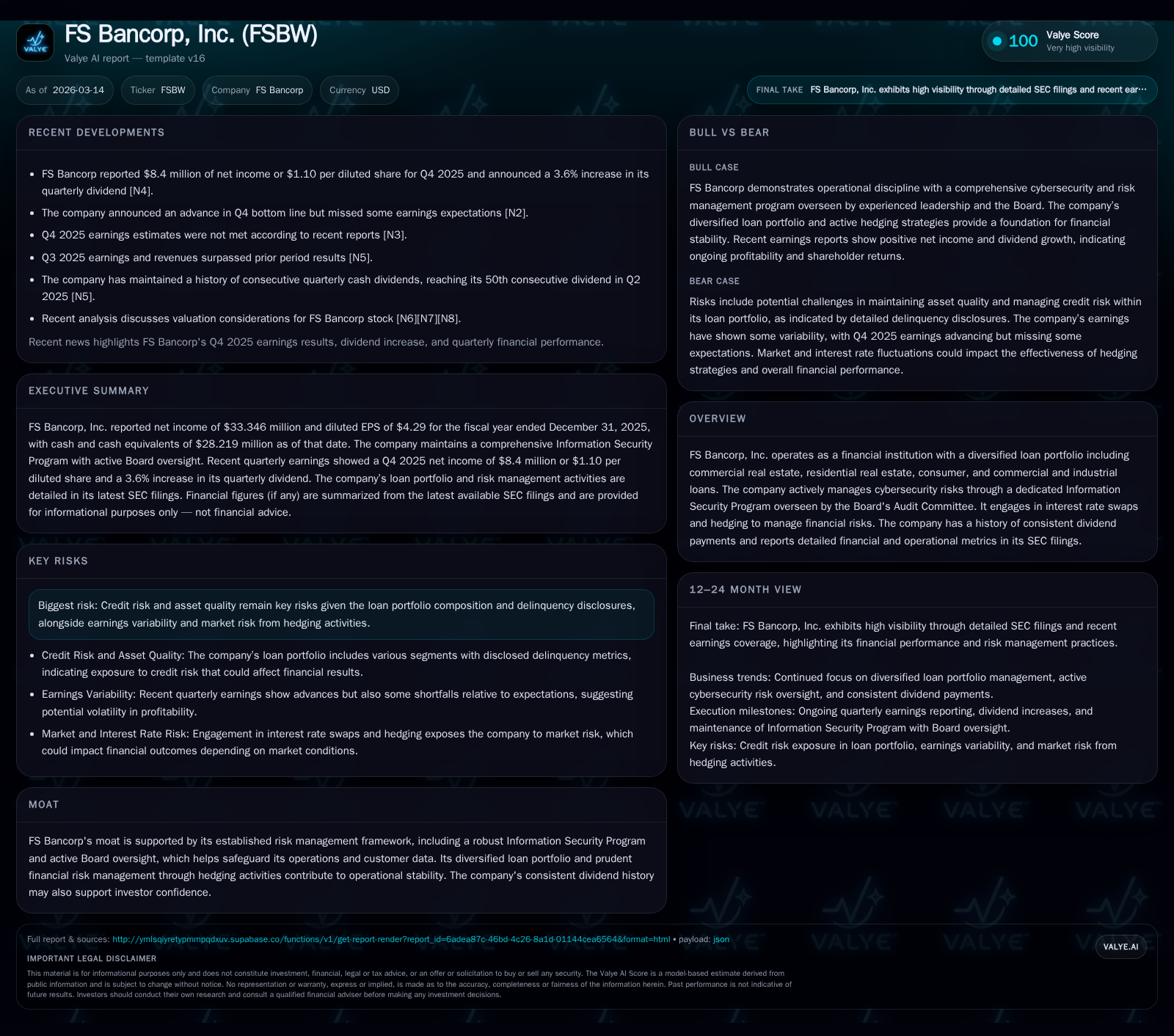
FS Bancorp, Inc. has demonstrated consistent profitability supported by a well-diversified loan portfolio encompassing commercial real estate, residential real estate, consumer loans, and commercial and industrial credits. The bank’s proactive enterprise risk management—particularly its extensive cybersecurity program overseen by the Board’s Audit Committee—and its use of interest rate swaps for hedging underpin operational stability amid evolving market conditions. The recently announced merger with Pacific West Bancorp in early 2026 represents a key growth milestone, though integration execution remains a material factor to monitor. Capital allocation reflects a disciplined balance between sustaining a consistent dividend track record and selective share repurchases alongside measured reinvestment.
Historical Growth Trends and Loan Portfolio Dynamics
FS Bancorp's financial performance over the past four years shows steady net income growth from $29.6 million in FY2022 to a peak of approximately $36 million in FY2023 before a mild contraction to $33.3 million in FY2025 [F1]. This decline (-4.8% YoY) contrasts with operating cash flow which recovered strongly (+42%) after a dip in 2024, evidencing robust underlying cash generation from core operations rather than accrual-based earnings alone.
Underlying drivers include the company’s diversified loan portfolio spanning commercial real estate (CRE)—owner-occupied/non-owner occupied buildings and construction loans—residential real estate including one-to-four family loans plus custom construction, consumer credits such as home equity loans and indirect home improvement loans, and commercial & industrial (C&I) lending [S4][S6]. This mix cushions FS Bancorp against sector-specific volatility.
An uptick in capital expenditures during FY2025 ($20.4 million vs ~1.6 million prior years) signals internal investments likely focused on IT infrastructure and digital capabilities necessary ahead of the planned merger [F1]. Equity has grown consistently from $231.7 million (FY2022) to nearly $308 million (FY2025), supporting an expanding asset base.
Historical performance (annual)
| FY | Net ($mm) | CFO ($mm) | Capex ($mm) | Net YoY |
|---|---|---|---|---|
| 2025 | 33 | 72 | 20 | -4.8% |
| 2024 | 35 | 51 | 2 | -2.9% |
| 2023 | 36 | 78 | 2 | +21.6% |
| 2022 | 30 | 185 | 2 |
Source: SEC companyfacts cache [F1].
Capital returns and efficiency (annual)
| FY | Buybacks ($mm) | FCF ($mm) | ROE% |
|---|---|---|---|
| 2025 | 15 | 52 | 10.8 |
| 2024 | 3 | 49 | 11.8 |
| 2023 | 0 | 76 | 13.6 |
| 2022 | 16 | 183 | 12.8 |
Source: SEC companyfacts cache [F1].
Net income softened in recent years despite improving underlying cash flows; capex ramp reflects strategic investments.
Enterprise Risk Management: Cybersecurity and Hedging Strategies
FS Bancorp deploys an enterprise-wide Information Security Program aligned with FFIEC standards incorporating annual risk assessments using the FFIEC Cybersecurity Assessment Tool (FFIEC CAT). These assessments evaluate program maturity and form the basis for ongoing mitigation plans [S1]. Complementary controls include vulnerability assessments, penetration testing exercises, social engineering simulations, and onsite security reviews.
Oversight resides with the Board’s Audit Committee guided by an approved Information Security Policy and formal risk appetite statement reviewed annually [S1]. The Chief Risk Officer leads overall risk management while the Chief Information Officer (holding CISSP certification) alongside an Information Security Manager run cybersecurity efforts as appointed officers reporting directly to the Audit Committee.
This extensive governance structure supports confidentiality, integrity, and availability objectives vital for banking operations under constant threat escalation today.
On financial risk management, FS Bancorp utilizes interest rate swaps designated as effective cash flow hedges against exposures from brokered deposits and borrowings which typically bear floating rates [S7]. This dynamic reduces earnings volatility arising from short-term funding cost fluctuations amid rising interest rate environments—a critical measure given the bank’s growing brokered certificates of deposit balance exceeding $200 million at year-end [S22].
2026 Merger with Pacific West Bancorp: Growth Catalyst or Integration Challenge?
In February 2026 FS Bancorp entered into a definitive agreement to merge Pacific West Bancorp into its subsidiary bank [S3]. This strategic move is poised to extend FS Bancorp's regional footprint by combining two Washington-state institutions with complementary market presence.
While specific synergy estimates or integration timelines have not been publicly disclosed beyond the filing date, common challenges surfaces in such deals include systems consolidation complexities, cultural alignment issues, regulatory approvals timelines, and credit portfolio overlap risks.
Key milestones to monitor include regulatory filings completion, operational integration progress reported in subsequent quarters’ disclosures, retention of key customer relationships across loan segments, and early cost savings realization frameworks.
Dividend Policy, Buybacks, and Capital Deployment Insights
FS Bancorp has maintained a consistent dividend payment history dating back several years with distributions increasing steadily from $2.86 million in FY2019 to $7.10 million by FY2022 [F1]. While exact dividend figures for FY23-25 are not itemized explicitly in source data after FY22, narrative disclosures confirm sustained dividend commitment [S1].
Alongside dividends, share repurchase activity has seen notable variation—modest buybacks near $223k in FY23 ramped quickly to $2.5 million in FY24 then surged to $15.4 million in FY25 as part of tactical capital return without curtailing equity base expansion [F1].
The dual approach underscores a capital allocation discipline balancing shareholder returns with reinvestment imperatives ahead of transformative corporate events like mergers.
Liquidity and Funding Structure Amid Rising Interest Rate Environment
Funding composition demonstrates evolving reliance on stable core deposits supplemented increasingly by brokered deposits which grew materially from negligible levels to over $220 million (~$20M brokered deposits plus ~$202M brokered CDs at year-end December '25) [S22]. This shift enhances liquidity depth but introduces sensitivity toward interest rate competition dynamics requiring active interest expense hedging.
Additionally, FS Bancorp utilizes Federal Home Loan Bank advances as collateralized borrowings forming part of their liability structure providing supplemental liquidity capacity particularly during periods of deposit volatility [S12][S25]. Asset pledging practices ensure compliance with collateral requirements governing these secured facilities.
Money market account deposits also constitute meaningful funding sources offering flexibility yet demanding close treasury oversight under volatile rate regimes [S7][S29]. The company reports strong liquidity buffers reflected by $28 million cash & equivalents at close of FY2025 [F1].
Terms such as 'brokered deposits', 'asset pledged as collateral', 'hedging relationships' embedded within FS Bancorp disclosures align with best practices among regional banks managing diversified liability mixes efficiently amid cyclical monetary tightening.
Key Financial Metrics: Profitability, Cash Flow, and Return on Equity
For fiscal year ending December '25 FS Bancorp reported net income of approximately $33.3 million translating into an approximate ROE of 10.8%, derived from net income relative to equity totaling nearly $307.7 million [F1]. Operating cash flow remained robust at about $72 million after sharply increased capex spending leaves free cash flow at roughly $52 million.
This level of ROE situates FS Bancorp within an attractive range for community banks that combine conservative underwriting standards with operational scale efficiency.
Continued growth trajectory emerging from balanced loan portfolio underwriting adds resilience even if near-term net income dips reflect macroeconomic pressures or elevated credit reserves needed against select delinquencies.
Outlook: Growth Prospects and Potential Headwinds to Monitor
The merger with Pacific West Bancorp opens avenues for market share gains along geographical lines with potential revenue diversification benefits through expanded product offerings consistent with aggregate loan book characteristics documented pre-deal [N1][S3][F1]. Success hinges on integration capabilities amid fragmented local banking markets which impose competitive pressure on margins and asset quality maintenance.
Credit risk remains salient given continued sector-specific watchlists especially within certain commercial real estate categories such as speculative construction loans where delinquency exposures warrant ongoing surveillance [S16][S23]. Earnings volatility tied to hedging outcomes will require tactical management as interest rate cycles evolve.
Absent explicit forward guidance from management documents semiannual filings suggest monitoring operational metrics including non-performing asset ratios post-merger alongside updates related to Information Security Program enhancements providing security coverage against cyber threats increasingly material across financial institutions.
This report synthesizes publicly available data sourced primarily from FS Bancorp's SEC filings including their most recent Form 10-K and quarterly reports alongside the definitive merger announcement per Form 8-K filings without projecting future financial outcomes or providing investment advice.
Disclaimer: This is research-only, informational analysis and not investment advice. It may include AI-generated interpretation and general industry context. Always verify important details using primary sources.

Comments