
Citizens, Inc. Reveals Growth Strategies in Niche Life Insurance Markets
Citizens, Inc. leverages its product diversification and investment portfolio management to strengthen its position in specialized domestic and international life insurance segments.
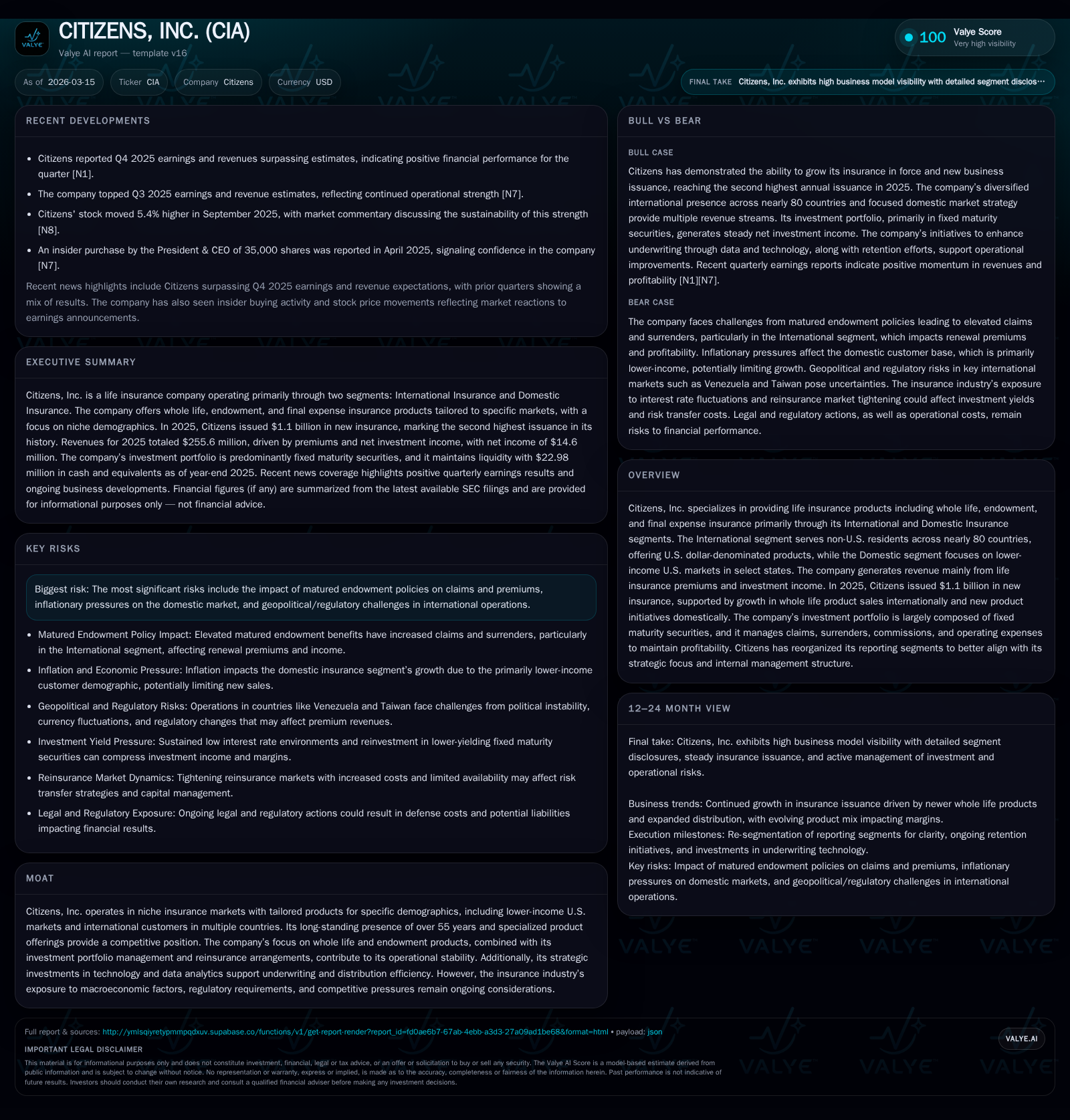
In 2025, Citizens, Inc. reported a 13.5% revenue increase and more than doubled net income compared to the prior year, driven by growth in international whole life sales and expanded domestic product initiatives. The company faces liquidity challenges linked to matured endowment policies while benefiting from higher investment income amid rising interest rates. Strategic technology investments and a refined segment reorganization aim to enhance underwriting efficiency and distribution in targeted markets. Despite inflationary pressures and regulatory complexities, Citizens maintains strong capital resources with no debt and a stable equity base.
Historical Performance: Revenue Growth and Operating Dynamics
Citizens, Inc. reported consolidated revenues of $72.1 million for fiscal year 2025, marking a robust 13.5% increase from $63.5 million in 2024 [F1]. This top-line growth was supported primarily by life insurance premiums—both first-year and renewal premiums—and enhanced investment income reflecting the recent uptick in interest rates [S1]. Net income more than doubled from $3.6 million in 2024 to $7.3 million in 2025, representing a 102.7% year-over-year expansion [F1].
Operating cash flow (CFO) showed a decline of approximately 43.6% year-over-year to $18 million but remained positive, illustrating the company’s solid operational liquidity position despite fluctuations in investment activities [F1]. Capital expenditures remained modest at $447,000 with a downward trend aligning with Citizens’ asset-light business model typical of life insurers reliant on financial assets rather than heavy fixed asset investment [F1].
Operational expense management contributed to improved profitability margins, underscored by controlled commissions and claims costs even as insurance benefits rose due to matured endowments (discussed further below). Seasonal variations impacted quarterly sales patterns, but the aggregate annual metrics signal operational resilience under shifting economic conditions [S1],[S2].
Historical performance (annual)
| FY | Rev ($mm) | Net ($mm) | CFO ($mm) | Capex ($) | Rev YoY | Net YoY |
|---|---|---|---|---|---|---|
| 2025 | 72 | 7 | 18 | 447000 | +13.5% | +102.7% |
| 2024 | 63 | 4 | 32 | 663000 | -5.0% | -66.3% |
| 2023 | 67 | 11 | 22 | 442000 | -0.6% | +218.3% |
| 2022 | 67 | 3 | 57 | 100000 |
Source: SEC companyfacts cache [F1].
Capital returns and efficiency (annual)
| FY | FCF ($mm) | ROE% |
|---|---|---|
| 2025 | 18 | 3.1 |
| 2024 | 31 | 1.7 |
| 2023 | 22 | 6.2 |
| 2022 | 57 | 323.5 |
Source: SEC companyfacts cache [F1].
*Revenue and earnings have rebounded strongly following the subdued performance in the prior year.
Product Portfolio Evolution and Market Segment Drivers
Citizens operates with two principal segments: International Insurance and Domestic Insurance — a segmentation refined as of December 31, 2025 to better reflect operational realities [S9],[S10].
The International segment focuses on U.S. dollar-denominated life insurance products sold primarily outside the United States via CICA International serving nearly eighty countries [S9]. In this geography, whole life insurance accounted for approximately 64% of insurance issued in dollar terms during 2025 (totaling around $480 million), exhibiting higher average face amounts (~$110k per policy) compared to traditional endowment contracts [S20]. This shift towards whole life policies drives premium persistency favorably given accumulated cash value features.
Conversely, the Domestic segment caters mainly to lower-income U.S. individuals through CLOA along with subsidiaries like SPLIC and MGLIC concentrated geographically in Louisiana, Mississippi, and Arkansas [S10],[S15]. Here new initiatives incorporating clinical/lab medical data into underwriting have led to increased policy counts but decreasing average face amounts—from roughly $11k in prior years down to about $9k—reflecting pricing sensitivity amid inflation impacting purchasing power [S20]. These lower-margin policies grow volumes but challenge unit economics.
Premium persistency remains an essential analytic factor: sustained renewal premiums underpin long-term cash flow stability while new product margins vary dynamically as Citizens balances competitive pricing against actuarial risk.
| Segment | $ Insurance Issued (2024) | # Policies Issued (2024) | $ Insurance Issued (2025) | # Policies Issued (2025) | % Change Insurance Issued |
|---|---|---|---|---|---|
| International | $475.7M | 4,465 | $480.4M | 4,337 | +1% |
| Domestic | $664.2M | 58,188 | $579.7M | 64,021 | -12.7% |
*Domestic segment shows volume growth offset by lower unit face amounts; international stable with modest increases.
Investment Income Trends and Interest Rate Environment Impact
Citizens’ net investment income rose moderately from $69.7 million in 2024 to roughly $72 million in 2025 despite experiencing unrealized losses tied notably to BlackRock asset write-downs within its fixed maturity securities portfolio [S1],[S2],[S21]. Fixed maturity securities compose nearly 89% of total investments (~$1.29 billion), dominated by marketable bonds classified as available-for-sale offering needed liquidity [S11],[S22].
The firm skillfully manages portfolio duration to cushion interest-rate risk inherent due to long-duration liabilities typical of life insurance products; however rising rates simultaneously enhance reinvestment yields supporting ongoing income generation albeit at mark-to-market valuation volatility [S1]. This interplay highlights typical insurer challenges around unrealized losses versus steady coupon flows from bonds.
Realized investment gains remain volatile given market swings but are augmented by disciplined asset purchases ($170 million of fixed maturities added in 2025) that optimize yield profiles over time [S22].
Managing Matured Endowment Maturities and Associated Liquidity Risks
Matured endowment policies pose notable payout liquidity risks for Citizens given contractual maturity dates that mandate either lump-sum redemption or policyholder election to leave funds on deposit earning guaranteed interest rates that may exceed current market returns [S8],[S18]. About 15% of endowment business is forecasted to mature over the next five years equivalent to approximately 5% of in-force business as of year-end-2025—a substantial payout exposure relative to policy size [S8].
If significant lump sum distributions occur simultaneously during high-maturity years there is risk the Company may need to liquidate investments potentially at adverse values impacting margins adversely given guaranteed minimum interest credits [S8]. Conversely prolonged deposits could depress profitability when credited interest exceeds reinvestment earnings.
Managing these payout cycles is critical alongside persistency efforts aimed at smoothing cash flows and avoiding margin compression from structural mismatches between asset returns and product guarantees.
Capital Allocation: Equity, Cash Flow, Dividends, and Debt Profile
Equity capitalization expanded steadily from $210 million at year-end-2024 to near $235 million at the end of fiscal year 2025 validating accumulation consistent with retained earnings and additional paid-in capital contributions where applicable [F1],[S1],[S5]. The resulting return on equity approximates a modest but positive ~3.1%, reflective of conservative underwriting discipline balanced against margin pressure from product mix shifts [F1].
Operating cash flow declined versus prior years but remained positive at $18 million supporting coverage of modest capital spending ($447K) correlating with ongoing investments into digital platforms without heavy fixed asset encumbrances typical for insurers [F1],[S22].
No outstanding debt exists on the balance sheet despite renewal of a committed $20 million credit facility extending through mid-2027 providing financial flexibility without current leverage use [S4],[S5],[S12],[S14],[S27]. Dividend distributions are regulated heavily given statutory solvency requirements including premium-to-surplus ratio floors limiting holding company extractions from subsidiaries—thus dividend policy remains conservative in prioritizing capital adequacy [S5],[S12],[S13].
Technology Integration Enhancing Underwriting and Distribution
Citizens has embraced technology upgrades particularly within its Domestic segment CLOA operation leveraging advanced clinical laboratory ordering automation (CLOA) technologies which integrate third party medical/lab data into underwriting workflows enhancing risk selection accuracy while improving process scalability [S1].
Digital distribution platforms and AI-driven analytics are increasingly deployed improving agent targeting efficacy especially critical in serving lower-income customer bases where precision pricing drives persistency improvements alongside underwriting gains.
Such innovation supports operational efficiencies critical within tight-margin niche insurers competing against broader market players investing heavily into consumer-facing digital experience platforms.
Regulatory and Geopolitical Factors Influencing International Operations
Regulatory compliance across multiple jurisdictions servicing nearly eighty countries injects complexity into Citizens’ international operations subjecting it both to solvency norms such as Puerto Rico’s premium-to-surplus ratio requirements applied through CICA International as well as geopolitical uncertainty impacting currency convertibility risk and cross-border regulatory harmonization challenges [S15],[S16].
Reinsurance costs are elevated amid tighter global markets exacerbated by pandemic-related losses, climate event claims volatility and cyber risk exposures influencing pricing dynamics for ceded premiums—the latter affecting cost management strategies intrinsic to capital preservation goals [S1],[S16].
Domestically inflation-driven increases in cost-of-living impact lapse risk among lower-income demographics targeted by the Domestic segment necessitating continuous actuarial adjustments alongside intensified customer engagement.
Future Outlook: Growth Opportunities and Constraints to Monitor
Explicit forward guidance remains limited but key metrics warrant monitoring including premium issuance volumes particularly within domestic CLOA products as inflationary headwinds evolve alongside ongoing impacts from matured endowment payouts internationally which could either strain liquidity or affect yield margins depending on policyholder payout elections [N1],[S1],[S2].
Product mix evolution continues trending towards whole life dominance reflecting preferences for financial security over accumulation-oriented endowments easing margin pressure albeit requiring continued underwriting discipline amidst competitive pressures.
Technological enhancements enable scalable improvements yet require investment balancing against cost structures.
Capital adequacy remains robust but dividends will be constrained until surplus metrics stabilize post-policy maturity cycles.
Investor focus should thus remain on persistency trends, investment portfolio yield trajectory relative to guaranteed credits on deposits post-maturity, claims experience shifts due to demographic factors, and regulatory developments internationally.
This analysis synthesizes information extracted exclusively from publicly filed SEC documents ([F1], [S#]) and recent news reports ([N#]) concerning Citizens Inc., without extrapolating beyond disclosed data or offering investment advice.
Disclaimer: This is research-only, informational analysis and not investment advice. It may include AI-generated interpretation and general industry context. Always verify important details using primary sources.

Comments