
Investar Holding Corp Strengthens Capital Base and Expands Loan Portfolio with Disciplined Growth
Investar Holding Corp fosters steady revenue growth through targeted commercial lending, prudent credit risk management, and consistent capital allocation.
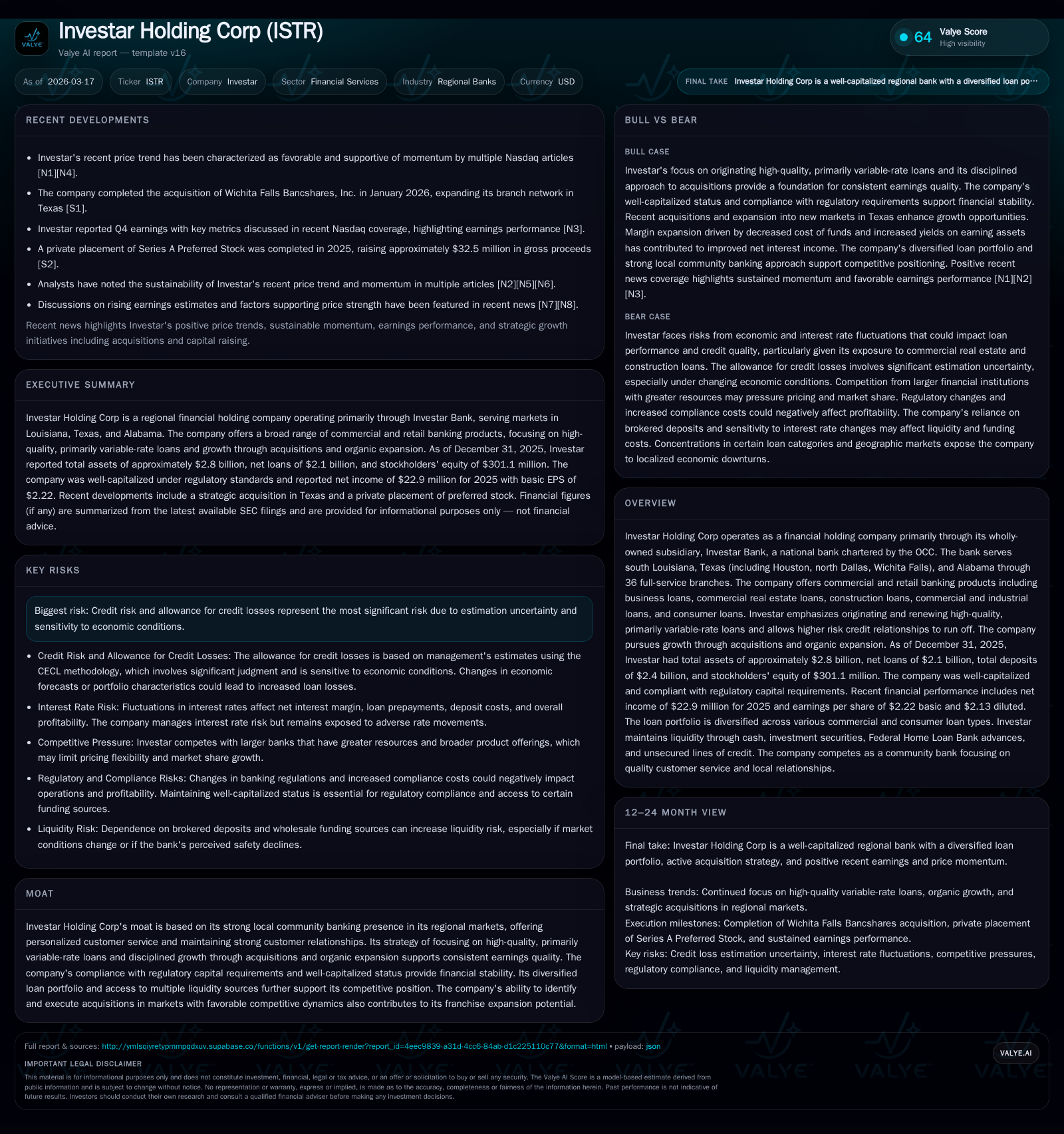
Investar Holding Corp operates as a local community bank primarily serving south Louisiana, Texas, and Alabama through 36 branches. The company has shown consistent revenue and net income growth from 2023 to 2025, driven by a focus on high-quality variable-rate loans, commercial real estate, and industrial loan segments. Its strong capital adequacy ratios and diversified funding sources underscore financial stability. Future growth is supported by acquisitions and organic expansion, though credit risk from economic volatility remains a key challenge. Dividend payments and share repurchases reflect a balanced approach to capital allocation.
Company Overview
Investar Holding Corp serves as the financial holding company for Investar Bank, a national bank chartered by the OCC with a presence primarily across south Louisiana, southeast Texas (including Houston, north Dallas, Wichita Falls), and Alabama through 36 full-service branches [S1]. The bank delivers a suite of commercial and retail banking products emphasizing owner-occupied commercial real estate loans, construction financing, commercial and industrial loans (including term loans and equipment financing), as well as consumer loans such as auto loans and credit cards [S17][S26].
This regional platform benefits from personalized customer service typical of community banks while aiming for consistent earnings quality through disciplined origination of predominantly variable-rate loans thus managing interest rate risk effectively [S17][N1].
Historical Financial Performance
Over the past three years, Investar has demonstrated resilient financial results amid varying macroeconomic conditions:
Historical performance (annual)
| FY | Rev ($mm) | Net ($mm) | CFO ($mm) | Rev YoY | Net YoY |
|---|---|---|---|---|---|
| 2025 | 94 | 23 | 18 | +7.1% | +13.1% |
| 2024 | 87 | 20 | 16 | +5.3% | +21.4% |
| 2023 | 83 | 17 | 26 | -21.1% | -53.3% |
| 2022 | 105 | 36 | 43 |
Source: SEC companyfacts cache [F1].
Capital returns and efficiency (annual)
| FY | Div ($mm) | Buybacks ($mm) | ROE% |
|---|---|---|---|
| 2025 | 4 | 2 | 7.6 |
| 2024 | 4 | 0 | 8.4 |
| 2023 | 4 | 3 | 7.4 |
| 2022 | 4 | 11 | 16.5 |
Source: SEC companyfacts cache [F1].
*Operating cash flow data for FY2023 is approximate; capex figures are not available for recent periods [F1].
Following a revenue decline in FY2022 due to macroeconomic challenges (not shown), the company restored growth momentum with consecutive annual revenue increases reaching over $93 million by FY2025.
Net income growth outpaced revenue expansion recently indicating margin improvement potentially driven by favorable loan mix shifts and disciplined expense management [F1]. Operating cash flow trends corroborate solid cash generation despite some variability.
Equity grew significantly between FY2024 and FY2025 due partly to retained earnings and proceeds from a Series A Preferred Stock issuance raising approximately $30 million net in Q3-2025 [S2].
Balance Sheet Strength and Capital Adequacy
As of December 31, 2025:
- Total assets were approximately $2.8 billion,
- Net loans were about $2.1 billion,
- Deposits totaled roughly $2.4 billion,
- Stockholders' equity stood at $301 million [S1][F1].
Regulatory capital ratios remained robust with:
- Tier 1 leverage ratio at approximately 10.73%,
- Tier 1 capital ratio near 12.85%,
- Total capital ratio close to 14.66%, all comfortably exceeding 'well-capitalized' thresholds [S1][S18].
The bank consistently complied with Basel III capital requirements including the conservation buffer [S18][S21]. Liquidity was supported by cash and cash equivalents around $35 million supplemented by long-term Federal Home Loan Bank advances totaling $60 million plus an unused unsecured line of credit near $60 million at last reporting [S4][S19]. Approximately 70% of total assets were funded by core deposits reflecting stable customer relationships vital for liquidity management [S7][S9].
Interest rate risk inherent in variable-rate lending concentration is managed through interest rate swaps that economically hedge customer exposures without significant earnings volatility impact [S16].
Loan Portfolio Composition & Credit Risk Exposure
Investar targets small-to-medium business borrowers across diversified loan categories including owner-occupied commercial real estate loans; construction financing; commercial & industrial loans; and consumer installment lending products [S17][S26].
The institution maintains conservative underwriting standards and allows higher-risk credits to run off rather than aggressively pursuing riskier portfolios [S27].
Allowance for credit losses on unfunded loan commitments increased modestly from about $42 thousand at end-2024 to approximately $425 thousand at end-2025 reflecting cautious provisioning amid regional economic uncertainties such as oil price fluctuations affecting Louisiana/Texas markets [S15][S13]. Recoveries related to prior impairments caused by Hurricane Ida also contributed positively to credit quality management efforts [S2].
Growth Prospects & Strategic Initiatives
Growth strategies include organic expansion within existing geographic markets supplemented by selective acquisitions of community banks demonstrating attractive competitive positioning [N1][S17]. Recent branch network adjustments involved converting production offices into full-service branches while closing less profitable locations such as the Anniston branch [S2].
Emphasis on variable-rate loans aligns with anticipated interest rate normalization post-volatility cycles potentially enhancing net interest margins provided deposit costs remain controlled [S5]. However regulatory constraints tied to acquisition funding combined with rising competition from larger regional banks present ongoing execution challenges [S27]. Geographic concentration risks necessitate continual monitoring of local economic health.
Capital Allocation & Shareholder Returns
Dividend payments have steadily increased from approximately $3.55 million in FY2022 to about $4.23 million in FY2025 supporting consistent shareholder returns amidst earnings growth [F1][S18]. Share repurchases have moderated after elevated activity in FY2022 ($10.5 million), totaling roughly $2.3 million in FY2025 reflecting a balanced approach between retention for growth and distributions to shareholders.
Dividend declarations are subject to regulatory restrictions including preferred stock dividend priorities but have not materially constrained payout levels recently [S18]. Interest deferral features on junior subordinated debt add complexity but are managed prudently within cash flow frameworks [S10][S28].
Industry Context Analysis
The US community banking sector faces challenges from technological disruption driving digital investments alongside competitive pressures from larger institutions offering scale advantages . Investar’s focused regional model leveraging personalized service helps mitigate some headwinds but limits rapid scaling benefits.
Inflationary pressures coupled with geopolitical uncertainties such as global conflicts may indirectly affect credit quality via borrower performance or collateral values predominantly concentrated in energy-sensitive regions like Louisiana.
Interest rate environments favoring variable-rate loan portfolios offer margin expansion potential but require vigilant interest rate risk management through ALCO oversight.
Conclusion
Investar Holding Corp exhibits solid operational performance anchored on conservative lending practices emphasizing high-quality variable-rate commercial loans across its regional footprint. Strong capitalization and liquidity buffers support resilience amid evolving macroeconomic conditions. Future expansion via selective acquisitions combined with organic growth appears credible though dependent on navigating competitive intensity and cyclicality impacting credit quality. Capital return programs balance shareholder interests while preserving regulatory compliance and funding capacity. Localized credit concentration risks warrant ongoing attention given exposure to region-specific vulnerabilities including energy market fluctuations.
This analysis reflects information available through March 17th, 2026 derived from SEC filings including Form 10-K and quarterly reports along with public disclosures without providing investment advice or recommendations.
Disclaimer: This is research-only, informational analysis and not investment advice. It may include AI-generated interpretation and general industry context. Always verify important details using primary sources.

Comments