
SafeSpace Global Corp's Trajectory: From Startup Losses to Strategic Expansion in AI Safety
SafeSpace Global Corporation has evolved from its pre-revenue startup phase into an emerging global provider of multimodal AI safety solutions, marked by strategic partnerships and ongoing infrastructure investments amid competitive industry conditions.
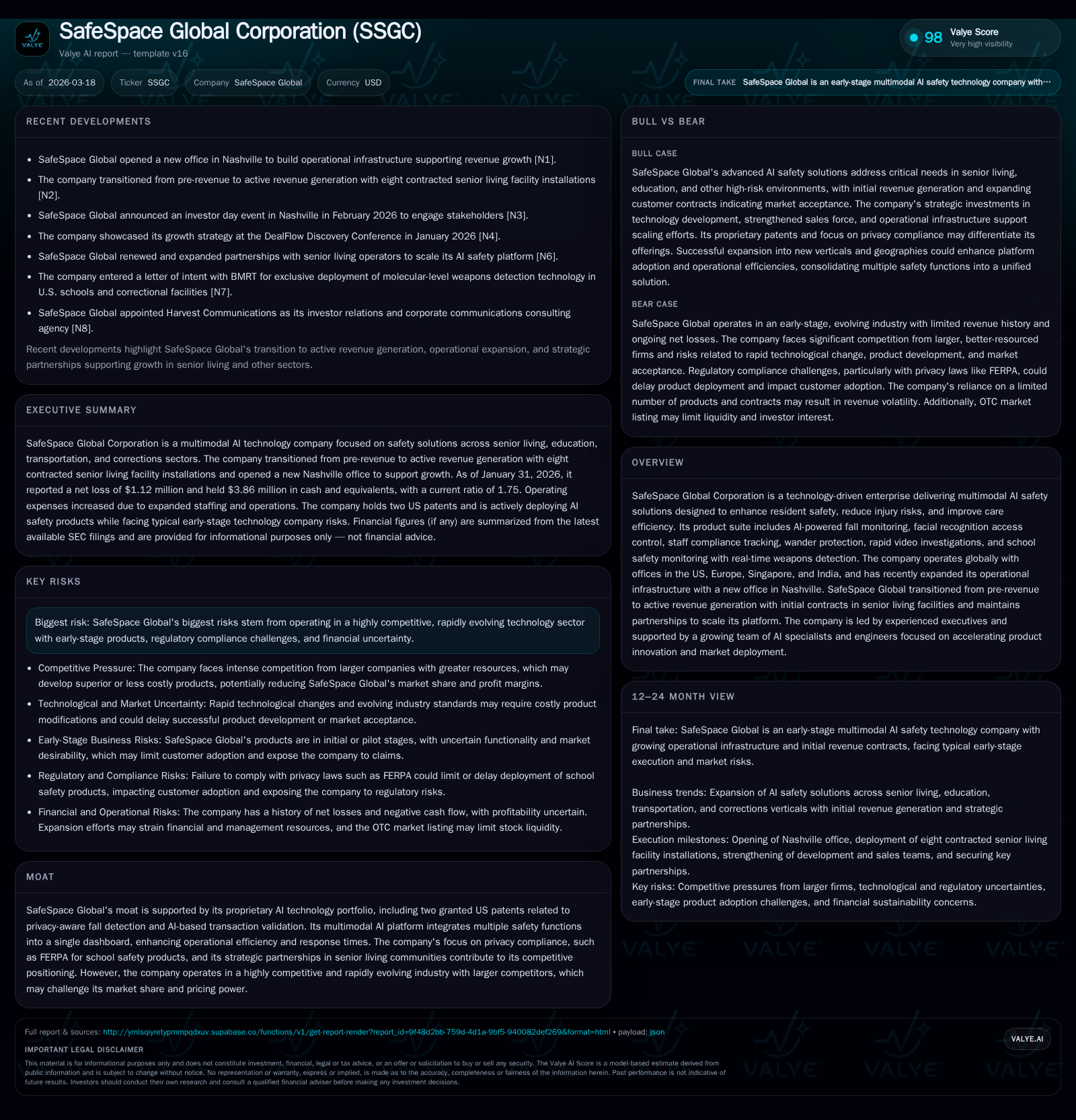
SafeSpace Global Corporation is transitioning actively from its early development and pre-revenue status to generating revenue through contracts in senior living facilities, while expanding geographically and broadening product applications. Its proprietary multimodal AI platform—featuring privacy-aware fall detection and facial recognition access control—forms the core of its competitive moat. Financially, the company continues to operate at a loss with negative cash flows tied to heavy R&D and operational spending; however, recent contract wins and partnerships signal growing market traction. Navigating regulatory compliance, sector competition, and capital constraints remain key challenges for SafeSpace as it aims to scale technology adoption across healthcare, education, and other safety-critical verticals.
Early Years and Product Introduction: Foundations of Growth
SafeSpace Global Corporation originated as a venture concentrated on innovating resident safety through advanced artificial intelligence technologies in healthcare environments, particularly senior living facilities [S1][S29]. The company’s foundational offering was the SafeSpace® Fall Monitoring system utilizing privacy-aware fall detection patented under U.S. law. This initial capability set the stage for a broader multimodal AI platform encompassing diverse safety functions unified under one dashboard.
Expanding beyond fall monitoring, SafeSpace developed SafeFace™ Access Control employing facial recognition technology for keyless door entry aligned with existing magnetic locking systems, enhancing both security and operational convenience. Complementary modules such as SafeFace Time Compliance monitor staff activity rigorously to improve care delivery oversight. Additional products like SafeGuard™ Wander Protection deliver alerts when at-risk individuals breach secured perimeters. Enhanced investigative tools like SafeTrace™ enable rapid retrieval of video clips tied to identified individuals. Furthermore, SafeSchool™, designed for real-time weapons detection in educational institutions, represents the company's strategic move into new verticals catering to public safety concerns [S1][S29].
The integration of these solutions constitutes a proprietary multimodal AI platform forming the company's defensive moat against competitors [S1]. Notably, two granted patents protect key technology elements—one focusing on privacy-preserving fall detection algorithms, another on AI transaction validation techniques—underscoring SafeSpace's innovation depth in safety tech [S2].
Escalating Competitive Dynamics and Market Positioning
Operating within an intensely competitive ecosystem dominated by larger technology enterprises endowed with more substantial capital resources, SafeSpace faces significant challenges in customer acquisition and pricing leverage [S1][S14][S22]. The rapid pace of technological evolution demands consistent innovation; failure to adapt swiftly risks obsolescence as competitors may introduce cheaper or more functional alternatives.
The AI-based safety industry is characterized by evolving standards, frequent new product launches, and persistent pressure on development timelines. These conditions place premium demands on agile R&D execution alongside robust market engagement strategies. SafeSpace’s smaller scale relative to incumbents may constrain its ability to match feature breadth or marketing reach without strategic alliances or focused niche positioning [S14].
Recent Revenue Milestones and Strategic Partnerships
A pivotal transition occurred during early 2026 where SafeSpace shifted from pre-revenue status into active revenue generation through contracting installations in eight senior living facilities [N2][S2]. This milestone validates commercial viability after years concentrated primarily on research and pilot implementations.
Key partnership expansions include bolstering collaboration with Signature HealthCARE—a multi-state operator—to deploy the multimodal AI platform systematically across multiple communities aimed at improving resident safety and standardizing reporting practices amidst labor shortages [N2][S2]. Additionally, the company secured a new contract with Wayman Place assisted living facility for its non-wearable elopement detection solution emphasizing dignity preservation.
To support these scaling efforts, SafeSpace inaugurated a dedicated office in Nashville serving as an operational hub for sales expansion and client engagement within healthcare verticals and beyond [N1][N3]. These accomplishments provide tangible proof points underpinning optimism toward achieving commercial traction despite nascent revenue figures.
Financial Performance Analysis: Revenue, Losses, Cash Flow Trends
Financially, SafeSpace's trajectory reflects typical startup dynamics with minimal revenues juxtaposed against mounting losses attributed to aggressive investment in R&D capacity building and market infrastructure development. Annual revenues hovered below $450K historically (FY2017: $409K) without sustainable upward momentum; notably experiencing a year-over-year decline of approximately 6.9% into FY2025 [F1].
Operating income deteriorated dramatically with a near fourfold increase in losses to approximately -$4.8 million in FY2025 from about -$0.98 million the preceding year (-388% YoY) signaling expanded operating expenses associated with business scaling endeavors [F1]. Similarly, net income followed a worsening trend reflecting a -560% YoY change culminating at around -$4.64 million loss in FY2025.
Operating cash flow remained negative throughout recent years but worsened substantially to negative $2.68 million by FY2025 compared with previous years’ lower outflows consistent with expanding operational activity levels without yet achieving positive cash generation [F1][S27].
Equity positions strengthened markedly—from negative balances in earlier years reaching positive $7.56 million by FY2025—indicating successful capital raises underpinning ongoing funding needs [F1]. Nonetheless liquidity must be carefully managed given sustained cash burn rates; as of early 2026 cash equivalents stood near $3.86 million providing runway but underscoring limited buffer absent further financing [F1][S10].
Historical performance (annual)
| FY | Net ($mm) | CFO ($mm) | OpInc ($mm) | Net YoY |
|---|---|---|---|---|
| 2025 | -5 | -3 | -5 | -560.3% |
| 2024 | -1 | 0 | -1 | +46.1% |
| 2023 | -1 | 0 | -1 | +4.3% |
| 2022 | -1 | 0 | -1 |
Source: SEC companyfacts cache [F1].
Capital returns and efficiency (annual)
| FY | ROE% |
|---|---|
| 2025 | -61.3 |
| 2024 | 239.6 |
| 2023 | 195.6 |
| 2022 | 56.1 |
Source: SEC companyfacts cache [F1].
Note: Revenue growth percentages are computed where data permits; negative values signify net losses; CFO denotes operating cash flow.
Growth Prospects Across Emerging Vertical Markets
SafeSpace is actively pursuing growth outside its initial senior living base by extending its multimodal AI platform into education (SafeSchool™), transportation hubs, correctional institutions—with planned future entries into commercial infrastructure settings that demand enhanced security monitoring [N2][S2]. This cross-sector diversification could mitigate single-segment concentration risk while leveraging platform synergies.
The integration advantage lies in unifying disparate safety modalities—fall detection combined with staff compliance tracking or rapid investigations—increasing user stickiness via consolidated dashboards allowing faster incident response times in labor-constrained environments where caregiver attention is scarce.
However, regulatory factors such as compliance with FERPA markedly impact deployment speed within school markets as adherence safeguards privacy but may delay acceptance or result in uneven geographic rollout necessitating adaptive strategies by SafeSpace [S2]. Furthermore, competitive pressure requires continuous feature enhancements aligned tightly to end-user operational requirements.
Capital Allocation Strategy and Shareholder Return Considerations
Capital allocation remains focused predominantly on sustaining growth initiatives—technology development teams expansion including hiring IT architects and AI specialists—and supporting new market entry efforts without distributing capital back via dividends or share repurchases consistent with typical early-stage profiles [F1][S18][S19][S20].
Current financial disclosures reveal no material commitments toward capital expenditures beyond software development investments typical of the technology sector nature of operations [S18][S27]. The absence of dividends aligns with ongoing net losses (~$4.6M FY2025 net loss) translating into negative approximate return on equity near -61%, reflecting no current profitability or shareholder yield generation prospects pending business maturity stages [F1].
Management’s reinvestment orientation underscores strategic prioritization toward building scalable revenue streams expected over medium-to-long terms rather than near-term cash returns.
Key Risks and Regulatory Compliance Challenges
Foremost risks confronting SafeSpace include intense competition from better-capitalized rivals which may erode market share or compel pricing concessions limiting profit margins [S1][S14]. The sector’s rapid evolution necessitates continual technological refreshment lest products become obsolete rapidly.
Regulatory compliance poses particular challenges; for example implementing SafeSchool™ across states requires navigating complex data privacy laws such as FERPA which restrict how student data can be collected/used potentially constraining market penetration or exposing regulatory penalties if not adhered to meticulously [S2][S25].
Additional risk factors include ongoing financial uncertainty due to negative cash flows raising questions regarding sufficiency of funding should revenue ramp slower than planned; retention of highly-skilled personnel critical for maintaining innovation pace; litigation risks linked tangentially through related party disputes though currently judged immaterial by management [S23]; all underscoring inherent volatility implicit within early-stage technology ventures.
Outlook: Technology Innovation and Market Adoption Signals
While explicit forward-looking financial guidance remains unavailable publicly reflecting typical early developmental phase cautioning qualitative disclosures convey optimism anchored on contract wins coupled with infrastructure expansion such as the Nashville office intended to catalyze sales momentum across diversified verticals globally [N3][N1][S2].
Investor Day events underscore management’s commitment toward transparency emphasizing dedication toward refining core AI algorithms enhancing privacy-aware capabilities while expediting deployment cycles via strategic field partnerships fostering brand establishment within critical care settings.
Analysis indicates that broadening adoption hinges significantly on execution capability balancing swift innovation cycles against rigorous field-testing demanded by life-safety applications where reliability is paramount. Execution risks persist surrounding funding adequacy given current cash burn trajectory but improved equity footing offers moderate runway extending potential before additional raises would be needed.
Disclaimer: This analysis is furnished solely for informational purposes without any recommendation regarding securities transactions or investment strategies related directly or indirectly to SafeSpace Global Corporation.
Disclaimer: This is research-only, informational analysis and not investment advice. It may include AI-generated interpretation and general industry context. Always verify important details using primary sources.

Comments