
Lifezone Metals Advances Kabanga Nickel Project Amid Liquidity Constraints and Intellectual Property Focus
Lifezone Metals balances development of a high-grade nickel project with expansion of patented Hydromet Technology under financial strain.
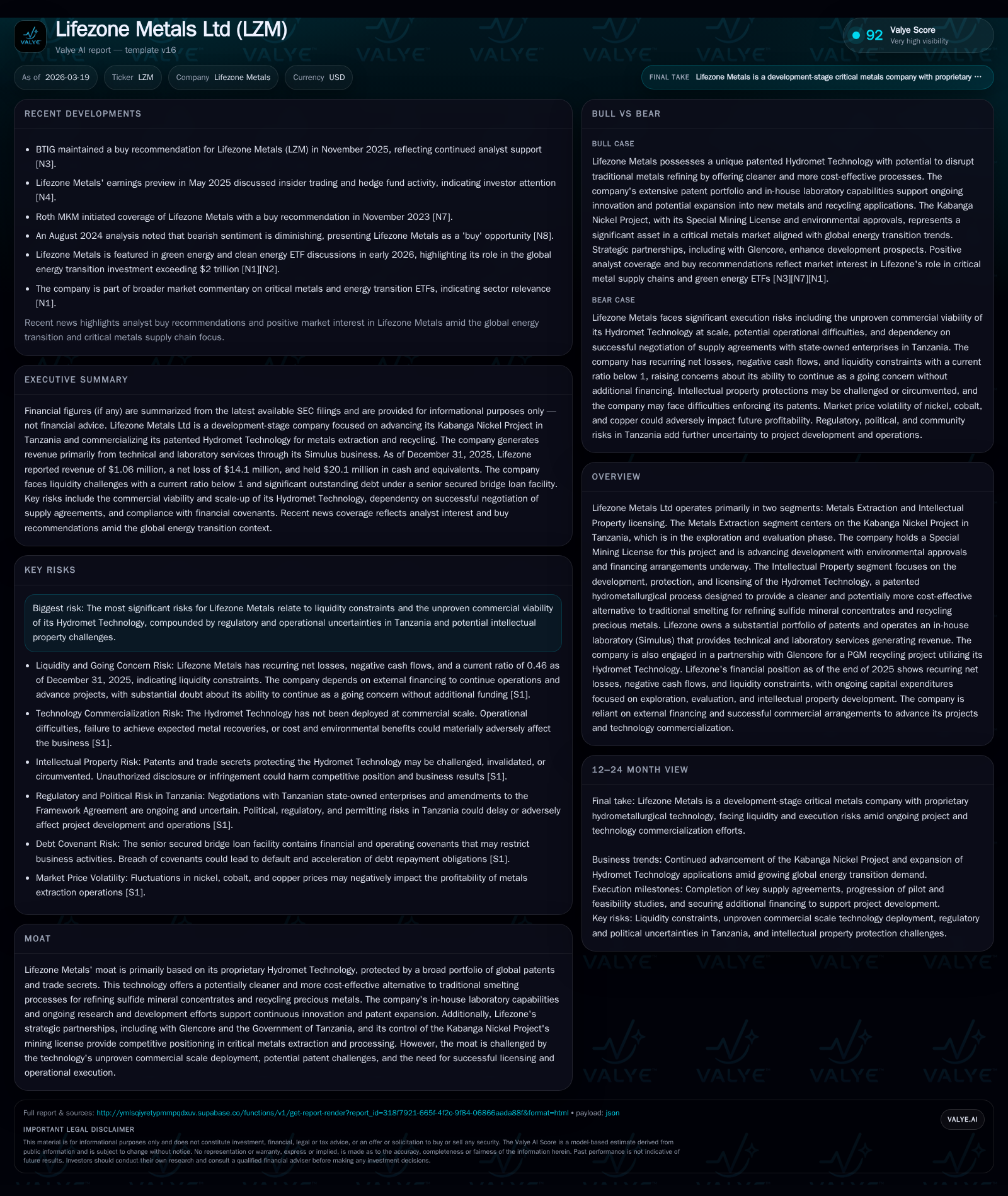
Lifezone Metals Ltd operates primarily through its Metals Extraction segment, focused on the Kabanga Nickel Project in Tanzania, and its Intellectual Property licensing business centered on the patented Hydromet Technology. The company has made progress advancing Kabanga’s feasibility study, environmental approvals, and financing arrangements but continues to face liquidity pressure given ongoing exploration-stage capital spending. Revenue growth reflects increased activity in laboratory services supporting IP commercialization, while operational losses narrow as administrative expenses decline. Future growth hinges on successful project financing, commercial deployment of Hydromet technology, and securing supply agreements amidst geopolitical and regulatory risks in Tanzania.
Company Overview and Business Segments
Lifezone Metals Ltd operates predominantly across two segments: Metals Extraction and Intellectual Property (IP) licensing [S1]. The Metals Extraction segment centers on the development of the Kabanga Nickel Project located in Tanzania's East African Nickel Belt—a high-grade nickel sulfide deposit regarded as one of the largest undeveloped globally [S1][S9]. Lifezone holds a Special Mining License for this project through its subsidiary Kabanga Nickel Limited (KNL), over which it gained full ownership after purchasing BHP's remaining 17% interest during 2025 [S1][S3].
The IP segment encompasses the development and commercialization of Lifezone’s proprietary Hydromet Technology—a patented hydrometallurgical refining process designed to offer a cleaner and potentially more cost-effective alternative to traditional smelting for processing sulfide mineral concentrates and recycling precious metals [S1][S18]. This segment also includes Lab Services via the Simulus laboratory based in Perth, which delivers technical services generating revenue while supporting R&D efforts [S1][S16].
Historical Performance and Operating Results
Lifezone's financial history reflects its developmental stage nature, with no revenue derived from metals extraction yet [F1]. The company generated modest revenue primarily from its IP segment—technical lab services—reaching USD 1.06 million in FY 2025, up substantially from roughly USD 140 thousand in FY 2024 [F1][S16]. This growth corresponds with intensified engagement of third-party customers at Simulus lab following reduced internal project activities.
Costs associated with sales rose commensurately due to increased raw materials and labor linked to higher service volume but remained moderate at just over half a million dollars [F1]. Gross profit improved accordingly but remains limited by overall scale.
Administrative expenses decreased significantly by nearly half year-over-year to about USD 19.1 million in FY25 from USD 39.1 million previously, mainly attributable to cost rationalization efforts including workforce reductions related to the metal extraction segment restructuring [F1][S23]. Despite this improvement, Lifezone reported an operating loss of approximately USD -18.4 million for FY25 compared with USD -48.3 million a year earlier.
Interest income dropped due to lower cash balances and falling bank rates while interest expense increased reflecting higher debt levels including loan facilities drawn against the Kabanga project [F1]. Fair value accounting for embedded derivatives related to convertible debentures also impacted results leading to non-cash fluctuations.
Historical performance (annual)
| FY | Rev ($) | Net ($mm) | Rev YoY | Net YoY |
|---|---|---|---|---|
| 2025 | 1057043 | -14 | +652.2% | +70.1% |
| 2024 | 140522 | -47 | -90.5% | +87.1% |
| 2023 | 1477826 | -365 |
Source: SEC companyfacts cache [F1].
Capital returns and efficiency (annual)
| FY | ROE% |
|---|---|
| 2025 | -19.4 |
| 2024 | -47.5 |
| 2023 | -284.2 |
Source: SEC companyfacts cache [F1].
Source: SEC filings and XBRL data [F1], [S1], [S16], [S23]
Capital Allocation and Returns
Lifezone’s capital expenditures focus on advancing the Kabanga Nickel Project through exploration and evaluation activities alongside investments into intellectual property maintenance and research initiatives [S9][S16]. Capex decreased notably from approximately USD 51 million in FY24 to around USD 22 million in FY25 as the company adopted a staged approach enhancing capital efficiency per newly announced plans [S9][F1].
As of December 31, 2025, Lifezone held cash and equivalents of about USD 20.1 million against current liabilities exceeding USD 59 million — yielding a current ratio near 0.46 indicating tight near-term liquidity conditions [F1][S3]. The company’s equity base remained positive at roughly USD 72.8 million at fiscal year-end despite accumulated losses [F1].
No dividends or share repurchases have been declared or executed consistent with developmental status and cash conservation priorities [F1]. Given recurring net losses and negative operating cash flows over recent years [F1], Lifezone remains reliant on external capital markets for funding.
Funding Structure & Liquidity Outlook
To support early-stage development at Kabanga, Lifezone secured a senior secured bridge loan facility totaling $60 million from Taurus Mining Finance in August 2025 with an initial tranche drawdown of $20 million completed soon thereafter [S1][S3][S7]. This facility matures July 31, 2027 with an interest rate of approximately 9.25% per annum plus associated fees; warrants were issued concurrently as part of debt terms [S7][S15].
Despite this infusion supporting critical infrastructure work toward final investment decisions (FID), management acknowledges continuing liquidity pressures outside the ringfenced project loan—covering overheads tied to corporate functions including IP development costs such as the Glencore recycling partnership—which require additional funding solutions like further equity offerings within six months [S4][S7].
Discussions remain active with international development finance institutions including the US Development Finance Corporation (US DFC), commercial lenders, export credit agencies and strategic investors supported by advisory engagements with Societe Generale and Standard Chartered Bank aimed at structuring long-term project financing arrangements [S8][S18].
The company highlights uncertainties around finalizing supply agreements — critical for establishing bankable commercial frameworks — often negotiated with Tanzanian state-owned enterprises subject to governmental approvals and regulatory complexities [S15].
Future Growth Prospects & Catalysts
Lifezone’s near-to-medium term outlook depends heavily upon achieving several key milestones:
- Completion of a multi-source project financing package enabling full-scale construction at Kabanga aligned with the staged development plan announced mid-2025 targeting annual throughput approximating 3.4 million tonnes ore mined underground [S1][S9].
- Successful negotiation and execution of supply agreements that define product marketing pathways including nickel sulfate for battery markets supported by strategic partnership MoUs such as that signed with Japan Organization for Metals and Energy Security for battery industry supply security [S1].
- Advancement towards first commercial production phases expected post-FID anticipated in calendar year 2026 — approval expected to considerably increase capex demands requiring fresh capital infusions beyond existing bridge facility capacity [S4][S7][S8].
- Expansion of intellectual property licensing revenues via broader market penetration of proprietary Hydromet Technology beyond partner Glencore’s PGM recycling pilot phase currently under evaluation pending positive feasibility outcomes alongside environmental permitting steps within the United States or other jurisdictions [S8][S16].
Notably revenue contributions from metals extraction are not expected imminently given ongoing exploration/evaluation status; success here is contingent upon demonstrated commercial viability through pilot projects using Hydromet technology as well as fully licensed mining operations completing environmental/social impact assessments certifying low impact operations with local stakeholder satisfaction [S6][S9].
Further intellectual property development is anticipated through continuous patent applications (currently holding over 160 patents worldwide plus many pending) underpinning their technology moat but requiring ongoing R&D investments carrying operational cost implications [S18][S25].
Risks Highlighted by Management
Key risks include:
- Liquidity Risk: Current cash balances insufficient for sustaining corporate overheads beyond short-term without additional equity or mezzanine financing; exposure heightened during ramp-up phases pre-cash flow positivity from mining operations [F1][S4].
- Technical & Commercial Risk: Hydromet process unproven at full commercial scale posing execution risk compounded by potential patent challenges or competitive technological disruption [S18].
- Regulatory/Political Risk: Operating predominantly in Tanzania exposes Lifezone to emerging market volatility including permitting delays, changing government policies affecting mining licenses or royalties alongside community relations sensitivities impacting social license to operate [S10][S26].
- Supply Chain/Agreement Uncertainty: Negotiations ongoing especially with Tanzanian SOEs for off-take agreements where unfavorable terms or implementation contingencies can materially alter project economics or delay schedule indefinitely [S15].
- Environmental & Social Governance (ESG): Increasing scrutiny necessitates adaptive operational strategies potentially increasing costs or derisking investor sentiment toward green credentials imperative for access to project financing [S10][S21].
- Financial Covenants & Default Risk: Bridge loan covenants may restrict operational flexibility; failure to comply could accelerate repayment obligations jeopardizing going-concern status absent successful refinancing transactions [S15].
Summary & Outlook
Lifezone Metals represents an upstream critical minerals developer advancing one of the world's largest undeveloped high-grade nickel sulfide deposits alongside pioneering hydrometallurgical refining technologies offering potential environmental advantages. Their staged approach blends pipeline IP licensing revenues alongside progressing resource development aligning them uniquely within global clean energy transition narratives emphasizing nickel supply chain resilience.
Nonetheless material obstacles persist notably concerning timely availability of sufficient capital reflective both of macro-market risk aversion towards late-stage resource plays without established production history plus geopolitical overlays inherent when developing projects primarily outside OECD jurisdictions.
Key events investors should monitor include:
- Timing of Final Investment Decision on Kabanga Nickel Project,
- Closure of comprehensive project financing package,
- Progression on environmental permitting milestones,
- Outcomes from pilot scaling feasibility studies related to Hydromet technology adoption,
- Finalization of supply agreements particularly involving Tanzanian SOEs,
- Quarterly updates on liquidity status relative to capital raising activities.
Disclaimer: This analysis is based solely on publicly available information up to March 19, 2026 ([F1], [S#]). It is intended for informational purposes only without investment advice or recommendation.
Disclaimer: This is research-only, informational analysis and not investment advice. It may include AI-generated interpretation and general industry context. Always verify important details using primary sources.

Comments