
California BanCorp’s Post-Merger Growth and Capital Strategy in a Concentrated California Market
The $4 billion community bank leverages relationship banking across California but faces geographic and credit concentration risks.
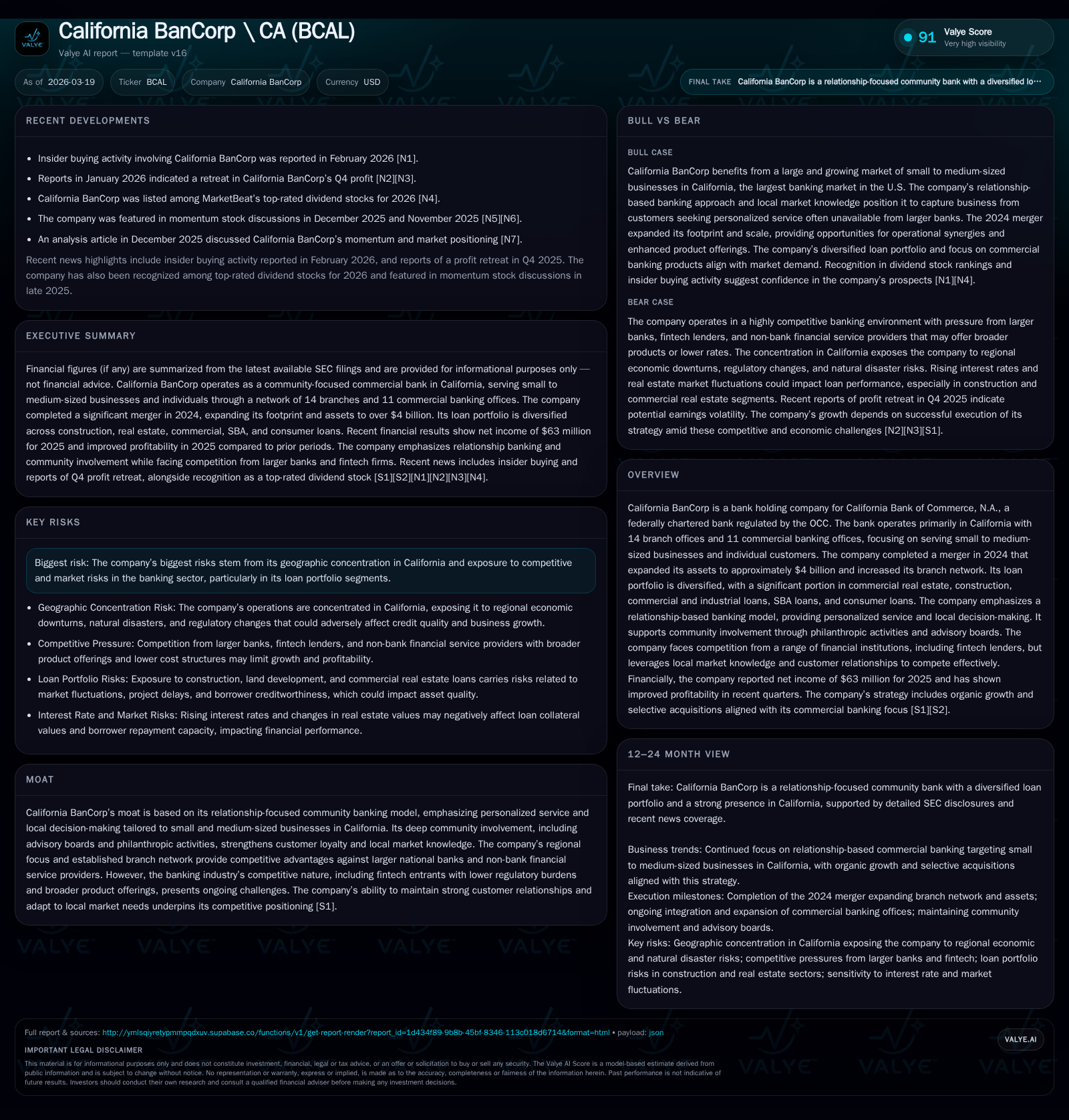
California BanCorp expanded significantly in 2024 through a merger increasing assets beyond $4 billion with a broad loan portfolio focused on commercial real estate and small to medium-sized businesses. The company’s growth is driven by organic expansion and strategic acquisitions, supported by a relationship-based banking model emphasizing local decision-making and community involvement. While net income surged over 10-fold year-over-year to $63 million at the end of 2025, the firm must manage risks from concentrated lending exposures, liquidity reliance on deposits, and competition from fintech and larger banks. Capital allocation includes modest buybacks funded by robust operating cash flow and a prudent capital position with equity around $577 million.
Company Overview
California BanCorp functions as the holding company for California Bank of Commerce, N.A., operating primarily within the state of California. Its operations center on serving small- to medium-sized businesses and retail clients through a network of 14 branch offices complemented by additional commercial banking offices. The company follows a federally chartered model regulated by the OCC [S1]. Strategic growth accelerated notably with its July 31, 2024 merger, combining the former California Bank of Commerce entity into its structure. This tie-up expanded total assets to approximately $4 billion while enhancing geographic presence across key California markets including Northern and Southern regions [S25].
Deep roots in California communities manifest via philanthropy, advisory boards consisting of local business leaders guiding strategic orientation, and employees’ active nonprofit participation. This fosters strong relational ties foundational to their "relationship-based community banking" approach [S24]. This model contrasts with larger national banks or fintech competitors by emphasizing local decision-making tailored to client-specific financial solutions.
Historical Performance Drivers
California BanCorp has demonstrated remarkable growth momentum recently fueled chiefly by its merger completed mid-2024. The transaction brought together complementary banking footprints enhancing scale and offering cross-market opportunities. The enlarged institution closed FY2025 with total consolidated assets exceeding $4 billion and shareholders' equity standing at roughly $577 million [F1].
Profitability rebounded sharply post-merger; net income for FY2025 reached $63.1 million versus $5.43 million in FY2024 — a more than tenfold increase signaling improved operational leverage after integration costs moderated [F1]. Operating cash flows likewise rose to nearly $57.3 million (+13.9% YoY), highlighting solid core franchise cash generation capability while capital expenditures remained modest totaling $346K [F1]. Return on equity based on these figures is estimated at approximately 10.9%, underscoring efficient capital utilization following expansion [F1].
Historical performance (annual)
| FY | Net ($mm) | CFO ($mm) | Capex ($) | Net YoY |
|---|---|---|---|---|
| 2025 | 63 | 57 | 346000 | +1060.6% |
| 2024 | 5 | 50 | 552000 | -79.0% |
| 2023 | 26 | 33 | 302000 |
Source: SEC companyfacts cache [F1].
Capital returns and efficiency (annual)
| FY | Buybacks ($mm) | FCF ($mm) | ROE% |
|---|---|---|---|
| 2025 | 3 | 57 | 10.9 |
| 2024 | 2 | 50 | 1.1 |
| 2023 | 1 | 33 | 9.0 |
Source: SEC companyfacts cache [F1].
Note: Revenue data not disclosed explicitly; focus on net income trends.
Loan Portfolio Composition & Credit Risk
The bank maintains a diversified loan book weighted heavily toward commercial real estate (CRE) loans which represent about 60% of total loans held for investment (including both SBA-backed and conventional segments) [S7]. Commercial & industrial (C&I) loans are the second largest segment at roughly 20%, followed by construction and land development loans (~4.6%) plus consumer loans [S7]. SBA loan exposures provide government guaranteed credit support adding stability but also complexity.
This composition positions the bank well within its core market niches but concentrates risk exposure geographically entirely within California [S9], subjecting it to economic cycles specific to that region including potential downturns in commercial real estate valuations which could pressure collateral values severely [S1]. Construction loans typically carry higher risk due to their dependence on project completion and sale or lease performance; hence management adopts conservative underwriting standards incorporating borrower cash flows, collateral appraisal rigor, and management evaluations [S6][S23].
Large individual lending relationships can generate volatility in portfolio metrics since singular changes materially impact financial results given portfolio scale relative to capital base [S18]. Regular assessment via risk ratings including Pass, Special Mention, Substandard, and Doubtful categories guides early intervention efforts [S15]. Substantial allowance for credit losses provisions are calculated using CECL methodology incorporating macroeconomic forecasts to cover expected losses over the loan life cycle [S21].
Deposits & Liquidity Position
Deposits form the cornerstone of funding representing approximately $3.37 billion as of December 31, 2025. The deposit mix skews toward stable demand deposits with noninterest-bearing demand accounts constituting ~35% of total deposits along with substantial interest-bearing NOW accounts and money market savings accounts comprising another ~61% combined piece [S16][F1]. Time deposits represent only about 3.8%, indicating limited reliance on less stable funding sources.
The company also utilizes reciprocal deposits through networks like CDARS/ICS ensuring large depositors maintain FDIC insurance coverage via dollar redistribution mechanisms essential for handling high-balance customers [S16]. Brokered time deposits remain nominal (0.1% of total deposits), limiting liquidity risk often associated with volatile brokered funds [S16][S14].
Liquidity is further bolstered via secured lines of credit with the Federal Home Loan Bank ($795 million facility with substantial availability) and Federal Reserve discount window arrangements though borrowings were minimal or zero as per latest disclosures [S5][S13][S15]. In sum, liquidity sources appear adequate relative to anticipated commitments including loan pipelines but remain susceptible to broader funding stress scenarios potentially affecting regional banks with concentrated deposit bases [S23].
Capital Structure & Allocation
California BanCorp enjoys a solid equity base around $576.6 million at FY-end December 2025 reflective of retained earnings accumulation post-merger scaling combined with disciplined capital management [F1]. The company’s legal lending limits tied to unimpaired capital impose controls on aggregate exposures per borrower mitigating concentration excesses subject to collateralization provisions [S7].
Capital allocation priorities include measured share repurchases which totaled approximately $3.37 million during FY2025 — a notable increase from earlier years but still moderate relative to net income generation suggesting primary focus remains on balance sheet strength rather than aggressive distributions [F1][S19]. No dividends were mentioned explicitly but operating cash flow coverage remains strong at nearly $57 million surpassing capex needs comfortably indicating availability of free cash flow supportive of internal reinvestment or shareholder returns [F1].
Subordinated debt exists (originally $18 million fixed-to-floating rate notes plus assumed legacy notes from merger amounting to about $35 million) used likely for regulatory capital buffer purposes but no recent drawdowns from external unsecured lines were reported implying conservative leverage stance [S19][S14][S15].
Competitive Environment & Strategic Positioning
Operating exclusively in California—the nation’s largest individual banking market—California BanCorp targets an appealing segment populated by approximately 1.7 million small to medium-sized businesses demanding personalized financial solutions absent from many larger institutions focused on scale rather than relationships [S9][S25].
The company faces intense competition not only from other local/regional banks but also growing fintech lenders which possess advantages such as lighter regulatory burdens allowing aggressive pricing or product innovation disrupting traditional banking paradigms [S12]. Additionally, megabanks have greater resources enabling extensive branch networks, marketing campaigns, technology investments, and product diversity.
California BanCorp counters these challenges through localized advisory boards tapping into community insights coupled with direct engagement via philanthropy lending public goodwill that boosts client loyalty—often intangible yet impactful competitive differentiators [S24]. Furthermore, maintaining decision-making authority closely aligned with client-facing officers expedites service customization—a key selling point against bureaucratic players.
Forward-Looking Considerations & Risks
Explicit guidance or forecasts are not provided beyond reaffirmation of strategic intent focusing on organic growth supplemented opportunistically by acquisitions compatible with its commercial banking ethos [S17]. Observers should watch how effectively loan growth balances risk concentration particularly if CRE markets soften given historical cyclicality in California real estate dynamics.
Key risks encompass:
- Geographic concentration heightening vulnerability to localized downturns.
- Credit losses relating especially to construction loans or large borrower defaults.
- Competitive pressures compressing margins or requiring technology investments.
- Regulatory compliance complexity imposing costs or restricting flexibility.
- Liquidity risks stemming from deposit withdrawal behaviors potentially amplified during stress periods.
- Reputation dependency underscoring challenges associated with service quality lapses. (Summary per risk disclosures in S1)
Conclusion
California BanCorp stands at an important juncture as an emerging mid-sized bank strengthened materially via a transformative merger expanding scale while remaining firmly rooted in localized relationship banking across California’s vibrant SME communities. The remarkable earnings recovery achieved post-merger illustrates operational resilience though continued vigilance over credit portfolio quality amid economic cycles remains paramount.
Maintaining this trajectory will require balancing organic expansion ambitions with disciplined risk management and judicious capital deployment especially given intensifying competition from fintech entities arrayed against entrenched regional competitors. The bank’s focus on personalized service delivered through deep community engagement could provide sustainable differentiation if execution stays consistent amid an evolving regulatory-financial landscape.
This report is intended solely for informational purposes based on available disclosures through March 19, 2026; it does not constitute investment advice or recommendations.
Disclaimer: This is research-only, informational analysis and not investment advice. It may include AI-generated interpretation and general industry context. Always verify important details using primary sources.

Comments