
Accenture’s Revenue Growth and Margin Pressures Highlight Shifting Dynamics in Consulting
Accenture's recent performance reveals solid top-line gains tempered by declining profitability amid rising costs and regulatory uncertainties.
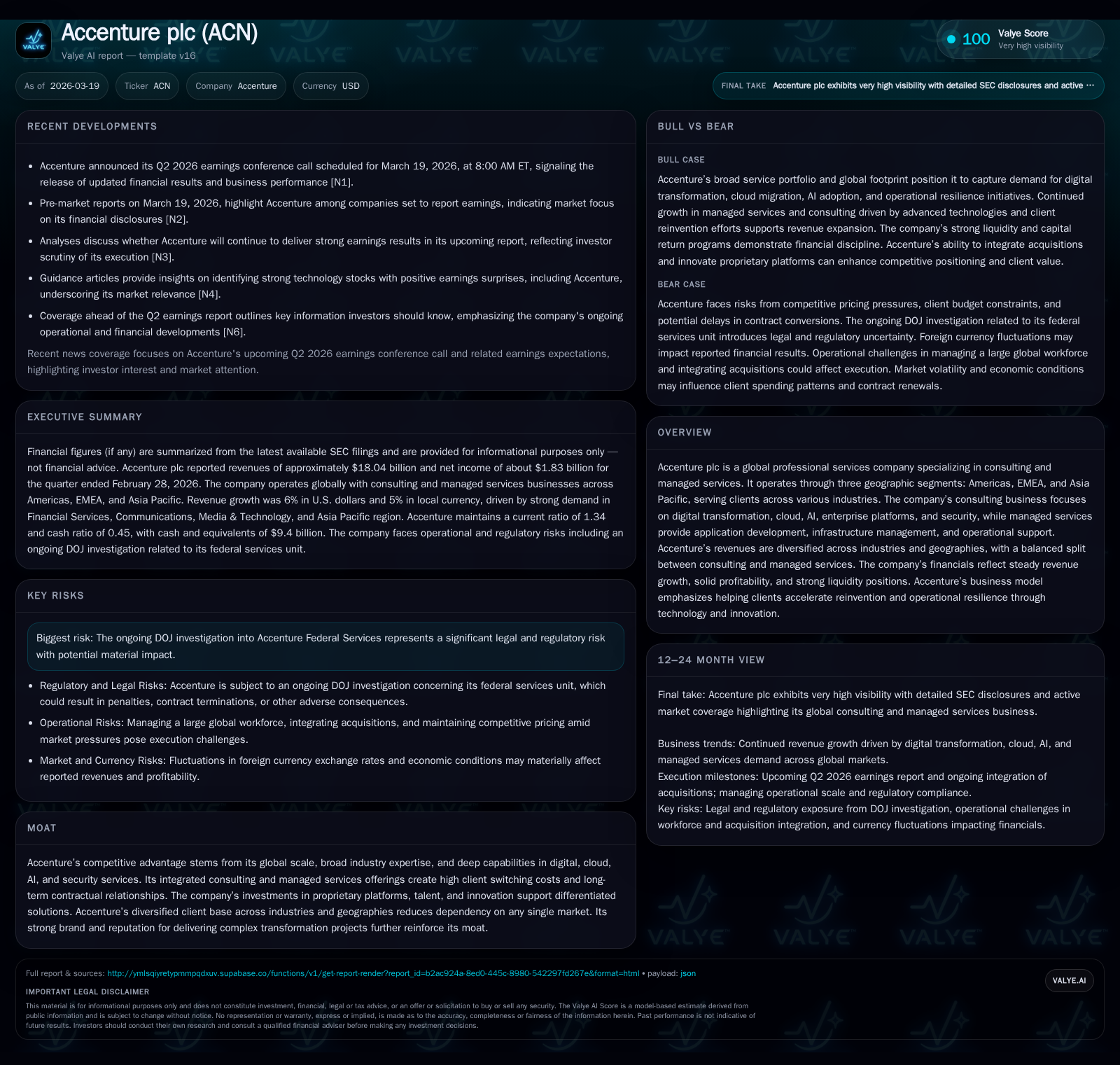
Accenture posted a 7.3% revenue increase in fiscal 2025, driven largely by expanding digital transformation and cloud services within its consulting segment. Despite revenue growth, operating income declined by 12.9% due to margin compression from payroll inflation and subcontractor cost increases across key regions. Geographic analysis shows Americas leading revenue contributions while EMEA and Asia Pacific face greater margin pressures. The ongoing U.S. Department of Justice investigation into Accenture Federal Services presents material legal risks that may cap near-term growth prospects. The company maintains strong cash flows and continues to return capital through dividends and sizable buybacks, reflecting disciplined capital allocation amid operational headwinds.
Trajectory of Revenues: Drivers Behind Growth and Margin Variance
Accenture posted total revenues of $17.6 billion for fiscal year 2025, a solid 7.3% increase over fiscal 2024's $16.4 billion [F1]. This growth was primarily fueled by the company’s consulting business lines focusing on digital transformation initiatives such as cloud migration, AI deployment, enterprise platform integration, and security enhancements — areas witnessing sustained client investment as firms seek operational resiliency and innovation acceleration . Managed services also contributed meaningfully with ongoing application development and infrastructure management contracts underpinning the recurring revenue base.
However, this topline expansion contrasted sharply with profitability trends: operating income fell by 12.9% year-over-year to just over $2 billion in FY25 compared to $2.35 billion in FY24 [F1]. Net income followed suit with a steeper decline of approximately 16%, reaching $1.41 billion [F1]. The margin contraction is chiefly attributable to rising labor costs — including higher payroll expenses driven by global talent shortages — as well as increased subcontractor fees necessary to fulfill evolving client requirements [S4]. The company’s geographic expense allocation reveals that wage inflation pressures were particularly marked across EMEA and Asia Pacific regions.[S4]
Segment-Level Revenue and Profit Trends Across Americas, EMEA, and Asia Pacific
Breaking down revenues geographically underscores differentiated market dynamics shaping financial outcomes. The Americas represent the largest single market segment accounting for roughly 48% of total revenues in late 2025 quarters, with reported revenues near $9 billion [S4][S6]. This region maintained relatively stable operating income supported by a favorable onshore-offshore delivery mix allowing cost containment.
Conversely, EMEA generated around 37% of revenues but faced more pronounced margin erosion; operating margins contracted due to elevated compensation rates juxtaposed with intensified competition requiring aggressive pricing strategies [S4][S6]. Asia Pacific contributed about 15% of revenues but exhibited the highest proportional rise in payroll-related costs that compressed profitability materially [S6]. Foreign currency fluctuations also exerted negative impacts on EMEA results when measured in local currencies.[S4]
Such geographic variance highlights Accenture’s challenge balancing growth ambitions with cost discipline amid diverse labor markets.
Consulting vs. Managed Services: Changing Mix and Client Demand Patterns
The split between consulting and managed services remains balanced near the midpoint at about half revenues each [S4]. Consulting continues to grow in areas like enterprise platforms—integrating SAP, Oracle—and cybersecurity which have risen as significant priorities amid increasing digital threats.
Managed services benefit from sticky client relationships anchored by long-term contracts providing steady cash flow streams despite slower booking-to-revenue conversion cycles . This segment's resilience partially offsets volatility seen in more project-based consulting engagements.
The interplay suggests client preferences are shifting modestly towards operational outsourcing solutions that embed technology stewardship over multi-year horizons, even as firms rely on high-touch advisory input for transformation programs.
New Market Dynamics: Effects of Legal Investigations on Business Operations
A focal new risk factor for Accenture is the ongoing U.S. Department of Justice (DOJ) civil and criminal probe into Accenture Federal Services (AFS). The investigation pertains to alleged inaccuracies submitted related to federal government security requirements compliance on certain service offerings [S5][S6].
This inquiry exposes Accenture to potential penalties under the False Claims Act including fines or contract termination sanctions that could materially affect the federal services revenue segment if adverse outcomes materialize [S6]. Given AFS’s role in highly regulated government contracts, reputational harm could curtail new bookings or renewals until resolution.
Management has disclosed cooperation with investigators but cannot estimate timing or financial impact beyond accrued reserves at this time [S6]. Investors should consider this unresolved legal event a significant constraint on short-to-medium term visibility.
Future Growth Opportunities Constrained by Macroeconomic Factors and DOJ Inquiry
Despite raising its full-year outlook recently, including a notable 10% dividend increase signaling robust free cash flow generation [N12], Accenture faces macroeconomic uncertainties impacting demand elasticity for large transformation projects [N12][S11][S13]. CFO remarks highlight cautious optimism tempered by a backlog situation influenced by global economic patterns limiting discretionary IT spend.
New bookings data indicate growth but reflect elongating sales cycles particularly for large managed services contracts which convert over longer periods compared to consulting engagements [S11]. Currency volatility also adds complexity to regional performance forecasts.
Monitoring backlog trends will be essential to gauge forward revenue momentum alongside updates on DOJ inquiry progress which may restrict certain contract activities pending clarification.
Capital Allocation Priorities: Balancing Buybacks, Dividend Growth, and Cash Flow Strength
Accenture’s capital return strategy remains consistent with strong free cash flow generation supporting dividends and aggressive share repurchases simultaneously [F1][N12][S19][S21]. Fiscal year 2025 free cash flow approximated $10.87 billion when subtracting capex from operating cash flow—up roughly 16% year-over-year from prior periods despite margin headwinds [F1].
Dividends paid exceeded $1 billion in Q1 FY26 alone with plans reflecting a sustainable payout bolstered by cash flows [N12][S19]. Share buybacks have remained sizable near $4.6 billion annually through FY25 affirming commitment to shareholder value even amid regulatory risks (DOJ) and earnings headwinds.
Equity rose above $31 billion amplifying capital base while return on equity held near a moderate ~4.5%, impacted by margin compression but stabilized by disciplined capital deployment [F1].
Looking Ahead: Investor Expectations and Key Milestones to Monitor
Consensus sentiment highlighted ahead of Q2 FY26 earnings points toward incremental earnings beats driven partly by resilient bookings growth despite legal/regulatory clouds [N3][N8][N14]. Market watchers should focus closely on backlog progression metrics, regional margin recovery concrete actions post pay inflation spikes, and any substantive DOJ case disclosures given their potential franchise-level impact.
Upcoming quarterly filings will be pivotal in clarifying whether operational adjustments can offset cost pressures without sacrificing growth investments or if margin deterioration will persist through FY26.
Historical Financial Performance Summary FY2022-FY2025 (USD Millions)
Historical performance (annual)
| FY | Rev ($bn) | Net ($mm) | CFO ($bn) | OpInc ($bn) | Rev YoY | Net YoY |
|---|---|---|---|---|---|---|
| 2025 | 17.6 | 1414 | 11.5 | 2.0 | +7.3% | -16.1% |
| 2024 | 16.4 | 1684 | 9.1 | 2.4 | +2.6% | +22.7% |
| 2023 | 16.0 | 1373 | 9.5 | 1.9 | +3.6% | -17.5% |
| 2022 | 15.4 | 1665 | 9.5 | 2.3 |
Source: SEC companyfacts cache [F1].
Capital returns and efficiency (annual)
| FY | Buybacks ($bn) | FCF ($bn) | ROE% |
|---|---|---|---|
| 2025 | 4.6 | 10.9 | 4.5 |
| 2024 | 4.5 | 8.6 | 6.0 |
| 2023 | 4.3 | 9.0 | 5.3 |
| 2022 | 4.1 | 8.8 | 7.5 |
Source: SEC companyfacts cache [F1].
*Revenue growth steadfast though profitability under pressure mainly due to escalating labor costs. *Operating cash flow shows robust upward trend underpinning capital returns despite earnings softness. *Capex rose modestly reflecting strategic investments post prior years’ reductions.[F1]
This analysis synthesizes Accenture’s financial disclosures ([F1], [S#]) alongside recent news commentary ([N#]) without projecting speculative scenarios outside confirmed data points or guidance. Risks stemming from regulatory inquiries warrant vigilant tracking but do not currently overshadow operational momentum supporting steady top-line expansion balanced against cost challenges typical within large-scale professional services firms.
Disclaimer: This report is intended solely for informational purposes; it does not constitute investment advice or recommendations regarding Accenture plc or any securities mentioned herein.
Disclaimer: This is research-only, informational analysis and not investment advice. It may include AI-generated interpretation and general industry context. Always verify important details using primary sources.

Comments