
Rice Acquisition Corp 3's Financial Standby Ahead of a Business Tie-Up
Examining the foundational financial posture and operational preconditions of Rice Acquisition Corp 3 as it prepares for its initial merger phase.
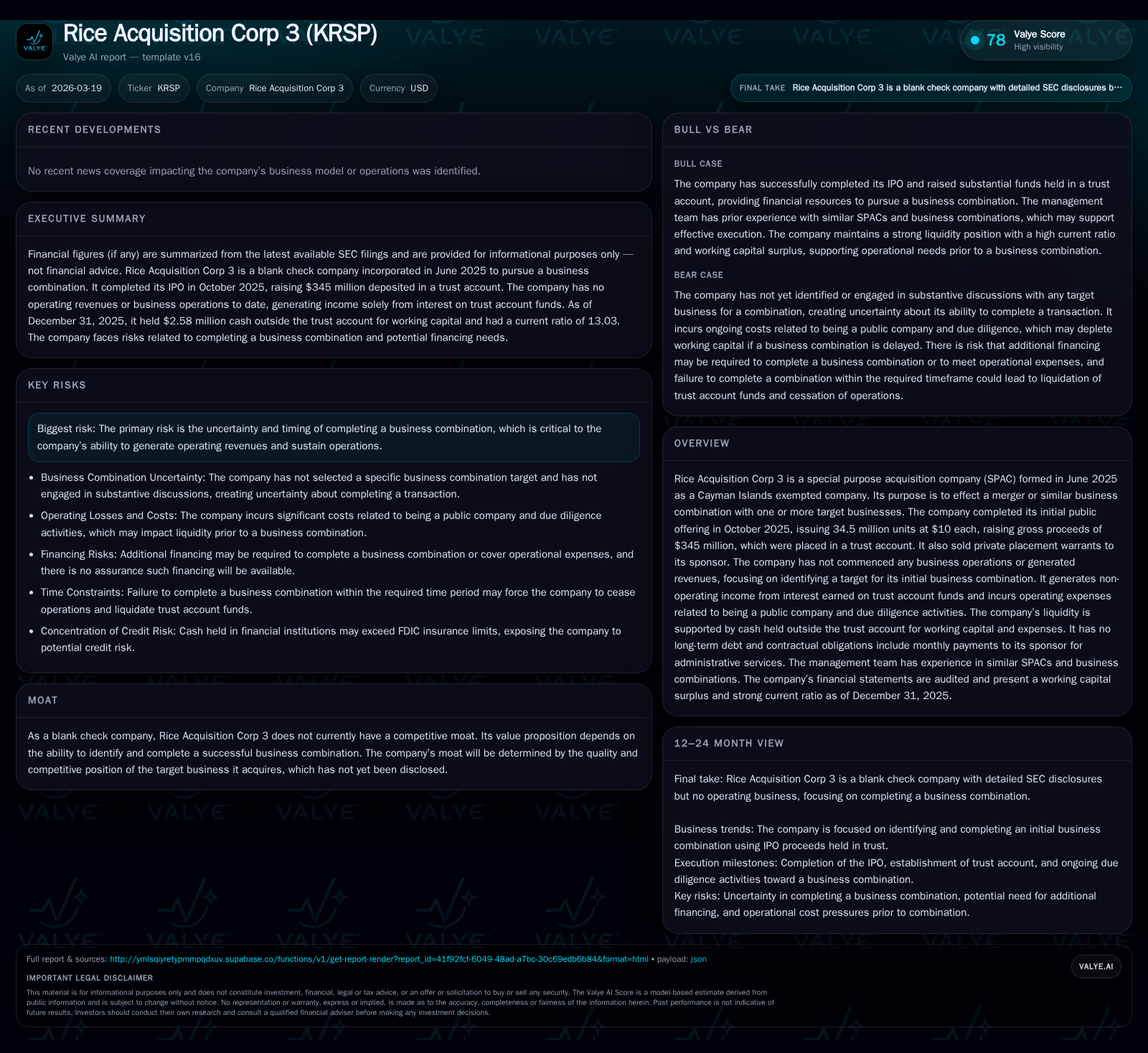
Rice Acquisition Corp 3, a Cayman Islands-based SPAC formed in mid-2025, raised $345 million through its October IPO placing funds in a trust account earmarked to facilitate its initial business combination. To date, the company has no operating revenues, generating only interest income on trust assets while incurring public company and due diligence expenses. Its capital structure includes sponsor private placement warrants and working capital managed outside the trust with high liquidity but carries risks linked to the timing and success of executing its inaugural transaction. Future growth hinges entirely on the quality and competitive positioning of the yet-undisclosed target business.
From Inception to IPO: Tracing Rice Acquisition Corp 3's Initial Financial Trajectory
Rice Acquisition Corp 3 (KRSP) was established as a Cayman Islands exempted company on June 6, 2025, explicitly created as a special purpose acquisition company (SPAC) aimed at executing a merger or similar transaction with one or more target businesses [S1]. Its financing was anchored by an initial public offering (IPO) completed on October 2, 2025, which issued 34.5 million units priced at $10 per unit, including full exercise of the underwriters' over-allotment option, generating gross proceeds of $345 million. These gross proceeds were deposited into an interest-bearing trust account dedicated exclusively for funding its future business combination [S1], [F1].
During the inaugural period from inception through December 31, 2025, KRSP did not engage in any operating activities beyond organizational matters and preparation for business combination transactions. Consequently, there were no operating revenues recorded [S1]. The company realized non-operating income primarily from interest earned on marketable securities within the trust account amounting to approximately $3.4 million, offset by operating expenses related to legal compliance, accounting, auditing, and due diligence activities amounting to roughly $548 thousand. The resulting net income was approximately $2.74 million for this initial fiscal period despite negative operating income reflecting these pre-revenue costs [F1].
Operational Snapshot: Non-Operating Income and Expense Dynamics Pre-Merger
KRSP’s operations currently revolve around managing cash in its trust account and incurring expenses tied primarily to maintaining public company status and sourcing acquisition targets [S1]. Interest rates on trust deposits dictate the yield on these idle funds; while modest, this generates predictable non-operating income crucial for covering administrative costs without capital erosion.
The SPAC environment inherently incurs 'due diligence cost pressures'—expenses linked to thoroughly evaluating potential merger candidates—to mitigate deal-related execution risks [S1]. These costs represent a significant share of operating expenses prior to deal consummation.
Capital Structure and Liquidity: Trust Account Mechanics and Sponsor Support
The IPO proceeds placed in KRSP's trust account totaled $345 million, inclusive of deferred underwriting fees capped at over $13 million payable upon completion of the initial business combination [S1], [S6]. This trust fund is held in highly liquid interest-bearing deposit accounts designed to safeguard investor capital until deployed.
Outside of the trust account lies working capital totaling approximately $2.58 million at year-end 2025 intended for operational use such as travel for target evaluation or legal expenditures related to deal closure preparations [S1], [F1]. This liquidity provides substantial runway for pursuit activities pending a successful transaction.
Sponsor involvement extends beyond equity participation; it purchased private placement warrants at $1 each totaling over $10 million, conferring rights to purchase additional shares post-combination—aligning sponsor incentives with shareholder value creation [S1], [S17]. Additionally, short-term promissory notes granted by the sponsor were present during early formation but were fully repaid before year-end, leaving no debt on books at that date [S4], [S5].
Administrative services agreement obligations impose monthly payments approximating $20 thousand payable to the sponsor for shared services until deal completion [S6], [S13]. This arrangement exemplifies typical SPAC cost structures facilitating lean operation pre-merger.
Risks and Business Combination Uncertainties Defining the Road Ahead
As is common with SPACs like KRSP, the primary risk remains contingent upon identifying and successfully consummating a qualifying business combination within prescribed timelines—typically around two years post-IPO—failure of which mandates liquidation and return of funds to public shareholders less fees paid [S1], [S3], [S15], [S17], [S25].
Additional execution risks include regulatory compliance costs associated with SEC scrutiny surrounding de-SPAC transactions and potential tax liabilities arising from interest earned within the trust account.
Capital call risk arises if due diligence or transaction closing expenses exceed estimates necessitating additional financing via equity issuance or loans from sponsors or affiliates—a contingency mechanism given limited third-party debt availability in SPAC structures [S8], [S22].
Shareholder redemption rights post-announcement introduce valuation uncertainty that can influence deal terms or financing structures further complicating smooth transaction closure.
Growth Prospects Tied to Target Selection and Market Context
KRSP’s future growth prospects are intrinsically linked to the caliber of its unidentified acquisition targets. The SPAC itself does not generate organic revenue; its value proposition is predicated on executing one or more combinations acquiring businesses with sustainable competitive advantages capable of delivering returns exceeding public market valuations post-merger.
While KRSP has not disclosed any active negotiations nor specified target sectors or geography as of December 31, 2025 [S23], growth ultimately depends on market conditions conducive to attractive valuations and robust strategic fit enhancing scalability or innovation potential.
This makes investment outcomes fluid and contingent strictly upon management's identification and effective integration of suitable opportunities—a hallmark risk/reward paradigm across SPAC vehicles.
Capital Allocation Intentions Amid SPAC Lifecycle Realities
The bulk of IPO proceeds remain secured in the trust account pending deployment towards an initial business combination constituting at least 80% of net assets therein post-expenses excluding redemptions per organizational charter terms [S19], [S21], [S27].
Interest generated on trust funds is partially available under defined 'permitted withdrawals' capped annually at five percent of earned interest after taxation for use in working capital requirements including administrative costs prior to combination closure but does not dissipate principal resources reserved for transaction financing.
Dividends or share repurchases are non-existent pre-deal by design owing to absence of operating cash flow generation capabilities. Sponsor incentive alignment occurs through equity-linked instruments such as deferred underwriting commissions payable upon business combination closing and warrant-based compensation fostering commitment towards value accretive combinations [S19], [F1].
Should additional capital calls prove necessary due to underestimated transaction costs or shareholder redemption volumes surpassing expectations, sponsors retain options including convertible working capital loans exercisable into warrants mirroring private placements providing flexible albeit dilutive financing alternatives.
Key Metrics Table: Financial Position at IPO Close and Working Capital
Historical performance (annual)
| FY |
|---|
| 2025 |
Source: SEC companyfacts cache [F1].
This snapshot encapsulates KRSP’s financial posture as of fiscal year-end December 31, 2025. Robust current ratio underscores sufficient liquidity outside the trust for ongoing operational needs despite nascent losses ahead of deal closure. The negative ROE signals early-stage expenditure-driven returns typical among newly formed blank check companies prior to revenue generation from completed acquisitions [F1].
Monitoring Triggers: Milestones and Events Investors Should Watch
Going forward, observers should prioritize tracking key events including:
- Deadline for consummation of an initial business combination stipulated by governing documents (typically two years from IPO).
- Timing and scale of public shareholder redemptions which can subtract from available cash for deal financing.
- Execution or conversion activity related to private placement warrants affecting dilution dynamics post-merger.
- Payment schedules pertaining to deferred underwriting commissions impacting net proceeds realized upon transaction closure.
- Any announcements regarding selected target companies signaling transition out of pre-combination phase.
- Potential requests by sponsors or affiliates for working capital loans hinting at escalating due diligence or negotiation expenses exceeding budget assumptions.
These milestones will collectively influence liquidity availability, valuation parameters, regulatory filings cadence, and eventual shareholder value realization linked directly to KRSP’s ability to pivot successfully from financial standby mode toward active operational status following its first merger.
This report synthesizes publicly available SEC filings up through March 19, 2026 without providing investment advice or forecasts beyond stated disclosures. All financial metrics relate strictly to documented historical data without projection assumptions. Please refer directly to source documents cited herein for definitive detail.
Disclaimer: This is research-only, informational analysis and not investment advice. It may include AI-generated interpretation and general industry context. Always verify important details using primary sources.

Comments