
ARGENX’s Surge to Profitability Behind VYVGART’s Commercial Ramp
ARGENX transformed from a development-focused biopharma into a profitable commercial-stage company driven by VYVGART's success and robust financial discipline.
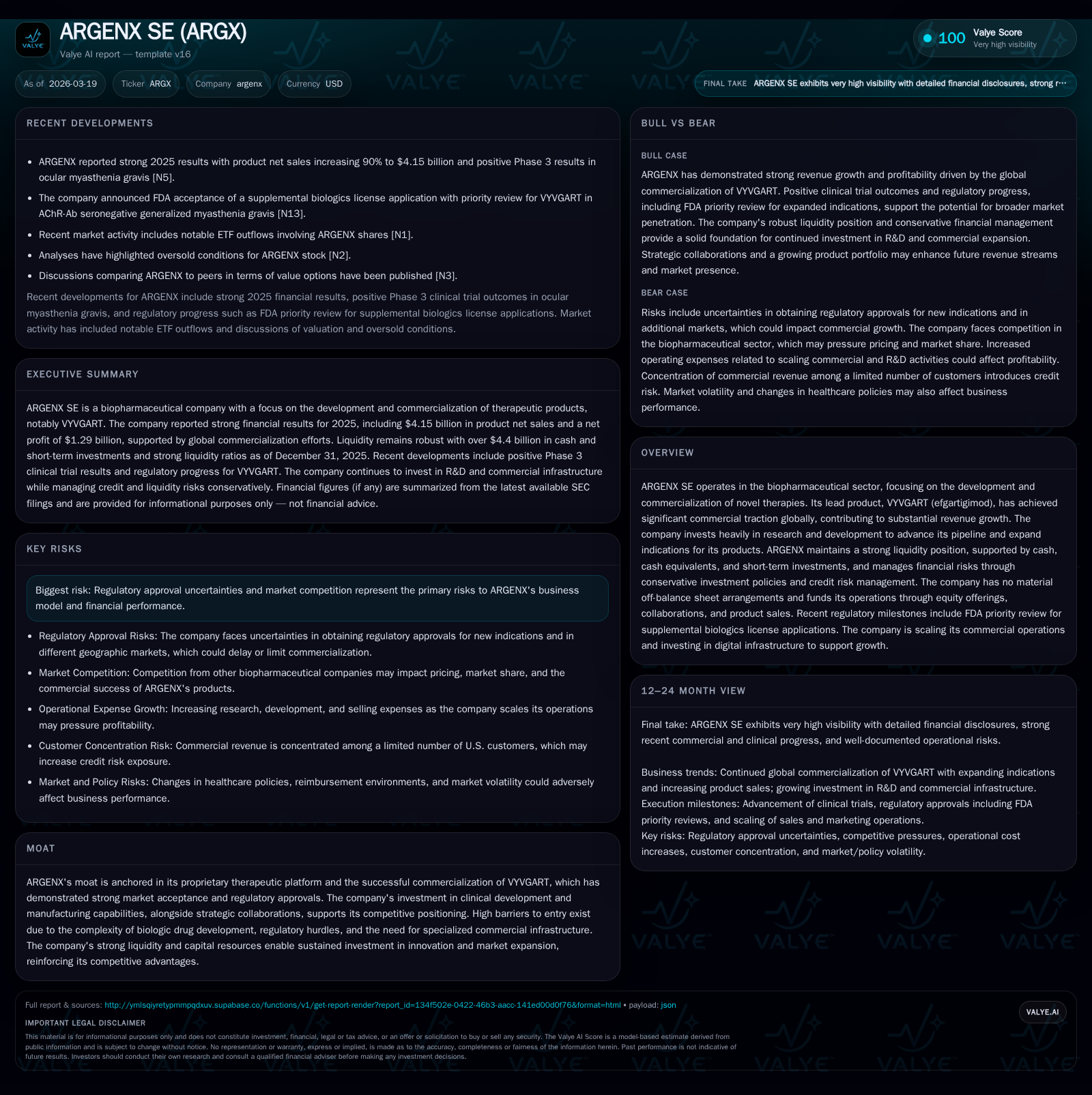
ARGENX SE has achieved remarkable financial turnaround with a 90% surge in product net sales in 2025, led by its flagship therapy VYVGART. The company shifted from operating losses to generating over $1 billion in operating profit, backed by global expansion and new disease indications. Elevated R&D investment sustains pipeline maturation while strong liquidity and capital management underpin growth strategies. Regulatory milestones and competitive pressures remain critical watchpoints as ARGENX scales its commercial infrastructure toward long-term sustainable returns.
From Development Heavyweight to Commercial Winner: Historical Growth Trajectory
ARGENX’s financial evolution over recent years epitomizes a successful transition from an R&D-heavy biotech to a commercial-stage profit generator. The company reported product net sales of approximately $4.15 billion for the year ended December 31, 2025, representing an impressive 90% increase from $2.19 billion in 2024 [F1][S1]. This sharp top-line growth derives principally from the accelerated global commercialization of its lead product, VYVGART (efgartigimod), which has established strong market acceptance across multiple geographies.
The scaling of commercial operations — including distribution infrastructure buildup and marketing efforts — contributed significantly to the operating leverage effect witnessed in the year. Operating income turned positive at about $1.05 billion in 2025 versus an operating loss of $21.65 million in the prior year [S1], signaling efficiency gains from higher sales volume absorption of fixed costs. Concurrently, total operating expenses rose by approximately 40%, reflective of ongoing investments but outpaced by revenue expansion.
Other operating income also improved by 46% year-over-year to nearly $97 million, fueled largely by research tax incentives and strategic supply agreements like those with Zai Lab in Greater China [S1]. This enhanced income stream further supported bottom-line progression.
VYVGART’s Role in Revenue Expansion and Disease Indication Reach
The cornerstone behind ARGEx's commercial success has been VYVGART's introduction and approval across multiple autoimmune disease indications. Notably, the FDA granted priority review status for supplemental biologics license applications covering ocular myasthenia gravis — a critical recent regulatory milestone — which unlocks new patient segments and growth vectors [N1][S1]. The drug’s SC (subcutaneous) administration route aligns well with patient preferences for ease of use, reinforcing adoption.
Globally, ARGENX has executed a well-orchestrated launch strategy spanning the U.S., Europe, and select international markets. The company’s geographic sales mix improvements reflect penetration beyond early adopters into broader payor exchanges with high creditworthiness profiles mitigating collection risks [S4]. These factors combined have driven smoother market integration typical of leading biologics commercialization campaigns.
R&D Investment: Innovations Fueled Amid Rising Expenses
Elevated research and development spending underscores ARGENX’s commitment to sustaining innovation alongside its commercial pursuits. In 2025, R&D expenses increased by roughly 39% year-over-year to $1.36 billion [S1][S9][S11], primarily attributable to expanded clinical trial activities, contract manufacturing organization (CMO) engagements for chemistry, manufacturing, and controls (CMC), regulatory submissions, quality assurance (QA), pharmacovigilance functions, and post-approval studies.
Personnel-related costs grew as the internal R&D workforce expanded, encompassing scientists and clinical staff supporting pipeline programs [S9]. Engagement with specialized CROs (contract research organizations) is central to maintaining clinical program momentum across phases.
This investment trajectory is consistent with industry norms where pipeline de-risking through phase advancement is capital intensive but critical for future sustainable revenues beyond current products.
Pipeline Progress and Market Opportunity: Indicators for Future Growth
Beyond VYVGART revenues, ARGENX’s medium-term growth relies on advancing its broader pipeline portfolio. Recent positive Phase 3 clinical data for ocular myasthenia gravis reinforce confidence in indication expansion potential [N1][S2], showcasing successful pipeline de-risking through pivotal clinical readouts.
Further FDA reviews are anticipated on additional assets within the late-stage development funnel [S2]. These developments create meaningful catalysts that could diversify revenue bases while leveraging existing manufacturing and commercial infrastructure — an efficiency multiplier common in best-in-class biopharma franchises.
Given the uncertain timelines inherent to drug development, monitoring upcoming milestones such as regulatory filings or trial initiations provides valuable directional clarity .
Navigating Regulatory Milestones and Competitive Risks
Key risks center on regulatory approval uncertainties as well as pricing and reimbursement challenges prevalent throughout the biopharmaceutical industry [S15][S16][N4]. While VYVGART has gained broad acceptance so far, emerging competitors targeting similar autoimmune pathways could pressure market share or pricing power.
Moreover, recent ETF outflows impacting ARGENX emphasize investor sensitivity to short-term volatility despite solid fundamentals [N4]. Regulatory headwinds or delays remain possible given evolving FDA requirements — requiring continued diligence in compliance and clinical trial management.
ARGENX’s high barriers to entry include complex biologic development know-how plus specialized commercial infrastructure investments that jointly function as moat elements supporting competitive positioning .
Capital Strength and Allocation: Balancing Growth with Financial Discipline
Financially well-capitalized, ARGEX held cash and cash equivalents totaling $3.5 billion alongside current financial assets near $0.9 billion as of December 31, 2025 [F1][S4]. Total equity stood robust at approximately $7.3 billion, reflecting multiple successful equity raise initiatives over time amounting to gross proceeds upwards of $5.9 billion since inception [S6].
The company maintains a conservative cash investment policy focused on capital preservation via AAA- or A-rated money market funds plus highly rated banking institutions — limiting credit risk exposure even amid geopolitical uncertainties [S5][S8].
Absence of debt instruments underscores balance sheet strength while no dividends or buyback programs have been initiated to date; capital allocation favors reinvestment into R&D pipeline advancement and commercial scaling efforts rather than shareholder distributions [S20]. This approach aligns with growth-stage biopharma norms prioritizing long-run value creation.
Cash Flows and Profitability: From Operations Toward Sustainable Returns
A hallmark achievement emerges from ARGENX’s shift to positive net cash flow from operating activities starting fully in 2025 — an inflection validating the scalability of its commercial model following years of negative operational cash flow related to heavy pipeline investment [S1][F1][S10].
Comparing annual periods shows an approximate $800 million increase in CFO attributable primarily to rising product net sales partially offset by working capital buildup linked to inventory stocking ahead of market demand peaks [S10]. Such positive operational cash generation represents a core buy-side metric signaling durable earnings power capability absent reliance on external financing.
Capital expenditure remains moderate relative to revenue scale, reflecting outsourcing strategies for manufacturing coupled with disciplined facility investments adaptable to evolving pipeline needs [S9][S11].
Key Metrics Recap: Understanding ARGENX's Return Profile and Liquidity Position
Historical performance (annual)
| FY |
|---|
| 2025 |
| 2024 |
| 2023 |
| 2022 |
Source: SEC companyfacts cache [F1].
Note: CFO numeric not tabulated due to reporting format restrictions; nonetheless positive net cash flow confirmed in narrative [F1][S10]. Figures rounded for presentation clarity.
Liquidity metrics highlight a current ratio exceeding five times at year-end reflecting substantial working capital cushion underpinning short-term obligations coverage comfortably beyond one year tenure [F1]. Despite elevated R&D spend compressing immediate returns metrics like ROE—which approximates negative due to earlier net losses—the swing into overall profitability augurs improving trajectory aligned with biotech commercialization lifecycle realities.
This analysis relies strictly on reported financials per company filings through March 2026 together with publicly available regulatory news releases. Forward-looking commentary focuses solely on documented guidance and observed milestones without conjecture beyond evidentiary support. Readers should consult official disclosures for formal investment decision-making contexts.
Disclaimer: This is research-only, informational analysis and not investment advice. It may include AI-generated interpretation and general industry context. Always verify important details using primary sources.

Comments