
Auburn National Bancorporation’s Steady Earnings Climb and Local Market Challenges
The bank's financial performance reflects solid net interest income growth amid a concentrated East Alabama economy with inherent credit risks.
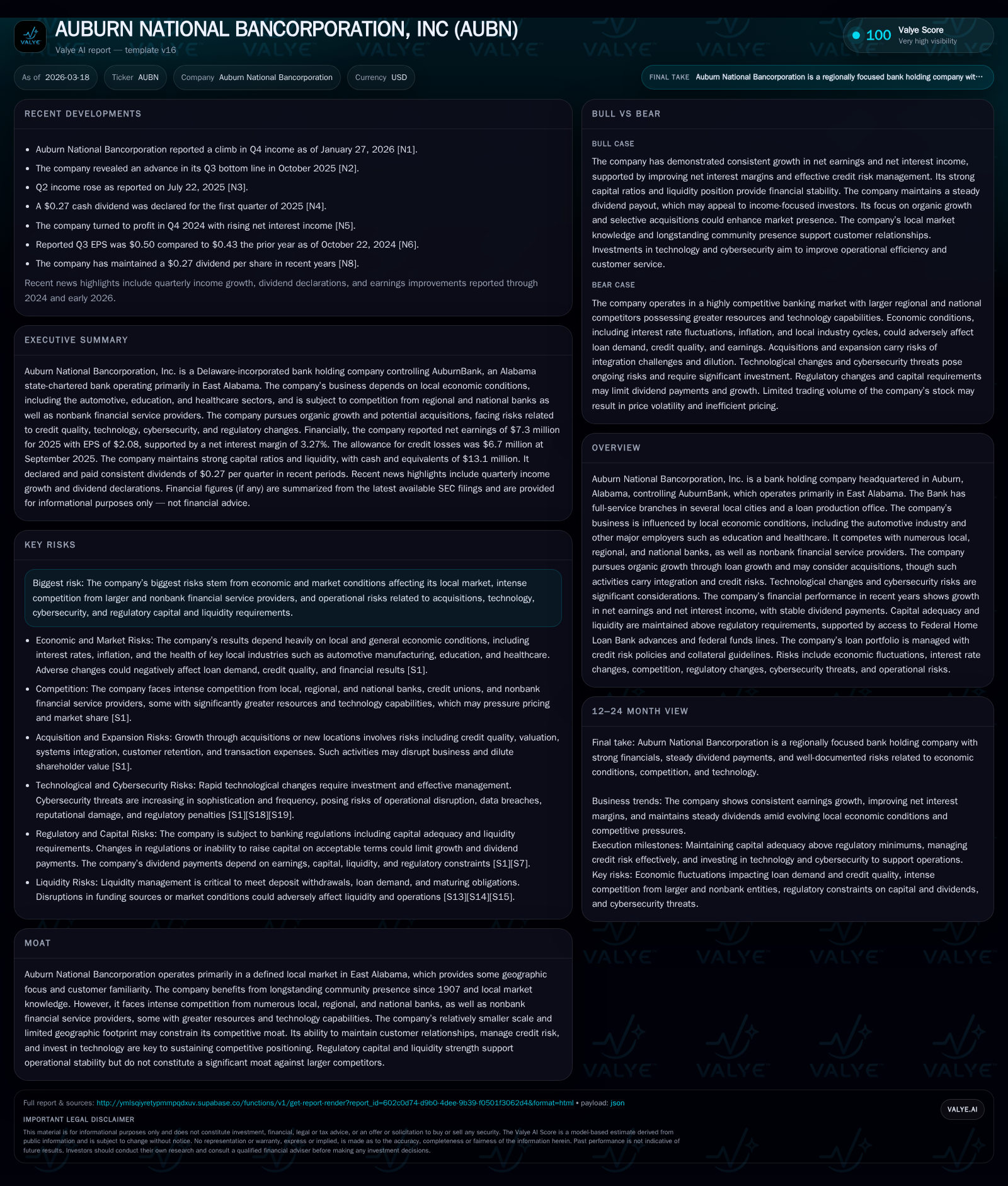
Auburn National Bancorporation, Inc. achieved a notable 13.4% increase in net income in 2025, propelled by a 9% rise in net interest income and margin expansion from 3.06% to 3.27% (tax-equivalent basis). This organic earnings growth is supported by steady loan portfolio increases within a localized geographic footprint dominated by automotive manufacturing, education, and healthcare sectors. However, a significant jump in credit loss provisions signals emerging risks tied to economic uncertainties and individual loan issues, emphasizing the cyclical sensitivity of its market. Capital ratios remain robust well above regulatory minimums, undergirding dividend stability and recent authorization of a $5 million share repurchase program. Investors should track future net interest margin resilience, credit loss trends, and the firm's ability to balance technology investments against competitive pressures.
Strong Earnings Trajectory Anchored by Net Interest Income Expansion
Auburn National Bancorporation reported a robust improvement in net earnings in fiscal year 2025, achieving $7.255 million compared to $6.397 million in 2024 — an increase of approximately 13.4% [F1][S1]. This performance gain was largely fueled by a 9% boost in tax-equivalent net interest income which rose from $27.2 million to $29.7 million over the same period [S1]. The bank’s net interest margin expanded notably from 3.06% in 2024 to 3.27% in 2025 on a tax-equivalent basis, reflecting effective repricing of interest-earning assets with yields increasing from around 5.23%-5.50% [S1][S11], alongside declining cost of interest-bearing deposits [S1]. Interest earning assets grew modestly by about 2%, complementing margin expansion [S1].
Some offset occurred due to a dip in noninterest income ($3.12 million versus $3.47 million), attributable primarily to waning residential mortgage lending revenues amid broader market softness [S1]. Operating expenses edged higher to $22.95 million from $22.17 million year-over-year, mostly driven by salary and benefits inflation reflecting tight local labor markets [S1]. The effective tax rate lowered slightly from ~23.8% to ~21.2%, benefiting from municipal securities income and favorable provisions [S1].
Local Economy’s Role in Shaping Loan Portfolio Risks and Opportunities
The bank’s core operational footprint remains concentrated in East Alabama around AuburnBank’s branch network [S1][S20]. Local economic conditions deeply influence loan demand and credit quality given limited geographic diversification.
Regional dynamics are significantly impacted by the adjacent automotive manufacturing cluster including suppliers operating within Lee County; these sectors are subject to cyclical swings related to inflationary pressures, Federal Reserve rate changes, tariffs, global trade uncertainties, and consumer spending patterns impacting auto sales [S20]. Additionally, substantial employment stems from education institutions and healthcare providers—areas vulnerable to potential federal policy shifts affecting funding flows or student loan availability [S20].
This reliance on a few major industries adds cyclicality; downturns affect borrowers’ cash flows which directly translate into increased credit risk for AuburnBank’s commercial real estate and consumer portfolios [S20][S11]. Competition for loans includes regional banks with larger balance sheets as well as national lenders and nonbank financial providers capable of delivering technologically advanced customer experiences [S20].
Credit Loss Trends Reflecting Macro Influences and CECL Methodology
A notable development in the full-year results was the material increase in provision for credit losses from $36 thousand in 2024 to $631 thousand in 2025 [S1][F1]. This spike was principally driven by two specific problem loans that were individually evaluated: one fully reserved against while another partially charged off [S1]. The allowance for credit losses correspondingly increased modestly to $7.2 million or roughly 1.27% of total loans at year-end from $6.9 million (1.22%) previously [S1].
The bank applies the Current Expected Credit Losses (CECL) standard extensively using forward-looking macroeconomic indicators including Alabama unemployment rates, commercial real estate price indices, home price trends, and state GDP projections provided by third-party data sources [S1][S10]. These factors embed substantial model uncertainty especially because CECL has not yet been tested over severe economic downturn cycles [S10]. Given ongoing inflation uncertainties, federal monetary policy adjustments, and regional economic vulnerabilities tied to automotive supply chain challenges, provisions remain sensitive.
Organic Growth Strategy: Navigating Competition and Technological Demands
Auburn National Bancorporation prioritizes organic growth primarily through expanding its loan book supported by deep-rooted local relationships dating back over a century [S2][N/A company meta overview]. The relatively compact footprint minimizes direct geographic diversity but supports customer familiarity.
The firm continues to evaluate acquisition targets — whether banks or branches — although management recognizes significant risks associated with integration complexity, cultural alignment, credit quality variation, pricing competition intensified by better-capitalized institutions including credit unions and fintech entities [S20][N/A company meta overview]. Larger competitors enjoy scale advantages especially around technology investments needed for products like mobile banking apps or real-time payment solutions that attract younger demographics.
Technology investments represent an ongoing imperative for AuburnBank but are challenged by scale constraints limiting its capacity compared with regional/national rivals investing hundreds of millions annually on digital infrastructure [N/A company meta overview]. Cybersecurity also demands attention given rising threats across banking platforms.
Capital Adequacy and Regulatory Compliance as Pillars of Stability
Capital strength remains a key pillar underpinning Auburn National Bancorporation's financial stability through economic cycles.
At December 31, 2025, the bank reported total risk-based capital ratio at a solid 17.14%, well above Basel III "well-capitalized" minimums; tier 1 leverage ratio stood at approximately 10.71%, while CET1 capital ratio was computed at about 16.06% [S1][F1][S7][S8][S13]. These buffers facilitate continued safe operations alongside regulatory compliance amid fluctuating profitability cycles.
Unrealized losses on securities impacted accumulated other comprehensive income (AOCI) reducing reported equity temporarily but did not threaten solvency given high-quality asset portfolios [S1][S8]. Deposit growth continued without major reliance on FHLB advances or discount window borrowings at year-end; liquidity lines exceed hundreds of millions providing further funding flexibility if required [S4][S5][S8].[Footnote: Deposits insured or collateralized form a large portion sustaining liquidity access.]
Capital Allocation Review: Dividends, Buybacks, and Investment Priorities
Management sustains meaningful dividends consistently—paying $1.08 per share annually during both 2024 and 2025 years—reflecting stable free cash flow generation (~$10.86 million) after capital expenditures of approximately $1.48 million mostly targeted at technology improvements [F1][S15].
Buyback activity has been minimal recently; no shares repurchased during calendar year 2024 though a new repurchase authorization up to $5 million exists through early-2027 aiming for opportunistic share returns without compromising capital adequacy or liquidity profiles [S3][F1].
Return on equity stands near ~7.9%, modest but consistent with community banking peers facing similar competitive dynamics [F1]. Given constrained scale effects alongside rising investments into digital capabilities required for competitive parity, capital allocation appears conservatively balanced between shareholder returns and growth imperatives.
Key Metrics Outlook: What Investors Should Monitor Moving Forward
(Analysis) In absence of explicit guidance on future financial targets beyond disclosed milestones, several operational metrics merit attention going forward:
- Net Interest Margin Sensitivity: With the Federal Reserve pivoting monetary policy downwards from peak fund rates (~5.25-5.50%) toward lower ranges (approximately 3.75-4%), deposit costs could fluctuate materially impacting margins depending on repricing velocities between asset yields versus funding costs [S22].
- Credit Provision Volatility: Watch how provisioning evolves as CECL models recalibrate against macroeconomic changes such as Alabama unemployment levels or real estate market health; further upticks may point toward stress within commercial real estate or construction portfolios currently sizable portions (~58% CRE exposure) [S11].
- Loan Growth Pace: Given localized economy basis heavily influenced by automotive sector cycles plus education/healthcare budgets potentially affected by federal policy changes, overall demand acceleration or contraction will affect asset base expansion outcomes [N/A Company meta overview].
- Competitive Positioning: Advances or setbacks in technology deployments including online/mobile platforms will impact ability to retain grassroots customers while fending off well-resourced competitors offering frictionless digital onboarding or alternative financing products.
- Capital Deployment Discipline: Continued balancing act among dividends consistency versus opportunistic buybacks or strategic acquisitions remains critical especially under uncertain industry consolidation trends.
Historical performance (annual)
| FY | Net ($mm) | CFO ($mm) | Capex ($mm) | Net YoY |
|---|---|---|---|---|
| 2025 | 7 | 12 | 1 | +13.4% |
| 2024 | 6 | 11 | 2 | +358.6% |
| 2023 | 1 | 12 | 0 | -86.5% |
| 2022 | 10 | 11 | 7 |
Source: SEC companyfacts cache [F1].
Capital returns and efficiency (annual)
| FY | Buybacks ($) | FCF ($mm) | ROE% |
|---|---|---|---|
| 2025 | 11 | 7.9 | |
| 2024 | 0 | 9 | 8.2 |
| 2023 | 229000 | 11 | 1.8 |
| 2022 | 504000 | 4 | 15.2 |
Source: SEC companyfacts cache [F1].
Table notes: Financials reflect full-year periods ending December 31 as sourced directly from SEC filings and companyfacts database [F1].[F1]
This analysis incorporates only publicly available information extracted from SEC filings through March 17 2026 without forecasting beyond stated data points except where expressly noted as analysis based on current industry context. Readers should consider evolving macroeconomic developments affecting the East Alabama region along with changing Federal Reserve policies shaping interest rate landscapes over time. Auburn National Bancorporation's niche focus combined with cautious capital strategies contribute to resilience but also present limitations against larger multi-regional competitors wielding extensive technological capabilities. As such the firm’s challenge remains optimizing organic expansion while managing credit risk prudently amid dynamic local economic cycles.
Disclaimer: This memorandum is prepared solely for informational purposes based on historical reported data without making any investment recommendation or prediction regarding future performance.
Disclaimer: This is research-only, informational analysis and not investment advice. It may include AI-generated interpretation and general industry context. Always verify important details using primary sources.

Comments