
Oragenics Advances ONP-002 Amid Persistent Financial Headwinds
Oragenics pushes forward with its neurological therapeutic candidate ONP-002 despite ongoing financial constraints and going concern risks.
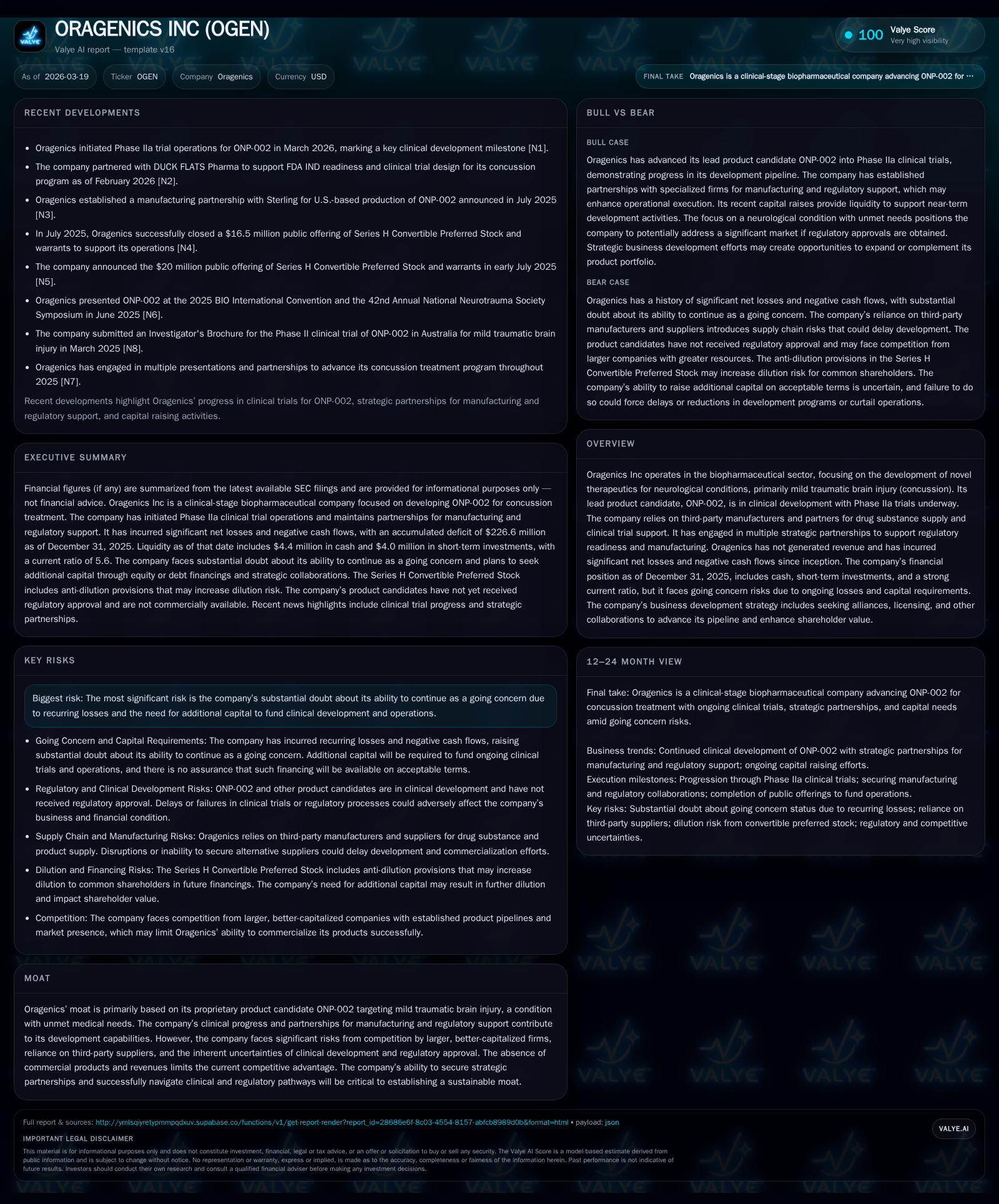
Oragenics Inc focuses on developing ONP-002, a novel treatment for mild traumatic brain injury, currently progressing through Phase IIa trials. The company has yet to generate revenue and continues to report significant net losses, with a narrowing trend in operating deficits. Its financial position shows decent liquidity but is overshadowed by substantial cash burn and capital raising dependence. Key upcoming milestones include clinical trial progress and potential strategic partnerships critical for sustaining operations amid regulatory and competitive uncertainties.
Emerging as a Contender: Oragenics’ Historical Growth and R&D Investment
Oragenics Inc’s financial history reflects the typical trajectory of an early-stage biopharmaceutical developer without commercialized products. It has consistently operated at a loss since inception, with no recorded revenues for years leading up to and including 2025. The latest full fiscal year data from 2025 indicates an operating loss of approximately $9.36 million, slightly narrower than the $10.56 million loss reported in 2024, marking an 11.3% improvement year-over-year [F1]. Correspondingly, net losses decreased by about 6.9% from roughly $10.57 million in 2024 to $9.84 million in 2025.
Operating cash flows have remained negative, reflecting continued investment in research activities without offsetting cash inflows; CFO ran at -$9.25 million for 2025 compared to -$8.60 million in 2024, signifying a higher use of cash by nearly 7.5% [F1]. Capital expenditures have been negligible recently, underscoring the company’s reliance on outsourced manufacturing rather than capital-intensive assets.
Crucially, the company’s R&D spending shifted focus over this period toward ONP-002 advancement for mild traumatic brain injury (mTBI). R&D expenses decreased to about $2.4 million in 2025 from higher levels the prior year after suspension of other vaccine and antibiotic programs [S5][S6]. This concentration aligns with Oragenics' strategic pivot to neurologic therapeutics following earlier program wind-downs.
Historical performance (annual)
| FY | Net ($mm) | CFO ($mm) | OpInc ($mm) | Capex ($) | Net YoY |
|---|---|---|---|---|---|
| 2025 | -10 | -9 | -9 | +6.9% | |
| 2024 | -11 | -9 | -11 | +48.8% | |
| 2023 | -21 | -7 | -21 | 127519 | -44.6% |
| 2022 | -14 | -15 | -14 | 127519 |
Source: SEC companyfacts cache [F1].
Capital returns and efficiency (annual)
| FY | FCF ($mm) | ROE% |
|---|---|---|
| 2025 | -118.9 | |
| 2024 | 4987.6 | |
| 2023 | -7 | -652.0 |
| 2022 | -15 | -109.8 |
Source: SEC companyfacts cache [F1].
Table: Oragenics Selected Historical Financials (USD) per latest filings [F1]
Clinical Progress and Strategic Partnerships Fuel Product Development
Oragenics’ lead candidate ONP-002 represents the core growth avenue amid its biopharmaceutical portfolio repositioning toward neurology-focused therapies targeting concussion or mild traumatic brain injury — a substantial unmet medical need characterized by limited existing pharmacologic options.
In March 2026, Oragenics publicly announced the initiation of Phase IIa trial operations for ONP-002, marking a critical clinical milestone intended to evaluate safety and efficacy under controlled conditions [N1]. Complementing these efforts is the partnership formed with DUCK FLATS Pharma aimed at FDA IND readiness support alongside clinical trial design consultation—key components enhancing regulatory preparedness essential for advancing through clinical phases expediently [N2].
Manufacturing capacities remain outsourced to third-party suppliers specialized in synthetic chemistry processes necessary for drug substance production of ONP-002; such arrangements are common within niche neurology biotech sectors lacking internal manufacturing scale-ups [S12]. However, this dependency introduces operational risks linked to supply chain reliability and regulatory compliance responsibilities.
The company’s strategic shift away from previous lantibiotics and COVID-vaccine initiatives has allowed sharper focus on ONP-002’s progression, encompassing regulatory filings, scale-up manufacturing readiness, and consultant engagements related explicitly to neurology assets extraction [S5][S6]. Continued external collaborations underpin potential partnering or licensing deals expected post-clinical milestones.
Capital Structure and Liquidity: Analyzing Financial Health and Going Concern Factors
Despite improved operating loss margins, Oragenics’ balance sheet reflects substantial financial headwinds inherent to pre-commercial biopharma entities relying heavily on equity financing.
As of December 31, 2025, the company reported approximately $4.4 million in cash and equivalents alongside current assets totaling roughly $10 million against current liabilities near $1.8 million—a robust current ratio around 5.6 indicating short-term liquidity strength on paper [F1].
However, this liquidity buffer belies underlying strain stemming from a high burn rate (operating cash flow negative $9.2 million annually) juxtaposed with sizable accumulated deficits exceeding $226 million [S1][F1]. Furthermore, Oragenics triggered an audit opinion containing substantial doubt about its ability to continue as a going concern within one year post-report issuance—underscoring persistent capital raising imperatives to sustain operations beyond near-term horizons [S1].
Recent financing includes a July 2025 public offering closing at approximately $15 million net proceeds from issuing Series H Convertible Preferred Stock combined with warrants—capital raised primarily devoted to funding ONP-002 activities and repaying prior short-term promissory debt instruments issued during early 2025 [S18][S19]. Notably, this preferred stock incorporates anti-dilution provisions that permit reducing conversion prices upon future discounted offerings; such terms could markedly dilute common shareholders' interests if additional financings proceed at lower valuations [S2].
Debt remains minimal but includes short-term promissory notes carrying relatively high implicit interest rates (via original issue discount), which were fully repaid shortly after equity raises mitigated immediate creditor exposure [S18]. While currently manageable, these financial instruments emphasize reliance on external funding amid non-existent operating revenues.
Looking Ahead: Key Milestones and Upcoming Catalysts to Watch
Beyond the recent Phase IIa trial launch for ONP-002 disclosed in early March 2026, Oragenics’ pathway toward establishing viability depends heavily on subsequent clinical data readouts that could validate safety profiles or hint at therapeutic efficacy signals critical for attracting larger pharmaceutical partners or licensing agreements [N1][N2][S1].
Achieving IND approval through regulatory agencies following comprehensive data submission will dictate next development phases—including potential pivotal trials necessitating extensive capital expenditure.
Management emphasizes business development efforts targeting strategic alliances designed not only to bolster regulatory navigation but also augment commercialization capabilities long term; however specific timelines or revenue forecasts tied to these arrangements remain undisclosed currently—reflecting typical early-stage drug development flux requiring cautious interpretation pending empirical results [S1].
Market acceptance dynamics hinge substantially upon competitive positioning relative to incumbent therapies or biosimilar entrants that could erode market share or pricing power upon ONP-002 launch if approved; watch for patent enforcement successes and exclusivity negotiations shaping commercial defensibility later stages.
Navigating Risks: Regulatory Hurdles and Competitive Threats
The extensive regulatory landscape governing clinical trial protocols represents a formidable hurdle for Oragenics; delays or failures due to safety issues or suboptimal efficacy findings during any phase could stall or permanently terminate development programs impacting future prospects materially [S4][S14].
Manufacturing third-party dependencies inject additional risk vectors whereby supplier noncompliance or capacity constraints might disrupt material availability impeding trial continuity—a concern articulated explicitly by company disclosures highlighting their limited control over outsourced entities despite prior timely fulfillments [S12].
Competitive pressures emanate from larger pharmaceutical conglomerates possessing deeper pockets that can outspend or expedite product cycles along with emerging biosimilars exploiting abbreviated approval pathways creating pricing challenges affecting profitability prospects even post-commercialization [S7]. Intellectual property litigation risks loom as well given heavy patent activity within biotechnology sectors relevant here—litigation outcomes could impose costly settlements or constrain market opportunities unless aggressively defended [S11][S14].
Moreover, intricate healthcare laws including anti-kickback statutes and false claims regulations elevate compliance complexity threatening punitive consequences if violated inadvertently during commercialization phases or clinical engagement protocols underscoring operational vigilance necessities going forward [S14][S15].
Capital Allocation: Costs, Cashflows, and Shareholder Impacts
From a capital deployment perspective, Oragenics continues operating at negative returns relative to equity base exhibited by an approximate ROE near -119%, driven by ongoing net losses that marginally improve but remain substantial (net loss of nearly $9.8 million on equity around $8.3 million at end-2025) [F1]. Operating expenses overwhelmingly represent R&D investments targeted toward advancing ONP-002 development alongside necessary general & administrative costs including expanding investor relations efforts evidenced by increased spending related to patent protection and corporate legal services reflecting focus on intellectual asset defense and capital market interaction growth strategies [S6].
Free cash flow remains deeply negative after subtracting negligible capex from significant operating cash deficits estimated close to -$9.3 million annually signaling urgent continuous funding needs absent revenue inflows driven entirely by capital raises particularly equity issuances as debt utilization remains strategically low due to cost considerations concerning interest expense spikes encountered previously in favored promissory note structures now retired through equity infusion repayment cycles [F1][S18][S25].
The lack of dividends or share buybacks aligns with industry norms where reinvestment into clinical pipelines predominates until product commercialization viability emerges; however shareholder dilution risk is elevated owing partly to outstanding preferred stock anti-dilution clauses that could depress common stock value impairing new financing attractiveness should further down-round financings occur without resolution ahead [S2][F1].
Disclaimer: This analysis synthesizes information from SEC filings and public news releases as of March 19, 2026 regarding Oragenics Inc., aiming to provide an objective overview without offering investment advice.
Disclaimer: This is research-only, informational analysis and not investment advice. It may include AI-generated interpretation and general industry context. Always verify important details using primary sources.

Comments