
Atara Biotherapeutics' Path From Pioneering Immunotherapy to Commercial Viability
Examining Atara's transition to profitability through its novel allogeneic T-cell platform amid regulatory and liquidity headwinds.
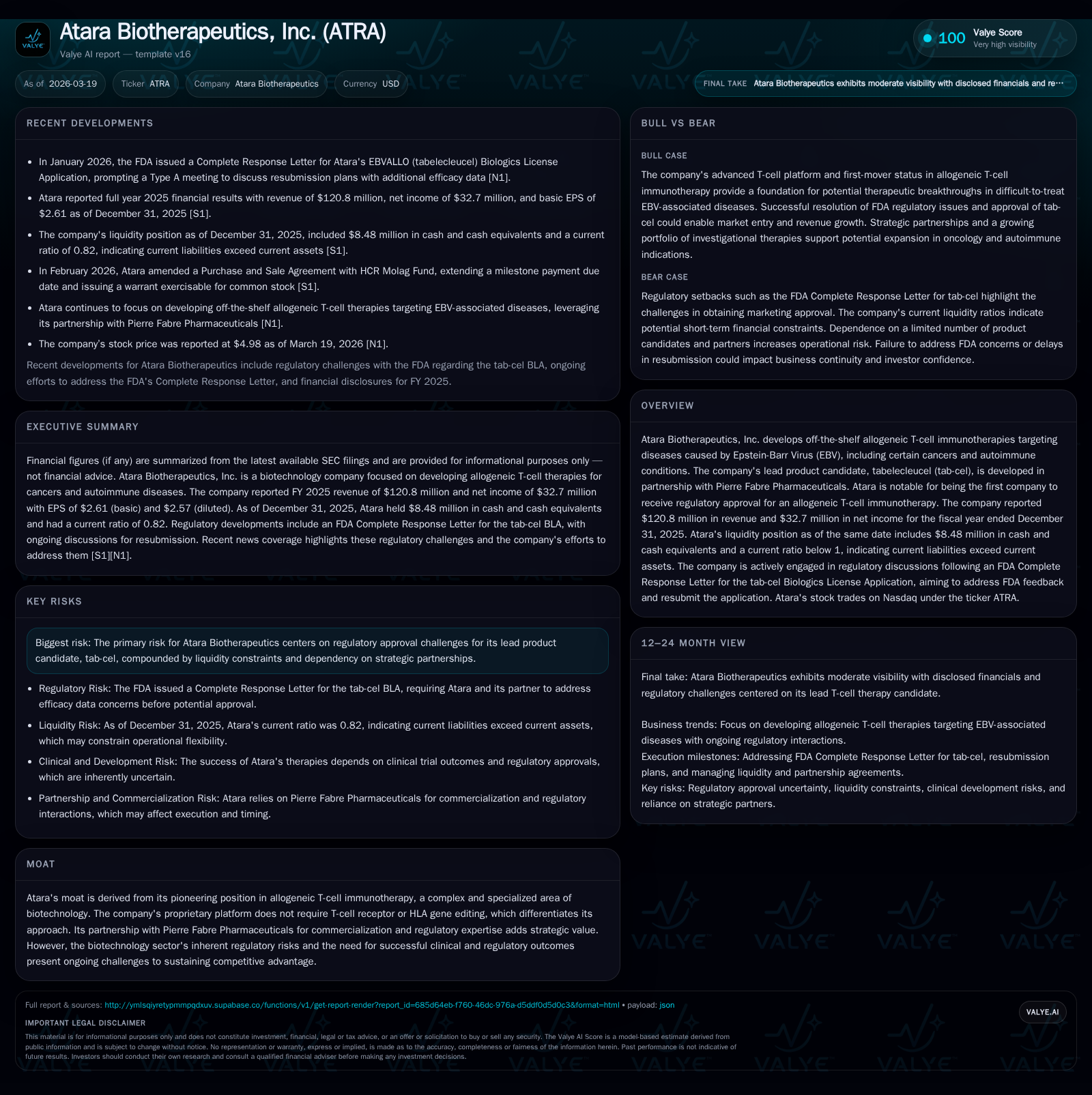
Atara Biotherapeutics, the first company to secure regulatory approval for an allogeneic T-cell immunotherapy, achieved a notable financial turnaround in FY2025 with positive net income of $32.7 million despite a slight decline in revenue. Its proprietary off-the-shelf platform avoids complex gene editing, enabling a strategic partnership with Pierre Fabre Pharmaceuticals. However, regulatory challenges persist following an FDA Complete Response Letter for its lead candidate, tab-cel, and liquidity constraints underscore ongoing risks. The company’s path forward hinges on successful FDA interactions and continued collaboration with its commercial partner.
From Heavy Losses to Positive Income: Historical Financial Trajectory
Atara Biotherapeutics has demonstrated a striking financial evolution over the last four fiscal years culminating in its profitable performance in 2025. While revenue slipped marginally by 6.3% YoY from $128.9 million in FY2024 to $120.8 million in FY2025, operating income swung dramatically from an operating loss of $83.4 million to a positive $35.9 million within the same period, underscoring substantive operational leverage gains and possible improvements in cost structure or revenue mix [F1].
Net income mirrored that trajectory, converting an $85.4 million loss in FY2024 into a $32.7 million net profit by year-end 2025—a reversal exceeding 138% growth on this metric year-over-year [F1]. Despite accounting profitability, the firm continued generating negative operating cash flow—improving but still a hefty -$50.9 million—indicative of ongoing cash demands possibly driven by clinical trial investments or receivables timing differences rather than expense overruns alone [F1]. Capital expenditures contracted sharply to zero dollars in FY2025 from minor spend previously, suggesting a shift towards controlling discretionary outlays during this critical inflection phase.
Historical performance (annual)
| FY | Rev ($mm) | Net ($mm) | CFO ($mm) | OpInc ($mm) | Rev YoY | Net YoY |
|---|---|---|---|---|---|---|
| 2025 | 121 | 33 | -51 | 36 | -6.3% | +138.3% |
| 2024 | 129 | -85 | -69 | -83 | +69.1% | |
| 2023 | -276 | -193 | -276 | -20.9% | ||
| 2022 | -228 | -270 | -281 |
Source: SEC companyfacts cache [F1].
Capital returns and efficiency (annual)
| FY | FCF ($mm) | ROE% |
|---|---|---|
| 2025 | -51 | -84.9 |
| 2024 | -69 | 87.8 |
| 2023 | -194 | 278.3 |
| 2022 | -275 | -180.3 |
Source: SEC companyfacts cache [F1].
Table: Atara Biotherapeutics Historical Financial Summary (FY2022-FY2025) including revenues and key profitability metrics demonstrating the turnaround.
Understanding Atara’s Proprietary Allogeneic T-Cell Platform
Atara’s technological advantage lies in its pioneering off-the-shelf allogeneic T-cell immunotherapy platform targeting Epstein-Barr Virus (EBV)-associated diseases. This platform notably circumvents the need for T-cell receptor or human leukocyte antigen (HLA) gene editing—a complex step common among cell therapy developers—thereby enhancing feasibility at scale and simplifying manufacturing demands [S1]. This approach supports tolerance across HLA mismatches enabling broader patient applicability without intensive customization.
This technology aligns well with sector trends favoring scalable allogeneic products over autologous approaches requiring patient-specific cell harvesting and re-engineering cycles—typically costly and logistically onerous.
Key Drivers Behind FY2025 Financial Recovery
The leap from an operating loss of over $83 million in FY2024 to a profit of nearly $36 million in FY2025 reflects multiple factors including initial commercial traction with its lead candidate tabelecleucel (tab-cel), strategic cost management and advancement of partnerships notably with Pierre Fabre Pharmaceuticals [F1][S1].
While Atara’s revenue dipped slightly year-over-year possibly due to market access delays or inventory cycles related to regulatory developments on tab-cel’s approval process,[F1] fixed cost reductions or non-recurring expense reversals likely contributed substantially to turning EBITDA positive.
Pierre Fabre’s role extends beyond commercialization—it also includes regulatory expertise assisting Atara navigating complex accelerated approval pathways.
Current Regulatory Landscape and Implications of the FDA CRL on Tab-cel
Despite early achievements—including being the first to gain regulatory approval for allogeneic T-cell therapy globally—Atara faces renewed scrutiny by the FDA after a Complete Response Letter (CRL) issued on January 9th, 2026 concerning tab-cel’s Biologics License Application (BLA). The CRL requires submission of additional efficacy data before full approval can be granted [S12][S11].
Pierre Fabre has requested and secured a Type A meeting with FDA scheduled for Q2 2026 to discuss next steps collaboratively alongside Atara ensuring alignment on supplemental trial endpoints or real-world evidence collection plans [S12]. This dialogue is critical as it determines both resubmission timeline and prospects for accelerated approval essential to patient access timelines.
Failure to meet FDA expectations could delay U.S. market entry substantially leaving commercial momentum vulnerable despite initial European approvals.
Clinical Pipeline and Strategic Partnership with Pierre Fabre Pharmaceuticals
Beyond tab-cel—in particular targeting EBV-positive post-transplant lymphoproliferative disorder (PTLD)—Atara’s immunotherapy pipeline encompasses investigational therapies addressing other EBV-driven malignancies as well as autoimmune diseases evidencing versatile application scope of its off-the-shelf platform [S12].
This breadth amplifies clinical development synergy while providing diversified future growth vectors should tab-cel face prolonged approval timelines or competition risk.
The alliance with Pierre Fabre Pharmaceuticals serves not only commercial purposes but lends significant regulatory navigation firepower critical for complex biologic therapies entering crowded markets requiring nuanced stakeholder management.
Liquidity and Financial Health: Beyond the Headlines
As of December 31st, 2025 Atara reported $8.48 million in cash and equivalents against current liabilities totaling approximately $14.9 million resulting in a current ratio below unity at roughly 0.82—a sign of near-term liquidity pressure [F1][S16][S19]. Negative equity persisted at around -$38.5 million reflecting accumulated losses offsetting shareholder capital.
Operating cash flow remained negative in FY2025 at roughly -$51 million despite accounting profits emphasizing ongoing cash burn likely tied to working capital needs such as inventory buildup or receivable collection lags plus sustained R&D investments [F1]. Capital expenditure was nil over the period indicative of prudent management tightening discretionary spending aligned with cash preservation priorities.
No dividends or share repurchases have been declared consistent with investment-stage biotech norms where reinvestment into product development predominates over capital returns.
Milestones and Regulatory Expectations: What to Monitor Next
Market participants should focus attention on Q2 2026 when the scheduled Type A FDA meeting on tab-cel will clarify regaining momentum towards BLA re-submission or outline additional data requirements potentially extending timelines further [S12][S11]. The outcome will strongly influence commercial launch sequencing strategies given tab-cel currently holds regulatory prominence as an approved allogeneic therapy albeit pending U.S admission.
Other pipeline progress updates or partnership expansions could surface but remain secondary compared to this pivotal regulatory event shaping near-term viability.
Risks Surrounding Market Launch and Sustained Competitive Advantage
Key risks revolve around potential further delays or failure obtaining FDA approval for tab-cel which would dampen revenue generation prospects significantly; liquidity constraints constricting operational flexibility; plus reliance on Pierre Fabre's execution capacity representing strategic single points of failure [S4].
Biotech sector-specific uncertainties including clinical development failures or unexpected adverse events add layers of risk typical for advanced cell therapy developers requiring vigilant monitoring as Atara balances innovative promise against stringent regulation and capital market realities.
This analysis is provided solely for informational purposes referencing public filings up to March 19th, 2026 without recommendation regarding investment decisions or securities transactions.
Disclaimer: This is research-only, informational analysis and not investment advice. It may include AI-generated interpretation and general industry context. Always verify important details using primary sources.

Comments