
Shell plc’s Shrinking Revenues Amid Growing LNG Demand and Capital Discipline
In 2025, Shell achieved profit growth despite a revenue decline, supported by strategic divestments and disciplined capital management.
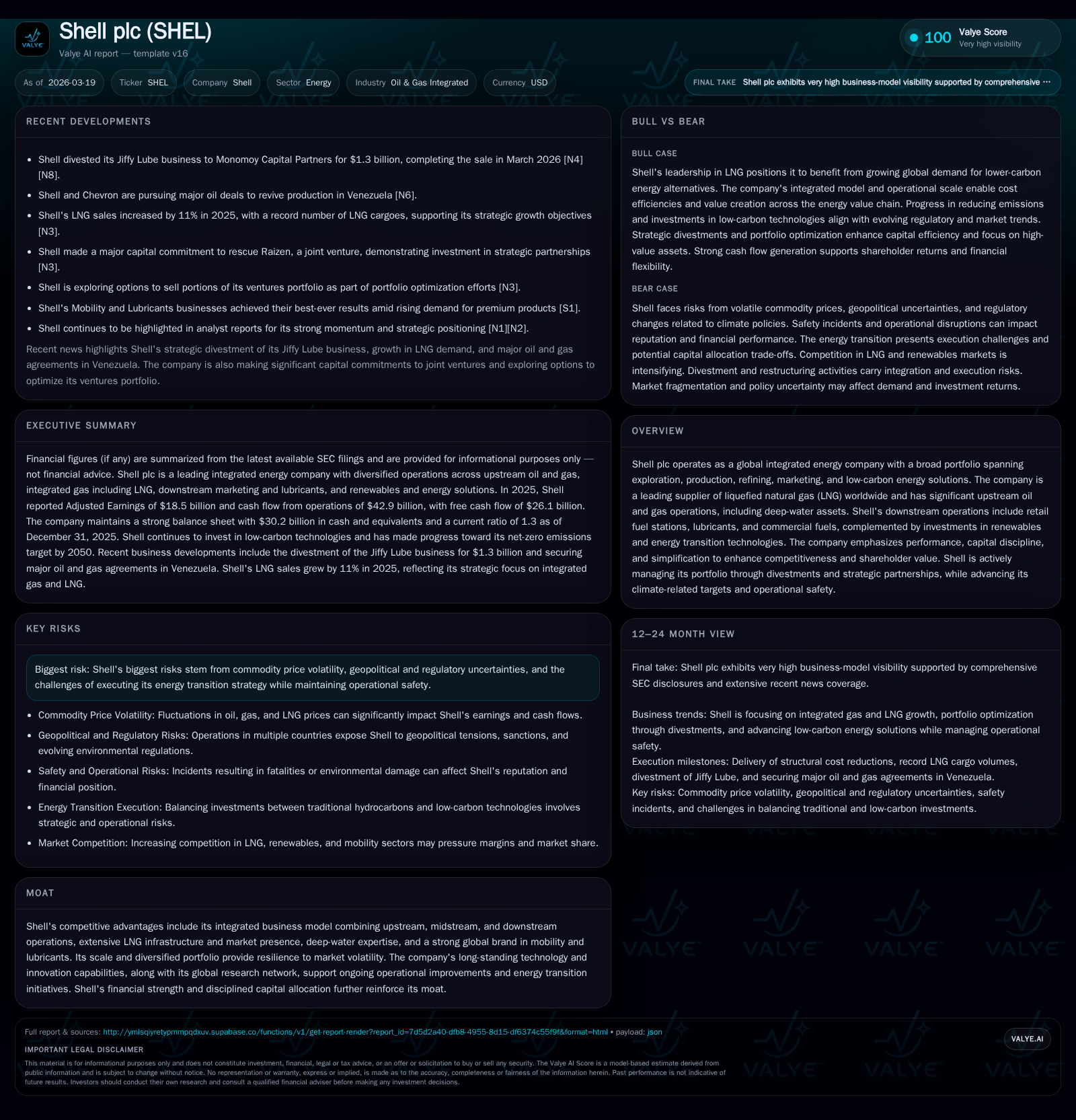
Shell plc’s revenues declined by 6.1% in 2025 while net income rose nearly 10%, highlighting a divergence driven by portfolio streamlining and operational efficiencies. The company fortified its liquidity through asset disposals including the $1.3 billion Jiffy Lube sale, enabling continued investments in LNG and energy transition projects amid strong LNG market fundamentals. Capital returns accelerated with shareholder distributions reaching the upper end of target ranges, supported by stable free cash flow generation and ongoing share buybacks. Key risks remain largely tied to commodity price swings and regulatory uncertainties as Shell balances traditional operations with ambitious low-carbon initiatives.
Revenue and Profit: A Tale of Divergence in 2025
Shell plc reported a contrasting financial performance in fiscal year 2025 where its total revenues fell by 6.1% year-on-year to $266.9 billion while net income increased significantly by approximately 9.7% reaching $18.1 billion as per SEC filings[F1][S1]. Equity attributable to shareholders also decreased moderately to $175.3 billion from prior year levels of about $180.2 billion[F1]. This divergence underscores a reshaping of Shell's business dynamics, where top-line softness contrasts with bottom-line resilience.
Historical performance (annual)
| FY | Rev ($bn) | Net ($bn) | Rev YoY | Net YoY |
|---|---|---|---|---|
| 2025 | 266.9 | 18.1 | -6.1% | +9.7% |
| 2024 | 284.3 | 16.5 | -10.2% | -15.9% |
| 2023 | 316.6 | 19.6 | -17.0% | -54.2% |
| 2022 | 381.3 | 42.9 |
Source: SEC companyfacts cache [F1].
Capital returns and efficiency (annual)
| FY | Div ($bn) | ROE% |
|---|---|---|
| 2025 | 8.6 | 10.3 |
| 2024 | 9.0 | 9.2 |
| 2023 | 9.2 | 10.4 |
| 2022 | 7.5 | 22.3 |
Source: SEC companyfacts cache [F1].
The near-10% rise in net income during falling revenue reflects improved operational efficiencies alongside strategic portfolio moves detailed below.
Decoding the Drivers Behind Positive Earnings Momentum
Shell's earnings momentum reflects an interplay of factors across its segments, primarily driven by Integrated Gas capacity expansion and upstream operational resilience[S1][N4][N13]. The Integrated Gas division remains central as Shell leverages its global LNG infrastructure during growing worldwide demand projected through 2040[N4]. Capacity additions and improved funds from operations contributed positively.
Upstream faced mixed crude pricing environments but benefited from deep-water oil production expertise which mitigated margin pressures[S1][N13]. Downstream operations delivered steady cash flows supported by retail fuel stations and lubricants but faced volume headwinds amid portfolio simplifications.
The company utilizes barrels of oil equivalent (boe/d) metrics internally to balance production rates across oil and natural gas streams efficiently.[S1]
Strategic Portfolio Management: Divestitures and Focused Assets
Consistent with its capital discipline mandate, Shell divested non-core assets including the announced sale of Jiffy Lube for $1.3 billion[N11], simplifying its portfolio and reallocating capital towards core growth projects in Integrated Gas and renewables[S1][S9].
Such divestments enhance liquidity and reduce operational complexity, enabling targeted investment strategies in higher-return areas while funding shareholder distributions without compromising financial stability.
Shell's strategic partnerships further complement this approach through collaborations that optimize resource allocation without diluting control over key assets.
LNG Leadership and Energy Transition: Growth Engines Looking Forward
Looking ahead, Shell's leadership in the liquefied natural gas sector is poised for further expansion aligned with sustained demand projections worldwide through at least 2040[N4][S1]. Investments into expanding LNG liquefaction capacities support this trajectory.
Concurrently, renewables R&D and emissions reduction targets reinforce Shell’s commitment toward energy transition initiatives balancing legacy business cash flows with environmental aspirations[S1]. However, transition execution complexities underscore ongoing risks.
Capital Structure Evolution and Liquidity Dynamics
At December end-2025, Shell’s total debt was reduced slightly by $1.4 billion to $75.6 billion versus the prior year, though gearing edged up from 17.7% to approximately 20.7%, reflecting changes in equity levels and capital structure optimization efforts[S4][S5][F1].
Cash and cash equivalents remained robust at $30.2 billion supporting operational flexibility[F1]. The debt maturity profile includes roughly one-tenth maturing within calendar year 2026 with repayment expected from combined cash flow sources including divestments[S4][S5].
Treasury risk management extends across currency diversification and interest rate hedging within centralized frameworks common to integrated production companies managing global exposure.[S4]
Shareholder Returns: Dividends, Buybacks, and Return on Equity
Capital allocation strategy reflected an elevated payout policy with shareholder distributions increasing from the prior range of 30–40% toward a new target band spanning approximately 40–50% of operating cash flow through cycles[S9][F1]. In absolute terms, distributions reached about $22.4 billion in FY25, with dividends amounting to $8.6 billion while buybacks comprised roughly $13.9 billion[F1][S9][S11].
Shell maintained disciplined share repurchasing programs through both on- and off-market mechanisms during early months of calendar year 2026 at average prices reflective of prevailing market conditions[S7]–[S29].
Return on equity for FY25 stood at approximately 10.3%, signaling healthy capital efficiency gains stemming from cost-cutting initiatives that yielded over $5 billion cumulative structural savings since early targets set around FY22[S9].
Key Milestones Ahead and Market Expectations
Looking forward, close attention will center on scheduled expansions of LNG infrastructure projects consistent with capacity growth strategies detailed in recent guidance[N4][S1]. Monitoring debt maturities—about one-tenth of total debt falling due in the next fiscal year—will be critical for assessing funding strategies including potential refinancing or asset sales.[S4]
With no explicit forward earnings guidance disclosed, watchers should also track commodity price trends as they interplay with dividend sustainability expectations given Shell’s progressive dividend policy targeting annual increases near 4% subject to board approval.[S9]
Risks in a Volatile Commodity and Regulatory Environment
Shell's value creation journey remains intertwined with significant risks highlighted in regulatory filings including commodity price volatility impacting upstream margins, geopolitical tensions influencing exploration/production access, and substantial costs related to compliance with evolving environmental regulations worldwide[S10].
The decarbonization imperative exposes tradeoffs between investment scale required for renewables adaptation against maintaining robust returns from hydrocarbon portfolios.[S10]
Operational safety continues as a cornerstone risk factor given global footprint complexity underscoring need for stringent governance controls.
This analysis synthesizes available financial statements alongside recent news disclosures without projecting speculative outcomes or providing investment recommendations.
Disclaimer: This is research-only, informational analysis and not investment advice. It may include AI-generated interpretation and general industry context. Always verify important details using primary sources.

Comments