
Phoenix Energy One Grows Production Tenfold Through Integrated Drilling and Acquisitions but Faces Capital Intensity and Leverage Risks
The company’s rapid expansion since 2019 leverages proprietary asset management and diversified U.S. basin operations, balancing growth with high debt levels and commodity-price exposure.
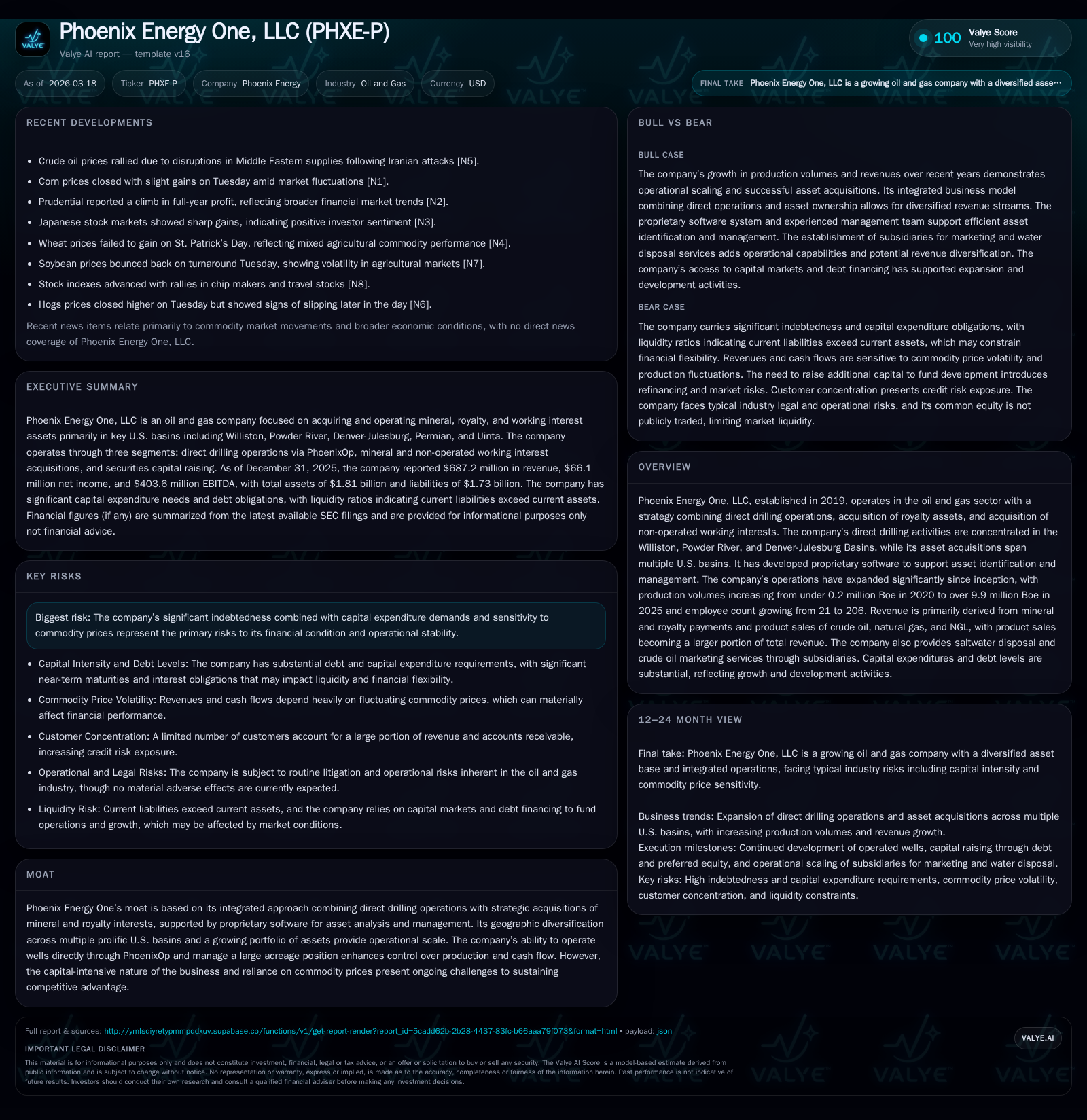
Phoenix Energy One, LLC has aggressively scaled its oil and gas production from under 0.2 million Boe in 2020 to over 9.9 million Boe in 2025 through a hybrid strategy of direct drilling operations and targeted acquisitions, supported by proprietary software tools. Its revenue mix has shifted with product sales comprising an increasing share alongside mineral and royalty income. The firm is heavily leveraged with approximately $1.53 billion in outstanding debt as of end-2025 and faces considerable capital expenditure needs exceeding $800 million annually to sustain growth. Despite strong operating income and a high return on equity, liquidity constraints and commodity price fluctuations remain key risks that could constrain future expansion.
Historical Growth and Drivers
Established in 2019, Phoenix Energy One has executed a fast-paced growth plan primarily driven by its integrated approach to oil and gas production that combines direct drilling operations with strategic acquisitions of mineral rights and royalty interests across major U.S. basins such as the Williston, Powder River, and Denver-Julesburg Basins . This geographic diversification aligns well with shale-centric plays offering prolific hydrocarbon extraction.
Between 2020 and 2025, production volume exploded from sub-0.2 million barrels of oil equivalent (Boe) to more than 9.9 million Boe . This massive increase coincides with expanding workforce headcount from just 21 employees at inception to over 200 by the end of 2025, reflecting scaling operational capabilities.
Revenue similarly climbed sharply to reach $687.2 million in fiscal year (FY) 2025 [F1], propelled by growing product sales which now constitute a larger portion relative to mineral royalties. The operating income for FY25 was $175.6 million against a net income of $66.1 million [F1], marking steady improvements in profitability driven by higher production volumes and operational leverage.
Historical performance (annual)
| FY |
|---|
| 2025 |
Source: SEC companyfacts cache [F1].
Note: Only revenue, operating income, and net income confirmed from latest filings [F1].
Future Growth Prospects
Phoenix Energy One plans robust direct drilling operations via its subsidiary PhoenixOp, expecting to drill between approximately 88 to 113 gross wells in operated acreage within the Bakken/Williston Basin alone during the next year [S6]. Additionally, it anticipates participation in hundreds of non-operated wells across other leasehold positions.
Capital expenditures related to these activities are estimated between $830 million and $890 million annually just for drilling and development [S6], indicating continued heavy financial commitment towards asset growth.
Complementing drilling efforts are mineral interest acquisitions facilitated by the company's proprietary software platform designed for asset identification and management . Furthermore, marketing activities under its Firebird Marketing unit have enabled it to act as principal for crude oil sales previously handled via third parties [S22], enhancing revenue control.
However, growth trajectories face caps from the company's large debt burden—$1.53 billion outstanding as of December 31, 2025 [F1][S15]—and prevailing commodity price uncertainties which influence cash flow predictability.
Forecasts and Milestones
Explicit management guidance on exact revenue or production milestones beyond stated drilling targets is absent; however, analysts should monitor:
- Progress on drilling completion rates within Williston Basin acreage,
- Quarterly updates on capex spending against planned budgets,
- Results from Firebird Marketing’s crude purchase-sale cycles,
- Updates on hedging positions covering at least three years of anticipated crude production,
- Debt covenant compliance relating to leverage ratios scheduled to tighten progressively through late-2026 [S7].
Returns and Capital Allocation
Despite rapid expansion financed chiefly via debt issuance—including multiple tranches under the Fortress Credit Agreement—the company generated an impressive approximate return on equity of 84.5% as of end-2025 based upon net income relative to reported equity levels [F1]. This elevated ROE reflects effective capital deployment but also signals risk tied to leverage.
Phoenix Energy One completed a Series A Preferred Share offering in September 2025 yielding $67.6 million in initial liquidation preference capital after offering costs [S12]. These preferred shares pay cumulative quarterly distributions starting at an annual rate of about 10%, stepping up ultimately to a perpetual rate of 11% beyond year five [S14]. Dividend payments totaled approximately $1.7 million accrued as liabilities by year-end FY25 [S14].
Cash balances stood at nearly $65.8 million at December close while current liabilities exceeded current assets ($418 million vs. $174 million), reflecting a tight current ratio around 0.41 suggesting near-term liquidity pressure without factoring available borrowing capacity [F1]. Cash flows remain sufficient presently but depend heavily on continuous capital markets access for funding ongoing large capex needs [S11].
No share repurchases or common stock dividends have been declared since all common units are held privately by Phoenix Equity without a public float [S20].
Industry Context Analysis
Phoenix Energy One operates amidst an industry increasingly subject to volatile pricing influenced by geopolitical tensions—as reflected recently when Iran-Israel hostilities temporarily closed the Strait of Hormuz causing crude price rallies [N8]. Such dynamics create both opportunities for cash flow boosts during price spikes but also underline vulnerabilities when prices fall below plan assumptions—as occurred mid-to-late 2025 when WTI prices dipped from roughly $70/bbl to about $55/bbl [S11].
The company's integrated approach leveraging direct operator control alongside non-operated interests permits flexible response strategies uncommon among pure royalty holders or solely operator-centric firms.
However, its substantial dependency on continuous high capital inflows contrasts with peer companies emphasizing free cash flow generation amid energy transition pressures.
Key Risks Highlighted
Material risks center on financial leverage that could strain liquidity if commodity prices remain subdued or fall sharply below plan levels triggering covenant breaches or forcing distressed asset sales [S10], plus execution risks inherent in managing multiple complex drilling programs simultaneously .
Legal proceedings exist but are regarded as routine without material impact forecasts per management opinions disclosed in latest filings [S20]. Nonetheless, regulatory changes or operational incidents could raise cost profiles or delay timelines.
Conclusion
Phoenix Energy One’s remarkable growth over six years is grounded in combining direct drilling expertise with an acquisition-driven asset buildout across several prolific U.S. basins enabled by technology-driven asset evaluation tools.
While providing strong returns fueled by aggressive capital deployment funded largely through debt facilities including sizable recently amended Fortress Credit Agreement tranches and ongoing bond issuances, the company faces challenges stemming from large near-term capex demands and tight liquidity ratios.
Future performance will critically hinge on maintaining favorable commodity prices or effective hedging strategies alongside prudent capital structure management amid industry cyclicality.
This analysis is based exclusively on documented data sources without predictive investment guidance or recommendations.
Disclaimer: This is research-only, informational analysis and not investment advice. It may include AI-generated interpretation and general industry context. Always verify important details using primary sources.

Comments