
Silexion Therapeutics Advances SIL204 Toward Phase 2/3 Trials While Managing Tight Cash and Regulatory Risks
Focused on RNAi therapies for KRAS-mutant cancers, Silexion aims to begin pivotal studies in 2026 despite limited liquidity and competitive pressures.
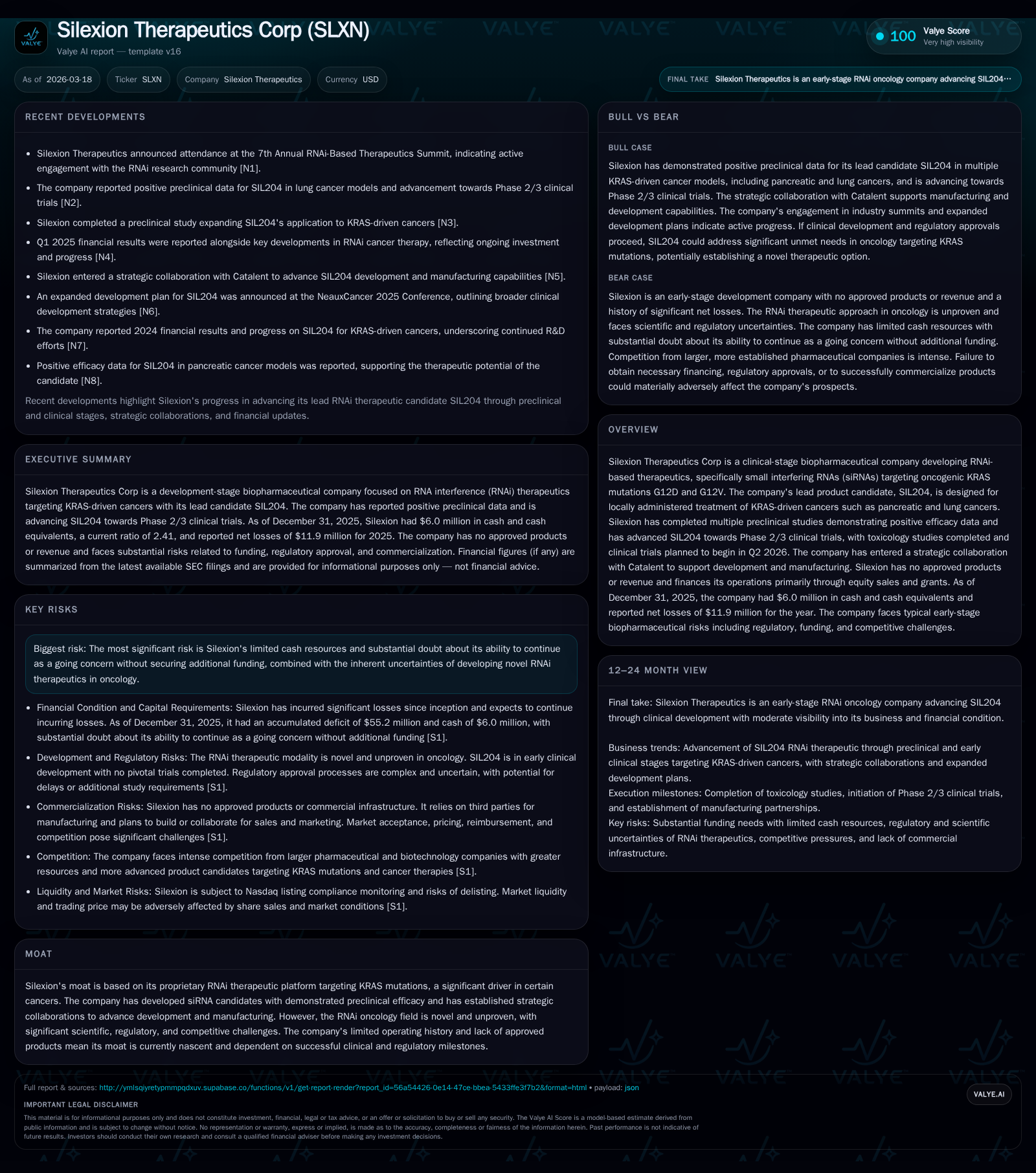
Silexion Therapeutics Corp is a clinical-stage biotech company focused on RNA interference (RNAi) therapeutics targeting oncogenic KRAS mutations, notably via its lead candidate SIL204 for pancreatic and lung cancers. The company plans to initiate Phase 2/3 trials in Q2 2026 following completed toxicology studies. Despite narrowing net losses to $11.9 million in 2025 from $16.5 million in 2024, Silexion faces significant liquidity constraints with $6 million cash on hand as of year-end 2025 and substantial doubt regarding its ability to continue without additional financing. Competition from established pharmaceutical companies and regulatory risks add complexity to its development path. Success depends on execution of clinical milestones, securing capital, and establishing strategic partnerships.
Company Overview
Silexion Therapeutics Corp is focused on developing RNA interference (RNAi) therapeutics targeting oncogenic KRAS mutations G12D and G12V that drive pancreatic and lung cancers. Its lead candidate, SIL204, consists of locally administered small interfering RNAs (siRNAs) designed to silence mutant KRAS expression within the tumor microenvironment. The company plans to commence Phase 2/3 clinical trials in Q2 2026 following completion of toxicology studies [S1].
Manufacturing scale-up efforts are supported through collaboration with Catalent, providing essential expertise for oligonucleotide synthesis and formulation critical for RNAi therapeutic production [S1]. As a clinical-stage biotech, Silexion has no approved products or commercial revenues.
Historical Financial Performance
Since inception in November 2008, Silexion has primarily allocated resources toward research and development activities including preclinical work, toxicology, and early clinical trials. The company’s operations remain pre-revenue, relying on equity financings and grants such as those from Israel’s Innovation Authority [S1].
Net losses decreased from $16.5 million in FY2024 to $11.9 million in FY2025—a 27.9% improvement—reflecting some operational efficiencies despite advancing clinical programs. Operating cash flow remained negative at approximately -$10.8 million in FY2025 compared to -$8.4 million the prior year, consistent with increased expenditures associated with late preclinical preparations [F1]. Capital expenditures were minimal ($9k) in line with industry norms for asset-light clinical-stage biotechs.
At December 31, 2025, cash and equivalents totaled roughly $6 million against current liabilities near $2.75 million, yielding a current ratio of 2.41 that provides short-term liquidity but insufficient runway for late-stage clinical activities without further funding [F1],[S4]. Shareholders’ equity improved markedly to $2.6 million from negative equity the prior year, indicating some financial stabilization likely related to recent equity raises or valuation adjustments.
Historical performance (annual)
| FY | Net ($mm) | CFO ($mm) | OpInc ($mm) | Capex ($) | Net YoY |
|---|---|---|---|---|---|
| 2025 | -12 | -11 | -12 | 9000 | +27.9% |
| 2024 | -17 | -8 | -13 | 22000 |
Source: SEC companyfacts cache [F1].
Capital returns and efficiency (annual)
| FY | FCF ($mm) | ROE% |
|---|---|---|
| 2025 | -11 | -457.6 |
| 2024 | -8 | 414.1 |
Source: SEC companyfacts cache [F1].
Note: Company is pre-revenue; no revenues reported.
Growth Outlook and Milestones
Future growth depends heavily on successful clinical development and regulatory approval of SIL204. The initiation of Phase 2/3 trials targeting locally advanced pancreatic cancer in Q2 2026 represents a key upcoming milestone [S1],[S22]. Positive results could validate SIL204’s mechanism addressing an unmet medical need given poor prognosis associated with KRAS-driven tumors.
Commercialization will require navigating complex regulatory pathways including cGMP manufacturing validations overseen by FDA and other agencies worldwide [S15],[S16]. Market acceptance may be challenged by the therapy’s novel local delivery approach compared to systemic small molecule inhibitors targeting KRAS G12C mutations developed by competitors such as Mirati Pharmaceuticals [S27].
Building or partnering for sales and marketing capabilities will be necessary post-approval as Silexion currently lacks commercial infrastructure [S27]. Reimbursement frameworks remain uncertain given the novel modality and oncology indications targeted [S10].
Capital Allocation & Financial Returns
As a development-stage entity without product sales revenue, Silexion allocates capital predominantly towards R&D activities encompassing clinical development programs. Funding sources have included equity issuances alongside grants; however cash reserves of approximately $6 million entering 2026 pose significant constraints relative to costly pivotal trials ahead [F1],[S4],[S20].
The independent auditor expressed substantial doubt about the company’s ability to continue as a going concern absent additional financing within twelve months post fiscal year-end [S4].
Return metrics reflect developmental stage characteristics: the approximate return on equity (ROE), calculated as net loss divided by shareholders’ equity at year-end 2025, was around -458%, illustrating ongoing operating losses against a thin equity base [F1]. Free cash flow remains deeply negative near -$10.8 million due to operating burn outpacing minimal capital expenditures.
No dividends or share repurchases have been made consistent with prioritizing operational funding during clinical maturation stages.
Industry Context & Competitive Positioning
The oncology field targeting KRAS mutations is rapidly evolving owing to breakthroughs enabling drugging previously undruggable targets via structure-based design. While systemic oral inhibitors against KRAS G12C have seen recent approvals, heterogeneity among KRAS mutations necessitates tailored approaches like Silexion’s local siRNA delivery platform ,[S27].
Despite scientific promise linked to RNAi technology allowing precise gene silencing with reduced off-target effects compared to chemotherapy or checkpoint inhibitors, challenges remain regarding delivery into solid tumors and complex pharmacokinetics profiles inherent to oligonucleotide therapeutics.
Competition includes large pharmaceutical firms such as Bristol-Myers Squibb (via Mirati), AstraZeneca (with Usynova), Revolution Medicines, Boehringer Ingelheim and Gilead pursuing diverse modalities against KRAS mutations—some already at late-stage development or regulatory approval phases—placing pressure on speed-to-market and differentiation strategies [S27].
Regulatory requirements extend beyond initial approvals; rigorous cGMP manufacturing quality assurance at third-party partners like Catalent introduces risks of production delays if compliance issues arise [S26],[S15]. Post-marketing pharmacovigilance obligations could entail costly safety monitoring or label modifications if adverse events emerge later during commercial use [S7],[S29].
Risk Factors Summary
- Liquidity Risk: Limited cash resources necessitate additional fundraising; failure risks curtailment of operations [F1],[S4],[S20].
- Clinical & Regulatory Risk: Trial outcomes inherently uncertain; regulators may impose delays or require costly post-marketing studies impacting timelines [S1],[S15],[S22].
- Competitive Risk: Well-funded rivals developing alternative therapies threaten market share even post-approval [S27].
- Intellectual Property Risk: Patent challenges or litigation can delay exclusivity windows affecting commercial viability amid evolving patent laws [S6],[S18],[S21].[F1]
- Operational Risk: Dependence on third-party manufacturers subject to audits poses supply risks; lack of commercial infrastructure may delay market entry if approved [S26],
- Market Risks: Pricing pressures from healthcare reforms may limit reimbursement levels affecting commercialization feasibility [S10].
Conclusion & Monitoring Points
As Silexion advances pivotal testing of SIL204 targeting challenging KRAS mutation subsets in mid-2026, key considerations include securing sufficient liquidity through timely capital raises; demonstrating compelling clinical efficacy; managing intellectual property complexities; progressing regulatory submissions including manufacturing validations; competing effectively against alternate modalities; and navigating reimbursement landscapes.
Investors should monitor:
- Progress updates on Phase 2/3 trial initiation,
- Announcements of additional financing arrangements,
- Regulatory feedback on trial design or manufacturing controls,
- Developments regarding strategic collaborations beyond Catalent,
- Safety signals emerging from ongoing studies,
- Biotech funding market conditions,
- Nasdaq listing compliance status ahead of September 2026 review.
This analysis uses exclusively disclosed SEC filings ([F1], [S#]) without offering investment recommendations or price targets. Readers should consider all outlined risks when evaluating operational sustainability or future prospects.
Disclaimer: This is research-only, informational analysis and not investment advice. It may include AI-generated interpretation and general industry context. Always verify important details using primary sources.

Comments