
Aebi Schmidt Expands North American Footprint, Faces Integration and Margin Pressures in Specialty Vehicles
Following its 2025 acquisition of The Shyft Group, Aebi Schmidt reports significant revenue growth but contends with integration costs and compressed profitability.
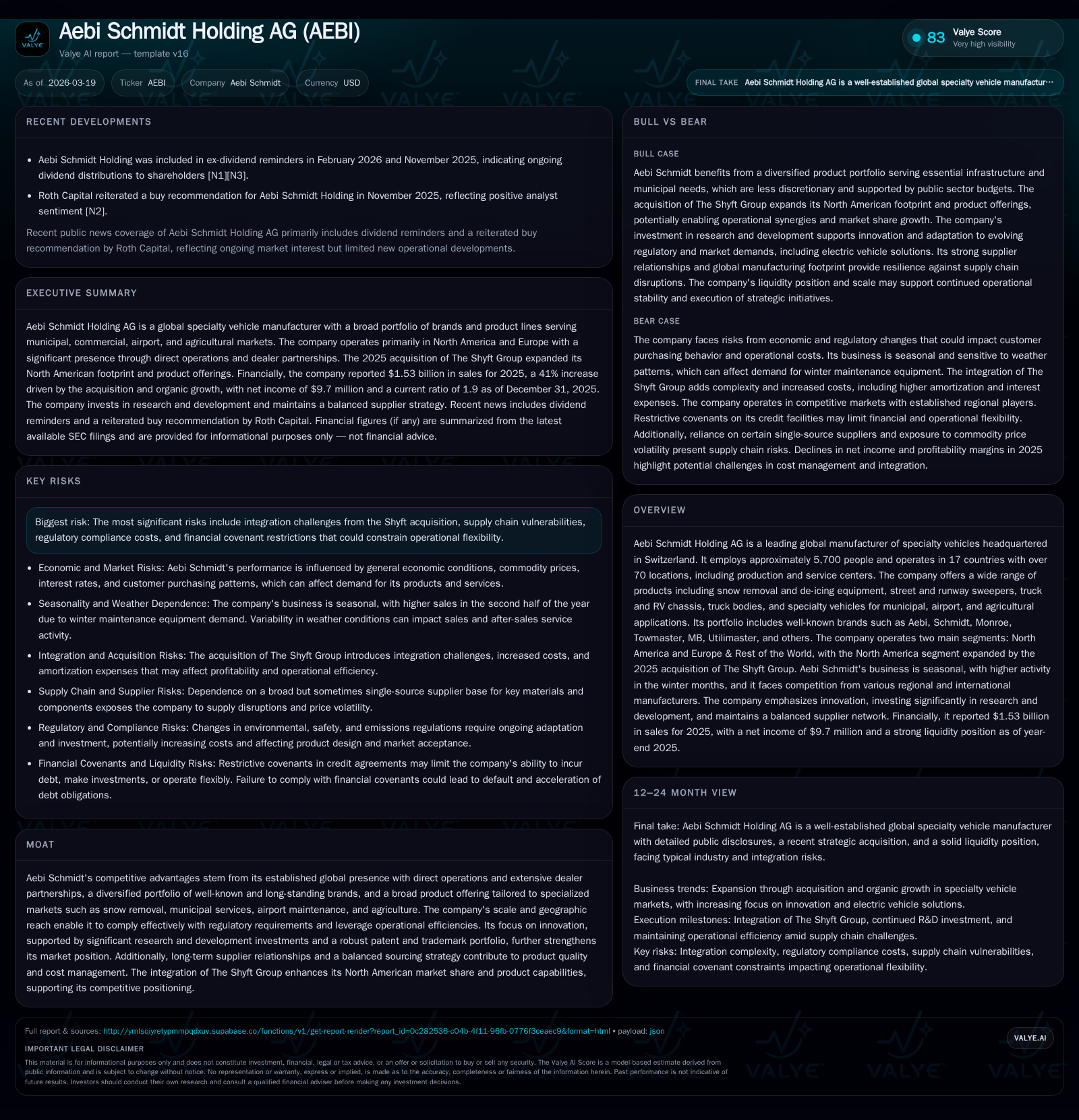
Aebi Schmidt Holding AG reported a substantial increase in sales for the year ended December 31, 2025, reaching $1.53 billion, driven primarily by the July 2025 acquisition of The Shyft Group. Operating income grew modestly to $73.1 million, while net income declined to $9.7 million due to higher interest expenses and merger-related costs. The company operates globally with diverse specialty vehicle offerings across municipal, airport, agricultural, and commercial sectors. Growth prospects depend on successful integration of Shyft, managing supply chain risks, and adapting to evolving regulatory environments.
Company Overview and Historical Performance
Aebi Schmidt Holding AG is a leading global manufacturer of specialty vehicles headquartered in Switzerland. Employing approximately 5,700 people across 17 countries with more than 70 locations including production facilities and service centers, the company also leverages dealer networks extending its reach into over 90 additional countries [S1][S21]. Its product range encompasses snow removal and road maintenance equipment, runway sweepers for airports, truck and RV chassis manufacturing, as well as truck bodies serving municipal, airport, agricultural, and challenging terrain applications [S1][S9].
The company owns established brands such as Aebi (specialized agricultural equipment for steep slopes), Schmidt (snow removal machinery), Monroe (work truck upfitting), Towmaster (trailers), MB (airport equipment), Utilimaster (fleet vans including electric vehicles marketed under Blue Arc), among others—all with longstanding market presence [S1][S6].
Financially, Aebi Schmidt demonstrated steady growth prior to its transformative acquisition of The Shyft Group in July 2025—a strategic move aimed at expanding North American market share and broadening its specialty vehicle capabilities [S1][S9].
Historical performance (annual)
| FY |
|---|
| 2025 |
Source: SEC companyfacts cache [F1].
Operating income and net income figures are drawn from SEC filings; cash flows represent operating activities; capex not explicitly reported [F1].
Sales growth from 2023 to 2024 was approximately +7%, reflecting organic expansion especially in Europe and the Rest of World segments supported by increased winter maintenance demand [S7][S9]. The sharp increase of +41% in sales during 2025 primarily reflects recognition of revenues from Shyft post-acquisition alongside organic growth [S7].
Operating income rose modestly (+7%) despite strong top-line growth due to margin pressure from integration costs and elevated SG&A expenses linked to Shyft's cost base. Net income declined significantly (-68%), impacted by higher interest expense related to acquisition financing as well as amortization of intangible assets arising from the merger [S7][F1].
Business Segments: Geographic & Product Mix
North America
Following the mid-2025 merger with Shyft, North America constitutes a significant portion of revenue with comprehensive offerings across five main lines: Airport & Chassis; Commercial Trucks; Goods Transport; Municipal; plus Specialty Vehicles [S9][S17]. Monroe brings expertise in work truck upfitting while Utilimaster leads walk-in van manufacturing including electric models under Blue Arc [S9]. Towmaster contributes heavy-duty trailers.
Airport operations combine legacy Schmidt and MB technologies delivering advanced snow removal equipment adhering to strict aviation safety standards—with increasing incorporation of automated control systems enabling partial autonomy [S9][S13][S17].
Municipal products include snow & ice control equipment (e.g., Monroe spreaders), liquid anti-icing systems (Swenson), and electric street sweepers (Schmidt), aligning with sustainability trends in municipal fleets [S9][S17].
Europe & Rest of World
Europe focuses on airport maintenance equipment led by Schmidt's high-speed snow sweepers alongside municipal solutions combining winter/summer road cleaning technology—including innovations like pre-wetted salt spreading devices and multipurpose narrow-track transporters derived from Scandinavian brands within the portfolio [S13][S17]. Agriculture remains key with Aebi’s specialized tractors designed for steep slopes enabling safe cultivation in mountain regions [S13][S21]. Electric drive vehicles are increasingly introduced here responding to rising sustainability demands.
Innovation & Investment
R&D expenses increased notably (+35%) reaching $26.5 million in 2025 following integration of Shyft’s engineering resources combined with internal development targeting regulatory compliance related to emissions reduction and operational efficiency improvements [S7][S24]. The company holds patents covering snowplows, truck bodies, sweeping machines, and control mechanisms supporting product differentiation [S23].
Capital expenditures are not explicitly detailed but continued investment is indicated in production facility upgrades and IT infrastructure including ERP implementation supporting operational efficiencies [S4][S19].
Seasonality & Market Drivers
The business exhibits seasonality aligned with northern hemisphere winter months—Q3/Q4 typically see heightened procurement activity as municipalities finalize budgets for snow removal ahead of winter—aftermarket services also grow concurrently contributing approximately 15-20% of revenues. Snowfall intensity directly influences demand while economic cycles affect replacement timing though base demand remains steady due to essential nature of municipal winter services [S18].
Urbanization supports long-term growth potential particularly within municipal services as expanding cities increase requirements for infrastructure maintenance beyond peak weather events [S22]. Recovery in airport traffic following pandemic disruptions sustains demand for compliant runway clearing solutions meeting stringent international regulations [S21].
Risks & Challenges
Integration risks include merging design/manufacturing cultures post-Shyft acquisition while capturing purchasing synergies amid overhead cost inflation remains crucial [N1][S20]. Supply chain vulnerabilities persist especially reliance on third-party chassis suppliers under bailment pools limiting flexibility; input price volatility—primarily steel/aluminum sourced regionally but exposed through tiered suppliers—adds earnings uncertainty amid geopolitical tariff tensions [S12][S22][S23].
Regulatory complexity increases costs as emissions standards tighten across U.S., Europe, and other regions; climate change impacts may reduce demand for core snow/ice products creating structural challenges requiring diversification toward sustainable electric models or service contracts for revenue stability [S20][N1].
Financial covenants attached to credit facilities constrain leverage flexibility raising refinancing risks if earnings fall short or macroeconomic conditions worsen; current ratio stands healthy at approximately 1.9x though free cash flow is slightly negative indicating working capital absorption possibly related to integration scale-up rather than operational distress at this stage [F1][S15][S16].
Returns & Capital Allocation
Return on equity remains modest at about 1.2%, reflecting amortization charges associated with acquired intangible assets dampening net profitability despite an expanded asset base post-Shyft consolidation [F1]. Free cash flow was slightly negative (-$5.2 million) highlighting working capital pressures likely tied to increased scale or integration activities rather than fundamental operational issues [F1]. No explicit dividend or share repurchase data is disclosed; management appears focused on debt reduction or reinvestment given merger-related leverage levels [N1][F1].[S15]
Forward Outlook: Growth Opportunities & Watchpoints
Successful integration will be critical for medium-term performance particularly optimizing overlap between legacy commercial trucks segment and Shyft’s fleet-centric offerings could unlock purchasing scale benefits improving margins beyond current compression seen post-merger.
Continued R&D investments position the company well amid evolving regulatory demands for lower emissions technology while a diversified geographic footprint aids risk mitigation from localized trade barriers or economic shocks.
Expanding electric vehicle portfolios may capture rising municipal sustainability mandates providing avenues beyond cyclical weather dependencies smoothing revenue volatility historically linked strongly to winter seasons.
Caution warranted around tariff escalations or supply interruptions especially affecting single-source components requiring alternate sourcing strategies or contractual protections.
Future disclosures on order backlog will provide enhanced visibility into sales momentum especially post-winter when procurement timing variances affect comparability.
Conclusion
Aebi Schmidt Holding AG has achieved significant expansion through strategic acquisition while maintaining leadership across multiple niche specialty vehicle categories worldwide leveraging known brands supported by differentiated technology investments. Near-term margin pressures driven by merger-related costs alongside net income contraction highlight integration challenges compounded by supply chain uncertainties. Balanced growth depends on effective synergy realization paired with innovation-led product evolution adapting successfully across diverse global markets amid tightening environmental regulations. Financial discipline remains key given debt levels constraining flexibility necessitating prudent cash flow management alongside selective reinvestment prioritization. Investors should monitor progress on North American segment consolidation alongside regulatory developments materially impacting core seasonal end-markets. Industry cyclicality linked with climatic variability plus material input cost swings influenced by global trade policies remain primary external risk factors going forward.
This report is based solely on information available through March 19, 2026 including Aebi Schmidt's SEC filings and public disclosures without extending any form of investment advice or price forecast.
Disclaimer: This is research-only, informational analysis and not investment advice. It may include AI-generated interpretation and general industry context. Always verify important details using primary sources.

Comments