
Signet Jewelers’ Financial Revival and Strategic Evolution in FY26
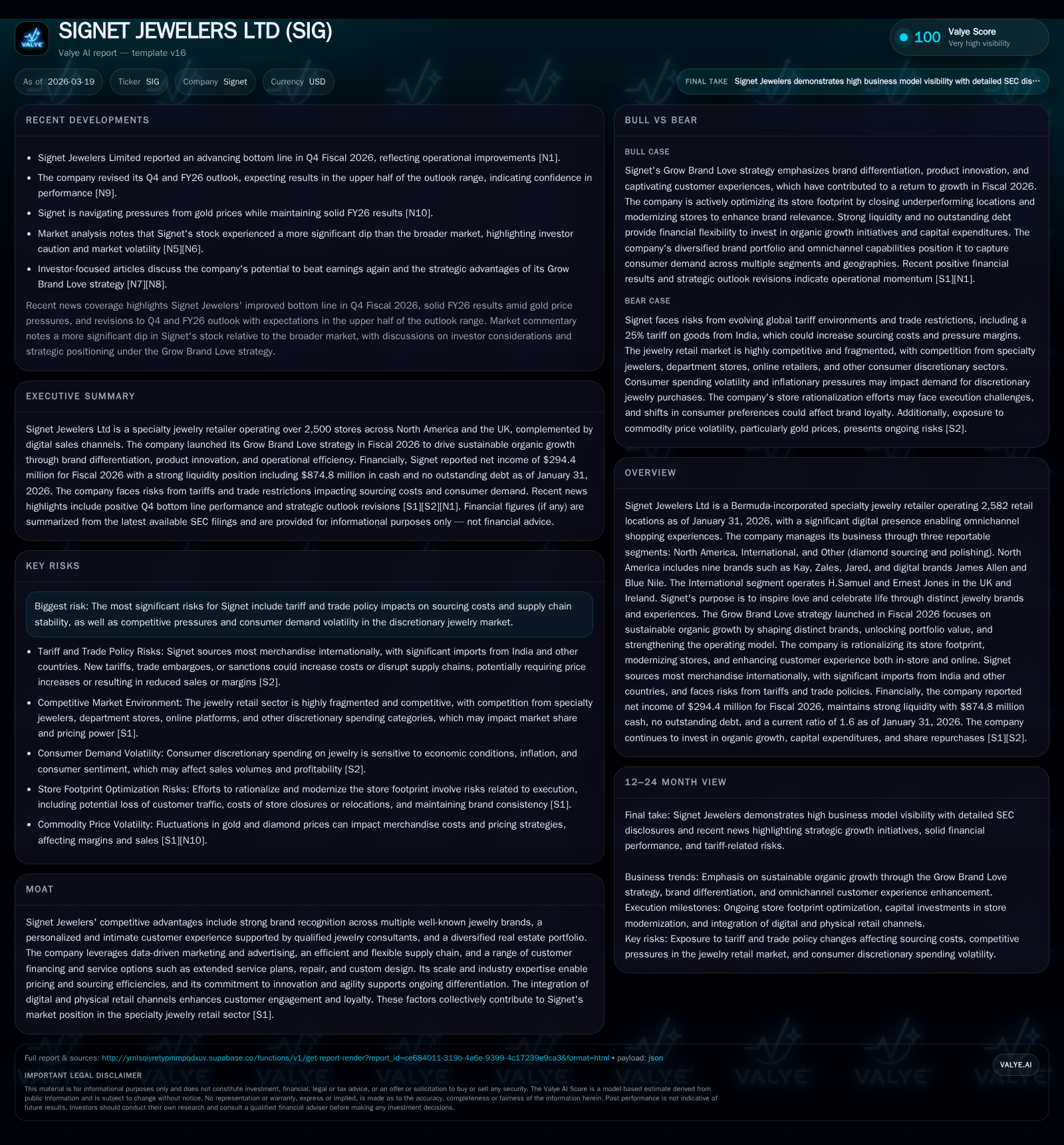
Signet Jewelers rebounded strongly in fiscal 2026 by leveraging its Grow Brand Love strategy, operational realignments, and disciplined capital management despite ongoing industry challenges.
In fiscal 2026, Signet Jewelers delivered a remarkable operating income increase of over 255% and net income surged by more than 380%, marking a significant recovery. This turnaround was driven by strategic brand repositioning under the Grow Brand Love initiative, which shifted focus from banner to brand-centric approaches, product innovation, and enhanced customer experiences both in-store and online. Operationally, Signet rationalized its retail footprint and invested heavily in digital integration, while navigating tariff-induced cost pressures that affected margins. Capital discipline remained a priority with substantial share repurchases and dividend growth. Entering fiscal 2027, the company aims to further refine brand distinctiveness, unlock portfolio value, and strengthen its operating model amid persistent tariff risks and demand volatility.
FY26 Turnaround: Historic Growth Amid Volatile Conditions
Fiscal 2026 proved transformative for Signet Jewelers as the company executed a strong financial comeback reflected in its key performance metrics. Operating income rose sharply to $393.1 million from $110.7 million in the prior year—a staggering increase of approximately 255%—while net income exploded by roughly 381%, reaching $294.4 million versus just $61.2 million last year [F1]. These gains underscore the effectiveness of initiatives launched under the "Grow Brand Love" strategy that marked a shift from survival mode to structured growth.
Revenue comparisons are nuanced due to prior-year challenges; although absolute revenue growth was moderate year-over-year at the consolidated level, margin expansion drove much of the profit improvement. Contributing factors included favorable shifts in sales mix benefiting higher-margin bridal categories, improved pricing architecture enhancing merchandise average unit retail (AUR), and robust service revenues such as repair plans [S14][S5]. Importantly, inventory turnover accelerated particularly during Q4 reflecting strong seasonal dynamics that amplified margin realization within a specialty retail context characterized by traditionally slow-turn inventory.
Grow Brand Love Strategy: Shaping Distinct, Coveted Brands
The centerpiece of Signet’s revival lies in the Grow Brand Love strategy initiated in Fiscal 2026 which replaced a banner-centric mindset with one focused on fostering brand equity through curated assortments and differentiated experiences [S1]. This approach aligns product innovation with each brand’s identity—brands like Kay, Zales, Jared domestically and H.Samuel internationally each receive tailored assortment curation optimizing style trends while honoring core customer expectations.
Marketing transformed into more targeted campaigns emphasizing emotional connection rather than broad discounting tactics historically prevalent in specialty jewelry retailing. Digital platforms were recalibrated for an intuitive shopping journey that marries online discovery with personalized service consultation—vital in high-consideration discretionary categories where trust and expertise drive purchase decisions.
Operational Adjustments: Store Footprint Rationalization and Digital Integration
Signet strategically reduced exposure to underperforming real estate assets by closing or relocating stores predominantly in declining malls or venues showing reduced foot traffic—a move aligned with global retail trends favoring fewer but more productive locations [S1][S4]. Concurrently, the firm invested significantly ($153.5 million) in capital expenditures focused on store modernization projects that incorporate contemporary design principles enhancing brand ambiance.
Digital infrastructure upgrades totaling approximately $41.5 million further supported omnichannel synergy—enabling seamless fulfillment options such as buy online pick-up in store (BOPIS), ship-to-store capabilities, and enhanced e-commerce merchandising curation that increases conversion rates while reducing return friction points common to fine jewelry e-tail.
Commodity Price Dynamics and Tariff Risks Impacting Margins
A pronounced challenge surfaced from tariff-induced cost pressures resulting from new import duties impacting goods sourced predominantly from India—accounting historically for near half of finished merchandise sourcing—and other countries critical to Signet’s supply chain such as Thailand and China [S2]. The imposition of an additional 25% tariff on Indian imports effective August 2025 notably strained merchandise cost structures.
Gold price volatility added another dimension of complexity given jewelry’s direct material linkage; however, Signet partially offset these headwinds through aggressive scrap recovery programs and rigorous pricing architecture modifications aimed at balancing competitive positioning with margin preservation [N5][S5]. These unit economics adjustments speak to a nimble response framework essential for navigating discretionary luxury goods markets subject to geopolitical trade fluctuations.
Capital Allocation Discipline: Share Repurchases, Dividends, and Capex Priorities
Capital stewardship remained a foundational pillar throughout FY26 as Signet deployed $205.2 million towards share repurchases under its ongoing $2.1 billion 2017 Share Repurchase Program authorization—with $517.9 million still available—as well as increased quarterly dividends by approximately 9% to $0.35 per share starting FY27 marking five consecutive years of dividend growth [F1][S6].
Investment focus balanced organic growth priorities particularly around store modernizations and digital IT initiatives supporting enhanced customer engagement modalities totaling over $195 million capital deployment combined across physical and virtual channels [S4][S15]. The company reported strong operating cash flow generation reaching $678.8 million (+14.9% YoY), ensuring free cash flow availability exceeded $525 million after capex contributions—thus underpinning financial flexibility for continued strategic initiatives alongside shareholder returns [F1].
Liquidity Position and Balance Sheet Strength in a Challenging Environment
Financial prudence is evident through the maintenance of zero outstanding debt following full maturity repayment of senior unsecured notes in Q2 FY25 using cash on hand [S8]. At FY26 close January 31st, liquidity was substantial—cash reserves stood at nearly $875 million augmented by an undrawn asset-based revolving credit facility providing an additional $1.2 billion capacity offering robust contingency buffers against cyclical retailer volatility common within discretionary sectors [F1][S9].
Working capital exhibited marked improvement driven by inventory management efficiencies—a critical lever mitigating inventory aging risks endemic to specialty jewelry—with current ratios comfortably exceeding 1.6x signaling sound short-term financial health [F1][S13]. The adjusted net debt leverage ratio remained prudent at approximately 0.3x emphasizing conservative capital structure conducive to risk-adjusted growth execution.
Outlook for FY27: Strategic Imperatives and Market Expectations
Looking forward into Fiscal 2027, Signet elevates its Grow Brand Love strategy imperatives into three refined pillars: "Shaping Distinct and Coveted Brands," "Unlocking Portfolio Value," and "Strengthening Operating Model" which collectively aim to deepen emotional consumer connections while improving portfolio margin resilience through pricing sophistication and sourcing leverage [N1][S1].
Manifestations include augmenting curated assortments reflective of consumer insights; expanding education around diamond origin narratives including natural versus lab-grown distinctions fostering trust; streamlining cost structures via organizational realignment; plus heightened digital personalization capabilities facilitating seamless buyer journeys.
External variables remain pivotal considerations including macroeconomic uncertainties impacting discretionary spend elasticity alongside ongoing trade policy evolutions maintaining vigilance regarding tariff-induced cost inflation—a recurring theme flagged explicitly by management risk disclosures requiring proactive mitigation strategies [S1][S2].
Investor Considerations: Valuation, Market Sentiment, and Risks
Equity market observers note a dislocation between Signet’s underlying brand equity value proposition inherent across flagship banners such as Kay and Jared versus prevailing valuation multiples—highlighting possible mispricing opportunities juxtaposed with lingering concerns around demand cyclicality characteristic of luxury discretionary retailing segments [N9][N10].
Key risks revolve around sustained tariff hikes impacting input costs unpredictably coupled with competitive pressures amid shifting consumer preferences accelerated by digital disruptors challenging traditional mall-anchored experiential formats integral to Signet’s historical advantage set.
Nevertheless, the company’s clear articulation of transformative strategic priorities coupled with demonstrated operating cadence improvements position it well for capturing selective growth pathways pending successful execution while maintaining capital allocation discipline.
Historical performance (annual)
| FY | Net ($mm) | CFO ($mm) | OpInc ($mm) | Capex ($mm) | Net YoY |
|---|---|---|---|---|---|
| 2026 | 294 | 679 | 393 | 154 | +381.0% |
| 2025 | 61 | 591 | 111 | 153 | -92.4% |
| 2024 | 810 | 547 | 622 | 126 | +115.1% |
| 2023 | 377 | 798 | 605 | 139 |
Source: SEC companyfacts cache [F1].
Capital returns and efficiency (annual)
| FY | Buybacks ($mm) | FCF ($mm) | ROE% |
|---|---|---|---|
| 2026 | 205 | 525 | 15.0 |
| 2025 | 138 | 438 | 3.3 |
| 2024 | 139 | 421 | 37.4 |
| 2023 | 376 | 659 | 23.9 |
Source: SEC companyfacts cache [F1].
Table note: Revenue data not consistently available; analysis based on operating income trends showing significant rebound reflecting strategic execution.
This report synthesizes publicly filed data up to March 19, 2026 including Form 10-K disclosures along with recent news coverage relevant to Signet Jewelers Ltd's fiscal year ending January 31, 2026 performance results without extending subjective investment advice or price forecasts.
Disclaimer: This is research-only, informational analysis and not investment advice. It may include AI-generated interpretation and general industry context. Always verify important details using primary sources.

Comments