
Plumas Bancorp Strengthens Community Banking with Cornerstone Acquisition and Capital Discipline
Plumas Bancorp sustains modest profitability growth through regional expansion, loan portfolio concentration, and disciplined capital management.
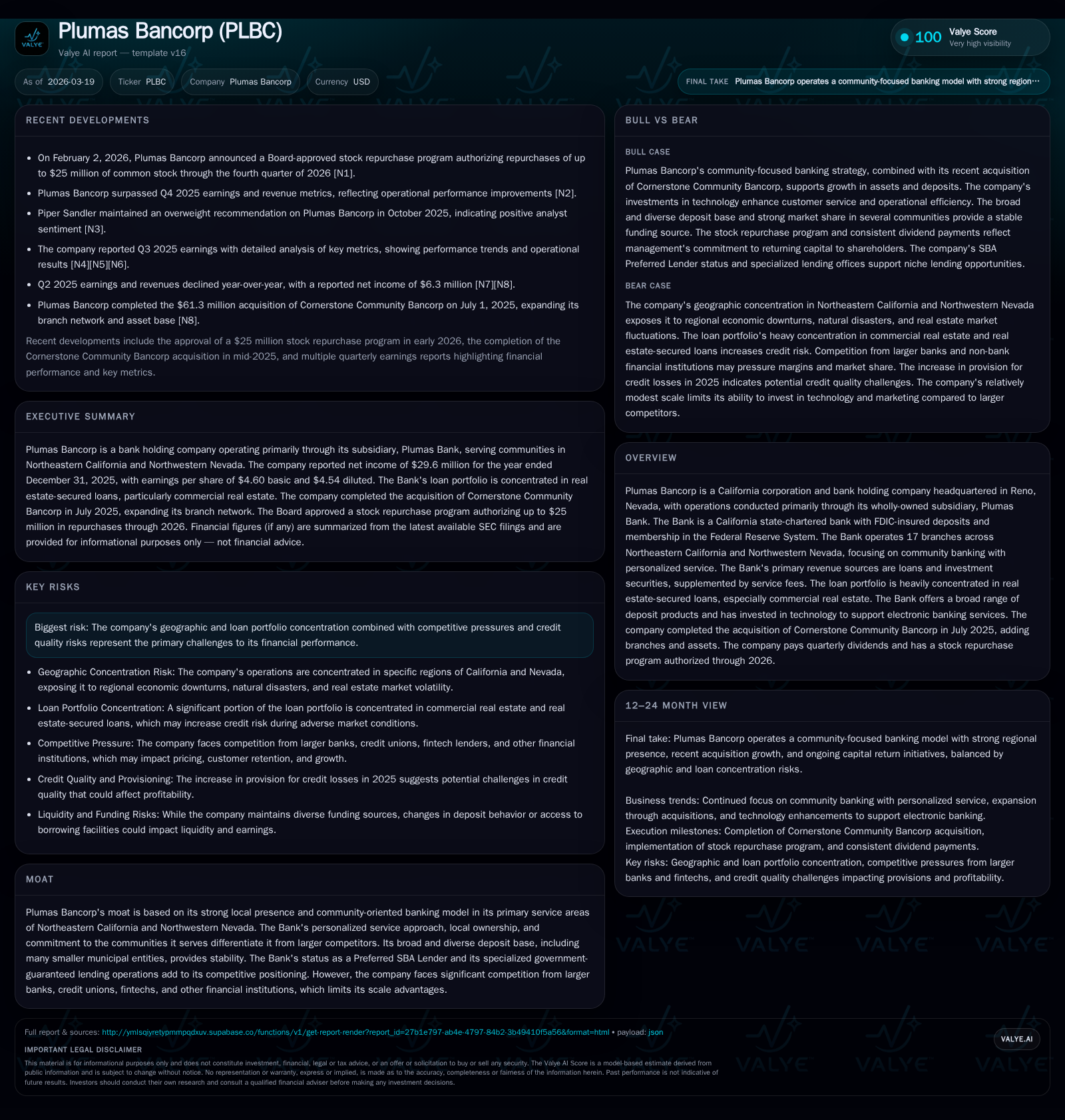
Plumas Bancorp, a California-focused community bank holding company headquartered in Reno, Nevada, demonstrated stable net income growth in 2025 driven by the strategic acquisition of Cornerstone Community Bancorp. The acquisition boosted assets by approximately $659 million and expanded its branch network, reinforcing its presence in Northeastern California and Northwestern Nevada. The company’s financials reveal robust capital ratios above regulatory minimums, steady deposit growth primarily from local businesses and municipalities, and a focused loan portfolio heavily weighted toward real estate-secured loans. Despite geographic and commercial real estate concentration risks alongside competitive pressures from larger banks and fintechs, Plumas Bancorp balances growth prospects with prudent capital allocation policies including dividends and share buybacks.
Company Overview and Historical Performance
Plumas Bancorp is a regional bank holding company operating primarily through its wholly-owned subsidiary Plumas Bank, a California state-chartered institution insured by the FDIC and member of the Federal Reserve System [S1]. Headquartered in Reno, Nevada, the Bank serves Northeastern California and Northwestern Nevada with a network of branches expanded following the July 2025 acquisition of Cornerstone Community Bancorp [N1][S19]. Its business model focuses on community banking with personalized service offerings targeted towards individuals, small- and medium-sized enterprises (SMEs), and smaller municipalities.
The acquisition added approximately $659 million in assets—including cash, investments, net loans, core deposit intangible, premises, equipment, insurance assets—and assumed about $581 million in deposits [S19]. As of December 31, 2025, total consolidated assets stood at approximately $2.24 billion with deposits at about $1.81 billion [F1][S23].
Historical performance (annual)
| FY | Net ($mm) | CFO ($mm) | Capex ($mm) | Net YoY |
|---|---|---|---|---|
| 2025 | 30 | 22 | 1 | +3.5% |
| 2024 | 29 | 31 | 1 | -3.9% |
| 2023 | 30 | 38 | 2 | +12.6% |
| 2022 | 26 | 57 | 3 |
Source: SEC companyfacts cache [F1].
Capital returns and efficiency (annual)
| FY | Div ($mm) | FCF ($mm) | ROE% |
|---|---|---|---|
| 2025 | 8 | 20 | 11.3 |
| 2024 | 6 | 30 | 16.1 |
| 2023 | 6 | 36 | 20.2 |
| 2022 | 4 | 54 | 22.2 |
Source: SEC companyfacts cache [F1].
Table: Summary financial performance highlights for Plumas Bancorp ([F1])
Net income showed modest growth of approximately 3.5% year-over-year to $29.6 million in FY2025 while operating cash flow declined roughly 29% reflecting higher integration-related expenses [F1]. Capital expenditures increased but remain moderate relative to cash flows [F1]. Equity rose significantly post-acquisition to $261 million from $178 million prior year due to stock issuance for merger consideration [S18]. Dividends paid totaled $7.7 million in fiscal year '25 consistent with a steady quarterly dividend policy [F1][S27].
Business Model & Competitive Positioning
Plumas Bancorp operates as an independent community bank emphasizing personal service within its geographic footprint [S1][S19]. The Bank's deposit base consists primarily of core deposits from individuals, local businesses, and smaller municipal entities resulting in relatively stable funding sources [S7]. Average deposit balances approximate $38,000 per account indicating broad retail/SME customer penetration.
The loan portfolio is concentrated notably in commercial real estate (CRE), comprising a significant multiple of the Bank's risk-based capital (~389%) which draws supervisory attention but is managed via established underwriting standards and quarterly portfolio reviews [S21][S28]. Variable-rate loans indexed mainly to prime or Treasury rates dominate the credit mix aiding interest rate risk management [S21].
Competition includes larger regional/national banks benefiting from scale advantages such as broader product offerings and higher lending limits as well as fintech entrants targeting digital-savvy customers [S16]. Plumas often arranges participations for loans exceeding legal lending limits due to these constraints.
Growth Prospects & Risks
Drivers
- Acquisition of Cornerstone bolsters market share and deposit base across Northern California/Nevada regions [N1][S19].
- Technology enhancements including international wire transfers and digital banking features aim to improve customer experience and retention [S19].
- Community banking focus on smaller municipalities offers relative deposit stability amid broader market volatility [S7].
Risks
- Geographic concentration subjects earnings to local economic cycles including real estate market fluctuations and agricultural commodity price shifts [S16].
- CRE concentration at nearly four times risk-based capital could lead to increased regulatory scrutiny or capital requirements limiting loan growth flexibility [S21][S28].
- Competitive pressure from larger banks’ scale economies and fintech innovations may challenge margin preservation and deposit growth [S16].
- Reliance on core deposits mitigates funding volatility but shifts toward higher-yield alternatives could pressure net interest margins [S11][S7].
Financial Position & Capital Allocation Strategy
As of December 31, 2025:[F1][S10][S13]
- Common Equity Tier I ratio: approximately 14.8%
- Total Risk-Based Capital ratio: approximately 18.5%
- Tier I leverage ratio: approximately 11.9% These ratios are well above Basel III well-capitalized thresholds including conservation buffers.
Liquidity is supported by unused borrowing capacity including up to $326 million from Federal Home Loan Bank advances (subject to additional stock purchase), unsecured short-term lines totaling $70 million from correspondent banks, and borrowing availability of about $39 million at the Federal Reserve Discount Window secured by investment securities [S4][S6][S7]. Cash holdings approximate $80 million providing additional liquidity cushions.
Repurchase agreements increased substantially post-acquisition reaching nearly $98 million at year-end due to conversion of reciprocal deposits assumed from Cornerstone [S8].
Capital allocation balances conservatism with shareholder returns:
- Quarterly dividends have been consistently paid totaling $7.7 million in fiscal '25 with slight increases per share recently [F1][S27].
- Board authorized a stock repurchase program up to $25 million early in '26 signaling confidence; however no shares have been repurchased yet reflecting cautious capital deployment amid integration efforts [N1][S27].
Industry Context Analysis
Operating primarily within localized Northern California/Nevada markets exposes Plumas Bancorp to region-specific economic cycles and natural disaster risks inherent in its concentrated footprint [S16]. The competitive environment features large banks with scale advantages alongside fintech firms innovating rapidly in digital banking services challenging traditional community banking models.
Concentration risks related to CRE portfolios require ongoing monitoring under regulatory guidance while balancing growth ambitions with asset quality vigilance—a common theme across mid-sized banks post-pandemic.
Outlook Considerations
Key factors influencing future performance include:
- Successful integration of Cornerstone acquisition impacting cost structures and revenue synergies.
- Local real estate market trends affecting credit quality given portfolio concentration.
- Regulatory developments around CRE concentrations possibly prompting higher capital buffers.
- Execution of share repurchases or dividend policy adjustments as signals of capital adequacy versus growth priorities.
- Adoption rate of digital banking enhancements relative to peers impacting competitive positioning.
Disclaimer: This report is prepared solely for informational purposes based on publicly filed SEC documents ([F1],[S#]) and news sources ([N#]). It does not constitute investment advice or recommendations nor analyze every financial nuance exhaustively due to data scope limitations.
Disclaimer: This is research-only, informational analysis and not investment advice. It may include AI-generated interpretation and general industry context. Always verify important details using primary sources.

Comments