
Chicago Atlantic BDC’s Reinvention of Specialty Finance in Regulated Sectors
Chicago Atlantic BDC leverages secured lending in underserved, complex sectors like cannabis to fuel robust earnings and portfolio growth.
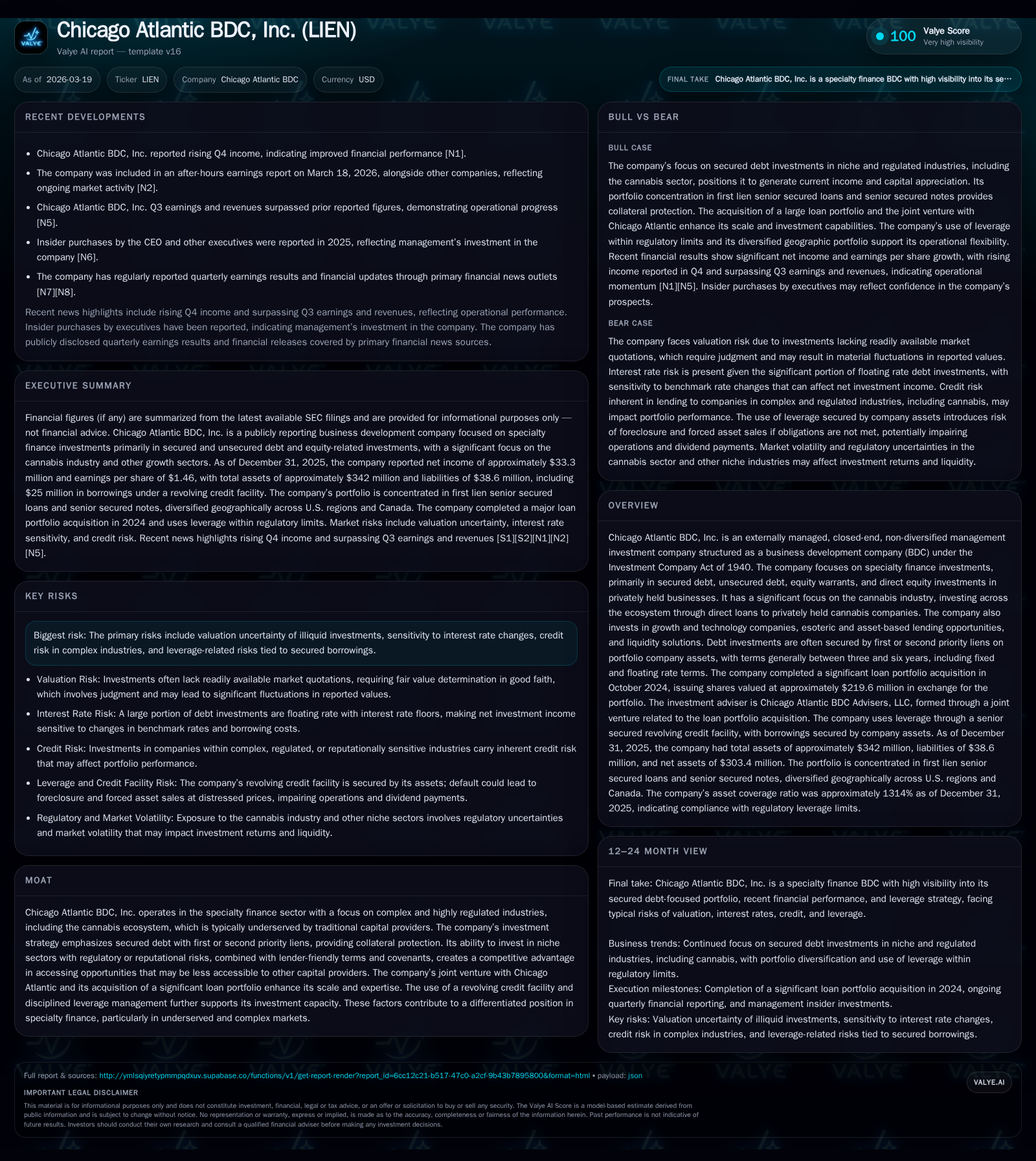
Chicago Atlantic BDC, Inc. has rapidly evolved from a start-up into a specialist lender focusing on highly regulated, niche industries such as the cannabis ecosystem. The company’s strategic use of secured debt investments, combined with portfolio acquisitions and a revolving credit facility, drove a significant net income surge from a loss in 2023 to over $33 million in 2025. While the firm faces risks tied to illiquid asset valuation and interest rate fluctuations, its robust capital structure and lender-friendly loan covenants underpin an attractive concentration in specialty finance.
Historical Growth Trajectory: From Start-Up to Specialist Lender
Founded in January 2021 as an externally managed business development company (BDC), Chicago Atlantic BDC, Inc. has positioned itself as a specialty finance player targeting niche sectors underserved by conventional lenders. The company’s hallmark has been its emphasis on secured debt investments within complex arenas — most notably the cannabis ecosystem — a sector traditionally starved of institutional capital due to federal regulatory constraints.
Financially, the trajectory exemplifies rapid maturation: net income evolved from a slight positive $1.9 million in 2022 to a loss of nearly $0.9 million in 2023 before exploding to $33.3 million by FY 2025 [F1]. This translates to a staggering approximately 3,705% year-over-year increase in net income over that interval. Equity levels mirrored this trend with a near quadrupling from roughly $85 million in 2023 to over $303 million by the end of 2025 [F1].
This profitability surge was fueled primarily by strategic portfolio acquisitions — including a transformative October 2024 purchase of a loan portfolio valued at approximately $219.6 million from Chicago Atlantic Loan Portfolio, LLC (CALP), compensated via equity issuance totaling more than 16.6 million shares [S23][F1]. These acquisitions bolstered asset scale and diversified Chicago Atlantic’s reach within secured lending.
Despite the impressive top-line improvement, operating cash flows have been uneven — including negative cash flows of about $20.5 million in 2025 — reflecting capital deployment dynamics inherent to BDC growth phases where investment outlays precede cash inflows from repayments or exits [F1]. This volatility is characteristic of specialty finance firms expanding into complex loans requiring extensive due diligence and management.
Historical performance (annual)
| FY | Net ($mm) | CFO ($mm) | Net YoY |
|---|---|---|---|
| 2025 | 33 | -20 | |
| 2024 | -5 | ||
| 2023 | -1 | 6 | -148.0% |
| 2022 | 2 | -50 |
Source: SEC companyfacts cache [F1].
Capital returns and efficiency (annual)
| FY | Div ($bn) | ROE% |
|---|---|---|
| 2025 | 11.0 | |
| 2024 | ||
| 2023 | 8.3 | -1.1 |
| 2022 | 0.0 | 2.2 |
Source: SEC companyfacts cache [F1].
Table: Annual financial results depict robust net income growth post major portfolio acquisition amid volatile cash flow patterns typical for BDCs.
Investment Focus: Navigating Cannabis and Esoteric Lending Opportunities
Chicago Atlantic BDC targets sectors where traditional banks typically hesitate due to regulatory complexity or reputational concerns. The core consists of secured loans prominently focused on the cannabis industry—providing direct loans collateralized predominantly by first or second priority liens on various assets excluding non-transferable cannabis licenses or inventory restricted by law [S1]. Terms generally range between three and six years.
Collateral often includes real estate holdings alongside tangible assets such as equipment and intangibles like intellectual property rights and receivables—a hallmark trait facilitating lender protections amidst sector-specific risks.
The company’s loan book contains both fixed- and floating-rate loans subject to interest rate floors mitigating downside cost exposures amid volatile rates common post-pandemic monetary tightening cycles [S1]. Additionally noted are "covenant-lite" structures—loans lacking comprehensive financial maintenance covenants—though these represent minority exposures given the firm's emphasis on lender-friendly terms designed to safeguard downside risk.
Beyond cannabis ventures, Chicago Atlantic allocates capital toward growth technology companies—particularly those with evidence of substantial equity raises validating market standing—and esoteric asset-backed lending opportunities wherein underlying collateral quality offsets unique industry risks such as regulatory uncertainty [S26]. The liquidity solutions arm focuses on event-driven financing needs with quick turnaround profiles tied to mergers or refinancing actions.
This multifaceted strategy allows diversification across sub-sectors while partnering with borrowers requiring sophisticated financing structures normally unavailable through traditional banking conduits.
Recent Financial Results: Profit Surge and Portfolio Evolution
According to the Q4 FY25 release [N4], income surged significantly partly ascribed to rising interest income stemming from an expanded loan portfolio following the strategic October 2024 acquisition mentioned earlier. This sizable addition elevated total assets above $340 million by year-end while boosting net investment income despite higher financing costs inherent to leverage usage.
Loan composition shifted slightly toward increased fixed-rate allocations within senior secured tranches—currently comprising nearly $94 million principal balance—and a substantial floating-rate constituency pegged primarily to PRIME or SOFR benchmarks amounting collectively upwards of $239 million [S8][S19]. Importantly floating rate loans benefit from contractual interest rate floors preserving yield sustainability even if benchmark rates retreat temporarily.
As detailed in their MD&A section [S3], although operational expenses related to financing costs climbed (notably commitment fees for the credit facility), the net effect remained accretive due to enhanced portfolio yield spreads and prudent credit selection evidenced by low delinquency/investment loss signals thus far.
Leverage Framework and Capital Structure: Managing Risks Through Revolving Credit
Central to Chicago Atlantic’s capital strategy is its senior secured revolving credit agreement initiated February 2025 providing up to $100 million capacity with customary provisions for letters of credit totaling up to $5 million [S2][S12]. As of December 31, 2025, borrowings stood at $25 million on this facility backed by all company assets pledged as collateral ensuring lender priority rights under default scenarios.
Interest expense components encompass SOFR plus premiums capped by minimum floor rates averaging about a total all-in cost near 6.7% annually at YE25—with amortization costs of deferred financing fees elevating effective rate marginally higher than pure cash coupon expenditures [S12][S27]. Covenants include standard affirmative/negative clauses common among revolving lines emphasizing limits on additional indebtedness and lien incurrence safeguarding asset coverage ratios essential for maintaining flexibility.
Leverage prudence emerges from management's view that borrowing will only occur when anticipated returns surpass associated funding costs signifying disciplined deployment rather than aggressive gearing which could amplify losses under credit stress periods [S5][S9]. Moreover potential foreclosure risk linked with secured credit facilities introduces downside liquidity risk necessitating ongoing covenant compliance monitoring for sustained operations continuity.
Dividend Policy and Shareholder Returns: Tracking Distribution Dynamics
The company operates an “opt out” dividend reinvestment plan (DRIP)—defaulting investors into share reinvestment unless opting otherwise—which affects how distributions reach shareholders practically impacting yield profiles [S5].
Reported dividends paid approximated $23.3 million for FY25 aligning coherently with current earnings generation fostering sustainable shareholder returns while preserving capital for internal reinvestment opportunities amidst portfolio scaling efforts [F1][S5].
Growth Outlook: Catalysts and Caution Points for 2026 and Beyond
Explicit formal forecasts are absent; however recent communications flag expanding opportunities within nascent cannabis markets propelled by gradual state-level regulatory easing creating broader financing demand enhancing prime lending pipelines across private cannabis operators [N4][S1]. Moreover enhanced sophistication in loan covenant structures suggests managerial acumen adapting underwriting rigor alongside sector maturation potentially insulating downside exposures over medium term horizons.
Conversely challenges remain such as macroeconomic headwinds including spotty credit access for cannabis ventures due to unresolved federal statutes plus inherent complexity valuing illiquid private debt instruments rendering volatility possible in mark-to-market net asset valuations affecting reported equity metrics particularly during turbulent market episodes [S13]. Strategic attention will also track interest rate environments impacting floating rate returns versus revolving credit costs especially if economic conditions prompt aggressive Fed tightening sequences diverging significantly from current baseline assumptions.
Strategic Challenges: Valuation Uncertainties and Interest Rate Sensitivity
Key risk exposures stem from valuation ambiguities intrinsic to private debt portfolios lacking public market quotations necessitating subjective fair value assessments applying consistent internal methodologies yet still vulnerable to material discrepancies under stressed assumptions or deteriorated borrower fundamentals [S1][S13]. Interest rate risk also features prominently given substantial floating-rate loan weighting (~72%), albeit mitigated somewhat via embedded interest floors keeping yields above base thresholds during easing cycles but subjecting earnings variability during rapid rate climb phases typical after monetary policy tightening waves [S1].
Leverage use compounds these sensitivities as cost-of-funds variability impacts net investment income margins directly tied to spread differentials between loan yields and borrowing costs under their revolver facility capped currently at about mid-6% range inclusive of fees/amortizations though this may evolve as credit markets shift directionally affecting refinancing ability/terms if needed pre-maturity events arise [S12][S25]. Overall prudence dictates continuous monitoring amid external regulatory uncertainties combining with evolving competitive landscapes especially given specialized borrower profiles often concentrated within few larger counterparties accounting for meaningful portions of book value introducing concentration risk factors materializing under downturn scenarios [S18].
This analysis is based solely on publicly available data without recommendations or price targets. It aims to provide structured insight respecting Chicago Atlantic BDC’s operational model within specialty finance leveraging secured loans amid the evolving regulated industries landscape.
Disclaimer: This is research-only, informational analysis and not investment advice. It may include AI-generated interpretation and general industry context. Always verify important details using primary sources.

Comments