
Natural Gas Services Group Confronts Rental Fleet Expansion Amid Rising Capex and Customer Concentration Risks
NGS’s growth relies on expanding a specialized compressor rental fleet amid rising capital demands and revenue concentration in top clients.
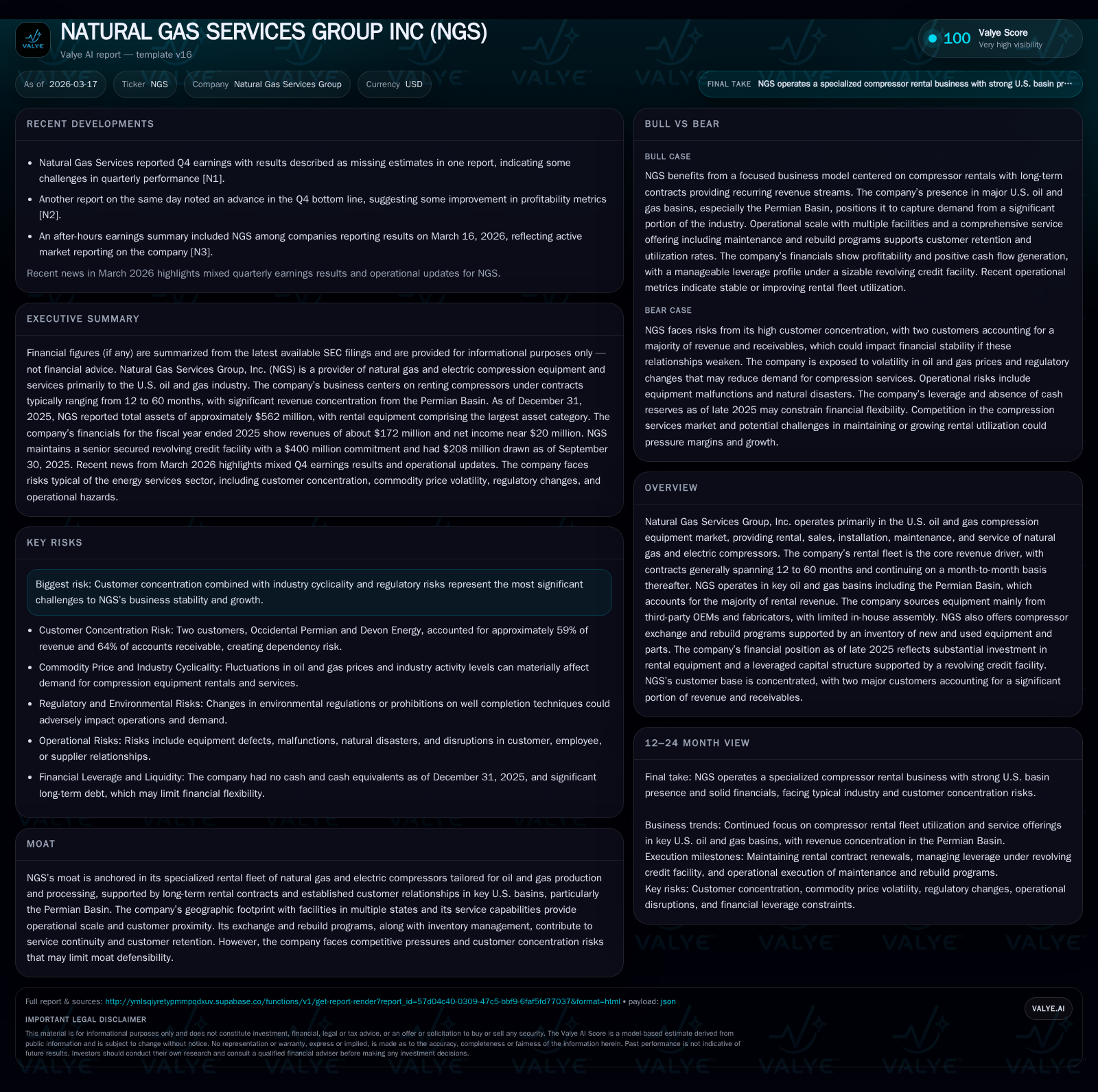
Natural Gas Services Group, Inc. (NGS) demonstrated near double-digit revenue growth in 2025 driven by increased rental utilization and fleet horsepower, primarily servicing major customers in the Permian Basin. The company’s core business centers on long-term compressor rentals supported by ongoing maintenance and rebuild programs. However, a surge in capital expenditures to expand the rental fleet has led to negative free cash flow despite strong operating cash flow, while customer concentration and cyclicality in oil and gas production pose structural risks. Monitoring unit utilization trends, contract renewals, and capital discipline will be essential as NGS navigates its growth trajectory.
Historical Performance and Revenue Drivers
Historical performance (annual)
| FY | Rev ($mm) | Net ($mm) | CFO ($mm) | OpInc ($mm) | Rev YoY | Net YoY |
|---|---|---|---|---|---|---|
| 2025 | 172 | 20 | 63 | 37 | +9.9% | +15.7% |
| 2024 | 157 | 17 | 66 | 33 | +29.4% | +262.9% |
| 2023 | 121 | 5 | 18 | 10 | +42.8% | +934.3% |
| 2022 | 85 | -1 | 28 | 0 |
Source: SEC companyfacts cache [F1].
Capital returns and efficiency (annual)
| FY | Buybacks ($mm) | FCF ($mm) | ROE% |
|---|---|---|---|
| 2025 | -59 | 7.3 | |
| 2024 | 0 | -5 | 6.8 |
| 2023 | 0 | -136 | 2.0 |
| 2022 | 7 | -37 | -0.2 |
Source: SEC companyfacts cache [F1].
Natural Gas Services Group (NGS) has established itself as a notable player in the natural gas compression equipment market, particularly within oil- and gas-rich U.S. basins such as the Permian. Over the last several years, the company has achieved material growth in revenue and profitability metrics.
In fiscal year (FY) 2025, NGS generated total revenue of $172.3 million, up approximately 9.9% from $156.7 million in FY 2024 and nearly doubling from FY 2022’s $84.8 million [F1]. This revenue expansion was primarily fueled by an increase in rental compressor unit utilization — both horsepower rented and number of active units — reflecting steady demand for compression services to support oilfield production activities.
Operating income rose to $37.3 million in FY 2025, a solid gain of roughly 11.9% year-over-year compared to $33.3 million for FY 2024 [F1]. Net income followed suit with a more pronounced increase of about 15.7%, reaching $19.9 million [F1]. These improvements stem from enhanced rental adjusted gross margins driven by higher utilization levels and selective emphasis on larger horsepower units which command better pricing.
Rental revenues represented approximately 95%+ of total company revenues during this period, underscoring the company's heavy dependence on operational leases rather than equipment sales or aftermarket services [S18],[S22]. Rental contracts conventionally span initial terms between one to five years with extension via month-to-month renewals thereafter [S18].
Rental Fleet Utilization and Unit Economics
Key performance indicators reveal an increase in rented horsepower to roughly 526k at September 30, 2025 versus ~475k one year prior — a roughly 10% uplift [S26]. Utilization percentages improved modestly to over 84%, indicating efficient deployment of assets without proportionate idle time.
While absolute costs of rentals rose due to inflationary pressures on labor and parts expenses, these were largely offset through integration of proprietary System Management and Recovery Technology (SMART) with telemetry software optimizing maintenance scheduling and reducing unplanned downtime [S14]. Adjusted gross margin on rentals improved both in absolute dollar terms and as a percentage (~61%) compared to prior periods, confirming that incremental fleet additions maintain profitability [S16].
The rental fleet expansion was supported by substantial capital investment; fiscal capex surged by about 69% to $121.5 million relative to prior year $71.9 million [F1]. This spending mainly focused on new compressor units and refurbishing existing assets to meet technical specifications demanded by upstream operators.
Capital Structure and Liquidity
NGS leverages a senior secured revolving credit facility with Texas Capital Bank featuring a total commitment level raised to $400 million as of April 2025 (from previous $300 million), plus an accordion feature up to an additional $100 million subject to lender approval [S4],[S9].
As of September 30, 2025, borrowings against this facility stood at approximately $208 million at a weighted average interest rate near 7%, leaving around $163 million capacity available under borrowing base calculations tied to accounts receivable, inventory, and fleet book values [S4],[S9]. The maturity date extends through early 2028.
Despite solid operating cash flow of $62.9 million reported for FY 2025, free cash flow was negative by about $58.6 million due to elevated capital expenditures aimed at enlarging the rental fleet [F1]. This funding mix reflects investments to capture rising industry activity but bears close monitoring given working capital demands inherent in equipment financing.
NGS maintains adequate current liquidity with a current ratio around 2.33 supported by current assets exceeding current liabilities significantly ($57.1M vs ~$24.5M) [F1].
Customer Concentration & Geographic Footprint
The company’s revenue generation is highly concentrated among two principal customers — Occidental Permian (Oxy) and Devon Energy — which together contribute roughly 59% of combined rental revenues during nine-month periods ending September 30, consistent with previous years [S11],[S26]. Likewise, accounts receivable exposure is similarly concentrated around these clients, representing over 60% collectively.
Geographically, NGS operates service facilities across five U.S. states: Texas, Oklahoma, New Mexico, Michigan, and Ohio, centered primarily around prolific oil- and gas-producing basins such as the Permian Basin which accounts for about three-quarters of its rental revenues [S12],[S26],[N7]. This footprint affords operational scale proximity advantages but also exposes it regionally alongside client risk profiles.
Growth Prospects & Industry Dynamics
Future growth drivers hinge upon continued upstream investment activity supporting oilfield development projects requiring compression solutions as well as leveraging longer-term rental contracts beyond their primary term into month-to-month renewals.
Ongoing shale gas developments within regions like the Marcellus Shale reinforce demand for smaller- and medium-horsepower units complementing larger engines favored for oil production operations based mainly in west Texas shale formations [S22].
Adjusted EBITDA gains are aided by technology upgrades (e.g., SMART systems) boosting uptime reliability and cost-efficiency enabling better margins despite inflationary pressures noted elsewhere in labor or parts costs [S14],[S16].
However, key constraints involve commodity commodity price volatility driving overall upstream capex - historically cyclical - regulatory uncertainties related to environmental compliance impacting well completion techniques or emissions policies may affect demand patterns [S10],[N8]. Also troubling is high revenue reliance on limited top customers potentially capping growth scalability absent diversification.
Forecasts & Milestones To Watch (Analysis)
Public disclosures have not included explicit earnings guidance or milestone projections beyond reporting quarterly earnings that revealed some margin tightening pressures yet bottom line advances recently [N1],[N7]. Investors should monitor:
- Trends in rented horsepower utilization rates,
- Contract renewal cadence post initial terms,
- Capital expenditure pacing relative to free cash flow generation,
- Customer diversification efforts,
- Pricing power amidst competitor activity,
- Regulatory developments affecting drilling or compression technology use,
- Market signals regarding oil/gas production outlook influencing equipment demand.
Subsequent quarterly reports will clarify whether elevated capex stabilizes or persists as NGS expands fleet capacity aligned with market conditions.
Returns & Capital Allocation
With net income growing faster than equity increases through FY25 ($19.9M net vs ~$274.7M equity), approximate return on equity stands near a modest but positive ~7.3%, implying effective deployment though room exists for improvement typical for asset-heavy industrial services businesses [F1].
Operationally strong cash flow generation contrasts against capex outflows resulting in consistent negative free cash flow positioning implied prioritization of expansion over shareholder returns currently [F1],[S29].
Dividend payments have been made but appear modest relative to net earnings; no share repurchases disclosed recently suggesting capital deployed favorably into organic asset buildout rather than buybacks [N11],[N12],[F1].
Management’s ongoing challenge will balance sustaining attractive returns while maintaining manageable leverage amid cyclical revenue swings.
Risks & Challenges Summary
Primary headwinds rest with:
- Customer concentration risk given reliance on two key producers,
- Oil and natural gas market cyclicality influencing upstream capex budgets,
- Inflation-induced cost increases for maintenance personnel/parts affecting margins,
- Regulatory landscape evolving around environmental standards applicable to hydraulic fracturing/compression emissions,
- Potential delays or defaults post-rental contract expiry impacting utilization rates,
- High capital intensity necessitating continual debt financing creating leverage risk.
While NGS attempts mitigation via proprietary fleet management tech improving operational efficiency along with geographic presence/G&A control measures these factors underscore sector susceptibility requiring vigilant monitoring.
Conclusion
Natural Gas Services Group has effectively scaled its specialized compressor rental franchise capitalizing on strong demand dynamics chiefly concentrated within large oil-producing basins like the Permian. Its financial results showcase revenue growth paired with solid profitability gains underpinning the core leasing business model.
However significant investments required for fleet expansion strain free cash flow generation despite solid operating cash inflows—accentuating financial leverage risks coupled with client concentration vulnerabilities.
The firm’s future depends heavily on maintaining high utilization across larger horsepower units underpinned by strategic contract term management amid volatile energy markets potentially tempered by regulatory shifts — all while balancing prudent capital deployment amid inflationary cost pressures.
This analysis is intended solely for informational purposes based on available filings ([F1], [S#]) and reported news ([N#]) through March 17, 2026; it contains no investment advice or recommendations.
Disclaimer: This is research-only, informational analysis and not investment advice. It may include AI-generated interpretation and general industry context. Always verify important details using primary sources.

Comments