
Trevi Therapeutics’ Clinical Progress and Financial Trajectory in IPF-Related Chronic Cough
Trevi Therapeutics advances nalbuphine ER toward pivotal Phase 3 trials while managing operational losses supported by a strong liquidity position.
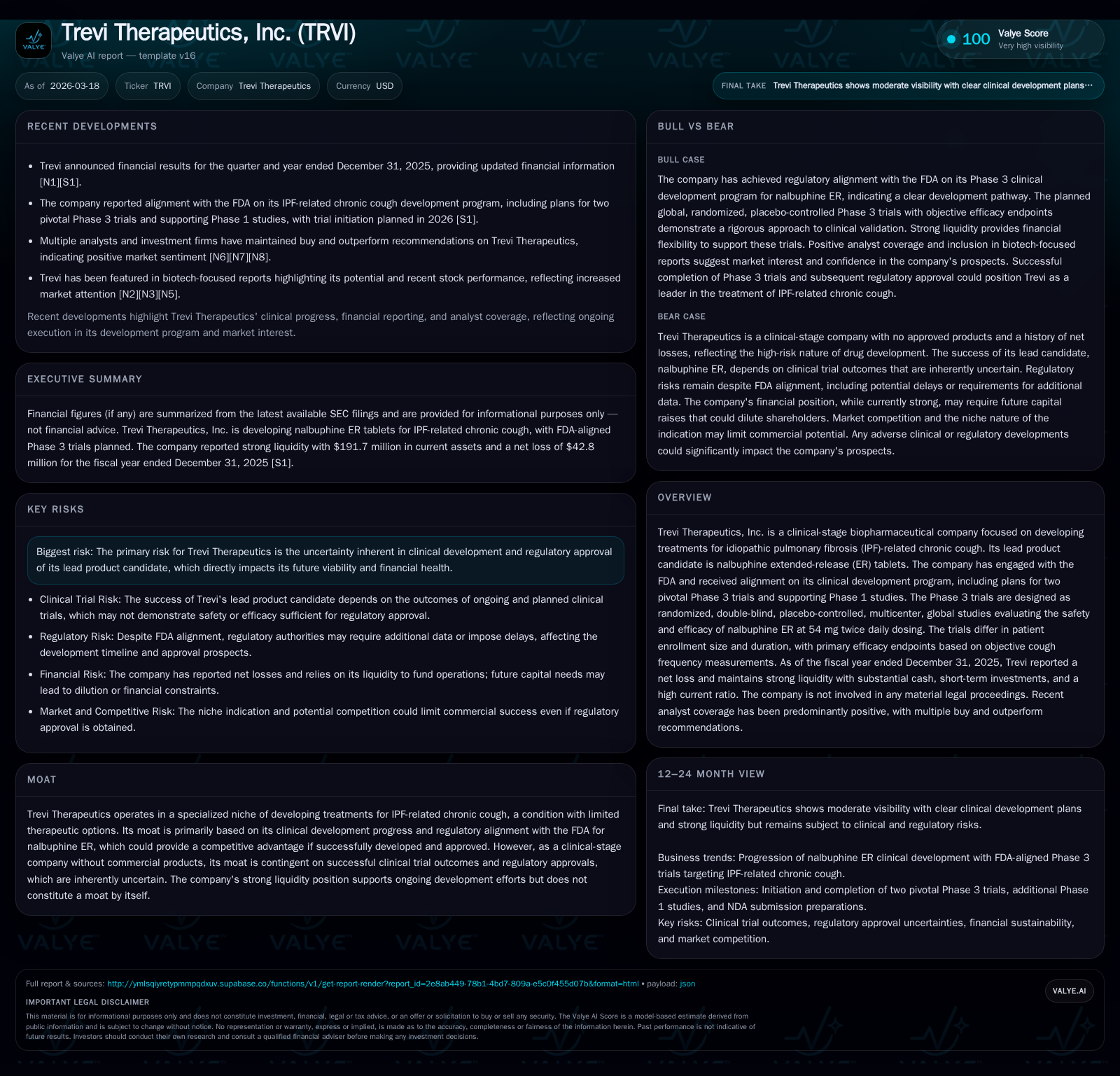
Trevi Therapeutics, a clinical-stage biopharmaceutical company targeting idiopathic pulmonary fibrosis (IPF)-related chronic cough, is preparing to initiate two pivotal global Phase 3 trials of its lead candidate nalbuphine extended-release (ER) tablets in 2026 with FDA alignment. The company continues to incur growing operating losses as it invests in late-stage development but maintains a robust liquidity runway with strong current assets relative to liabilities. Key near-term milestones include trial initiations and interim data monitoring, which will critically shape Trevi's regulatory and commercial outlook. The path remains contingent on trial success amid typical clinical-stage risks.
A Targeted Solution for IPF-Related Chronic Cough
Trevi Therapeutics operates within a narrowly defined clinical niche addressing idiopathic pulmonary fibrosis (IPF)-related chronic cough, a debilitating symptom with scarce therapeutic options currently available. Their lead asset, nalbuphine extended-release (ER) tablets, is positioned as a potential first-in-class therapy targeting this unmet medical need [N1][S9][S14]. This concentration on a single indication underscores Trevi's strategic moat—contingent on translating promising early-phase data into successful pivotal trial outcomes and regulatory approvals.
The company’s engagement with the U.S. Food and Drug Administration has yielded alignment on its clinical development pathway post-End-of-Phase 2 meeting. Notably, approval from regulatory authorities on trial design underpins confidence in advancing nalbuphine ER through rigorous efficacy and safety evaluation [S15]. However, Trevi must still navigate typical clinical-stage uncertainties.
Analysis of Historical Financial Performance and Income Trends
Trevi's financial trajectory from FY2022 through FY2025 reveals escalating operating and net losses consistent with intensifying investment in its clinical pipeline. The following table encapsulates key annual financial metrics:[F1]
Historical performance (annual)
| FY | Net ($mm) | CFO ($mm) | OpInc ($mm) | Capex ($) | Net YoY |
|---|---|---|---|---|---|
| 2025 | -43 | -42 | -49 | 12000 | +10.8% |
| 2024 | -48 | -38 | -52 | 35000 | -64.8% |
| 2023 | -29 | -32 | -34 | 137000 | +0.3% |
| 2022 | -29 | -28 | -30 | 159000 |
Source: SEC companyfacts cache [F1].
Capital returns and efficiency (annual)
| FY | FCF ($mm) | ROE% |
|---|---|---|
| 2025 | -42 | -23.3 |
| 2024 | -38 | -48.1 |
| 2023 | -32 | -35.2 |
| 2022 | -28 | -27.1 |
Source: SEC companyfacts cache [F1].
Operating losses have increased moderately from approximately $29.9 million in FY2022 to $49.3 million in FY2025 as R&D spend intensified towards late-stage studies. Net income loss expanded similarly but at a slightly lower trajectory reflecting other income/expense dynamics.
Operating cash flow outflows rose roughly 10% year-over-year into FY2025 despite capex expenditures shrinking sharply—now negligible—signaling the business burns primarily through operational activities rather than investing cash demands at this stage.
Current Clinical Trial Strategy and FDA Alignment
Recent disclosures confirm Trevi’s plan to initiate two pivotal Phase 3 trials evaluating nalbuphine ER dosing at 54 mg twice daily for IPF-related chronic cough starting mid-2026 [N1][S9][S15]. Both studies are randomized double-blind placebo-controlled designs conducted across multiple global centers.
The larger Phase 3 trial intends to enroll about 300 patients with an extended follow-up of up to one year with the primary efficacy endpoint assessed at six months based on relative changes in objective cough monitoring frequency over a full day. The smaller Phase 3 trial will enroll approximately 130 patients over a shorter fixed dosing interval of three months [S15]. Patients will be randomized two-to-one in favor of active treatment.
FDA’s protocol support lends regulatory validation to the study constructs but final protocol clearance remains pending [S15], implying some residual protocol risk ahead. Cough frequency quantified via digital cough monitors exemplifies objective endpoint capture—a standard increasingly employed across respiratory symptom trials to overcome subjective bias challenges.
Future Growth Prospects and Regulatory Considerations
The immediate growth vector hinges on successful Phase 3 initiation slated for Q2 and H2 of 2026 paired with accrual milestones that could prime Trevi for an NDA submission pathway pending positive efficacy and safety findings [N1][S9][S15]. Complementary Phase 1 supportive studies remain planned ahead of the submission package.
Growth catalysts beyond trial initiation encompass potential label expansion discussions conditional on data robustness as well as prospective geographic market entries where IPF treatment standards differ—a typical analytic consideration in biopharma product rollouts.
Regulatory considerations extend beyond routine approval risks given the niche indication status; however orphan drug or fast-track designations may be relevant avenues though not explicitly referenced here. Clinical outcome variability intrinsic to symptomatic endpoints like cough further complicates forecasting.
Capital Structure, Cash Runway, and Allocation Priorities
Treasury strength remains one of Trevi’s salient financial attributes heading into critical clinical phases. As of December 31, 2025:
- Cash & equivalents stood at $18.9 million;
- Total current assets were approximately $191.7 million versus current liabilities near $9.7 million;
- Resulting current ratio approximated an exceptionally healthy ~19.7 [F1][S11][S16][S18], underscoring ample short-term liquidity coverage.
Total equity surged from roughly $99.6 million at end-2024 to $183.2 million by end-2025 [F1], likely attributable to financing rounds that bolster funding capacity amidst intensifying operating burn.
Capital expenditures remain minimal relative to operating expenses reflecting intensive research-driven spending rather than physical asset acquisition [F1].
Capital allocation has been exclusively directed toward clinical development efforts without any reported dividends or share buyback programs during recent periods [S20][S21][S22]. This prioritization aligns with sustaining operations amid ongoing negative cash flows exceeding $42 million annually.
Market Positioning Risks and Development Execution Challenges
Trevi faces inherent high-risk exposures typical of clinical-stage biopharmaceutical companies specializing in orphan or niche diseases such as IPF-related chronic cough [S4][S12][S13][S14]. Principal risks revolve around:
- Uncertainty of favorable Phase 3 outcomes and corresponding FDA acceptance;
- Competitive pressures within symptomatic treatment spheres where few options currently exist but potential entrants or alternative approaches could arise;
- Regulatory hurdles given endpoint novelty and symptom variability;
- Operational execution risks including patient enrollment pacing across multiple geographies;
- Financing risk should capital markets conditions deteriorate leading up to commercialization attempts.
Mitigation is partly provided by FDA alignment achieved recently but the overall risk profile remains elevated pending conclusive proof-of-concept at scale.
Key Milestones to Monitor and Analytical Outlook
Investors should closely track several near-term inflection points defining Trevi’s progression:
- Initiation of the first Phase 3 trial targeted for Q2 2026,
- Commencement of second Phase 3 trial planned later in calendar year,
- Interim safety or efficacy data announcements if applicable,
- Completion of supportive Phase 1 studies feeding into NDA submission frameworks [N4][N2][S3].
While no explicit forecast or guidance figures are disclosed beyond these structural milestones [N1][S9], public commentary suggests analyst focus on enrollment pace and tolerability signals as critical gauges ahead.
Positive trial outcomes would markedly enhance Trevi’s commercial viability prospects given the lack of approved therapies specifically addressing IPF-related chronic cough symptoms. Conversely, delays or negative results would exacerbate financial strain amid limited near-term alternative revenue sources.
Ultimately, Trevi Therapeutics sits at a strategic juncture where pipeline progression dictates not only scientific validation but also sustained financial operational feasibility.
Disclaimer: This analysis is based solely on information publicly disclosed through SEC filings and reputable news sources as cited herein. It does not constitute investment advice nor a recommendation regarding securities of Trevi Therapeutics.
Disclaimer: This is research-only, informational analysis and not investment advice. It may include AI-generated interpretation and general industry context. Always verify important details using primary sources.

Comments