
Alto Neuroscience’s Biomarker-Driven Psychiatry Ambitions Tested by Capital and Clinical Challenges
Alto Neuroscience leverages its Precision Psychiatry Platform to develop treatments for resistant depression while managing significant financial losses and operational risks.
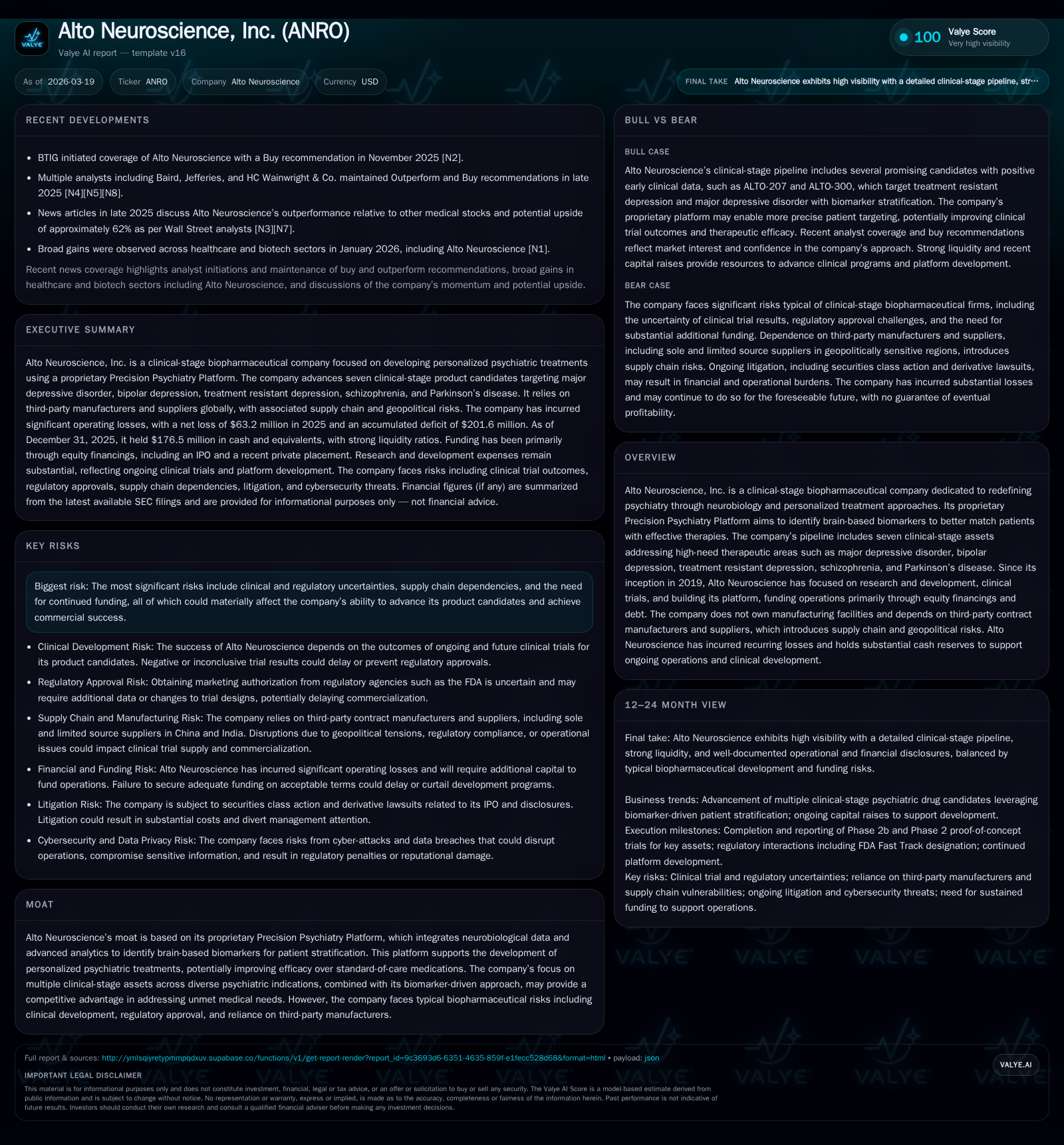
Founded in 2019, Alto Neuroscience has rapidly built a diversified pipeline of seven clinical-stage neuropsychiatric assets centered on its proprietary biomarker-based Precision Psychiatry Platform. The company’s lead candidate, ALTO-207, targets treatment-resistant depression (TRD) with upcoming pivotal Phase 2b and Phase 3 trials expected starting 2026 and 2027 respectively. Despite advancing clinical programs, Alto continues to operate at a loss with negative cash flows financed through equity raises and debt. Key challenges include obtaining regulatory approval for companion diagnostics integral to their personalized medicine approach, supply chain dependencies on contract manufacturers, and high R&D burn requiring recurrent capital inflows. Upcoming milestones around trial readouts and FDA engagements will materially influence the firm’s path toward commercialization.
From Startup to Clinical Stage: Alto’s Rapid Pipeline Expansion Since 2019
Founded in 2019, Alto Neuroscience has positioned itself as an innovator in neuropsychiatry through an aggressive buildout of a pipeline targeting highly unmet needs such as major depressive disorder (MDD), bipolar depression (BPD), treatment-resistant depression (TRD), schizophrenia, and Parkinson's disease-related neuropsychiatric symptoms [S1][S2]. The company has devoted substantially all resources to research and development since inception. This focus is reflected in recurring net losses exceeding $60 million annually ($61.4M in 2024 versus $63.2M in 2025) without any revenue generation from product sales yet [F1].
Cash burn driven by clinical trials reflects advancement of seven clinical-stage assets alongside continuous investment into their proprietary Precision Psychiatry Platform. Capital expenditures declined sharply from approximately $2.08 million in fiscal year (FY) 2024 to about $24 thousand in FY2025, signaling prioritization of funding trial progression over infrastructure expansion [F1][S12]. Equity financings including an IPO in early 2024 and a sizeable private placement (~$50 million gross) in October 2025 underpin this runway alongside debt arrangements providing financial flexibility [S1][S2][F1].
Historical performance (annual)
| FY | Net ($mm) | CFO ($mm) | OpInc ($mm) | Capex ($mm) | Net YoY |
|---|---|---|---|---|---|
| 2025 | -63 | -52 | -66 | 0 | -2.9% |
| 2024 | -61 | -47 | -69 | 2 |
Source: SEC companyfacts cache [F1].
Capital returns and efficiency (annual)
| FY | FCF ($mm) | ROE% |
|---|---|---|
| 2025 | -52 | -41.8 |
| 2024 | -49 | -40.6 |
Source: SEC companyfacts cache [F1].
Table shows annual financial performance reflecting consistent operating losses due to developmental focus [F1].
Precision Psychiatry Platform: Differentiating Through Brain-based Biomarkers
Central to Alto’s strategy is its Precision Psychiatry Platform — a scalable technology integrating neurobiological data with advanced analytics to identify brain-based biomarkers for patient stratification [S1][S2]. This approach aims to overcome traditional psychiatry’s reliance on symptom-based diagnosis by enabling targeted therapeutics tailored to biological subtypes.
Biomarker-driven drug development increasingly demands companion diagnostics approved alongside therapeutics. Alto anticipates initiating FDA discussions regarding companion diagnostics following Phase 2 meetings for candidates ALTO-100 and ALTO-300, highlighting regulatory complexity inherent to validating this platform-centric approach [S1][S2]. Delays or failures in companion diagnostic approval could materially impede market entry.
Clinical Programs Spotlight: ALTO-207 and the Quest for Treatment-Resistant Depression
The flagship candidate ALTO-207 was acquired from Chase Therapeutics Corporation in mid-2025; it combines pramipexole — a dopamine D3-preferring agonist with known antidepressant effects — with ondansetron, an antiemetic designed to mitigate typical pramipexole side effects allowing rapid dose escalation [S2]. This fixed-dose combination addresses the significant unmet need among TRD patients unresponsive to existing therapies.
Preliminary Phase 2a data using CTC-501 (pre-acquisition designation) showed statistically significant improvements on primary scales evaluating depressive symptoms in a small randomized placebo-controlled cohort of 32 patients [S2]. Building on this signal, pivotal Phase 2b studies are planned to commence H1 2026 with potential FDA feedback qualifying these as registrational trials.
Subsequent Phase 3 trials target early 2027 following protocol alignment with FDA requirements [S2]. The combination's rapid titration capability offers practical advantages addressing tolerability issues common with traditional dopamine agonists.
Financial Trajectory: Analysis of Losses, Cash Flows, and Recent Private Placement
Alto Neuroscience has consistently reported net operating losses reflective of its clinical-stage focus without commercial revenues. Operating income improved modestly by approximately 3.3% from -$68.6 million in FY24 to -$66.4 million in FY25 [F1]. Net income declined somewhat due to increased non-operating expenses ending at -$63.2 million compared to -$61.4 million the prior year [F1].
Operating cash flow deteriorated further by over 9%, totaling nearly -$52 million consistent with expanded clinical activities [F1]. Capital expenditures dropped precipitously as noted earlier.
Liquidity remains robust given a current ratio above 15x derived from cash and equivalents near $176 million against current liabilities just over $11 million at year-end 2025 [F1]. This strong short-term balance sheet position is supported by recent capital raising activities including the October 2025 private placement that netted approximately $49.7 million gross proceeds through sale of common stock and pre-funded warrants at roughly $5.91 per share/warrant [S1][S2], as well as ongoing credit facilities established since late 2022 with amendments providing term loans up to $75 million total availability [S7][S10][S11].
No dividends or share repurchases have been authorized or executed as typical for development-stage biopharmaceutical firms prioritizing capital deployment toward R&D [S23]. Return metrics such as ROE remain deeply negative at about -42%, consistent with ongoing investment into pipeline maturation rather than profitability at this stage [F1][S23].
Balancing Growth Drivers Against Regulatory and Manufacturing Risks
Alto's growth prospects depend fundamentally on transitioning clinical candidates successfully through costly late-phase trials while validating the Precision Psychiatry Platform’s biomarker utility under regulatory scrutiny [S4][S6][S20]. The necessity of companion diagnostics poses additional layers of complexity — if regulators delay or reject associated diagnostic approvals, adoption hurdles could widen considerably.
Manufacturing risks compound these challenges given Alto’s reliance on third-party contract manufacturing organizations (CMOs) for product supply rather than owning internal production facilities [S1][S20]. This dependency exposes operations to supply chain disruptions exacerbated by geopolitical tensions or industry-wide material shortages.
The company also faces standard biopharma risks including adverse trial outcomes or longer-than-expected timelines that could impair capital efficiency or market positioning.
Capital Allocation Strategy and Capital Structure Overview
Capital raised historically via equity issuance—such as IPO proceeds ($133 million net after costs raised February 2024)—and sizeable private placements feed primarily into expensive clinical trial progression costs as well as incremental investments into biomarker platform refinement [S1][S14]. Additional funds support licensing fees tied to acquisitions like ALTO-207 alongside expanding governance structures suitable for public companies.
Debt financing through an amended credit facility provides further runway but imposes covenants such as maintaining minimum cash runway levels (>5 months), restricting certain corporate actions until trigger events such as market capitalization thresholds are met ($700 million) easing obligations temporarily [S7][S10][S11][S18][S22].
Financial discipline is reflected by zero payments toward dividends or buybacks revealing prioritization of capital towards operational necessities—a norm within investigational-stage biotech firms focused solely on value creation via scientific advancement rather than shareholder distributions currently [S23].
Milestones Ahead: Near-Term Trials, FDA Engagements, and Commercialization Challenges
Key upcoming events are pivotal to validate both therapeutic efficacy of ALTO-207 alongside regulatory viability of Alto’s platform-driven personalized psychiatry approach [S2]. The planned initiation of ALTO-207 Phase 2b trials in early-mid-2026 marks a critical juncture; success here may position these studies as registrational pending FDA input.
A subsequent Phase 3 launch aiming for early calendar year 2027 hinges heavily on prior milestone achievements plus comprehensive alignment with FDA regarding trial design parameters ensuring data quality supports approval pathways.
Beyond efficacy endpoints lie complexities around companion diagnostic submissions—failure or delay here could place marketing launches at risk despite positive drug trial data.
On commercialization fronts, reimbursement pathways remain uncertain due to the novelty of precision psychiatry treatments requiring payer education along with demonstration of measurable health economic benefits essential for favorable formulary positioning.
Manufacturing scale-up capabilities coordinated through CMOs must also be timely secured ahead of market introduction while navigating potential supply chain challenges amplified by geopolitical instability noted earlier.
Understanding these factors collectively will be essential for stakeholders monitoring Alto Neuroscience's trajectory over the next few years as it attempts to transform psychiatry therapeutics through biology-driven personalization amid substantial operational volatility.
This report synthesizes publicly available information without extending investment recommendations or price forecasts. Readers should consider company filings directly along with broader industry developments when forming views on Alto Neuroscience’s evolving prospects.
Disclaimer: This is research-only, informational analysis and not investment advice. It may include AI-generated interpretation and general industry context. Always verify important details using primary sources.

Comments