
Aemetis Faces Capital Strain While Advancing Renewable Fuel Expansion
Aemetis, Inc. continues to invest in renewable fuel projects but grapples with severe liquidity and debt refinancing risks.
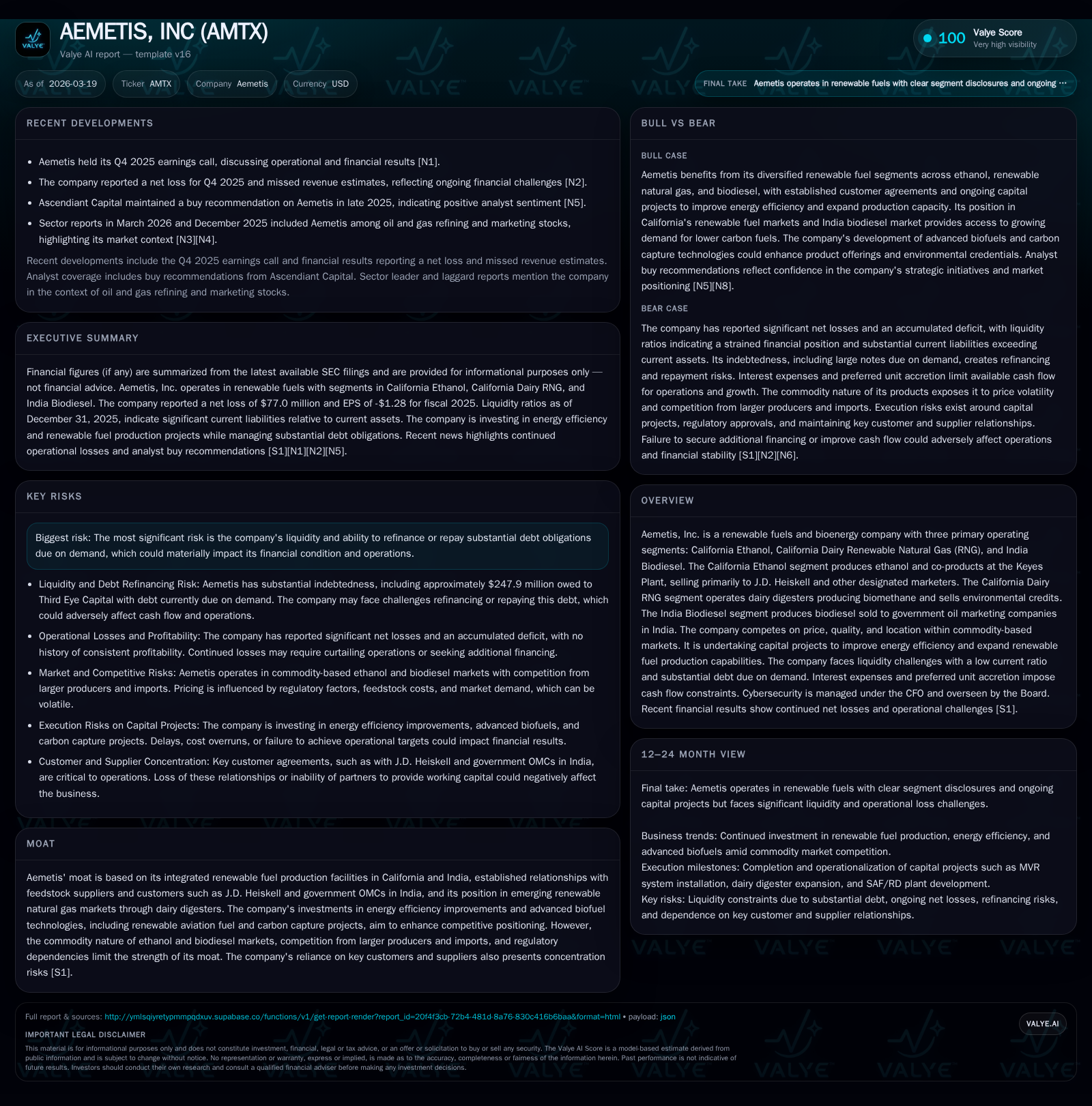
Aemetis operates integrated renewable fuel businesses spanning California ethanol, California dairy RNG, and India biodiesel. Over the past several years, revenue has declined sharply amid ongoing operating losses and substantial debt obligations due on demand, creating pronounced liquidity challenges. The company’s growth strategy hinges on capital-intensive projects aimed at improving energy efficiency and expanding biofuel production capacity, but its constrained financial position threatens operational flexibility. Monitoring developments around debt refinancing and working capital arrangements with key customers will be crucial for assessing sustainability.
Company Overview
Aemetis, Inc. is positioned within the renewable fuels sector through three primary business lines: California Ethanol production, California Dairy Renewable Natural Gas (RNG), and India Biodiesel manufacturing. Its operations are geographically split between California—focused on ethanol and dairy RNG—and India—centered on biodiesel sales to government oil marketing companies. The company emphasizes integration by leveraging feedstock supply chains and byproduct markets primarily locally in California and through strategic partnerships internationally.
While Aemetis aims to improve energy efficiency and enlarge production capacity via projects like installing mechanical vapor recompression systems at its ethanol plant and developing renewable aviation fuel (SAF) facilities, it confronts material financial constraints.
Historical Financial Performance
Over the last four years for which data is available up to FY2023 revenue has contracted severely from $212 million in 2021 to just under $77 million in 2023—a drop of about 64% [F1]. This decline signals significant challenges possibly stemming from competitive pressures, commodity price volatility, or operational disruptions.
Operating income has remained negative throughout this period, hitting -$37.4 million in 2023 and continuing into a comparable loss figure of -$37.2 million expected for FY2025 based on trailing disclosures [F1]. Net income has also been persistently negative; although the net loss widened significantly from -$46.4 million in 2023 to -$77.0 million in FY2025 (in year-over-year terms this is a moderate improvement from the deeper prior losses) [F1].
Operating cash flow illustrates large volatility: positive $13.8 million in 2023 turning sharply negative (-$32.9 million) in 2024 before recovering modestly (+$3.3 million) last year [F1]. Capital expenditure spending remains substantial at above $20-30 million annually directed toward capacity expansion and plant upgrades.
Equity holders continue to see deteriorating net asset value; total shareholders’ equity is deeply negative (-$307 million as of end-2025), reflecting accumulated deficits largely driven by sustained losses and heavy leverage investment strategies [F1].
Historical performance (annual)
| FY | Net ($mm) | CFO ($mm) | OpInc ($mm) | Capex ($mm) | Net YoY |
|---|---|---|---|---|---|
| 2025 | -77 | 3 | -37 | 26 | +12.0% |
| 2024 | -88 | -33 | -40 | 20 | -88.6% |
| 2023 | -46 | 14 | -37 | 33 | +56.9% |
| 2022 | -108 | -23 | -34 | 39 |
Source: SEC companyfacts cache [F1].
Capital returns and efficiency (annual)
| FY | FCF ($mm) | ROE% |
|---|---|---|
| 2025 | -23 | 25.1 |
| 2024 | -53 | 33.2 |
| 2023 | -19 | 21.4 |
| 2022 | -62 | 53.4 |
Source: SEC companyfacts cache [F1].
Note: Revenue data post-2023 has not been disclosed explicitly as of filing.
Growth Prospects
Even as the firm struggles financially, it publicizes investment initiatives that could foster medium-term growth if successfully implemented:
- California Ethanol segment: Upgrades including an MVR system are intended to cut natural gas consumption by over 80%, which could lower costs and carbon intensity—potentially strengthening market positioning under California's Low Carbon Fuel Standard program.
- California Dairy RNG: Expansion of dairy digesters targeting more than tripling RNG annual production capacity to approximately 1.6 million MMBtu aligns with growing demand for low-carbon transportation fuels.
- India Biodiesel: Efforts focus on maintaining strategic agreements with government-controlled oil marketers amid a competitive environment dominated by larger fossil diesel producers and importers.
- Emerging Technologies: R&D on cellulosic ethanol, renewable aviation fuel (SAF), renewable diesel (RD), renewable hydrogen integration, and carbon capture/storage projects represent avenues for product diversification with potential regulatory credit benefits ([S22], [S24], [S25]).
Nonetheless, these prospects are highly dependent on:
- Securing additional financing under demanding credit market conditions.
- Maintaining pivotal working capital support from J.D. Heiskell in California and supplier relationships in India.
- Navigating regulatory permits without cost overruns or delays that could jeopardize timely project completion.
Forecasts, Milestones & Expectations
Explicit guidance beyond disclosed project plans has not been provided; however, tangible milestones to watch include:
- Commissioning timelines for MVR installation at the Keyes Plant.
- Scaling up RNG production capacity through new digester builds and pipeline expansions slated into near-term years.
- Progress against renewable aviation fuels plant construction efforts.
- Resolution or extension of substantial demand-note maturities owed to Third Eye Capital (~$248 million currently outstanding).
- Outcomes of strategic renegotiations or renewals of working capital agreements critical for ongoing operations ([N1], [N2], [S17], [S23]).
Analysts will need updates from quarterly reports or investor calls regarding these parameters.
Returns & Capital Allocation
Return metrics are severely pressured given consistent operating losses that have amplified accumulated shareholder deficits:
- Approximate return on equity is challenging given negative equity; calculated simplistically as net income divided by equity yields an anomalous positive percentage driven by negative denominator effects—but this does not reflect economic profitability due to ongoing losses [F1].
- Operating cash flow turned positive last year but free cash flow remains negative due to high capex commitments (~-$22.7 million FCF estimated for 2025).
- No dividends have been declared or paid recently; no programmatic share repurchases occur though an $80 million repurchase authorization was announced early 2026 subject to resource availability ([S23]).
Heavy interest expense ($46+ million annually) plus preferred unit accretion (~$8 million annually) further constrains distributable cash flow ([S8]).
Debt servicing takes priority over discretionary capital allocation according to management disclosures emphasizing risk of forced asset sales or operational cutbacks if refinancing options are limited ([S5], [S6], [S9]).
Liquidity & Leverage Risks
The company's liquidity profile remains critically strained:
- A current ratio of
0.07 highlights extreme mismatch between readily available assets ($26.9 million) versus due current liabilities (~$371 million) as of December 31, 2025 ([F1]). - All major debt instruments held with Third Eye Capital aggregate roughly $248 million due currently on demand creating potential near-term redemption risk ([S9], [S17]).
- Working capital agreements vital for raw materials sourcing and uninterrupted plant operations carry termination clauses enabling counterparties unilateral withdrawal within contractual notice periods ([S9], [S17]).
- Management acknowledges that inability to refinance or replace expiring obligations would severely impair operations requiring asset sales or restructuring ([S5], [S8], [S17]).
Competitive Landscape & Regulatory Conditions
Ethanol production is commoditized with pricing sensitive to feedstock (corn) costs which alone dictate margins alongside energy inputs like natural gas ([S13], [S17]). Competition includes large Midwestern U.S plants shipping ethanol into California plus Brazilian imports which benefit from different incentive schemes.
Renewable natural gas from dairy digesters competes with traditional fossil gas and other RNG sources with sales linked closely to fluctuating California Environmental credits such as D3 RINs or LCFS credits pricing ([S13]).
In India’s biodiesel segment, Aemetis contends against entrenched petroleum diesel producers controlling distribution networks though it maintains specialization in feedstock diversity aiming at margin optimization ([S13], [S15]).
Compliance with stringent U.S./California environmental & safety standards entails ongoing capital investment while evolving regulations pose uncertainty especially around carbon dioxide emissions legislation impacting production costs long-term ([S16], [S19], [S21]).
Governance & Controls Insight
Cybersecurity risk has been specifically integrated into the financial controls framework overseen by the CFO who possesses deep experience combining IT/cybersecurity vigilance with finance controls ([S1], [S29]). The Board receives annual cybersecurity reports reflecting a mature approach amidst increasing digital threats relevant to operational resilience.
Conclusion & Monitoring Points
Aemetis presents a compelling case study of a renewable fuels operator balancing ambition against financial distress:
- Operational innovation focused on cleaner production methods contrasts starkly with pressing liquidity constraints exacerbated by a concentrated debt structure stressing near-term solvency.
- Sustained improvements hinge crucially on successful capital raises or refinancing while maintaining key commercial relationships underpinning working capital access critical for continuity.
- Investors must track progress toward commissioning greenfield projects along with any modification in debt maturity timelines plus updates on credit market reception.
- Regulatory developments impacting biofuels incentives or environmental compliance could materially shift economics either favorably or adversely depending on geographic exposure.
This report synthesizes publicly available information without offering investment advice or price forecasts.
Disclaimer: This is research-only, informational analysis and not investment advice. It may include AI-generated interpretation and general industry context. Always verify important details using primary sources.

Comments