
KEEMO Fashion Group’s Financial Struggles and Strategic Outlook in Apparel Wholesale
KEEMO operates a lean virtual network model in China’s apparel wholesale space but faces steep losses and liquidity pressure amid intense competition.
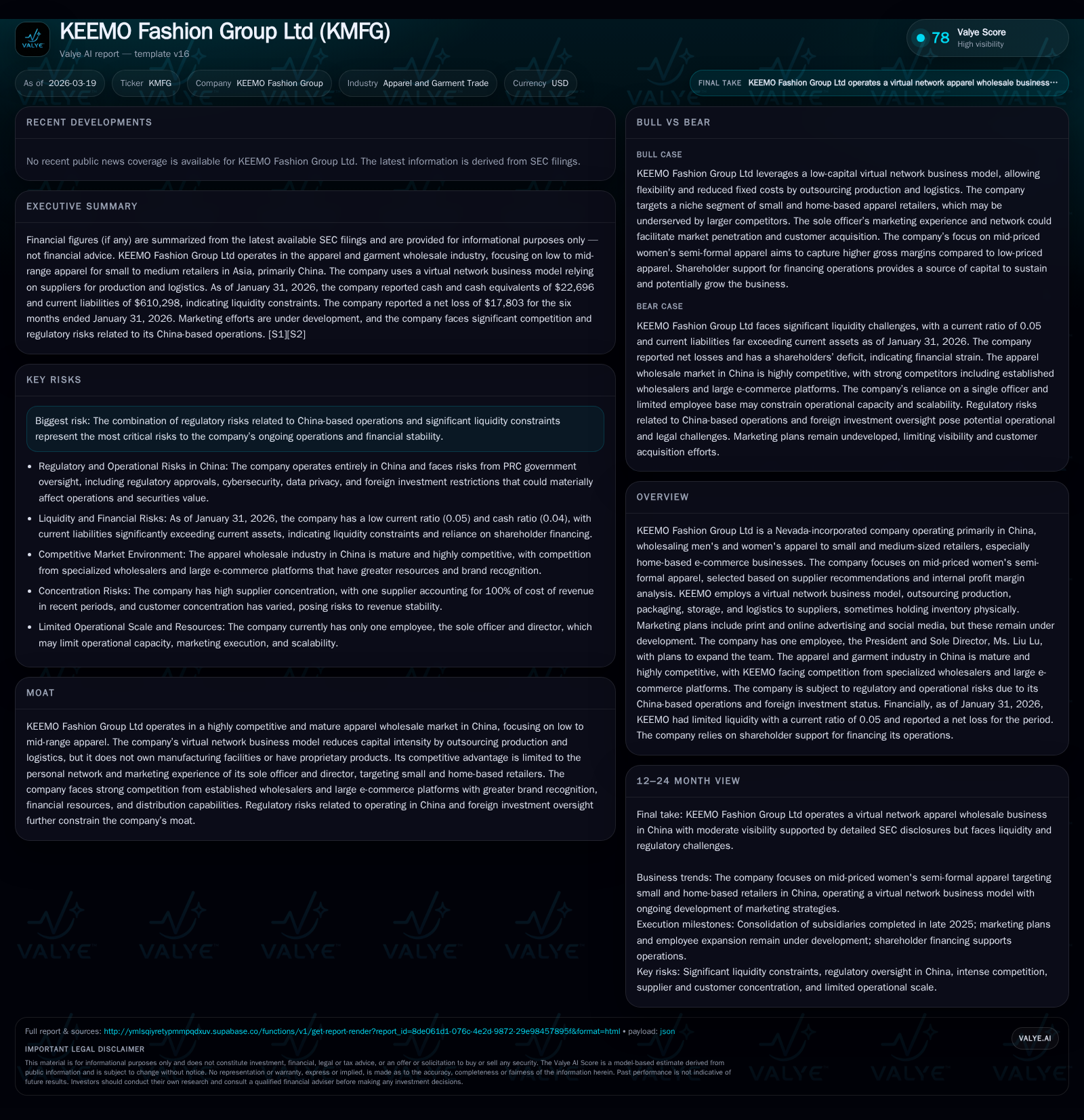
KEEMO Fashion Group Ltd is a Nevada-incorporated company focused on wholesaling mid-range women's semi-formal apparel to small retailers in China through a highly outsourced virtual network business model. The company has experienced persistent operating losses over the past three fiscal years, despite modest improvement in the latest period. Liquidity remains critically strained with current liabilities vastly exceeding current assets, placing heavy reliance on shareholder funding. Regulatory risks stemming from Chinese government oversight further complicate the landscape. Management’s growth plans hinge on expanding marketing initiatives and operational capacity, but absent meaningful capital infusion or competitive differentiation, the outlook remains constrained.
KEEMO’s Business Model and Competitive Context
KEEMO Fashion Group Ltd operates within a tightly contested segment of China’s apparel wholesale industry characterized by low to mid-range pricing tiers. Incorporated under Nevada law yet headquartered in Shenzhen, China, KEEMO adopts a virtual network business model. This approach forgoes ownership of manufacturing facilities or inventory warehouses for the most part, instead relying heavily on suppliers for production, packaging, storage, and logistics functions [S1]. The company selectively acquires mid-priced women’s semi-formal apparel aimed primarily at small to medium-sized retailers — particularly home-based e-commerce operators who may lack scale for their own logistics or trend selection.
Inventory decisions are guided by internal profit margin analysis coupled with supplier trend recommendations, reflecting an SKU assortment strategy tailored around margin optimization rather than proprietary design or branding leverage [S14]. However, KEEMO's limited competitive moat stems largely from the personal network and marketing experience of its sole officer and director rather than sustainable operational scale or technological differentiation. This backdrop places KEEMO at risk amid dominant wholesalers with expansive distribution networks and large integrated e-commerce platforms boasting strong brand recognition.
Reviewing Historical Growth Trends and Profitability Dynamics
Financial results over the past three fiscal years illustrate persistent challenges balancing growth with profitability. Operating income reflects consistent net losses — though the trend shows some improvement: from a loss of $42,275 in FY2024 to a loss of $33,121 in FY2025 represents a reduction of 21.7% year-over-year albeit still negative [F1]. Net income mirrors this pattern exactly due to minimal non-operating items.
Operating cash flow depicts an even steeper decline with FY2025 cash outflow at $16,333 compared to $9,322 outflow in FY2024 (a deterioration greater than 75%) signaling worsened working capital or timing pressures [F1]. The prolonged negative free cash flow suggests that operating losses are accompanied by additional strain on liquidity.
Historical performance (annual)
| FY | Net ($) | CFO ($) | OpInc ($) | Net YoY |
|---|---|---|---|---|
| 2025 | -33121 | -16333 | -33121 | +21.7% |
| 2024 | -42275 | -9322 | -42275 | -90.5% |
| 2023 | -22196 | -17837 | -22254 |
Source: SEC companyfacts cache [F1].
Capital returns and efficiency (annual)
| FY | ROE% |
|---|---|
| 2025 | 40.4 |
| 2024 | 86.4 |
| 2023 | 332.8 |
Source: SEC companyfacts cache [F1].
Despite some contraction in operating losses in recent periods, sustained negative earnings highlight structural issues within revenue generation and cost management under a thinly staffed operational model.
Market Positioning and Operational Risks
China's apparel wholesale sector is well-established and saturated. KEEMO competes mainly by offering mid-tier women's apparel curated through supplier input — effectively leaning on third-party product designs without proprietary lines or exclusive agreements. Such SKU assortment strategies provide flexible inventory options but limit pricing power given commoditized nature.
The absence of owned manufacturing impairs margin control since cost efficiency largely depends on supplier pricing stability. Additionally, large e-commerce platforms dominate digital channels leveraging scale discounts and direct consumer access that challenge small wholesalers like KEEMO targeting fragmented small retail operators with limited buying power [S14].
This environment constrains revenue uplift potential without significant differentiation in brand visibility or supply chain innovation.
Liquidity Position and Capital Structure Analysis
Liquidity represents one of KEEMO’s most critical vulnerabilities at present. As of January 31, 2026 data reveal current assets totaling about $29k juxtaposed against current liabilities exceeding $610k — yielding an alarming current ratio near 0.05 indicating extreme short-term solvency risk [F1][S24].
Cash and equivalents account for roughly $22k of this asset base while accounts receivable are negligible at under $50 [F1]. These figures imply scant cushion against payables and related party obligations exceeding half a million dollars.
Management discloses reliance on substantial continuing financial support from a principal shareholder who has indicated willingness to provide additional funding to sustain operations [S6][S7]. This source acts as an ephemeral bridge rather than a stable capital foundation given growing accumulated deficits which topped approximately $82k negative equity as of FY2025 end [F1].
Negative cash flows exacerbated by working capital mismatches underline high dependency on this shareholder backstop absent significant operational improvements.
Regulatory Environment Challenges
Operating exclusively within Mainland China exposes KEEMO to elevated regulatory risk layers including stringent oversight under the Holding Foreign Companies Accountable Act (HFCAA). This US legislation specifically targets auditing transparency concerns related to companies domiciled or operating heavily in China [S1].
Simultaneously Chinese authorities exercise broad discretionary power over foreign investment approval processes and can impose anti-monopoly actions or tighten cybersecurity/data privacy controls potentially disrupting normal business conduct.
Recent precedent sectors such as education technology have faced radical regulatory changes causing sharp market valuation declines — while no direct analogous policy toward apparel wholesale exists yet there is no immunity from future intervention [S1]. These regulatory factors form latent caps on business expansion feasibility beyond pure economic competition.
Forward-Looking Indicators: Growth Constraints and Potential Catalysts
Management articulates growth ambitions centered around enhancing market outreach via print media advertising and online/social media channels — currently described as nascent or under development [S14]. Such marketing sophistication would be essential for penetrating fragmented small apparel retailer segments effectively.
However, current operations are run solely by President Liu Lu with no other employees onboard limiting scalability potential unless human capital investments increase substantially soon [S14]. Furthermore customer concentration remains notable though there is no single dominant revenue contributor recently after subsidiary consolidation effects [S10].
Potential growth drivers thus hinge precariously on execution upgrading both organizational structure and marketing reach amidst stiff competitor ecosystems.
Capital Allocation Profile
Given ongoing yearly net losses culminating in an accumulated deficit north of $82k at fiscal year end 2025 there are no dividends payable nor share repurchases funded so far consistent with an early-stage distressed equity stance focused on survival not returns enhancement [F1].
Return on equity is distorted by negative equity base; calculated ROE approximates 40% due to division by negative equity but does not indicate positive profitability realistically [F1].
Capital expenditures are negligible consistent with outsourced operational approach minimizing fixed asset investments thus preserving cash around variable cost structures rather than asset-heavy commitments.
Key Investor Milestones to Monitor
With no explicit financial guidance provided by management investors should track:
- Development of tangible marketing campaigns beyond conceptual phases,
- Expansion beyond single-person executive functioning toward broader team capacity,
- Improvements in liquidity ratios driven by positive working capital cycles or fresh financing inflows,
- Regulatory developments impacting cross-border listings or foreign investment permissions,
- Customer base diversification decreasing dependency concentration risks,
- Operational integration benefits derived from recent subsidiary acquisitions.
These milestones will offer insight into whether KEEMO can transition from loss absorption toward sustainable profitable growth given sector complexity surrounding low-margin apparel wholesaling within China's regulatory milieu.
This report uses publicly available SEC filings dated through March 19, 2026 ([F1],[S#]) combined with company disclosures summarized for analytical synthesis. No predictions or investment advice are provided.
Disclaimer: This is research-only, informational analysis and not investment advice. It may include AI-generated interpretation and general industry context. Always verify important details using primary sources.

Comments