
LIVEPERSON INC's AI-Driven Platform Drives Growth Amid Persistent Profitability Challenges
LivePerson leverages proprietary Conversational AI and extensive integrations to power nearly a billion monthly interactions, fueling revenue gains despite ongoing net losses.
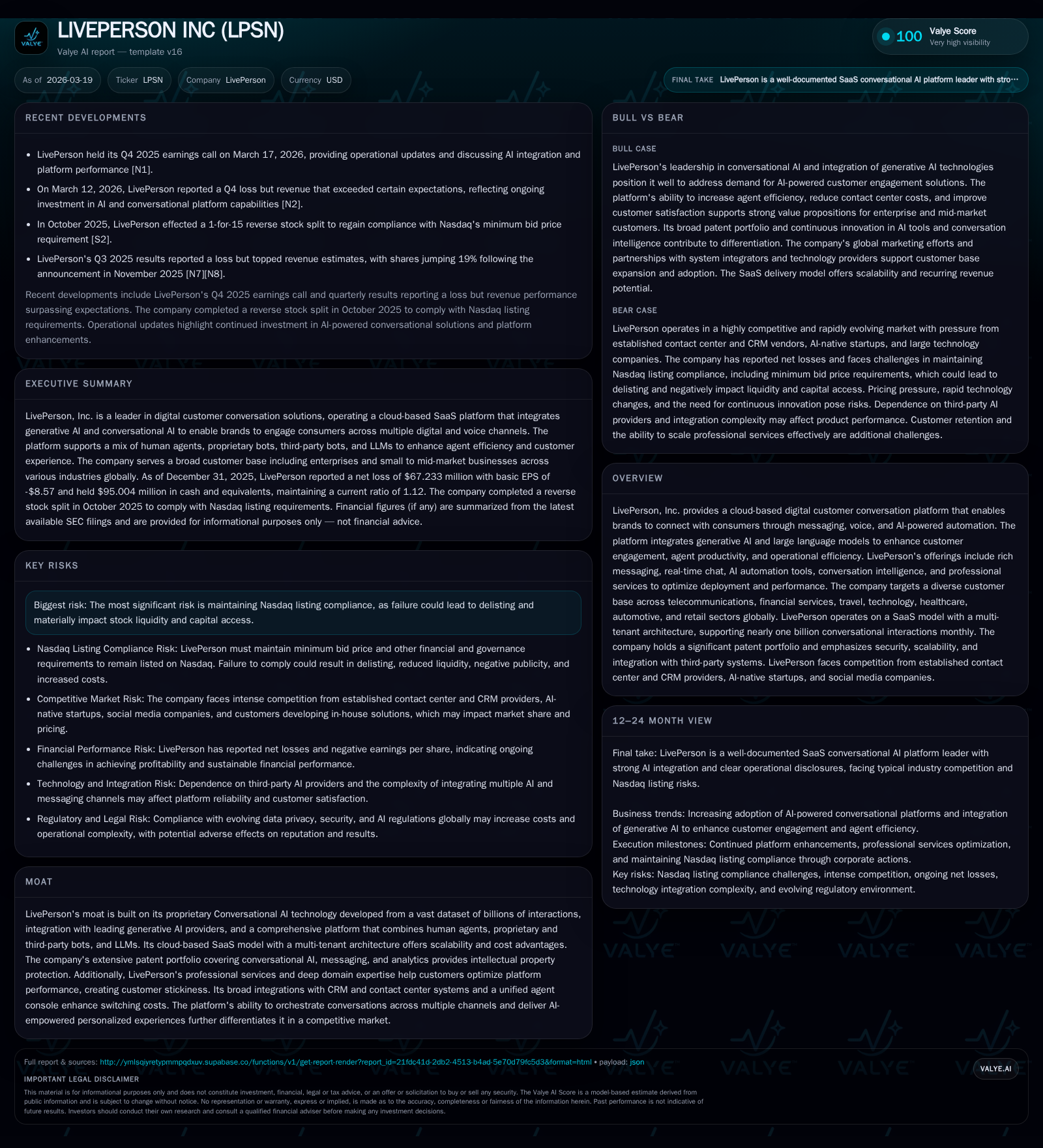
LivePerson has demonstrated consistent revenue growth supported by its cloud-based digital customer conversation platform enhanced with generative AI. Despite improving operating losses and net income in recent years, the company remains unprofitable with negative cash flows. Its differentiated offering combines human agents, proprietary and third-party bots, and large language models to optimize customer engagement. Risks include maintaining Nasdaq listing compliance amid share price challenges. Monitoring LivePerson's ability to translate its robust technology into sustained profitability is critical going forward.
Company Overview
LivePerson Inc. operates a cloud-based digital customer conversation platform that enables enterprises to engage consumers via messaging, voice, and AI-driven automation. The platform supports nearly one billion conversational interactions monthly and leverages proprietary Conversational AI combined with integrations from leading generative AI providers such as OpenAI and Microsoft [S1][S13][S16]. Its ecosystem blends human agents with bots and large language models (LLMs) seamlessly to elevate customer experiences and agent efficiency.
Founded in 1995 and publicly traded on Nasdaq and the Tel Aviv Stock Exchange, LivePerson targets diverse sectors including telecommunications, financial services, healthcare, automotive, retail, travel hospitality, and technology [S4][S20]. The company emphasizes security—achieving SOC2 and PCI compliance—and scalability through multi-tenant SaaS architecture hosted on secure third-party data centers [S11][S16][S26].
Historical Growth and Performance
LivePerson's revenue trajectory exhibits moderate growth with notable volatility in profitability metrics over recent years:
Historical performance (annual)
| FY | Net ($mm) | CFO ($mm) | OpInc ($mm) | Capex ($mm) | Net YoY |
|---|---|---|---|---|---|
| 2025 | -67 | -30 | -79 | 12 | +49.9% |
| 2024 | -134 | -15 | -183 | 25 | -33.7% |
| 2023 | -100 | -20 | -111 | 29 | +55.5% |
| 2022 | -226 | -62 | -222 | 48 |
Source: SEC companyfacts cache [F1].
Capital returns and efficiency (annual)
| FY | Buybacks ($) | FCF ($mm) | ROE% |
|---|---|---|---|
| 2025 | -43 | 151.1 | |
| 2024 | 0 | -40 | 199.5 |
| 2023 | 0 | -48 | -208.6 |
| 2022 | 221000 | -111 | -331.6 |
Source: SEC companyfacts cache [F1].
Revenue series is available only through FY2018; profitability metrics are for fiscal years ending Dec 31.
Revenue grew approximately 14% from $218.9 million in 2017 to $249.8 million in 2018 reflecting increasing market adoption of AI-enabled conversational platforms [F1]. Operating losses have improved dramatically from -$221.9 million in 2022 to -$78.7 million in 2025 indicating operational cost controls or revenue mix benefits [F1]. Similarly, net losses narrowed substantially though the company remains unprofitable at a net loss of $67.2 million in the latest reported fiscal year [F1]. Negative cash flow from operations persisted at $30.4 million outflow despite halving capital expenditures relative to prior year levels [F1]. Share repurchases ceased after minimal activity in prior years.
Business Model & Industry Positioning
LivePerson employs a SaaS model delivering a multi-channel conversational platform that combines messaging apps, branded websites/apps, SMS, social media platforms, and voice channels into unified workflows for enterprise contact centers [S1][S6][S14]. Generative AI integration is native—allowing human agents augmented with copilot tools like Assist, Summary and Rewrite—and orchestration between proprietary bots, third-party bots and LLMs [S8][S21]. This approach amplifies agent productivity by enabling handling multiple simultaneous chats with AI-driven automation taking care of transaction work while agents focus on relationship building [S7][S13].
The platform serves various industries globally including telecommunications, financial services, consumer retail, healthcare, travel/hospitality and automotive across the Americas, EMEA and APAC regions [S4][S27]. No single customer accounted for over 10% of revenues ensuring diversified exposure [S4].
A protective moat arises from decades-long accumulated conversational data powering proprietary natural language understanding engines (such as the Intent Manager real-time intent recognition system), intellectual property protections with hundreds of patents spanning conversational AI and analytics technologies, plus deep industry expertise used by the LP360 Professional Services team to optimize deployments [S10][S11][S21]. Extensive APIs enable integration with CRM systems like Salesforce and telephony partners such as Avaya enhancing switching costs and platform stickiness [S8].
Future Growth Prospects
LivePerson’s near-term growth hinges on accelerating adoption of its generative AI-enhanced capabilities deployed within its Conversational Flywheel framework that turns conversation data into insights driving better engagement strategies [S15][S20]. The Syntrix simulation platform launched late-2025 offers enterprises testing tools to validate conversational AI agent readiness at scale—a competitive differentiator given enterprise risk aversion towards autonomous AI deployments [S10].
Expanding voice channel support integrated seamlessly with messaging promises to capture incremental use cases; LivePerson highlights this as an area expected to synergize human-AI collaboration efficiently [S20]. Expansion in verticals like financial services or healthcare where regulatory scrutiny demands high trust further benefits from LivePerson’s robust security posture [S11][S26]. International market expansion into EMEA and APAC also provides runway for growth based on rising digitalization trends.
However, growth could be tempered by intensifying competition from large CRM/contact center incumbents (Salesforce, Oracle), technology giants embedding basic messaging bots (Google/Facebook), pure-play generative AI startups focused on specialized vertical workflows or cheaper entry-level messaging vendors offering commoditized products free or low cost [S9]. Maintaining differentiation through technology leadership plus deep domain professional services will remain critical.
Financial Milestones & Capital Allocation
As of December 31, 2025, LivePerson reported negative shareholders’ equity of approximately -$44.5 million reflecting accumulated losses offsetting capital raised [F1]. Return measures such as ROE are distorted due to negative equity but net loss improvements indicate progress.
Free cash flow remains negative given persistent operating outflows (-$30.4 million) exceeding capital expenditures (~$12.1 million), consistent with ongoing investments into product development and scaling partnerships [F1]. No dividends have been declared historically nor share buybacks since cessation post-2022 suggest management prioritizes liquidity preservation amid turnaround efforts [F1][S12].
The company executed a reverse stock split in October 2025 to regain Nasdaq minimum bid price compliance following prior share price pressures; maintaining listing standards remains a material near-term risk factor [S2][S19].
Risks & Considerations
Key risks include potential failure to maintain Nasdaq Global Select Market listing requirements particularly related to the minimum bid price threshold enforced October 13, 2026 post-reverse split which could lead to delisting impacting liquidity and capital access [S2][S19].
Additional risks encompass cybersecurity vulnerabilities inherent in cloud-hosted platforms despite robust controls overseen by certified security professionals reporting regularly to the Board [S26], regulatory shifts globally around data privacy affecting data use critical for AI training sets [S11][S18], intensifying competition compressing pricing power [S9], execution risks scaling new Syntrix simulation tools broadly across customers [S10], as well as dependency on partner ecosystem reliability affecting integration quality and customer satisfaction.
Conclusion
LivePerson Inc occupies a strategically important niche enabling enterprises’ transition toward modern digital-first customer engagement powered by conversational AI complemented with rich messaging multi-channel reach across voice and SMS/social apps globally. Historical performance shows healthy revenue growth paired with gradual narrowing of operating losses but persistent net losses remain an open challenge along with negative cash flows.
Capital discipline historically limited share repurchases or dividends as focus shifted toward regaining listing compliance following share price headwinds addressed via reverse split late-2025.
Going forward the company's ability to leverage its differentiated AI-powered platform innovation encompassing generative models alongside human oversight while driving scalable commercial momentum amid intense competition stands central to realizing sustainable profitability trajectories—alongside navigating Nasdaq compliance risks.
Monitoring incremental operational break-even progress through margin improvements alongside cash flow normalization will be key indicators of advancement toward durable value creation.
This analysis summarizes LivePerson Inc’s disclosed business fundamentals and financial performance as of its latest SEC filings dated March 16th, 2026 alongside relevant earnings commentary but does not constitute investment advice or recommendations.
Disclaimer: This is research-only, informational analysis and not investment advice. It may include AI-generated interpretation and general industry context. Always verify important details using primary sources.

Comments