
WaterBridge Infrastructure's Financial Tightrope: Balancing Debt and Delaware Basin Dynamics
WaterBridge’s operations and financial results hinge on the interplay of reservoir-driven water volumes, concentrated basin exposure, and a heavy debt load.
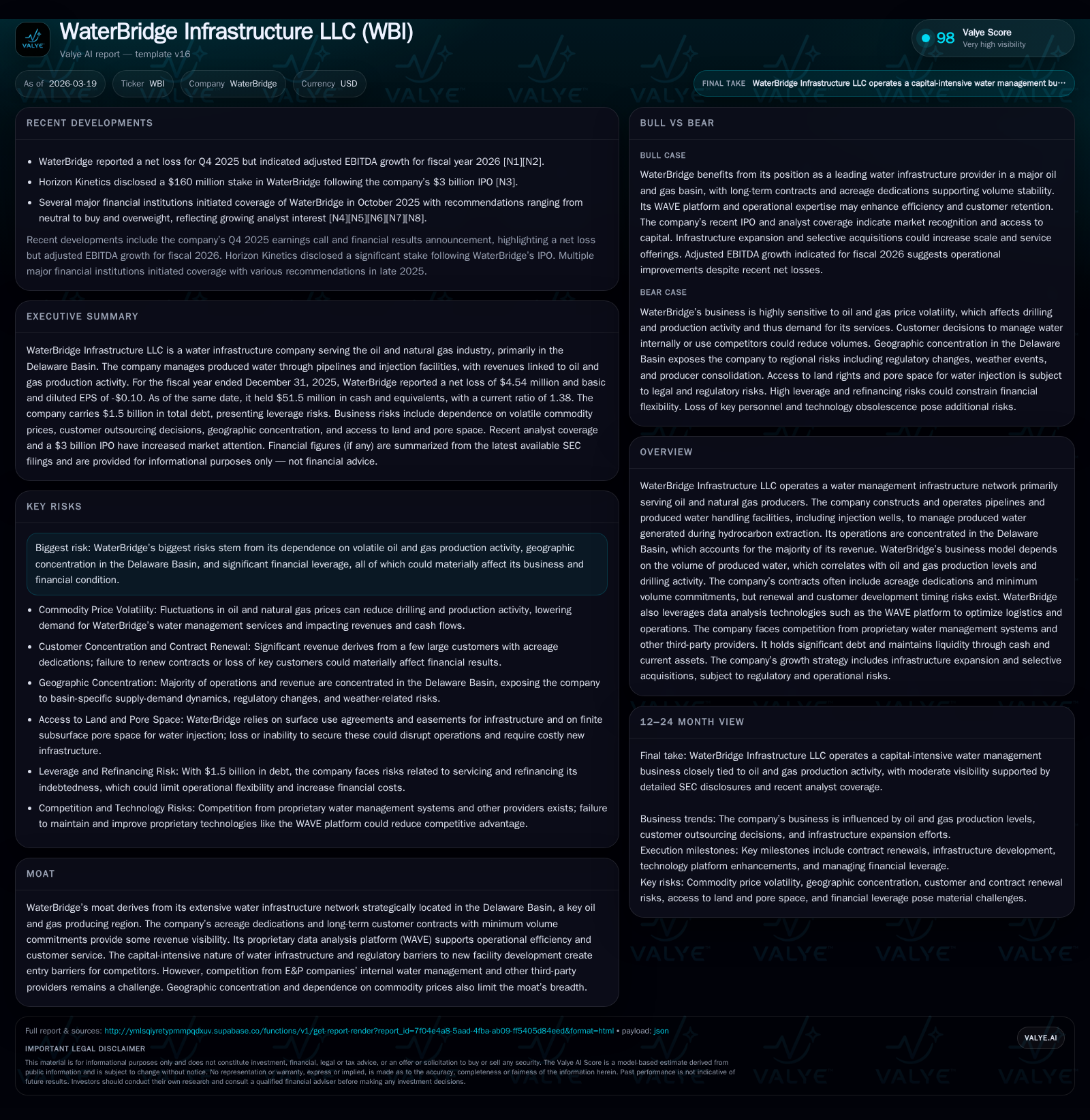
WaterBridge Infrastructure LLC operates a specialized produced water management network primarily in the Delaware Basin, capitalizing on acreage dedications and minimum volume commitments but facing risks from commodity volatility and customer concentration. Its 2025 financials reflect modest operating income but net losses with negative free cash flow amid a $1.5 billion debt burden secured by company assets. The company’s proprietary WAVE data platform offers operational efficiencies critical in a competitive environment where upstream production activity directly dictates revenue growth. Investors should focus on drilling activity trends, contract renewal progress, and adherence to stringent debt covenants as key signals for near-term performance.
Historic Revenue Trajectory and Key Drivers Behind Oilfield Water Volumes
WaterBridge Infrastructure operates within a niche but highly cyclical intersection of produced water logistics tied directly to oilfield production life cycles. The company's 2025 financial results reveal operating income of approximately $78.9 million; however, this positive operating margin masks a net loss near $4.5 million due largely to financing costs from substantial indebtedness and investments in infrastructure expansion required to support ongoing operations ([F1]). This underscores the capital-intensive nature of produced water gathering and disposal networks where pipeline construction, injection well operations, and facility maintenance are nontrivial cost centers.
Year-over-year performance is primarily driven by fluctuations in hydrocarbon extraction activity within WaterBridge's core geographic footprint—the Delaware Basin. Increasing drilling activity leads to greater volumes of produced water requiring management. Conversely, downturns in upstream spending compress demand for WaterBridge’s services ([N1], [N2]). The company's revenue thus mirrors the upstream operators' development cadence dictated by oil & gas price environments.
Historical performance (annual)
| FY |
|---|
| 2025 |
Source: SEC companyfacts cache [F1].
Note: CFO denotes cash from operations; Capex reflects sizeable infrastructure investments necessary to maintain network capacity to handle produced water volumes.
Oil Price Sensitivity and Its Impact on Produced Water Demand
The company's dependence on oil & gas production makes it inherently sensitive to commodity price volatility—a fact cautioned emphatically in risk disclosures ([S1], [S2]). Declines or anticipated declines in oil prices can cause upstream producers to curtail drilling or defer completions, directly reducing produced water volumes flowing through WaterBridge’s pipelines and handling facilities.
Factors such as access to capital for E&P firms, expectations on future commodity pricing, equipment availability, consolidation trends in producers' ranks, regulatory constraints, and geopolitical uncertainty all feed into production pacing decisions that ripple down to water infrastructure usage ([S1]). Consequently, WaterBridge confronts not only technical operational challenges but strategic demand uncertainty hinging on external market forces beyond its control.
Management’s commentary affirms fiscal year 2026 adjusted EBITDA growth goals yet acknowledges these are counterbalanced by contract renewal timelines whose outcome can hinder revenue predictability if customers delay commitments or reduce volumes ([N2]). This dynamic stresses how tightly intertwined upstream sentiment is with midstream water service economics.
Operational Footprint Concentration: Strengths & Vulnerabilities in the Delaware Basin
WaterBridge’s geographic focus exclusively centers on the Delaware Basin region spanning Texas and New Mexico—the locus of significant unconventional resource plays ([S7], [S18]). This concentration consolidates infrastructure synergies allowing efficient pipeline routing, centralized injection well fields, and streamlined produced water logistics.
However, it also concentrates risk: basin-specific regulatory changes (e.g., environmental restrictions affecting wastewater handling), adverse weather events like drought or flooding impacting operations, regional limitations on raw water availability or processing, plus growing consolidation among customer E&P operators who might curtail capital allocation adversely impact WaterBridge’s utilization rates ([S7]).
Customer concentration further amplifies exposure—three customers alone accounted for roughly one-third of revenues at year-end 2025 ([S8]). Loss or nonrenewal of contracts with Permian Resources Corporation (14%), Devon Energy (11%), or bpx energy (10%) would materially impair cash flow generation.
WAVE Platform and Tech-Enabled Efficiency: Differentiators Amid Competitive Pressures
In a commoditized field where proprietary gathering systems owned by E&P companies threaten traditional third-party water providers’ market share, WaterBridge seeks differentiation through technology integration via its WAVE data platform (, [S16]).
WAVE aggregates real-time data across pipelines and injection wells enabling predictive logistics planning—optimizing truck routing schedules, balancing throughput among injection facilities, anticipating maintenance needs, and supporting scenario analysis to respond rapidly to customer volume fluctuations.
Such operational efficiencies not only reduce marginal costs but enhance customer service reliability—a critical factor when customers weigh continuing third-party contracts versus building internal solutions or benchmarking alternative providers (). Failures to innovate technologically may erode pricing power given intensifying competition.
Debt Structure, Capital Allocation, and Implications for Cash Flow Sustainability
WaterBridge carries roughly $1.5 billion in total debt secured against nearly all assets ([F1], [S5], [S6]), exposing it to refinancing risks amid variable interest expense burdens (noted at around an average rate exceeding 6% as of December 31, 2025 ([S11])). Accelerated amortization clauses tied to covenant breaches could force premature repayment harming liquidity positioning.
The company posted negative free cash flow near $119 million in the latest fiscal year as operating cash failed to cover incremental capex commitments necessary for expansion projects ([F1]). This negative FCF limits discretionary spending—share repurchases are minimal or nonexistent given these constraints ([S26], [S29]) while dividend policies remain undeclared formally with payments contingent on board discretion factoring in financial health indicators.
Returns reflect this tension; ROE stands at roughly -0.8%, evidencing how leverage cost pressures combined with operational cash demands constrain profitability despite positive operating margins ([F1]).
If cash flows falter further due to production slowdowns or contract lapses coinciding with looming refinancing windows, WaterBridge may face restricted access to affordable capital markets funds increasing liquidity strain risk ([S10], [S13]).
Outlook for 2026: EBITDA Growth Targets Against Customer Contract Renewals and Market Risks
Management anticipates adjusted EBITDA growth relative to fiscal year ’25 levels premised on stable or improved drilling activity sustaining increased produced water volumes entering its network ([N2]). However, timing risks surround renewal of acreage dedication contracts which undergird minimum volume commitments—should negotiations drag or terms worsen due to changing upstream economics or competition from self-managed systems, revenue growth could stall.
Further complicating outlook is macro volatility: shifting commodity prices may trigger cautious customer capital deployment altering WaterBridge’s utilization curves unpredictably ([N1]). Meanwhile regulatory developments affecting waste disposal practices could impact operational costs unexpectedly.
Absent explicit formal guidance beyond EBITDA commentary publicly disclosed information suggests investors must track contract renewal progression closely during quarterly disclosures as harbingers of sustainable growth potential amid external challenges.
What Investors Should Watch: Volume Commitments, Production Trends, and Debt Covenants
Operationally critical indicators include:
- Drilling rig counts & completion rates within the Delaware Basin serving as leading proxies for input volume growth potential;
- Progress updates on acreage dedication contract expirations approaching within upcoming quarters; successful negotiations are vital for preserving minimum volume baselines crucial for revenue stability;
- Commodity price trajectories influencing upstream producer capex appetite;
- Compliance with debt covenants detailed under credit agreements given substantial leverage; any breaches could trigger accelerated repayment affecting liquidity;
- Capex pacing correlated with customer infrastructure needs against expansion timelines;
- Maintenance of WAVE platform advantages vis-à-vis peer technology advancement signals continued operational differentiation potential.
Monitoring these variables through SEC filings such as quarterly earnings releases ([N1]) alongside proxy statements helps gauge evolving risk profiles linked both to macro market cycles and company-specific contract developments.
This analysis synthesizes public filings up to March 19, 2026 without extending into speculative forecasts or investment advice.
Disclaimer: This is research-only, informational analysis and not investment advice. It may include AI-generated interpretation and general industry context. Always verify important details using primary sources.

Comments