
IZEA Worldwide's Turnaround: From Operating Losses to Positive Cash Flow
IZEA Worldwide, Inc. has shifted from a multi-year pattern of operating losses to modest profitability and positive cash flow, underpinned by liquidity strength and strategic capital allocation.
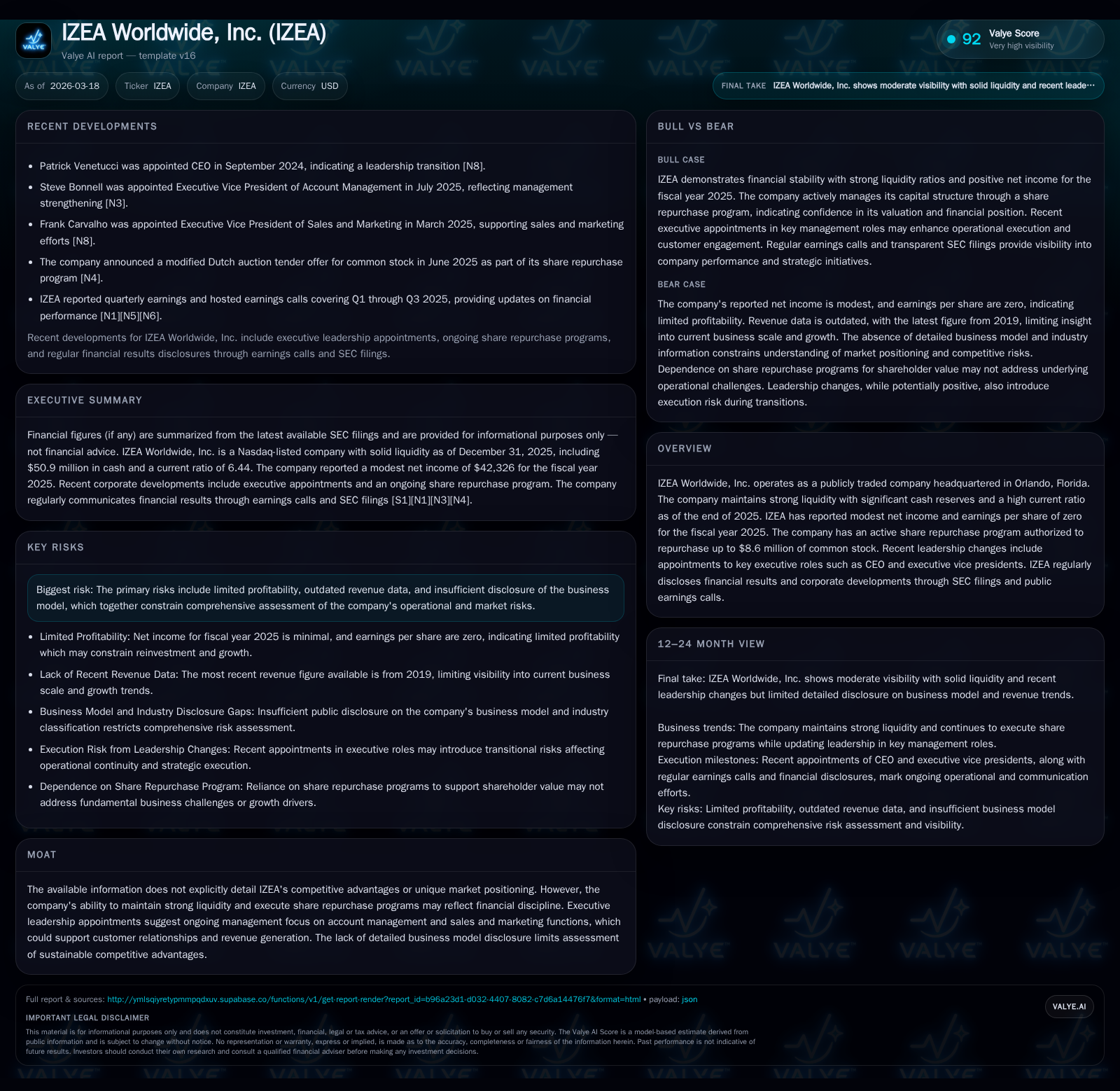
After enduring consecutive years of substantial operating losses through 2024, IZEA Worldwide achieved a notable turnaround in fiscal 2025 with operating income losses shrinking by over 90% and a return to positive net income. This improvement coincided with achieving positive operating cash flows and a robust liquidity position featuring a current ratio exceeding 6x. The company’s capital discipline is reflected in its declining capex spend and an active share repurchase program aimed at offsetting dilution. Leadership changes focusing on sales and account management are positioned to further stabilize revenue growth, though limited disclosed revenue data and lack of explicit forward guidance add uncertainty. Monitoring execution on go-to-market initiatives and customer retention will be critical in assessing sustainable recovery.
Historical Financial Trends: Declining Losses and Stabilizing Performance
IZEA Worldwide has undergone a significant financial transition over the past four fiscal years. Operating income losses contracted from nearly -$19.5 million in FY2024 to approximately -$1.86 million in FY2025, marking an impressive 90.5% year-over-year improvement [F1]. Concurrently, the company reversed a steep net income loss of over -$18.8 million in FY2024 to a modest net profit of approximately $42K in FY2025, representing a full swing but still marginal absolute gain [F1].
In terms of cash generation, after suffering consistent negative operating cash flows throughout 2022 to 2024 peaking at -$11.46 million in FY2024, IZEA’s operating cash flow turned decisively positive, registering about $2.43 million in FY2025—a stunning turnaround of over 121% YoY improvement [F1]. Despite this progress on costs and cash management fronts, annual revenue figures have not been updated beyond 2018 where reported top-line was roughly $20 million; the static nature of this top-line figure points to either stagnation or undisclosed fluctuations restricting a full assessment of growth dynamics.
Historical performance (annual)
| FY | Net ($mm) | CFO ($mm) | OpInc ($mm) | Capex ($) | Net YoY |
|---|---|---|---|---|---|
| 2025 | 0 | 2 | -2 | 56683 | +100.2% |
| 2024 | -19 | -11 | -19 | 74985 | -156.5% |
| 2023 | -7 | -5 | -10 | 131722 | -64.4% |
| 2022 | -4 | -3 | -6 | 79006 |
Source: SEC companyfacts cache [F1].
Capital returns and efficiency (annual)
| FY | FCF ($mm) | ROE% |
|---|---|---|
| 2025 | 2 | 0.1 |
| 2024 | -12 | -38.6 |
| 2023 | -5 | -11.3 |
| 2022 | -3 | -6.4 |
Source: SEC companyfacts cache [F1].
Table: IZEA Operating Income (OpInc), Net Income (NetInc), Operating Cash Flow (CFO), Capital Expenditures (Capex), and year-over-year percent changes for fiscal years ending December.
Corporate Leadership Shifts Impacting Growth and Market Positioning
Strategic leadership changes complement IZEA's operational rebound narrative. Most notably the appointment of Patrick Venetucci as CEO as of early 2026 emphasizes sharpened focus on sales effectiveness and account management optimization [S1], [S3]. Sector-specific terms such as “go-to-market execution” resonate here as the new leadership cohort aims to tighten client engagement pipelines alongside marketing activation efforts—critical facets given flat recent top-line visibility.
The executive team restructuring includes filling executive vice president roles tailored towards sales and marketing functions which underpin growth engines in platform-based business models common in digital influencer marketing sectors that IZEA participates in [S1]. These moves suggest management prioritizes entrenched customer relationships and streamlined revenue channels; however without detailed segment disclosure or express revenue guidance from SEC updates their impact remains speculative but promising.
Liquidity Strength and Capital Structure Insights as Financial Foundation
A prominent pillar supporting IZEA’s emerging stability is its robust liquidity profile. Cash & equivalents swelled to about $50.9 million by the end of FY2025 while current assets stood near $55.1 million against modest current liabilities approximating $8.56 million—implying an exceptionally healthy current ratio around 6.44 [F1]. Such liquidity runway provides key operational flexibility dubbed 'capital adequacy' within sector vernacular vital for weathering residual earnings volatility while investing selectively.
Debt exposure appears minimal or non-material per recent filings , [S12] allowing IZEA to prioritize organic growth investments and shareholder returns without distress risk hanging over near-term funding cost structures.
Capital Allocation Strategy: Stock Repurchases in Context
Consistent with its emphasis on shareholder value enhancement amid limited dividend distribution policy (none declared), IZEA maintains an ongoing authorized share repurchase program with remaining capacity up to $8.6 million [S10], [S11], [S17].
These buybacks are governed via Rule 10b5-1 trading plans which permit tactical open-market purchases based on favorable price conditions—a prudent ‘capital return policy’ frequently employed within tech-adjacent equities aiming to offset dilution linked historically with employee options or capital raises.
The sustained buyback initiative signals confidence from management regarding intrinsic valuation thresholds despite operational challenges.
Evaluating Profitability Metrics: ROE and Cash Flow Dynamics
While trailing twelve-month net income turned positive at only about $42K in FY2025 corresponding with an equity base circa $48.9 million yields an approximate ROE around a negligible 0.1%—indicating modest profitability relative to invested capital [F1]. The slender margin reflects persistent headwinds but also closing losses compared with prior years’ double-digit negative returns.
Importantly free cash flow (operating cash flow minus capex) approximated over $2.37 million indicating tangible internal liquidity creation post investment expenditures—a crucial ‘cash conversion’ metric signifying operational resilience although still nascent vis-à-vis growth scaling requirements.
Capex spending tapered steadily across the period—down from $132K in FY2023 to just under $57K recently—which may intimate cautious capital deployment aligned with consolidating platform capabilities rather than aggressive expansion.
Risks Reflecting Limited Disclosure and Profitability Uncertainties
Key challenges remain entrenched in IZEA’s disclosure practices combined with historical earnings gaps limiting comprehensive assessment by investors or counterparties [S4], [S5], [S6], [S7]. Sparse recent revenue updates—stuck at levels reported through 2018—and vague descriptions about core business segments restrict understanding sustainable competitive positioning or addressable market trends.
Risk factors cited emphasize potential volatility from regulatory environments impacting digital marketing channels alongside litigation risks customary for publicly traded entities.[S4]
Additionally weak historical profitability rates coupled with negligible ROE highlight ongoing earnings recovery complexities necessitating vigilant monitoring during the transition phase.
Growth Outlook and What To Watch Next: Pipeline and Market Signals
No explicit forward-looking guidance is articulated within recent SEC materials nor public earnings communications thereby precluding definitive forecasting.
Nonetheless critical metrics for evaluation going forward include client acquisition pace measured through win rates on new contracts; platform adoption rates indicative of user engagement; gross margin improvements signalling pricing power; and retention statistics pivotal for subscription or recurring revenue models.
The new executive team's emphasis on sales maneuvering potentially unlocks inflection points but execution risk lingers given industry competition and historic performance inconsistency.
Monitoring quarterly results for relative improvements across these vectors will be essential for validating whether IZEA can extend its operational turnaround into sustained growth territory.
This analysis relies exclusively on documented filings and available company facts without speculative forecasts or investment recommendations. Readers should consider underlying information constraints when interpreting results or prospects described herein.
Disclaimer: This is research-only, informational analysis and not investment advice. It may include AI-generated interpretation and general industry context. Always verify important details using primary sources.

Comments