
Indaptus Therapeutics’ Clinical Setbacks and Financial Strains Shape Its Road Ahead
Indaptus Therapeutics confronts the dual challenges of paused clinical enrollment and capital constraints as it advances its novel immunotherapy platform.
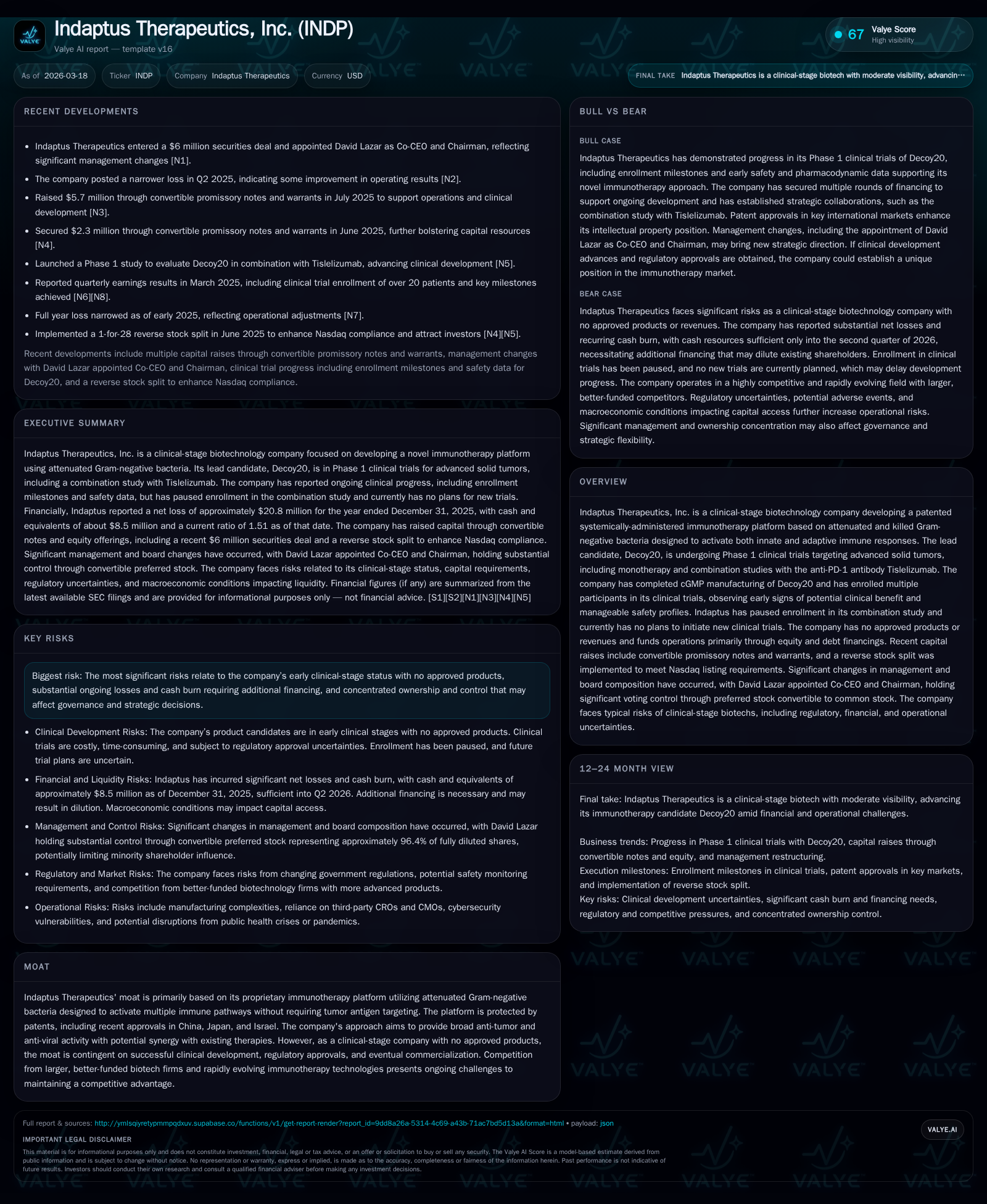
Indaptus Therapeutics is developing a pioneering immunotherapy centered on attenuated Gram-negative bacteria to activate broad immune responses against cancer. Despite completing cGMP manufacturing of its lead candidate Decoy20 and progressing Phase 1 monotherapy trials, combination study enrollment has been paused with no current plans for new trials, reflecting development hurdles. Financially, the company faces escalating losses and cash burn, relying heavily on equity and debt financings, with significant dilution risk from preferred stock conversion. Patent protection in China, Japan, and Israel supports its platform moat, while governance concentration and macroeconomic pressures compound risks as Indaptus seeks strategic clarity for its next phase.
Platform Innovation: Leveraging Attenuated Bacteria for Immune Activation
Indaptus Therapeutics operates on a distinct immunotherapy premise using systemically-administered attenuated and killed Gram-negative bacteria designed to activate multiple immune pathways simultaneously without direct tumor antigen targeting [S2]. This approach harnesses both innate immunity components — such as macrophages and natural killer cells — alongside adaptive immune effectors including T cells to generate broad-spectrum anti-tumor and anti-viral activity. The multi-pathway immune priming is achieved through bacterial components acting as pattern recognition receptor agonists, potentially leading to durable immunological memory observed in preclinical models.
The lead clinical asset, Decoy20, completed cGMP manufacturing indicative of readiness for human administration with consistent quality standards [S2]. The Phase 1 program initiated under FDA IND approval proceeds with dose escalation aiming to identify the maximum tolerated dose (MTD) and recommended Phase 2 dosing by evaluating dose-limiting toxicities (DLTs), pharmacokinetics (PK), pharmacodynamics (PD), as well as safety profiles [S2]. Trials include monotherapy arms across advanced solid tumors refractory to available treatments plus combination cohorts with anti-PD-1 checkpoint inhibitor Tislelizumab intended to explore synergistic effects amplifying anti-tumor responses.
Enrollment in the combination study arm involving Tislelizumab has been paused with no participants remaining following discontinuation; there are currently no announced plans for new clinical trials [S1]. This pause impacts near-term R&D spending expectations with anticipated short-term reductions in research expenses [S1].
Historical Financial Trajectory: Escalating Losses and Cash Burn Patterns
Over the four-year span from FY2022 through FY2025, Indaptus’s financial metrics illustrate deepening operating losses coupled with persistent negative cash flow reflective of intensive R&D investment without corresponding revenue generation [F1]. Operating income declined from -$14.9 million in FY2022 to -$19.8 million by FY2025 (a 29.1% YoY deterioration). Net income mirrored this trajectory worsening from -$14.3 million to -$20.8 million (a 38.8% YoY change). Operating cash flow (CFO), a critical measure of liquidity from core operations, lagged substantially at roughly -$14.8 million in FY2025.
Equity contracted dramatically from $24.6 million at end-FY2022 down to just over $3 million by FY2025 indicating significant capital erosion driven by cumulative losses [F1]. Consequently, Indaptus's calculated return on equity (ROE) stands at approximately -661%, evidencing an extreme deficit position.
Historical performance (annual)
| FY | Net ($mm) | CFO ($mm) | OpInc ($mm) | Net YoY |
|---|---|---|---|---|
| 2025 | -21 | -15 | -20 | -38.8% |
| 2024 | -15 | -12 | -15 | +2.6% |
| 2023 | -15 | -13 | -16 | -7.7% |
| 2022 | -14 | -13 | -15 |
Source: SEC companyfacts cache [F1].
Capital returns and efficiency (annual)
| FY | ROE% |
|---|---|
| 2025 | -661.5 |
| 2024 | -380.8 |
| 2023 | -127.7 |
| 2022 | -58.2 |
Source: SEC companyfacts cache [F1].
This financial pattern reflects the typical biotech development curve where substantial investment precedes product approval or commercialization revenue inflows.
Regulatory Milestones and Patent Protections Across Key Markets
The company’s technological innovation benefits from intellectual property coverage secured through granted patents in critical international jurisdictions including China, Japan, and Israel [S8]. These patents notably protect their unique use of attenuated Gram-negative bacteria immunotherapeutic compositions which do not require tumor antigen specificity.
From a regulatory standpoint, Indaptus successfully cleared the U.S. FDA Investigational New Drug (IND) application enabling the initiation of Phase 1 trials [S2]. Yet ongoing compliance complexities permeate areas such as adherence to good laboratory practices (GLP), good clinical practices (GCP), cGMP standards for manufacturing processes.
The company also faces extensive healthcare legal frameworks encompassing fraud-and-abuse statutes—such as the federal Anti-Kickback Statute—and false claims acts applicable across marketing and sales incentives which remain significant operational cost centers [S4][S5]. Future drug pricing reforms under legislation like the Inflation Reduction Act could further compress eventual reimbursement scenarios [S6][S14].
Funding Overview: The Impact of Preferred Stock Conversion and Capital Needs
Indaptus’s capital structure was recently transformed via issuance of preferred stock convertible into approximately 111 million common shares representing about 96.4% of fully diluted shares post-conversion [S1]. This transaction presents material dilution risk along with concentration of voting power consolidating control within a dominant investor group.
At fiscal year-end 2025, cash and equivalents stood at approximately $8.5 million against current liabilities of about $6.2 million yielding a current ratio near 1.51 implying modest short-term liquidity buffer though reliant on continuous financing access [F1][S7]. Historical funding has predominantly involved equity offerings including convertible notes and warrants raising low single-digit millions per tranche but raising concerns about sustainability amidst rising operating deficits.
Global macroeconomic headwinds—including inflationary pressures—add challenges for capital availability which weighs on long-term viability absent strategic transformational transactions or successful commercialization paths [S1][S7].
Risks Ahead: Development Uncertainties and Market Dynamics
As an early-stage clinical biotechnology company without approved commercial products or revenues, Indaptus confronts substantial execution risks spanning clinical development uncertainties tied to obtaining adequate safety/tolerability data necessary for progression toward pivotal trials [S1][S2]. Competitive pressure from well-capitalized peers advancing immunotherapies heightens market challenges.
Governance concerns arise due to concentrated ownership following preferred stock conversion which shifts effective voting control potentially influencing corporate decisions restricting minority shareholder influence [S1]. Compliance obligations under multifaceted healthcare regulations impose ongoing cost burdens alongside reputational exposure if inadvertent violations occur particularly within federal fraud laws domain including Anti-Kickback rules frequently scrutinized in biotech sectors [S4][S5].
Pricing pressures arising from sustained governmental reforms targeting drug affordability threaten future market economics complicating commercial feasibility considerations even post-approval [S6][S14]. Prolonged clinical pauses alongside funding uncertainties amplify downside risks necessitating cautious evaluation by stakeholders.
Outlook: Strategic Shifts and Value Catalysts Remain Uncertain
The company has not provided explicit guidance regarding reinitiation of paused trials or new protocol launches currently indicating an operational lull with uncertain timing for these activities [S1][S2]. Watchpoints include announcements signaling reversal of enrollment pause or identification of suitable post-investment transactions potentially involving mergers or acquisitions that might rejuvenate pipeline prospects or provide additional capital resources enabling further development.
Data readouts establishing clear dose-response relationships accompanied by favorable safety/tolerability profiles may catalyze renewed interest if emerging efficacy signals support progression toward later-phase testing cohorts enhancing valuation visibility.
Maintaining patent exclusivity remains essential while management’s navigation through macroeconomic turbulence paired with governance consolidation implications will be critical for preserving shareholder value amid intense industry competition.
This analysis synthesizes information up to fiscal year-end 2025 reflecting Indaptus Therapeutics’ developmental status intertwined with its financial realities grounded strictly in disclosed filings without speculative forward-looking projections beyond documented guidance or public statements.
Readers should consider this report informational rather than prescriptive investment advice.
Disclaimer: This is research-only, informational analysis and not investment advice. It may include AI-generated interpretation and general industry context. Always verify important details using primary sources.

Comments