
IPM’s Strategic Shift to Enterprise IT Services After Newtek Acquisition
The acquisition of Newtek Technology Solutions in 2025 marked a pivotal transformation of IPM’s business model from consumer-focused software to enterprise IT and cloud services.
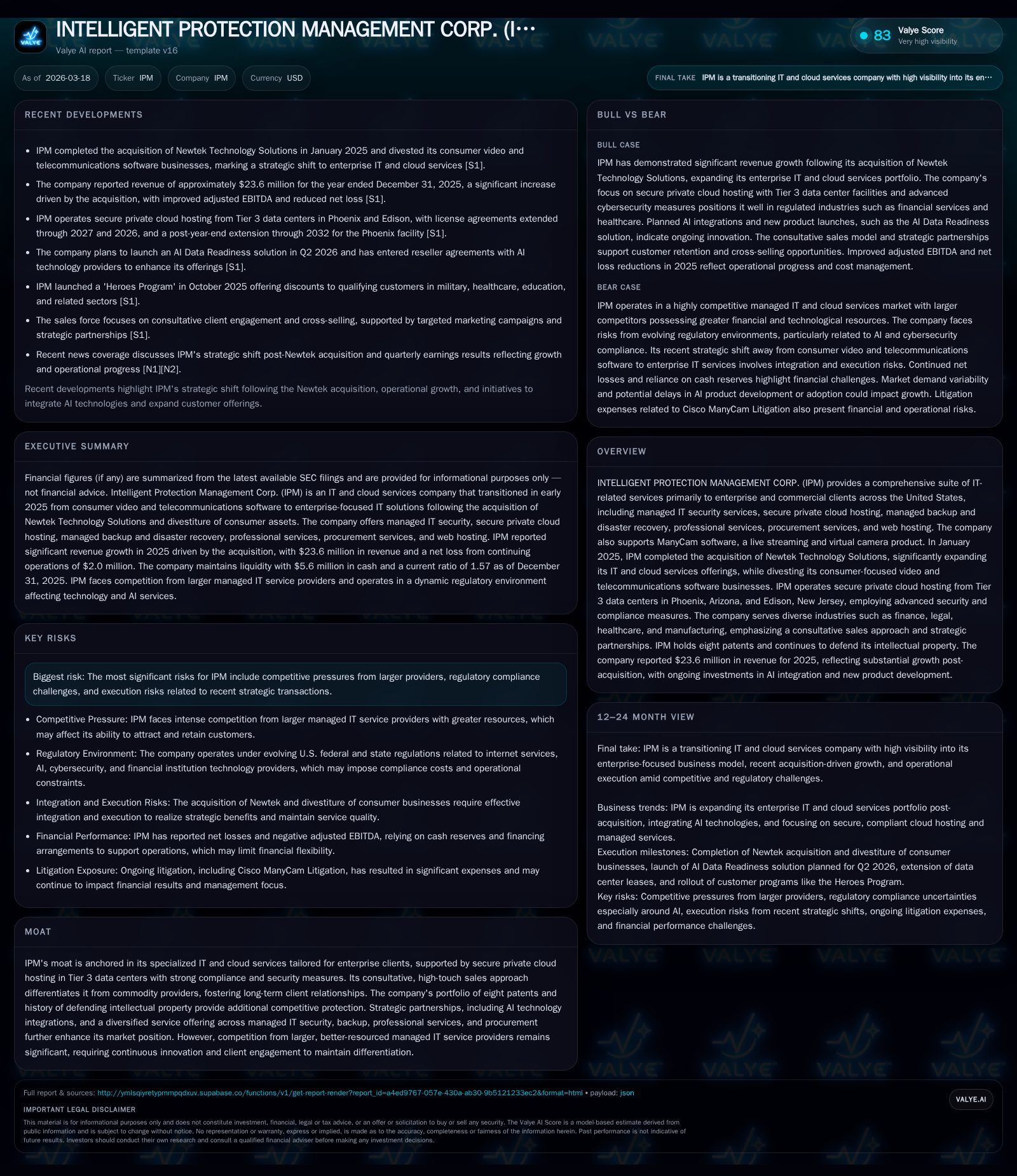
INTELLIGENT PROTECTION MANAGEMENT CORP. (IPM) underwent a significant strategic realignment in early 2025 by acquiring Newtek Technology Solutions and divesting its consumer video and telecommunications software businesses. This shift reshaped IPM’s revenue base markedly, reflected in a revenue surge of over 2000% in FY2025, driven by managed IT security subscriptions, secure private cloud hosting, and professional services targeting enterprise clients. While this transition has begun to stabilize cash flow with positive operating cash flow in 2025, IPM continues to face operating losses amid competitive pressures and ongoing patent litigation against Cisco. Looking forward, the company’s growth will hinge on leveraging its specialized service offerings, patent portfolio, and navigating regulatory as well as operational execution risks.
Transformation Through Acquisition: The End of Consumer-Focused Businesses
Prior to January 2025, IPM operated a network of consumer-oriented video-based applications such as Paltalk, Camfrog, Tinychat, alongside telecommunications software like Vumber. On January 2, 2025, IPM completed two strategic transactions: the acquisition of Newtek Technology Solutions (NTS) and the divestiture of its consumer-facing assets [S1][N1][S6]. This marked a fundamental pivot away from consumer products towards specialized IT services for enterprises.
The Divestiture involved selling the video streaming apps Paltalk and Camfrog plus telecommunications provider Vumber to Meteor Mobile Holdings for $1.35 million in cash along with assumption of related liabilities [S6][S8]. Concurrently, operations of Tinychat were ceased before closing.
The NTS acquisition significantly expanded IPM's managed IT security services, cloud hosting capabilities using Tier 3 data centers in Phoenix and Edison, professional services consulting offerings, and procurement solutions [S1]. This repositioned the company squarely in the enterprise IT services market.
Financial Leap: Historical Growth and Operating Challenges in Fiscal 2025
IPM's financials reflect the transformational impact of its strategic overhaul. Revenue spiked from approximately $1.1 million in FY2024 to over $23.6 million in FY2025—a staggering year-over-year increase of roughly 2049.9%, primarily attributed to Newtek's contribution [F1]. Despite this leap in scale, operating income remained negative at around -$4.72 million but showed a slight improvement relative to prior years' losses [F1]. Net income loss narrowed substantially from -$8.4 million in FY2024 to -$1.96 million in FY2025.
Crucially, operating cash flow turned positive for the first time post-acquisition at about $1.08 million versus a negative $3 million outflow the year before [F1]. Capital expenditures remained restrained at approximately $280k—down around 28% YoY—consistent with an asset-light managed service model focusing on leasing rather than owning infrastructure [F1].
Historical performance (annual)
| FY | Rev ($mm) | Net ($mm) | CFO ($mm) | OpInc ($mm) | Rev YoY | Net YoY |
|---|---|---|---|---|---|---|
| 2025 | 24 | -2 | 1 | -5 | +2049.9% | +76.8% |
| 2024 | 1 | -8 | -3 | -5 | -90.0% | -689.5% |
| 2023 | 11 | -1 | -1 | -2 | -0.1% | +68.7% |
| 2022 | 11 | -3 | -3 | -4 |
Source: SEC companyfacts cache [F1].
Capital returns and efficiency (annual)
| FY | Buybacks ($) | ROE% |
|---|---|---|
| 2025 | 400000 | -10.8 |
| 2024 | 7213 | -70.8 |
| 2023 | -5.3 | |
| 2022 | -16.3 |
Source: SEC companyfacts cache [F1].
Results underscore the challenge of integrating large acquisitions while stabilizing cost structures.
Growth Engines: Deepening Managed IT Security and Private Cloud Offerings
Post-acquisition IPM’s core offerings cluster around six integrated IT service areas: managed IT security subscriptions providing proactive cybersecurity management under contractual SLAs; secure private cloud hosting from isolated suites within Tier 3 certified data centers located in Phoenix (lease extended through August 2032) and Edison (lease expiring end-2026 with renewal or relocation plans underway); managed backup and disaster recovery solutions emphasizing automated off-site replication; broader professional services spanning cybersecurity design to hybrid cloud deployment; procurement services bundling hardware/software configurations; and web hosting [S1][S2][S14][S23].
Each managed IT security subscription typically involves recurring fees calibrated under detailed SLA frameworks ensuring uptime guarantees and standardized performance metrics critical for enterprise customers [S23]. The Tier 3 data center certification highlights infrastructure resilience standards addressing power redundancy and fault tolerance required by heavily regulated verticals like finance or healthcare [S1].
Significant efforts are also targeted at innovating AI-driven solutions such as an "AI Data Readiness" product slated for Q2 2026 launch aimed at improving data reliability and securing AI implementations—a signpost for future service enhancements leveraging machine learning technologies [S14]. Procurement offerings complement these cloud-centric solutions by enabling hardware/software sourcing with value-added configurations tailored per customer contracts.
Competitive Moat and Industry Positioning Amid Larger Provider Rivalry
IPM differentiates itself through a consultative sales approach focused squarely on named enterprise accounts requiring tailored security and cloud management solutions rather than commodity-based provisioning common among large-scale MSPs (Managed Service Providers). This approach involves senior account executives supported by solution architects closely managing client engagements which foster higher customer stickiness.
Competitive threats remain robust from better-resourced peers such as Rackspace Technology Inc., Cognizant Technology Solutions Corporation and CDW Corporation among others actively investing in overlapping markets [S16]. To maintain differentiation amid fierce competition requires continual innovation on product capabilities—including AI integration—and expansion into adjacent service domains.
Moreover regulatory compliance regimes governing financial institutions impose exacting standards which IPM navigates via FFIEC supervision encompassing cybersecurity audits and business recovery planning—enhancing its appeal for clients within tightly regulated sectors [S9]. These factors cumulatively establish a defensible service niche although scalability challenges persist given sizable competitors’ economies of scale.
The Patent Portfolio and Intellectual Property Defense as Strategic Assets
Intellectual property underpins another pillar of competitive advantage for IPM through its portfolio of eight patents primarily covering proprietary streaming-related inventions but now leveraged across broader technology offerings [S1]. Most notably ongoing litigation initiated by wholly owned subsidiary Paltalk Holdings against Cisco over alleged infringement related to US Patent No. 6,683858 resulted initially in a jury verdict awarding damages of $65.7 million in August 2024 [S9].
However subsequent orders partially granted new trials on damages following motions filed by Cisco have introduced ambiguity regarding ultimate recoverable amounts with appellate briefs due by March-end 2026—posing material contingent risk over near-term earnings impact from settlement proceeds or penalties collected.
Such legal action underscores IPM’s commitment to defending its technology moat beyond client service excellence by actively enforcing intellectual property rights creating additional barriers against replication from competitors lacking comparable patent protections [S9].
Capital Allocation Patterns: Buybacks, Cash Flow Turnaround, and Equity Trends
Despite sizable net losses throughout recent years—including almost $2 million loss for FY2025—IPM demonstrated capital discipline evidenced by turning positive operating cash flows ($1.07 million) for the first time since transition epoch compared with significant cash burn pre-acquisition [F1][S12]. Capital expenditures remained modest ($280k), consistent with its use of leased Tier 3 data center suites rather than heavy CapEx investment [F1].
Balance sheet strength is maintained with cash & equivalents near $5.6 million as year-end 2025 supporting liquidity alongside minimal leverage—no drawn amounts under revolving credit facility up to $1 million secured by company assets at March quarter-end [F1][S4][S21]. Equity capital grew markedly due to Preferred Stock issuance totaling four million shares tied to NTS consideration contributing to latest book equity over $18 million after steady decline prior periods stemming from accumulated losses [F1][S12].
Stock repurchase activity resumed post-Transactions with ~$400k repurchased during fiscal year under board-authorized plan aimed at offsetting dilution related to employee stock options granted amid retention efforts [F1][S7][S15]. No dividends are currently paid reflecting focus on reinvestment amid growth phase.
Regulatory and Litigation Headwinds: The Cisco Patent Dispute Outlook
A prominent risk disclosed relates to the ongoing appellate patent infringement litigation against Cisco stemming from jury verdict affirming infringement but remanding damages calculation back for reconsideration earlier decisions upheld validity claims [S9].
With briefs due end-March 2026 followed by possible oral arguments or judgment based solely on written submissions imminent thereafter this dispute introduces uncertainty regarding possible adjustment or enforcement of sizable damages awards amounting originally to nearly $66 million plus interest.
Though this remains a strong defensive mechanism bolstering intellectual property moat it also represents unpredictable contingent liabilities or windfall gains that could materially affect future reported results depending upon court outcomes or settlements negotiated at pending stages [S9].
Watch Points Ahead: Leasing Strategies, Client Retention & Margin Trajectory
From an operational vantage point sustainability of core assets hinges significantly on renewal or replacement strategies around its data center leases:
- Phoenix facility lease extended recently through August 2032 offering long-term stability,
- Edison site lease expires end-2026 requiring either renewal negotiations or migration plans into comparable Tier 3 certified environments [S1]. These decisions will be crucial given the criticality of infrastructure underpinning secure private clouds central to IPM’s enterprise value proposition.
Equally important will be continued success deepening penetration into existing corporate customers via upselling bundled solutions while expanding new client acquisitions within targeted verticals utilizing consultative selling techniques [S16]. Margins remain challenged presently due to integration costs but improved economies of scale combined with higher-margin subscription renewals may drive gradual profitability improvements over medium term.
Concurrently adoption pace and monetization efficiency surrounding forthcoming AI-enabled products like "AI Data Readiness" will serve as bellwethers for value creation from emerging technology trends impacting managed IT security domains [S14].
Conclusion
INTELLIGENT PROTECTION MANAGEMENT CORP.’s reorientation following the Newtek acquisition transformed it into an emerging managed IT enterprise player specializing in secure private cloud hosting supported by resilient Tier 3 data centers coupled with comprehensive cybersecurity subscriptions servicing demanding regulated sectors nationwide.
This strategic repositioning propelled remarkable growth reflected sharply in FY2025 revenue scaling yet maintaining operating losses typical during integration phases while cash flows turned positive signaling operational improvements underway. Challenges lie ahead including sustaining competitive differentiation vs larger MSPs through high-touch consultative sales complemented by proprietary patents actively defended against tech incumbents like Cisco underscoring innovation-driven moats. Strong liquidity framed by conservative capital allocation featuring modest buybacks supports continued investment into promising avenues such as AI-enhanced offerings designed for market expansion amidst complex regulatory environments governing cybersecurity providers. Monitoring lease renewals impacting cloud infrastructure alongside margin trajectories amid client retention dynamics will be key indicators tracing IPM’s path toward profitable scaling.
Disclaimer: This report is an informational analysis based on publicly available filings dated through March 17 and March 18 2026 without any investment recommendations or price targets offered herein.
Disclaimer: This is research-only, informational analysis and not investment advice. It may include AI-generated interpretation and general industry context. Always verify important details using primary sources.

Comments