
GitLab Inc: AI-Powered DevSecOps Platform Driving SaaS Expansion and Cash Flow Turnaround
GitLab combines a unified AI-driven DevSecOps orchestration platform with flexible SaaS models to fuel growth amid profitability challenges.
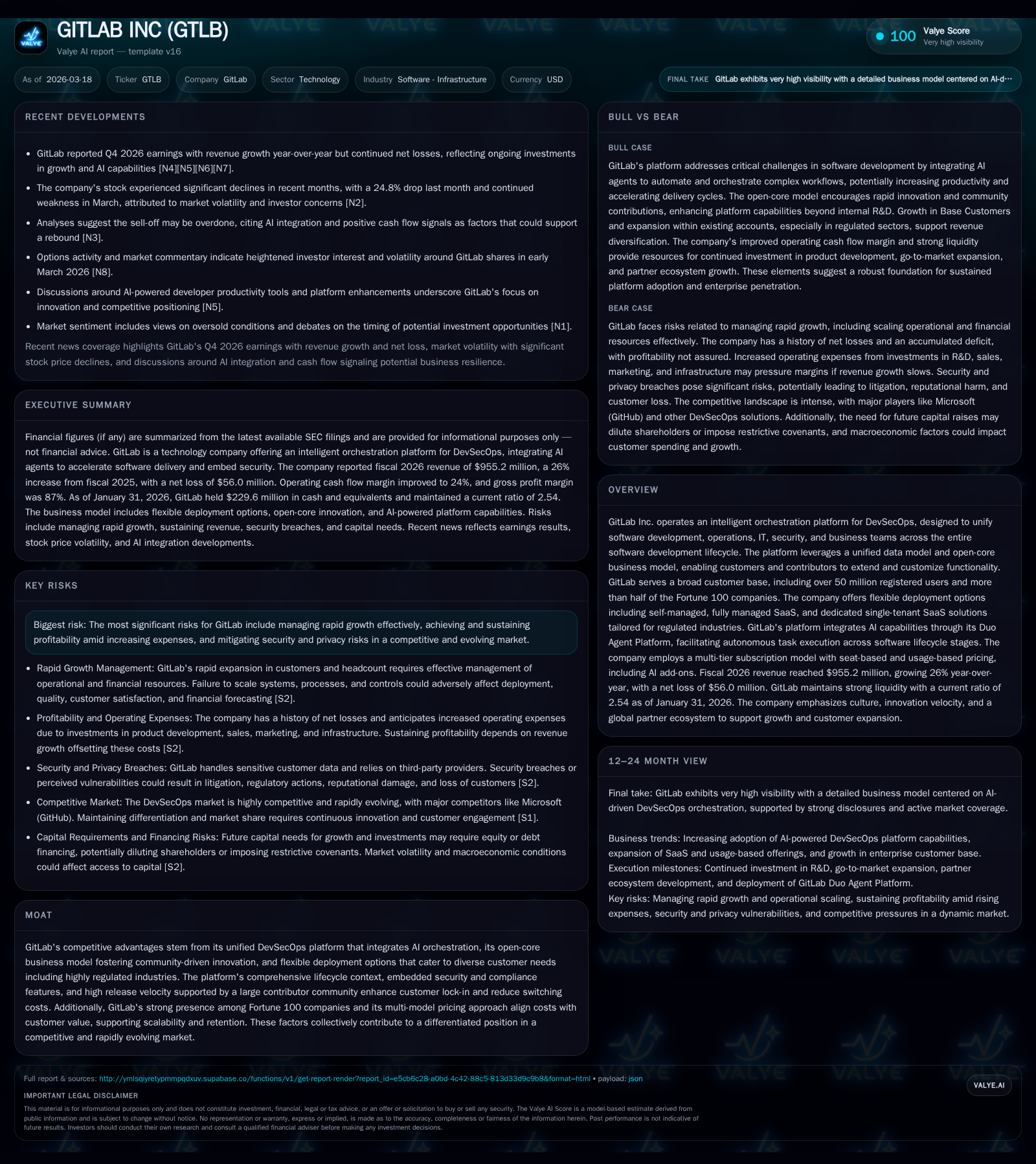
GitLab has leveraged its open-core intelligent orchestration platform integrating AI agents across the DevSecOps lifecycle to drive 26% revenue growth to $955 million in FY2026, supported by increasing customer adoption and usage-based pricing innovations. Despite operating losses of $70 million, GitLab turned operating cash flow positive with a 24% margin, reflecting operational leverage from scalable SaaS deployments. The company’s growth strategy focuses on expanding enterprise adoption, maturing full-lifecycle capabilities, and growing AI agent-driven consumption through GitLab Credits, while managing risks related to rapid scaling and security vulnerabilities.
Historical Performance: Revenue Surge Meets Improving Operating Efficiency
GitLab reported fiscal year 2026 revenue of $955.2 million, marking a robust 26% increase over the $759.2 million achieved in fiscal year 2025 [F1]. This acceleration reflects the growing adoption of its unified DevSecOps platform across diverse customer segments including over half of Fortune 100 companies. While top-line growth is substantial, GitLab remains unprofitable on an operating basis but has materially improved its operating income trajectory. Operating losses narrowed from $142.7 million in FY2025 to $70.5 million in FY2026 — a +50.6% improvement indicating more efficient scale economics despite sustained investment in product development and go-to-market capabilities [F1].
Net loss widened to $55.9 million from only $6.3 million the prior year due primarily to one-time charges and increased non-operating expenses but remains modest relative to revenue scale [F1]. Crucially, GitLab converted its formerly negative operating cash flow (–$63.9 million in FY2025) into a strongly positive figure of $232.9 million (a 24% margin) in FY2026 — a dramatic turnaround underscoring operational leverage effects within the SaaS model [F1]. Capital expenditure rose moderately (188% YoY) reflecting investments aligned with growth initiatives but remained well covered by free cash flow generation.
Historical performance (annual)
| FY | Net ($mm) | CFO ($mm) | OpInc ($mm) | Capex ($mm) | Net YoY |
|---|---|---|---|---|---|
| 2026 | -56 | 233 | -70 | 11 | -784.5% |
| 2025 | -6 | -64 | -143 | 4 | +98.5% |
| 2024 | -424 | 35 | -187 | 2 | -146.2% |
| 2023 | -172 | -77 | -211 | 6 |
Source: SEC companyfacts cache [F1].
Capital returns and efficiency (annual)
| FY | Buybacks | FCF ($mm) | ROE% |
|---|---|---|---|
| 2026 | 222 | -5.6 | |
| 2025 | -68 | -0.8 | |
| 2024 | 0 | 33 | -74.3 |
| 2023 | 0 | -83 | -22.3 |
Source: SEC companyfacts cache [F1].
Figures reflect reported annual results; negative values denote losses.
Strategic Differentiation: The Open-Core AI-Driven DevSecOps Advantage
GitLab’s strategic moats derive primarily from its unified data model underpinning an intelligent orchestration platform that spans development to operations with embedded security capabilities — collectively known as the DevSecOps lifecycle coverage [S4][S6]. This architecture eliminates fragmentation inherent in siloed toolchains by orchestrating teams alongside AI agents collaboratively executing tasks autonomously via the Duo Agent Platform [S1]. This autonomous coordination reduces cycle times significantly and mitigates bottlenecks typically caused by handoffs or tool incompatibilities.
Notably distinctive is GitLab’s open-core business model which invites external developers and customers to contribute enhancements directly through an expansive public repository. In calendar year 2025 alone, there were over 6,500 community-merged contributions accelerating innovation velocity beyond internal R&D limits while fostering trust through transparency [S4][S6]. This approach aligns incentives across users and developers alike.
Deployment flexibility amplifies competitive positioning — customers may opt for self-hosted solutions suited for stringent control environments or choose between fully managed public/private cloud SaaS offerings or GitLab Dedicated single-tenant SaaS tailored for regulated industries such as government and finance demanding data residency and FedRAMP compliance [S4][S15]. Unlike some competitors locked into single infrastructure models or limited integration scope, GitLab supports LLM neutrality with on-premise gateways facilitating air-gapped environments crucial for sensitive workloads [S9].
Growth Drivers and Market Expansion Paths for FY2026 and Beyond
GitLab’s growth engine combines bottom-up adoption—where developers initiate use locally—with top-down enterprise buying driven by C-suite priorities on security compliance and digital transformation [S5][N10]. The company’s multi-modal subscription pricing includes seat-based licenses augmented by usage-based GitLab Credits tied directly to AI agent activity enabling granular alignment of cost with value realization at scale [S20].
This model proved effective as Base Customers grew from approximately 9.5K to over 10.4K within a year pointing to strong net new additions amid recurring sales cycles [S2][F1]. Dollar-Based Net Retention Rate hovered around an impressive ~118%, signaling healthy upsell dynamics especially among customers expanding AI-driven workflows and migrating incremental projects onto the platform [N3][N4].
The trend towards SaaS migration accelerates continued demand for GitLab.com cloud-hosted offerings where elimination of infrastructure management overhead appeals broadly while still supporting enterprises’ need for comprehensive audit-ready governance built into software workflows rather than separate checkpoints—critical for digitally mature clients balancing speed with regulatory mandates [S4][N1]. Partnership expansions with hyperscalers like AWS and GCP also support extended market reach through reseller ecosystems and integrated service offerings speeding deployment timeframes at scale [S5].
Capital Allocation: Robust Cash Flows Amid Net Losses and No Share Repurchases
Despite continuing GAAP net losses reflecting investment-heavy growth phases ($56M net loss in FY2026), GitLab generated free cash flow exceeding $222 million after subtracting capex from operating cash flow—a stark improvement versus prior years’ negative cash flow profiles—providing a solid foundation for capital reinvestment strategy execution rather than shareholder distributions or buybacks currently withheld since FY2022 [F1][S18][S19].
Cash reserves stood healthy at approximately $230 million with current assets more than double current liabilities yielding a comfortable current ratio (~2.54x), ensuring sufficient liquidity buffer to fund ongoing R&D programs focusing on expanding AI capabilities across the full software development lifecycle stages including CI/CD enhancements and advanced security testing modules essential for maintaining competitive differentiation [F1][S11].
Consistent with its growth orientation and open-source reinforcement approach capital allocation emphasizes funding talent acquisition particularly engineers specialized in DevSecOps tooling and AI integration alongside marketing initiatives designed both to educate markets on GitLab’s unique value proposition as well as drive deeper penetration into complex enterprise accounts requiring vertical-specific security controls such as financial services or public sector entities [S17].
Risks and Operational Challenges in Scaling Rapid Growth
Accelerating expansion places inherent strain on management bandwidth necessitating enhancements in internal process controls to avoid degradation in customer onboarding speed or overall product quality as complexity rises with broader use-case requirements—highlighted candidly in ongoing SEC risk disclosures emphasizing challenges around scaling teams effectively without impairing project delivery timelines or introducing operational inefficiencies that could dampen net retention gains or margin progressions [S2][N9].
Security risks remain prominent given GitLab’s integrated AI tooling footprint; any vulnerabilities exposed could lead to reputational damage or regulatory scrutiny especially given heightened compliance standards facing customers within heavily regulated verticals like healthcare or government contracting sectors obliging strict data protection standards monitored under regimes including FedRAMP or GDPR frameworks [S8][N9]. Legal proceedings around alleged misrepresentations tied partially to AI monetization claims have been resolved favorably but underline ongoing litigation vigilance requirements amidst evolving market expectations on AI claims transparency [S16][S24]. Competitive pressures persist from incumbent offerings like Microsoft-owned GitHub which leverage broad ecosystems though their more fragmented approach contrasts with GitLab’s unified platform strategy which may offer long-term structural advantages if innovation cadence sustains expected levels beyond immediate quarters [S14][S29].
What to Watch Next: Milestones in AI Adoption, Customer Expansion, and Profitability Trajectory
Absent explicit forward financial guidance as per recent earnings releases and investor communications documents [N3], monitoring key performance indicators will be instructive including ARR growth trending aligned with expanding Base Customer counts notably among larger enterprises (> $100K ARR segments), improvements in dollar-based net retention rates indicative of successful upsell motions linked increasingly to AI capabilities consumption patterns facilitated by GitLab Credits usage metrics reported publicly where available.
Tracking operating income trends remains critical as margins inch toward breakeven thresholds supported by scalability benefits derived from increased SaaS penetration versus legacy self-managed deployments combined with measured expense discipline post aggressive hiring phases detailed elsewhere suggests potential profitability inflection points achievable within medium term horizons conditional upon sustained demand elasticity amidst macroeconomic uncertainties.
Partnership expansions particularly deeper integrations with cloud hyperscalers signal potential channel shift impacts on distribution efficiency pricing competitiveness worth evaluating alongside continuous product innovation velocity maintained via monthly iterations sustained through community contribution flows illustrating how open core continues delivering differentiated capabilities critical for long-term defensibility within the DevSecOps orchestration sector space [N10][N4][S4].
This report synthesizes publicly available SEC filings along with recent news coverage to provide a comprehensive analysis of GitLab's business fundamentals without offering investment recommendations. Investors should consider additional sources when evaluating company prospects.
Disclaimer: This is research-only, informational analysis and not investment advice. It may include AI-generated interpretation and general industry context. Always verify important details using primary sources.

Comments