
NextNav's Spectrum Leasing and 5G-Integrated PNT Growth Under Debt Covenant Constraints
NextNav leverages proprietary low-band spectrum and terrestrial PNT technology to address GPS limitations, while navigating financial losses and regulatory hurdles.
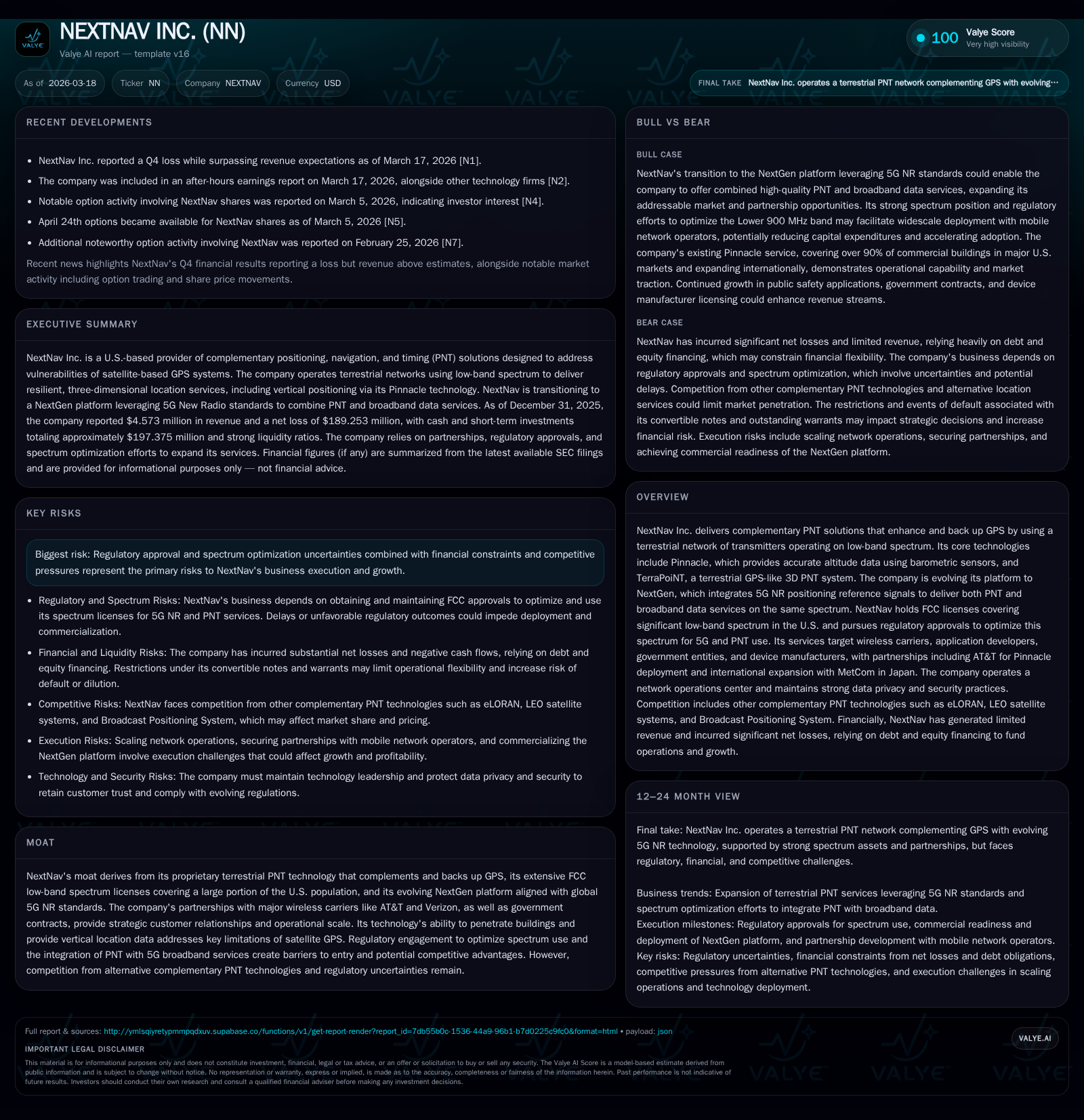
NextNav provides complementary positioning, navigation, and timing (PNT) solutions through a terrestrial network, addressing shortcomings of satellite GPS such as indoor penetration and vertical location. Its core Pinnacle and TerraPoiNT systems rely on FCC-licensed low-band spectrum covering over 90% of the U.S. population. The company is advancing its platform toward a NextGen integration that utilizes 5G NR positioning signals to enhance both PNT precision and broadband data delivery. Despite revenue contraction and deepening operating losses in 2025, NextNav maintains strategic partnerships, including with AT&T and MetCom in Japan, and has secured $190 million in convertible notes financing to support R&D and network expansion. However, restrictive debt covenants and regulatory uncertainties present operational challenges.
Overview of NextNav's Business and Market Position
NextNav Inc. operates as a specialized provider of complementary Positioning, Navigation, and Timing (PNT) services designed to augment traditional satellite-based systems like GPS. Unlike conventional GNSS technologies that rely on satellites susceptible to jamming or signal loss indoors or in urban canyons, NextNav employs a terrestrial network transmitting on licensed low-band spectrum around 900 MHz. This approach enhances signal strength significantly, enabling signal penetration into buildings and providing three-dimensional location data, critical for emergency response (especially vertical "z-axis" positioning), autonomous systems like drones, and other emerging applications.
The company's core products include Pinnacle—a technology leveraging barometric sensors integrated with terrestrial transmitter networks—and TerraPoiNT, which functions as a terrestrial GPS-like system offering broad coverage with elevated resistance to interference.
Historical Financial Performance and Drivers
NextNav's revenue peaked at $5.67 million in FY2024 before declining approximately 19% to $4.57 million in FY2025 [F1]. This contraction resulted primarily from reduced service contracts with government entities and commercial customers. The revenue base exhibits significant customer concentration: two clients accounted for nearly 87% of revenue in the latest reporting period [S15][S25].
Operating income remained deeply negative, worsening slightly year-over-year from an operating loss of approximately $60 million in FY2024 to over $70 million in FY2025 [F1], reflecting intensifying investments across research & development (+17% increase to $19 million) and selling/general administrative expenses (+18% increase to nearly $40 million) [S5][S14]. Despite these expenditures aiming at scaling technology maturity (notably the NextGen platform integrating emerging global standards such as 3GPP’s Release-compliant 5G NR positioning reference signals), the company has yet to achieve operating leverage.
The net loss expanded sharply, more than doubling from roughly $102 million in FY2024 to $189 million in FY2025 [F1]. A substantial portion stems from non-cash expense items including fair value adjustments on derivative liabilities associated with its convertible notes financing structure [S8][S11].
Historical performance (annual)
| FY | Rev ($mm) | Net ($mm) | CFO ($mm) | OpInc ($mm) | Rev YoY | Net YoY |
|---|---|---|---|---|---|---|
| 2025 | 5 | -189 | -51 | -70 | -19.3% | -85.8% |
| 2024 | 6 | -102 | -38 | -60 | +46.8% | -42.0% |
| 2023 | 4 | -72 | -35 | -64 | -1.6% | -78.8% |
| 2022 | 4 | -40 | -37 | -66 |
Source: SEC companyfacts cache [F1].
Capital returns and efficiency (annual)
| FY | Buybacks ($) | FCF ($mm) | ROE% |
|---|---|---|---|
| 2025 | -51 | 219.5 | |
| 2024 | -38 | -203.3 | |
| 2023 | 4000 | -38 | -91.1 |
| 2022 | 4000 | -40 | -40.1 |
Source: SEC companyfacts cache [F1].
Table: Key annual financial metrics reflect steep losses amid rising R&D programs; capital expenditures collapsed in ’25 relative to prior years indicating possible focus shift towards operational scaling over asset-intensive build-outs.
Capital Structure, Liquidity, and Capital Allocation
NextNav restructured its debt profile by retiring its high-interest (10%) '2026 Notes' totaling $70 million through proceeds raised via a private placement of $190 million senior secured convertible notes due June 30, 2028 at a reduced coupon rate of 5%, thus significantly lowering interest burden albeit increasing dilution risk due to embedded conversion features [S4][S7][S8][S22]. The carrying value of this long-term debt was about $158 million net of debt discount at year-end [S8]. While these notes provide longer financial runway amidst heavy investment phases, they come with stringent covenants restricting dividend payments; share repurchases; asset sales; intellectual property transfers; issuance of additional debt above permitted limits; mergers; investments; all designed to protect noteholders yet limiting corporate flexibility [S2][S24].
Cash flow remains under pressure with operating cash outflows at roughly $50.7 million against minimal capital investment ($50k capex reported for full year indicating focus on software/internal tech development rather than physical asset acquisition) [F1][S16]. Free cash flow remains deeply negative with no dividends declared nor share buybacks occurring during these periods [F1]. Equity was negative at about -$86 million as of end-2025 following accumulated losses driven by persistent operational deficits compounded by mark-to-market impacts on derivative instruments tied to convertibles [F1].
Technology Evolution and Market Opportunities
At the heart of NextNav’s differentiation lies its FCC-licensed contiguous low-band spectrum totaling approximately 12 MHz centered around the ~900 MHz band that covers over ninety percent of the U.S population—a valuable scarce resource facilitating dense terrestrial transmitter deployment providing strong signal integrity indoors where GPS fails [S1][S18].
The company is progressing toward a unified NextGen platform leveraging standardized Positioning Reference Signals embedded within globally adopted 5G New Radio (NR) protocols defined by the Third Generation Partnership Project (3GPP). This transition enables simultaneous delivery of ultra-reliable PNT alongside broadband data services using common infrastructure and spectrum assets—an advanced model promising operational efficiencies and new revenue avenues aligned with broader telecommunications digitization trends [S1].
Partnerships further reinforce market penetration efforts: agreements with wireless carriers such as AT&T focus on deployment of Pinnacle services enhancing E911 capabilities through precise altitude information; internationally, NextNav has initiated equity participation within MetCom consortium targeting Japanese market expansion that could unlock scale beyond domestic operations [N1][S20].
Risks and Operational Challenges
Significant risks persist related primarily to regulatory approval timelines governing optimal use and potential reinstatement petitions concerning certain transferred spectrum licenses initially held by Telesaurus/Skybridge entities—outcomes bear directly on operational capacity expansion [S1][S23]. Competitive pressures arise from alternative complementary PNT approaches including hybrid positioning technologies blending inertial navigation systems or leveraging Wi-Fi/bluetooth beacons that could limit market adoption velocity.
Financially constrained by recurring negative cash flows amid escalating R&D & G&A spend requirements, NextNav faces balancing innovation-driven growth prospects against covenant-limited capital management strategies restricting its ability to swiftly adapt via mergers or aggressive capital returns [S24]. Furthermore, dependence on a narrow customer base elevates revenue volatility risks.
What To Watch: Milestones And Indicators Ahead (Analysis)
Given absence of explicit current-year guidance formalized beyond public filings:
- Progression metrics surrounding NextGen platform’s commercial rollout will be key catalysts,
- Regulatory developments regarding spectrum license status remain pivotal,
- Scaling partnership deployments domestically and internationally,
- Improvement trajectory toward achieving positive operating leverage,
- Management’s ability to manage covenant constraints while fostering innovation.
Monitoring periodic updates around government contract awards or expansions into adjacent verticals such as autonomous vehicles or smart city infrastructure could provide insight into market traction beyond core carrier partnerships.
Conclusion
NextNav stands uniquely positioned within terrestrial PNT markets due to its scarce spectrum holdings combined with technology designed expressly for overcoming satellite GPS vulnerabilities indoors or vertically within buildings—critical gaps increasingly acknowledged across public safety communications and advanced applications needing reliable three-dimensional location information.
However, the company faces a complex scenario involving restrictive financial covenants tied to convertible note financing used to manage past high-cost debt loads while investing heavily in next-generation integrated solutions aligned with global telecom standards but not yet translating into scale revenues sufficient for profitability.
Strategic cellular carrier alliances alongside international expansion efforts suggest potential pathways toward large-scale commercial acceptance; nevertheless execution risks remain substantial owing chiefly to regulatory licensing complexities and competitive evolutions within an emerging yet fragmented complementary PNT ecosystem.
Disclaimer: This report is intended solely for informational purposes based on publicly available information as of March 18, 2026. It does not constitute investment advice or recommendations regarding securities or positions discussed herein.
Disclaimer: This is research-only, informational analysis and not investment advice. It may include AI-generated interpretation and general industry context. Always verify important details using primary sources.

Comments