
Crimson Wine Group Confronts Industry Headwinds Amid Margin Stability and Strategic Acquisition
In 2025, Crimson Wine Group navigated net sales declines driven by volume drops and trade policy shifts, while enhancing direct-to-consumer margins and completing a notable acquisition.
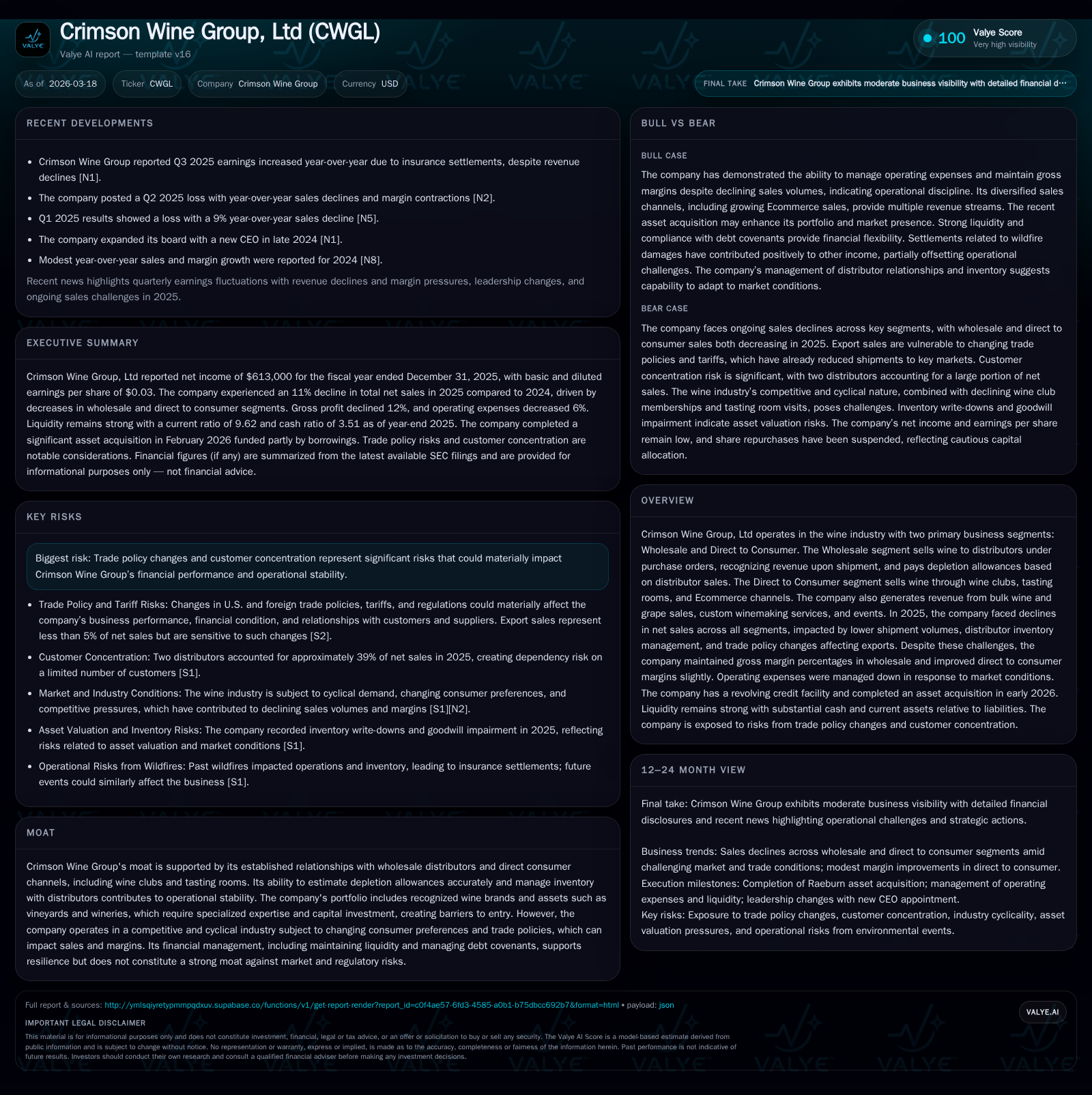
Crimson Wine Group experienced an 11% decline in net sales in 2025, primarily due to lower wholesale shipment volumes and export challenges linked to evolving trade policies. Despite this, the company maintained gross margin percentages in wholesale and improved margins in direct-to-consumer channels by controlling operating expenses. Cash flow from operations weakened, and free cash flow remained negative amid continued capital expenditures. The firm strengthened its portfolio with a $35 million acquisition funded partly through revolver borrowings. Close monitoring of distributor inventory strategies and trade policy developments will be crucial for growth prospects going forward.
Company Overview and Business Model
Crimson Wine Group, Ltd operates primarily within the wine industry, focusing on two main business lines: Wholesale and Direct-to-Consumer (DTC). The Wholesale segment involves selling wines to distributors under purchase orders with revenue recognized upon shipment; it also administers depletion allowances based on actual distributor depletion—that is, end customer sales—accrued as a reduction of sales which Crimson calculates with historical precision minimizing financial discrepancies [S1][S18]. The Direct-to-Consumer segment includes wine clubs, tasting rooms, ecommerce platforms, and other direct sales channels.
Additional revenue derives from bulk wine and grape sales, custom winemaking services, and hosted events—all supplementing core operations [S1]. Crimson’s product portfolio contains established wine brands supported by vineyards and winery assets demanding specialized care and considerable capital investment, limiting entry for potential competitors.
Historical Financial Performance
The company’s revenues peaked prior to recent years but have faced pressure recently due to structural market shifts and external challenges:
Historical performance (annual)
| FY | Net ($mm) | CFO ($mm) | OpInc ($mm) | Capex ($mm) | Net YoY |
|---|---|---|---|---|---|
| 2025 | 1 | 1 | -4 | 4 | -28.0% |
| 2024 | 1 | 3 | 0 | 5 | -72.8% |
| 2023 | 3 | 6 | 2 | 9 | +190.0% |
| 2022 | 1 | 7 | 2 | 8 |
Source: SEC companyfacts cache [F1].
Capital returns and efficiency (annual)
| FY | Buybacks ($mm) | FCF ($mm) | ROE% |
|---|---|---|---|
| 2025 | 0 | -3 | 0.3 |
| 2024 | 2 | -3 | 0.5 |
| 2023 | 3 | -3 | 1.7 |
| 2022 | 7 | 0 | 0.6 |
Source: SEC companyfacts cache [F1].
Not shown: dividends are not disclosed explicitly [F1], share buyback programs were suspended in March 2025 after limited activity [S8][S20].
The year-over-year decline from a modestly profitable operating income in 2024 to an operating loss in 2025 was driven by revenue pressures paired with increased cost absorption despite active expense management [S1]. While net income remained positive, it contracted significantly relative to prior years.
Drivers Behind Past Growth Trends
Historically, growth was driven by expanding distribution channels domestically and modest export opportunities across Canada and Europe [S1]. However, total revenues declined sharply (-11%) in the latest reporting period:
- Wholesale segment: Sales down by approximately $5.6 million or -14%. The reduction stems mainly from lower domestic shipment volumes as distributors opted to reduce on-hand inventory levels amid softening consumer demand [S1]. Meanwhile export volumes were negatively impacted by U.S.-foreign government trade policy changes raising tariffs or imposing restrictions on alcohol products — particularly affecting Canada and Europe markets [S1][S15][S16][S17]. Notably, though shipments declined relative to prior years’ elevated volumes, reported consumption (depletions) reportedly remained stable compared to the previous year.
- Direct-to-Consumer segment: Fell by about $1.5 million (-6%). This drop was attributable primarily to decreased wine club memberships and reduced tasting room visits, signaling more cautious discretionary spending among consumers [S1]. Despite these top-line declines effectively pressuring channel profits, incremental improvements in gross margin indicate better operational efficiency or pricing leverage [S10].
Future Growth Prospects
While short-term headwinds persist—chiefly from unstable trade relations affecting exports and ongoing shifts within wholesale distribution models—the company is seeking avenues for growth:
- Acquisition strategy: The February 2026 purchase of Raeburn Assets for roughly $35 million (funded primarily via $29 million borrowing on its existing revolving credit facility) indicates expansion into complementary premium brand assets suggesting a focus on portfolio diversification [S3][S6][S7].
- Balance between wholesale and DTC: Enhancing Direct-to-Consumer engagement through wine clubs, ecommerce upgrades, experiential retailing via tasting rooms could partially offset wholesale channel softness [N/A beyond provided data].
- Operational cost control: Continued management of expenses as evidenced during challenging periods may help preserve margins.
However, downside risks remain substantial:
- Unpredictable distributor inventory policies could further distort shipments vs sales volumes impacting reported revenue timing.
- Evolving governmental trade policies could exacerbate export market access restrictions or cost burdens.
- Competitive pressure within an industry sensitive to cyclical discretionary spending trends.
- Customer concentration risk is tangible; two distributors accounted for nearly half of net accounts receivable as of late [S22].
Forecasts / Milestones / What To Watch For (Analysis)
No explicit guidance was provided for upcoming periods; however investors should monitor:
- Shipment velocity trends through distributors relative to depletion data as an indicator of demand alignment.
- Impact of Raeburn integration on consolidated financials and brand strength.
- Changes in trade policy negotiations affecting key export jurisdictions.
- Cash flow trajectory given negative free cash flow pressures despite operational cash generation.
- Further corporate actions related to capital allocation including any resumption of share repurchases or dividend initiation.
Returns / Capital Allocation
Returns & Cash Flow
The company's return on equity calculated approximately at 0.3% for FY2025 using net income over ending equity balances indicates minimal profitability relative to invested capital [F1]. Operating cash flow significantly declined (-47%) from prior year levels to about $1.4 million while capital expenditures fell by roughly one quarter but remained relatively high at just under $4 million [$3.9M] indicating ongoing investments into asset base maintenance or capacity expansions [F1][S8][S12]. Consequently, free cash flow stood negative near -$2.5 million reflecting spending exceeding generated cash flows.
Debt & Liquidity Positioning
Crimson maintains moderate debt levels with senior secured term loans totaling approximately $15.4 million outstanding at varying maturities into the late 2030s carrying fixed interest rates around 5–5.4%, alongside an available revolving credit facility sized at $60 million extended until mid-2028 post amendment [S1][S4][S6][S13][F1]. Recently drew down on this revolver for acquisition purposes leaving roughly half capacity available ($31M as of Feb ’26). The firm is compliant with all covenants including fixed charge coverage ratios supporting continuing access to credit lines; liquidity remains strong with over $20M cash equivalents [F1][S21].
Capital Return Policy
The company suspended its share repurchase program in March 2025 after modest activity during the year with only about $350K spent on buying back shares versus multi-million totals previously [S8][S20], signaling a more conservative stance on buybacks amid weaker earnings performance.
No dividends have been disclosed suggesting retained earnings are being prioritized toward reinvestment or debt management rather than shareholder distributions currently.
Industry Dynamics (Analysis)
Wine companies broadly face challenges balancing inventory within complex wholesale networks that often distort shipment-to-consumption dynamics—a phenomenon vividly demonstrated here where shipments slowed yet depletion remained stable indicating cautious reorder pacing but consistent end-market consumption patterns. Further complicating factors include increasingly volatile global trade regimes that impose additional tariff burdens elevating costs or restricting access especially for premium alcoholic beverages exported from the U.S. Direct consumer engagement through diversified channels such as wine clubs serves as an important buffer contributing not only margin accretion but also enhances brand loyalty improving resilience against wholesale disruptions. Capital-intensive vineyard maintenance cycles imply companies must carefully manage CAPEX versus cash flows ensuring sustainability across vintages under fluctuating economic climates.
Conclusion
Crimson Wine Group's financial results for FY2025 underscore significant headwinds primarily stemming from supply chain and external regulatory factors impacting volume-driven revenues across wholesale and export channels alongside softer demand within DTC operations—but cost containment efforts have helped stabilize gross margins particularly within direct channels. The strategic acquisition of Raeburn Assets exemplifies management’s commitment toward portfolio strengthening that could deliver medium-term revenue diversification benefits albeit introducing leverage considerations given substantial revolver usage post-close. Operating cash flow deterioration coupled with continued capital spending has yielded negative free cash flow posing near-term liquidity management challenges mitigated somewhat by strong liquidity reserves and covenant compliance. Future performance will hinge materially upon distributor inventory decisions aligning closer with depletions figures, successful integration of acquisitions enhancing competitive positioning, navigating evolving international trade policies affecting exports, as well as creative expansion of direct consumer sales channels maintaining relevance amidst shifting consumer preferences.
This report is based solely on information publicly available as of March 18, 2026, including SEC filings and does not constitute investment advice or recommendations concerning Crimson Wine Group or any securities mentioned herein.
Disclaimer: This is research-only, informational analysis and not investment advice. It may include AI-generated interpretation and general industry context. Always verify important details using primary sources.

Comments