
Bleichroeder Acquisition Corp. II Launches SPAC with $287.5M Trust for Tech-focused Business Combination
The newly public SPAC aims to leverage its experienced management to identify technology sector targets, with an announced quantum computing deal.
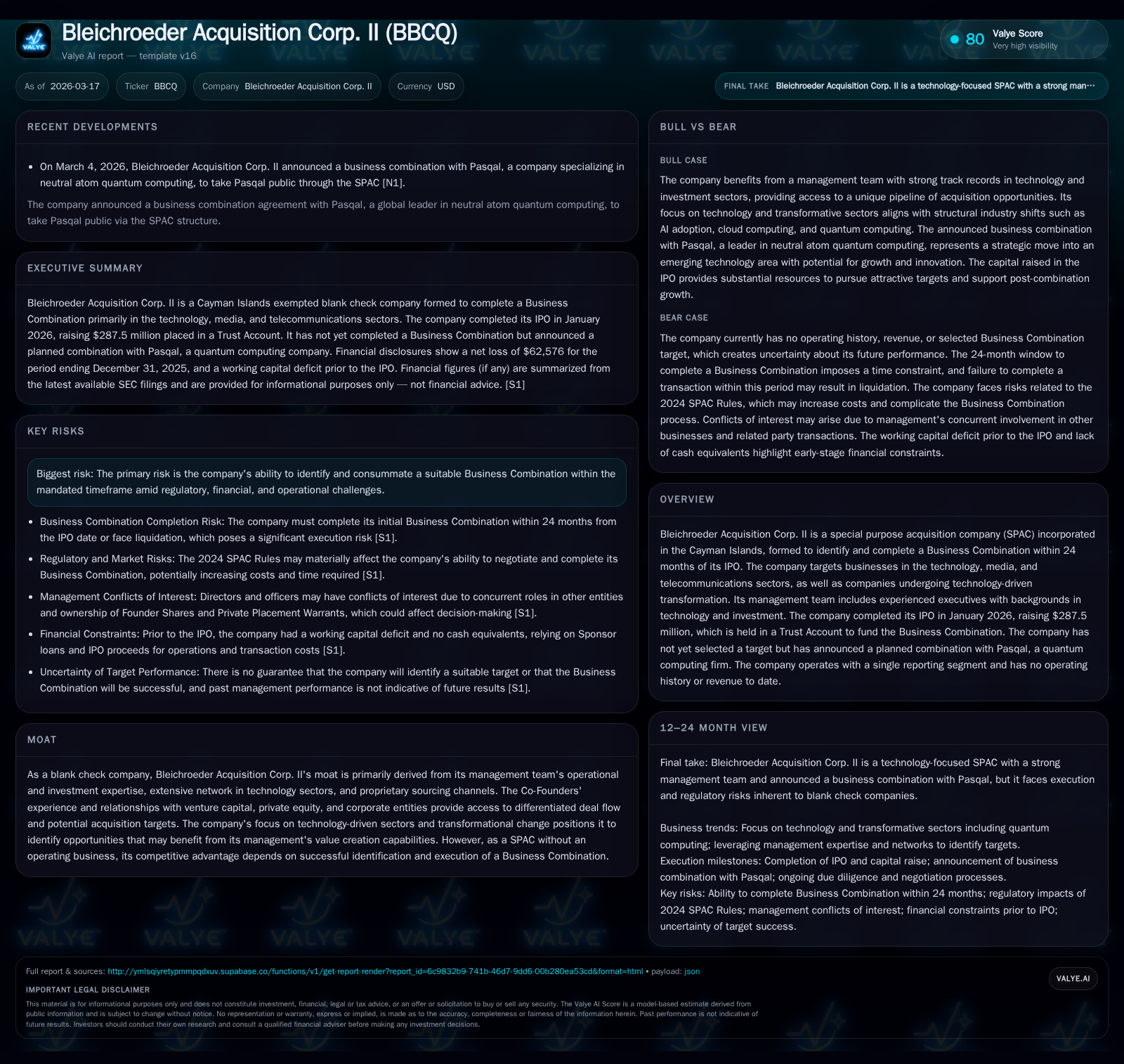
Bleichroeder Acquisition Corp. II is a Cayman Islands-incorporated blank check company that completed its IPO in January 2026, raising $287.5 million placed into a trust account for a technology-driven business combination within 24 months. It has no operating history or revenues to date but has announced a planned merger with Pasqal, a quantum computing firm. The company benefits from management’s deep industry expertise and network in technology sectors that provide deal flow advantages. Risks remain centered on successfully consummating a qualifying transaction within regulatory and financial constraints.
Company Overview and Historical Performance
Incorporated in the Cayman Islands on August 27, 2025, Bleichroeder Acquisition Corp. II (ticker: BBCQ) is a special purpose acquisition company (SPAC) formed to acquire a business within 24 months following its Initial Public Offering (IPO), which closed on January 9, 2026. The IPO raised gross proceeds of $287.5 million by selling 28,750,000 Units at $10 per Unit, including the underwriters' full over-allotment option of 3,750,000 Units [S1][S3][S20]. Simultaneously, the company sold 7,750,000 Private Placement Warrants for $7.75 million, of which the Sponsor acquired approximately two-thirds [S20]. The net proceeds from the IPO, after underwriting fees and offering costs totaling nearly $17.9 million—including a $5 million cash underwriting fee and $12.25 million deferred underwriting fee—were placed into a trust account reserved exclusively for funding the Business Combination [S1][S20].
As a newly formed blank check entity without operational history or revenues through December 31, 2025, the company's expenses have been confined to organizational activities and administrative costs amounting to $62,576 [F1][S1]. The net loss for this period mirrors these formation costs since operations had not yet commenced. Working capital deficits existed prior to the IPO but were rectified once offering proceeds became available for general corporate use outside the trust account [F1][S6]. The current liquidity structure shows minimal current assets relative to liabilities as of year-end 2025 but this is balanced by incoming capital infusion at IPO [F1].
The company operates under a single reporting segment focused solely on identifying and completing its initial Business Combination; thus there are no segmented revenues or operations to summarize historically [S4].
Historical performance (annual)
| FY |
|---|
| 2025 |
Source: SEC companyfacts cache [F1].
Table: Key financial figures reflecting corporate formation through end-2025; IPO proceeds largely raised post-period.
Future Growth Prospects
Bleichroeder Acquisition Corp. II targets acquisition candidates primarily in technology-centered industries including technology media telecommunications (TMT) companies as well as traditional sectors undergoing technology-driven transformation. This thematic focus aligns with trends such as AI adoption across industries, cloud computing growth enabling SMB scalability without fixed cost burdens, autonomous robotics emergence across various verticals, and early-stage quantum computing commercialization potentializing application software development beyond hardware-centric models [S21][S23].
The management team intends to capitalize on proprietary sourcing channels derived from their extensive networks spanning venture capital firms, private equity players and corporate executives within the targeted sectors — providing access to differentiated deal flow not readily available to typical market participants [S22]. This strategic advantage allows them to selectively pursue companies positioned at key inflection points requiring organizational scaling or operational innovation support where active management expertise can unlock value [S22].
Notably, the company announced an agreement in principle for its inaugural Business Combination with Pasqal — a leader in neutral atom quantum computing — leveraging this emerging technology theme expected to disrupt computing paradigms with implications across sectors from pharma research to cryptography [N1]. However, until such transaction closes successfully within the mandated timeframe by January 9, 2028 (24 months post-IPO), no operating revenue or standalone business performance metrics will materialize from Bleichroeder Acquisition Corp. II itself [S1].
Forecasts and Milestones
Explicit guidance remains limited given the nature of SPAC structures which do not generate internal revenues until after mergers close. The principal near-term milestone is consummation of an approved Business Combination by the January 2028 deadline; failure would likely trigger liquidation distributing trust account funds back pro-rata to public shareholders excluding deferred underwriting fees and costs [S1]. Benefits of completing this deal include publicly listing Pasqal or other target entities thus providing enhanced liquidity options for their owners alongside scaling capital structures supported by Bleichroeder’s cash reserves.
Investors should monitor disclosures on proxy or tender offer filings ahead of shareholder votes on proposed combinations (if such votes are held), including redemption statistics indicating shareholder confidence or dissent towards proposed deals and any supplemental financing arrangements that might be announced around transaction closings [S11][S15][S19]. Additionally noted is potential sponsor-led purchase transactions of publicly held shares aimed at ensuring minimum cash requirements or shareholder approval thresholds are met — common tactical tools employed by sponsors that may affect free float and shareholder composition post-merger [S24][S25].
Returns and Capital Allocation
With no operating revenue or assets beyond cash trusts held as of December 31, 2025—and net losses limited solely to formation expenses—traditional return metrics like ROE or free cash flow generation do not apply meaningfully at this stage [F1]. Reported approximate ROE is skewed by zero equity base resulting in a mathematically high ratio but not representative of economic returns given absence of operations [F1].
Capital allocation pre-Business Combination focuses exclusively on minimizing dilution and protecting trust assets earmarked for acquisitions while funding due diligence through working capital outside the trust account derived from offering proceeds net of costs and sponsor loans repaid at IPO closure [S6][S13]. No dividends or share repurchases have occurred nor are planned prior to completing acquisition(s) due to lack of earnings or cash flows suitable for distribution [F1][S11].
Upon closing an initial deal involving one or more target businesses meeting valuation thresholds (minimum fair market value equal to at least approximately 80% of trust assets adjusted for underwriting fees), funds may be deployed flexibly including cash payments supplemented by issuance of equity or convertible debt securities adjusted according to transaction terms negotiated in good faith between parties according to market conditions prevailing at time of execution [S10][S26]. This expected capital flexibility optimizes combination structure enabling payment maximization while preserving some cash working capital post-close.
Risks
Primary risks facing Bleichroeder Acquisition Corp. II pertain notably to:
- Its ability to identify attractive acquisition candidates consistent with stated sector focus before expiration of the prescribed completion window,
- Successfully negotiating definitive agreements factoring in increasingly stringent regulatory scrutiny on SPAC transactions coming into effect from new SEC rules issued in recent years,
- Potential adverse shareholder reaction during redemption votes potentially constraining available merger financing,
- Market volatility impacting valuation dynamics undermining deal attractiveness,
- Dependence on management team’s engagement as key personnel are concurrently involved with other ventures limiting available bandwidth prior to deal closure,
- Post-combination execution risks intrinsic to acquiring early-stage technology firms like Pasqal that may have nascent commercial traction but uncertain profitability profiles.
These factors collectively underscore elevated operational uncertainties inherent within SPAC approaches notwithstanding experienced sponsorship backing warranting careful consideration by stakeholders evaluating this blank check vehicle ahead of its transition into an operating public entity.
Conclusion
Bleichroeder Acquisition Corp. II represents a focused channel for investors seeking exposure indirectly into transformative technology domains via special purpose acquisition mechanics rather than direct private placements or venture stakes. Its sizable trust capital combined with seasoned technologists steering deal selection establishes favorable groundwork though realization remains contingent upon timely transactional execution ideally culminating in bringing disruptive firms like Pasqal public providing potential long-term growth pathways.
This report relies exclusively on disclosed SEC filings through March 16, 2026 ([F1],[S#]) and reputable news sources ([N#]). It does not constitute investment advice nor endorsement but aims only at factual analysis based on available data.
Disclaimer: This is research-only, informational analysis and not investment advice. It may include AI-generated interpretation and general industry context. Always verify important details using primary sources.

Comments