
BayCom Corp Drives Stability Through Interest Rate Risk Management and Capital Strategy
BayCom Corp manages its banking operations with a disciplined focus on interest rate risk and a capital strategy shifting funding toward deposits to support earnings stability.
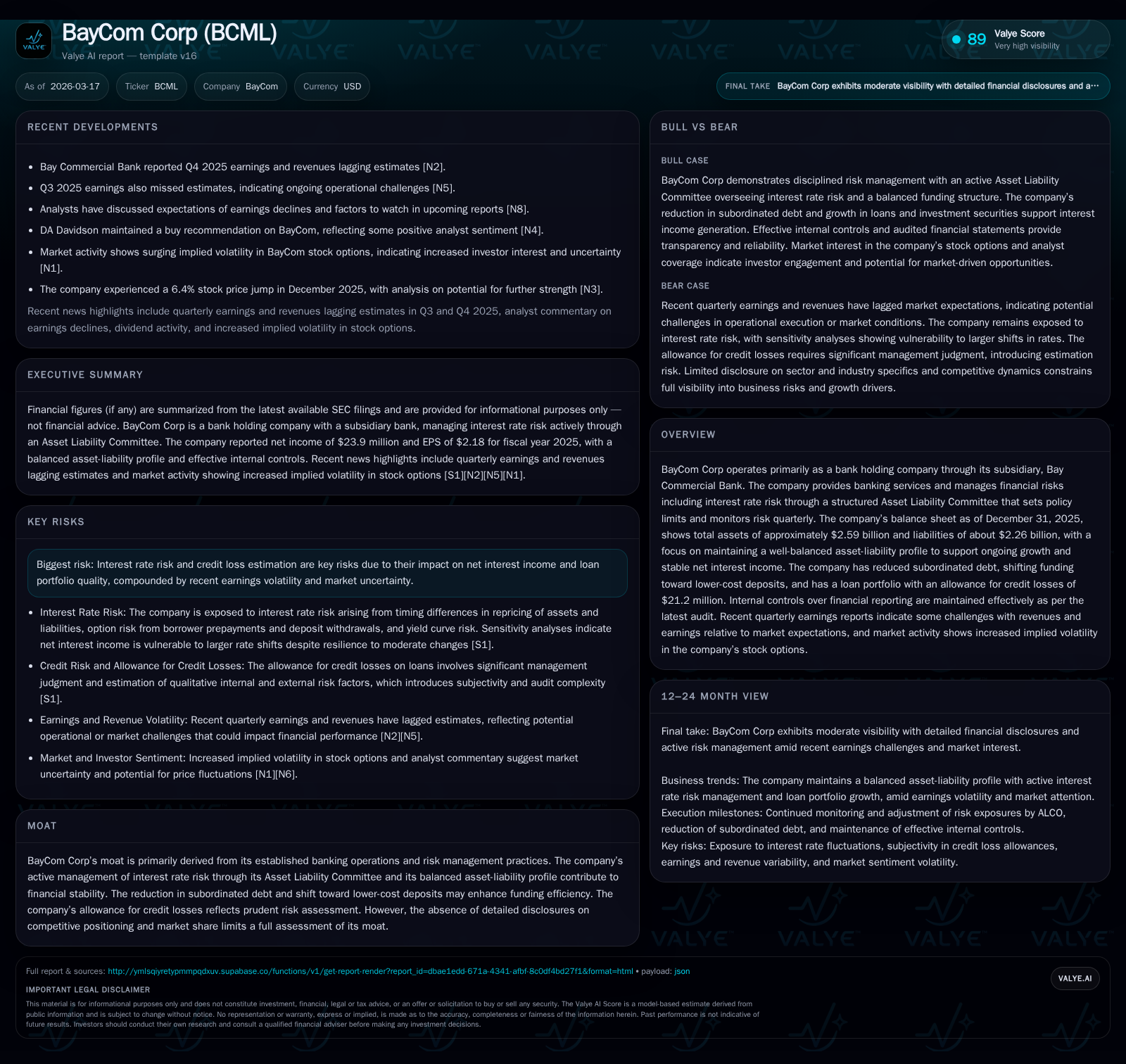
BayCom Corp operates primarily through Bay Commercial Bank, managing total assets of $2.59 billion at the end of 2025. The company’s historical financials reflect modest growth and solid cash flow generation, with net income around $24 million in 2025 and approximate ROE of 7.1%. Central to its stability is an active Asset Liability Committee (ALCO) that governs interest rate risk exposure, maintaining a well-balanced asset-liability profile amid rate fluctuations. Strategically, BayCom has redeemed all subordinated debt by 2025, moving its funding base toward lower-cost deposits, improving the net interest margin potential. Credit quality metrics show prudent allowances for loan losses totaling $21.2 million, highlighting risk awareness amid volatile revenue pressures. Capital allocation demonstrates consistent dividend payments and opportunistic share repurchases supported by robust free cash flow. Investors should watch how ALCO adjustments, deposit retention, and credit trends evolve in response to ongoing market volatility.
Historical Financial Performance and Key Growth Drivers
BayCom Corp’s financial trajectory over the past four years shows a pattern of modest but steady profitability interspersed with episodic volatility typical for regional banks navigating changing economic environments. Net income peaked at approximately $27.4 million in FY2023 before slipping to around $23.6 million in FY2024 and stabilizing near $23.9 million in FY2025 [F1]. Operating cash flow held firm at just over $31 million in 2025, slightly up from the prior year’s $30.3 million, underscoring resilient core operations despite market headwinds [F1]. Capital expenditures remained controlled around $1.7 million annually, aligned with ongoing investment in technology infrastructure and branch maintenance rather than expansionist outlays [F1]. BayCom’s equity base grew moderately to about $338.6 million by end-2025 from $324.4 million a year earlier, supporting capital adequacy [F1]. In aggregate, the firm achieved an approximate return on equity of 7.1% for 2025—indicating disciplined earnings generation balanced against a cautious risk posture [F1].
Historical performance (annual)
| FY | Net ($mm) | CFO ($mm) | Capex ($mm) | Net YoY |
|---|---|---|---|---|
| 2025 | 24 | 32 | 2 | +1.3% |
| 2024 | 24 | 30 | 2 | -13.9% |
| 2023 | 27 | 31 | 2 | +15.6% |
| 2022 | 24 | 40 | 1 |
Source: SEC companyfacts cache [F1].
Capital returns and efficiency (annual)
| FY | Buybacks ($mm) | FCF ($mm) | ROE% |
|---|---|---|---|
| 2025 | 7 | 30 | 7.1 |
| 2024 | 9 | 29 | 7.3 |
| 2023 | 24 | 29 | 8.8 |
| 2022 | 18 | 39 | 7.5 |
Source: SEC companyfacts cache [F1].
Table: BayCom Corp Historical Financial Highlights (FY2022–FY2025) [F1]
Interest Rate Risk Management: The Role of ALCO in Earnings Stability
The cornerstone of BayCom’s financial stability is its Asset Liability Committee (ALCO), which meets quarterly to oversee the company’s exposure to market risks arising from interest rate changes [S1]. BayCom recognizes that asymmetries in asset versus liability repricing timings—termed repricing or gap risk—can materially affect net interest margins (NIM). The ALCO actively manages both reprice risk and embedded option risk from prepayments on loans or early withdrawal features on deposits.
The company adopts an asset sensitive stance when short-term rate increases are likely to improve net interest income because assets reprice faster than liabilities. Conversely, they manage liability sensitivity prudently so that liability cost increases do not outpace asset yield benefits under rising rate scenarios [S1]. To accomplish this balancing act, ALCO establishes policy limits on interest rate gaps and monitors income simulations reflecting hypothetical parallel shifts in yield curves as well as more complex nonparallel shift exposures common in today’s markets.
This structured oversight reduces earnings volatility caused by abrupt market moves while allowing BayCom to capitalize on favorable rate environments without exposing itself excessively to downside risks.
Funding Mix Transition: From Subordinated Debt to Lower-Cost Deposits
A significant strategic maneuver completed in FY2025 was BayCom’s full redemption of its remaining subordinated debt balance of approximately $63.7 million as of the end of FY2024 [S10][S29]. This debt had carried fixed costs linked partly to floating-rate benchmarks with added spreads (e.g., SOFR plus basis points). By retiring this higher-cost junior debt during Q3 of FY2025, BayCom materially lowered its weighted average cost of funds.
This transition shifted the funding profile toward core deposits—particularly noninterest-bearing demand balances and time deposits—offering more stable and typically lower-cost financing relative to subordinated instruments [S6]. For instance, certificates of deposit maturing within one year totaled about $471 million at year-end with management confident that competitive deposit pricing will retain much of this base even upon rollovers [S5].
Furthermore, the bank benefits from considerable undrawn credit lines including a $580 million borrowing capacity from the Federal Home Loan Bank (FHLB) system and an approximately $49 million Federal Reserve discount window capacity that bolster liquidity without immediate cost burdens [S5][S9].
Soundly managing this mix allows BayCom to optimize net interest margin sustainability amidst fluctuating market rates while maintaining regulatory compliance regarding capital structure.
Credit Quality and Loan Portfolio Risk Metrics
BayCom maintains a loan portfolio exceeding $2 billion by the end of FY2025 with an allowance for credit losses totaling roughly $21.2 million—up from prior periods—reflecting proactive provisioning based on updated credit loss estimation models including CECL methodology revisions capturing slower economic growth forecasts and elevated unemployment assumptions [S14][S25].
Despite growing allowances and recent charge-offs (~$948K in FY2025 down from ~$5M including a large specific reserve-related write-down in FY2024), management considers current loan impairment levels manageable within normal parameters for commercial real estate concentrations prevalent across their regional footprint [S14][S26]. The portfolio includes originated loans plus acquired portfolios recorded at fair value upon acquisition with embedded credit deterioration adjustments accounted for conservatively [S20].
However, risks remain from potential collateral shortfalls tied to select commercial real estate loans placed on nonaccrual status following depreciated appraisals as part of ongoing risk assessment processes; hence credit fundamentals warrant continued scrutiny given macroeconomic uncertainties impacting borrowers’ repayment capacity.
Capital Position, Dividends, and Share Repurchase Program Trends
BayCom follows a balanced capital allocation approach emphasizing steady dividends combined with opportunistic share repurchases aligned with available free cash flow generation.
In calendar year FY2025 alone, the Company declared approximately $9.9 million in common stock cash dividends equating roughly to quarterly payments of $0.30 per share as reaffirmed as recently as February of FY2026 [S7]. Buybacks moderated compared to earlier years with nearly $6.9 million spent repurchasing shares indicative of prudent capital deployment amid prevailing market conditions [F1][S7].
Free cash flow after capex approximates $30 million annually—a sufficient runway underpinning these shareholder returns while preserving investment capacity for operational needs [F1]. Equity rose organically by about $14 million during FY2025 maintaining regulatory capital cushions within comfortable bounds for its size class [F1][S10]. ROE near an estimated ~7% suggests moderate but steady returns balancing growth ambitions against capital preservation objectives.
Liquidity Overview and Regulatory Capital Considerations
Liquidity management remains another pillar underpinning BayCom’s stability framework.
At the holding company level on an unconsolidated basis there are liquid assets approximating $7.5 million as of December ’25; however more substantial liquidity exists within bank-level investment securities and cash balances nearing several hundred millions including high quality U.S government agency securities providing ready convertibility without marked impairments [S4][S21]. Additionally, borrowing capability via committed lines totals over half a billion dollars allowing tactical borrowing if needed without undue pressure even during stress scenarios [S5][S6][S9].
Further obligations such as lease commitments totaling about $13.7 million over coming years are manageable within this liquidity cushion [S4]. Regulatory capital requirements imposed by Federal Reserve mandates continue to be met consistently with CET1 ratios comfortably above minimum thresholds given BayCom's sub-$3 billion asset size exclusion from full enhanced supervision standards [S23].
Earnings Challenges Amid Market Volatility and What to Monitor Moving Forward
Despite structural soundness across balance sheet metrics and funding strategies, recent quarters have presented revenue challenges driven largely by variable market interest rates influencing net interest income streams as well as credit provisioning adjustments reflective of evolving economic outlooks [N1]. Surging implied volatility in BayCom's stock options evidences mounting investor caution regarding earnings predictability over near terms [N1].
Key indicators going forward will include ALCO’s evolving positioning responses such as shifts between asset-sensitive or liability-sensitive postures; deposit retention trends signaling customer loyalty amid competition; updates on loan performance particularly delinquencies or additional nonaccrual designations; plus any substantive provision for credit loss recalibrations aligned with macroeconomic developments.
In sum, while BayCom's deliberate methods provide robustness against typical shocks experienced by midsize banks operating regionally, continuous vigilance coordinated through ALCO oversight will be essential to maintain earnings stability amid persistent market flux.
Disclaimer: This analysis is intended solely for informational purposes based on publicly available data sources cited herein through March 17, 2026; it does not constitute financial advice or recommendations.
Disclaimer: This is research-only, informational analysis and not investment advice. It may include AI-generated interpretation and general industry context. Always verify important details using primary sources.

Comments