
BuzzFeed's Brand Strength and AI: Growth Drivers and Profitability Challenges
BuzzFeed leverages iconic digital brands combined with proprietary AI technology to engage young audiences while grappling with persistent losses and liquidity constraints.
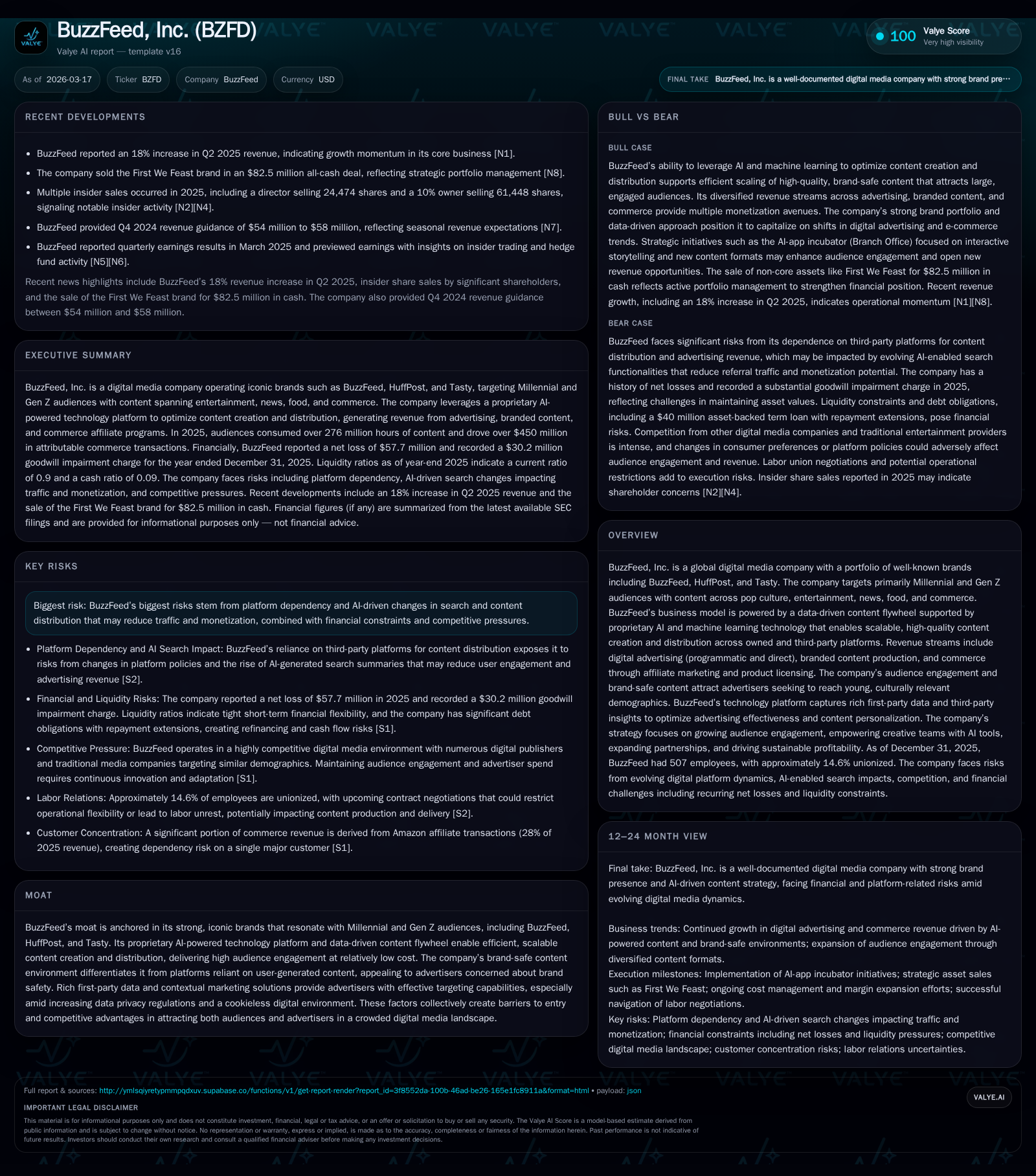
BuzzFeed, Inc. stands out as a digital media company with strong brand assets including BuzzFeed, HuffPost, and Tasty that resonate powerfully with Millennial and Gen Z consumers. Its proprietary AI-driven content flywheel fuels scalable and cost-efficient content generation, driving engagement—but this growth has not yet translated into profitability. Financially, BuzzFeed faces operating losses, negative returns on equity, and liquidity pressures amid an evolving digital advertising environment challenged by platform dependence and AI disruptions in content discovery. Future growth hinges on expanding commerce initiatives and deepening AI tools, but investors should monitor milestones related to audience retention, monetization improvements, and debt refinancing.
Iconic Brands Powering BuzzFeed’s Audience Reach
BuzzFeed's foundation rests on a powerful portfolio of digital media brands including BuzzFeed itself, HuffPost, and Tasty — all well-established pillars among Millennials and Generation Z consumers [S1][S14][S23]. These brands cover distinct but complementary domains: entertainment/pop culture for BuzzFeed; news and opinion for HuffPost; and food-focused video content for Tasty — collectively spanning lifestyle topics that engage younger demographics effectively.
The company has cultivated these brands into trusted destinations favored by advertisers seeking brand-safe environments amidst the rise of user-generated content platforms often criticized for toxic or misleading material [S14][S21]. With over 276 million hours consumed across its properties in 2025 [S20], BuzzFeed commands notable digital shelf space where young audiences not only consume but actively engage.
This brand resonance creates a moat of sorts — viewers are drawn to culturally relevant content produced under editorial oversight rather than open social feeds. The company's ability to blend creativity with data insights enhances stickiness, enabling BuzzFeed to maintain differentiated audience segments attractive to marketers focused on precision targeting within identity-conscious cohorts.
Historical Financial Performance: Operating Losses Amid Growing Engagement
From a financial perspective, BuzzFeed reveals a striking paradox: growing engagement metrics notwithstanding, profitability remains elusive. Operating income remained negative at approximately -$47.9 million for fiscal year 2025—a deterioration from the prior year loss of -$23.5 million but improved versus dramatic losses experienced in earlier years (-$184.3 million in 2022) [F1]. Similarly, net income was negative $57.7 million in 2025 [F1], reflecting ongoing investment in content production capabilities along with market headwinds affecting digital advertising.
Operating cash flow was also negative at nearly -$18.7 million in 2025 despite modest improvement year-over-year (+9.3%) [F1]. Capital expenditures have increased considerably (roughly +183% YoY in 2025 versus 2024) as the company invests selectively in technologies underpinning the AI-driven content platform.
Meanwhile, the balance sheet reveals tightening liquidity—the current ratio stood at 0.9 at the end of 2025 [F1], signaling that current liabilities exceed current assets. Cash on hand totaled just $8.5 million at year-end [F1], spotlighting ongoing funding needs amid unprofitable operations.
Historical performance (annual)
| FY | Net ($mm) | CFO ($mm) | OpInc ($mm) | Capex ($mm) | Net YoY |
|---|---|---|---|---|---|
| 2025 | -58 | -19 | -48 | 2 | -471.8% |
| 2024 | -10 | -21 | -24 | 1 | +88.6% |
| 2023 | -89 | -6 | -40 | 1 | +55.9% |
| 2022 | -201 | -8 | -184 | 5 |
Source: SEC companyfacts cache [F1].
Capital returns and efficiency (annual)
| FY | FCF ($mm) | ROE% |
|---|---|---|
| 2025 | -21 | -116.9 |
| 2024 | -21 | -9.6 |
| 2023 | -7 | -81.4 |
| 2022 | -13 | -105.1 |
Source: SEC companyfacts cache [F1].
Operating income and net income values are reported in millions USD; negative values denote losses; YoY % calculated based on available annual figures.
BuzzFeed’s Data-Driven Content Flywheel and AI Technology Advantage
At the heart of BuzzFeed’s operational model lies its proprietary AI-powered technology platform—a "content flywheel" designed to efficiently create high-quality content tailored for scaled distribution across both owned properties and third-party networks [S6][S14][S15]. Machine learning algorithms analyze rich first-party data collected from extensive audience interactions to shape editorial choices and optimize timing for maximal engagement.
This technology stack enables BuzzFeed to produce culturally resonant articles, quizzes, videos, and branded entertainment that scale faster than traditional media houses can manage cost-effectively [S14][S21]. The flywheel effect emerges as increased audience engagement yields more data insights which fuel subsequent content refinement creating a virtuous cycle difficult for competitors lacking similar capabilities.
Moreover, this system primes BuzzFeed's ability to serve contextual advertisements aligned with emerging privacy regulations as the internet transitions toward a cookieless environment—a significant advertiser concern amid growing scrutiny on data collection practices [S23]. Offering brand-safe environments combined with first-party data facilitates more effective targeting without compromising user trust.
Revenue Streams and Market Dependencies: Advertising and Commerce
BuzzFeed generates revenues through three main channels: advertising (programmatic plus direct sales), branded content production for clients seeking custom assets including long-form videos or campaigns, and commerce-related earnings primarily derived from affiliate marketing plus product licensing agreements [S6][S14].
Advertising remains the largest single source fueled by high audience engagement metrics deployed across owned sites like BuzzFeed.com as well as third-party platforms such as social media channels [S14]. Brand safety continues to be a crucial value proposition helping retain premium ad spend despite competition from major social platforms increasingly challenged by user-generated toxic content risks [S21].
Commerce activities leverage editorial shopping content led by the company’s strong brands fueling hundreds of millions dollars annually in attributable retail transactions from partners including Amazon, Target, Walmart—which accounted for about $450 million in attributable transactions in 2025—and plans exist to expand into new verticals beyond conventional consumer retail categories [S20][S23].
Revenue concentration risk exists given sizable dependence on affiliate streams linked closely with Amazon and Google ecosystems; nonetheless diversification efforts via branded custom content may mitigate fluctuations tied solely to programmatic ad spend volatility driven by macroeconomic cycles affecting advertiser budgets.
Capital Structure, Liquidity Profile, and Debt Management
BuzzFeed's capital structure reflects substantial indebtedness partially restructured through recent credit agreements securing asset-backed term loans totaling approximately $45 million outstanding at December 31, 2025 [F1][S4][S5][S7]. The $40 million initial borrowing replaced convertible notes due in early 2026 at redemption price offering debt relief but introduced minimum liquidity covenants requiring maintenance of cash balances between $3.5 million (through April 30, 2026) reverting to $5 million thereafter [S4][S5].
Multiple amendments have extended repayment deadlines modestly while imposing incremental interest rate premiums above base rates—a signal of financial stress managing near-term obligations amidst cash burn challenges [S5]. As of year-end cash available stood at only $8.5 million while current liabilities exceeded current assets illustrating working capital constraints (current ratio: ~0.9) though capital expenditure outlays emphasize investment intent albeit on a limited scale relative to runway needs [F1][S8].
Returns on equity were sharply negative due to substantial accumulated deficits totaling around $680 million coupled with persistent net losses resulting in an approximate ROE near -117% at latest fiscal year-end [F1]. These figures underline ongoing challenges converting scale into earnings despite steady traffic growth.
Risks from Platform Dependency and AI-Era Disruptions
BuzzFeed faces substantial risk stemming from dependency on third-party platforms for traffic referrals—with sizable portions of online users arriving via external search engines or social networks fueling audience volumes necessary for monetization [S1][S9]. The rapid integration of generative AI technologies into search capabilities threatens disruption by altering discovery paradigms potentially diminishing referral traffic visibility especially impacting news-oriented properties such as HuffPost where algorithmic changes could degrade output relevance or reduce click-through rates [S2].
Simultaneously evolving data privacy laws globally increase compliance costs while constraining traditional targeted advertising models; regulatory scrutiny over user tracking techniques heightens legal exposure risk alongside expensive potential litigation around privacy infringements flagged by recent court cases emphasizing wiretapping or trap-and-trace regulations applying even to signal-level monitoring on websites operated or affiliated with BuzzFeed [S11][S12][S25].
Financial flexibility is limited by debt service obligations; failure to refinance or raise new capital could force downsizing or delay innovation plans further complicating competitive positioning against dominant ecosystems like Meta or Google that integrate superior AI ad targeting at scale [S7][S10].
Future Growth Potential: Expanding Commerce and AI-Enabled Initiatives
Looking ahead, BuzzFeed’s strategic focus emphasizes leveraging its sizable first-party data sets harnessed through expanded commerce partnerships beyond existing consumer retail sectors—potentially touching new e-commerce verticals aligned with vast demographic segments it serves—an avenue buoyed by forecasts projecting U.S e-commerce market penetration reaching nearly $1.8 trillion by end of the decade [S14][S21][S23].
Further investment targets include scaling their AI-app incubator named "Branch Office," dedicated to pioneering interactive storytelling platforms augmented by cutting-edge generative AI tools designed to empower creative expression enabling fresh types of audience engagement unattainable via legacy formats currently pervasive across digital publishing firms [S14].
This dual emphasis underscores an attempt to evolve beyond legacy advertising-reliant modes toward innovative revenue streams catalyzed by proprietary technology enhancing product differentiation while deepening consumer connections critical amid rising platform gatekeeping risks.
What Investors Should Monitor: Key Milestones Ahead
Without explicit forward guidance provided recently, market participants should focus on several key indicators indicative of operational momentum or distress:
- Trends in referral traffic volumes sourced from major social media platforms and search engines affecting organic reach potential;
- Development trajectory of quarterly operating income margin improvements signaling reined-in costs or better monetization efficiency;
- Free cash flow generation narrowing losses serving as proxy for sustainable operations;
- Compliance status regarding liquidity covenants embedded within credit agreements indicative of refinancing feasibility;
- Commercial uptake success rates from novel AI-powered formats launched through Branch Office incubator initiatives revealing go-to-market efficacy;
- Legal risk developments around privacy-related litigation bearing potential reputational or financial impacts.
Continuous monitoring along these dimensions alongside competitive dynamics will illuminate if BuzzFeed can transition from burdensome losses toward healthier profitability anchored upon its unique brand-AI combo advantage.
This analysis synthesizes publicly filed SEC disclosures dated up through March 16, 2026 ([F1], [S#]) without projecting speculative financial outcomes beyond stated facts or extrapolations absent company guidance or verifiable data. It reflects factual observations aligned with standard investigative diligence consistent with buy-side analytical rigor but does not constitute investment advice.
Disclaimer: This is research-only, informational analysis and not investment advice. It may include AI-generated interpretation and general industry context. Always verify important details using primary sources.

Comments