
First Community Corp Builds on Regional Banking Strength with Solid Dividend Growth
FCCO advances its Southeastern regional banking presence through a blend of organic expansion and merger-driven scale, coupled with disciplined capital management underpinning steady dividends.
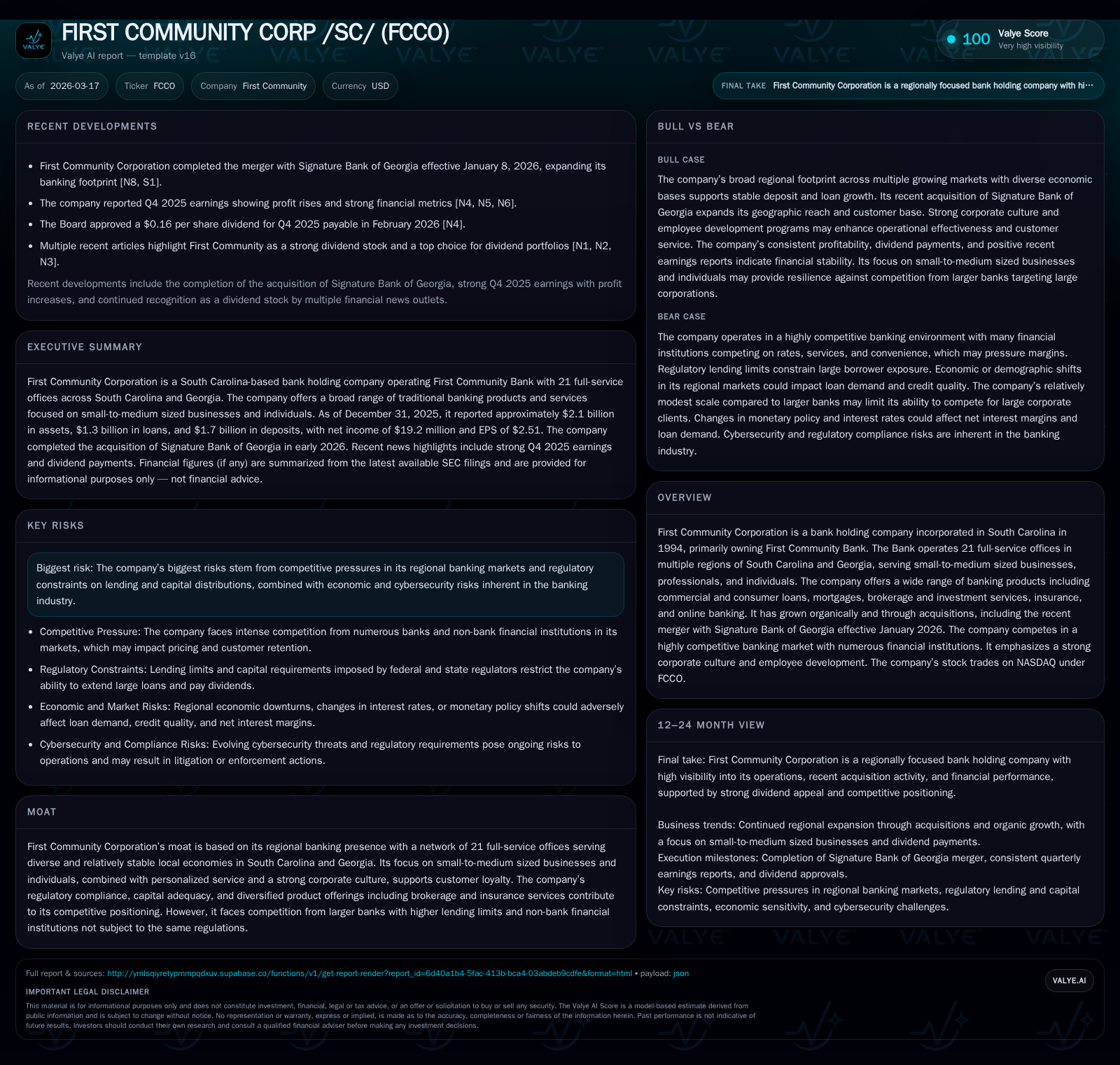
First Community Corp demonstrated robust net income growth of 37.6% year-over-year in FY2025, fueled by the recent merger with Signature Bank of Georgia and ongoing organic growth. The company operates a strategic network of 21 full-service branches across South Carolina and Georgia, targeting small-to-medium businesses and individual customers with diversified banking, brokerage, and insurance products. FCCO maintains a well-capitalized foundation with over $167 million in equity at year-end 2025, supporting consistent dividend payments amid regulatory constraints. Cybersecurity governance is tightly integrated into risk oversight, reflecting the bank's proactive approach to emerging operational threats. Key metrics to monitor include loan portfolio expansion post-merger and net interest margin dynamics given regional economic factors.
Accelerated Earnings Growth Supported by Organic and Acquisition Strategies
Historical performance (annual)
| FY | Net ($mm) | CFO ($mm) | Capex ($) | Net YoY |
|---|---|---|---|---|
| 2025 | 19 | 19 | 1110000 | +37.6% |
| 2024 | 14 | 11 | 1097000 | +17.8% |
| 2023 | 12 | 12 | 1071000 | +192.9% |
| 2022 | 4 | 22 | 1223000 |
Source: SEC companyfacts cache [F1].
Capital returns and efficiency (annual)
| FY | Div ($mm) | FCF ($mm) | ROE% |
|---|---|---|---|
| 2025 | 5 | 18 | 11.5 |
| 2024 | 4 | 10 | 9.7 |
| 2023 | 4 | 11 | 9.0 |
| 2022 | 4 | 21 | 3.4 |
Source: SEC companyfacts cache [F1].
First Community Corporation (FCCO) reported net income of approximately $19.2 million for fiscal year 2025, marking an impressive 37.6% increase from the prior year’s $13.95 million [F1]. This earnings acceleration reflects both organic growth across its established regional footprint and the strategic merger with Signature Bank of Georgia effective January 2026, which expanded FCCO’s market presence into Georgia midyear [N3][S3]. Operating cash flow also rose substantially—by nearly 72% year-over-year—to $18.7 million in FY2025 indicative of solid core earnings quality and efficient cash generation amid growth initiatives [F1]. Capital expenditures remained modest and stable around $1.1 million annually suggesting disciplined spending to support branch operations and technology infrastructure enhancements.
Momentum can be traced from moderate profitability levels in FY2022 ($4 million net income) followed by steady improvement each subsequent year culminating in this strong performance (see table below). Loan portfolio expansion supported by deposit base growth underpins these earnings gains alongside realized synergies from the recent acquisition.
Expanding Physical Footprint and Client Base Across South Carolina and Georgia
FCCO’s operational reach now encompasses 21 full-service offices strategically located across diverse economic regions primarily within South Carolina but recently extended into Georgia following the Signature Bank merger completion in January 2026 [S1]. The branch network includes dense coverage in Lexington County (6 offices), Richland County (4 offices), Greenville County (2 offices), plus single offices in other notable counties such as Anderson, York (SC), along with Richmond and Columbia Counties in Georgia.
This geographic positioning provides penetration within multiple stable local economies characterized by small-to-medium business activity—a niche where FCCO leverages personalized relationship banking models tailored to owner-managed enterprises plus individual customers seeking comprehensive financial solutions including consumer loans, mortgages, brokerage investments, insurance products, and digital banking services [S11]. The interplay of branch density alongside cross-selling capabilities enhances customer retention and revenue diversification.
Regional Banking Moat: Customer Loyalty and Diversified Product Offering
FCCO’s moat is built principally on delivering value through deep client relationships prevalent among SMBs and individual house-holds across its footprint. The company emphasizes high-touch service combined with broad product offerings—from commercial lending encompassing working capital loans to real estate mortgage products—as well as non-lending revenue streams like brokerage services delivered via affiliated registered representatives [S11].
By structuring product bundling strategies that embed insurance sales or investment advisory alongside deposit accounts or credit facilities, FCCO fortifies switching costs for clients despite competitive pressures from larger banks wielding higher credit limits or fintech firms offering alternative digital solutions. The broker-dealer affiliation under LPL Financial umbrella enhances the institution's wealth management presence without incurring direct trust powers presently but retaining flexibility for future initiatives.
Compliance adherence coupled with strong corporate culture nurturing skilled customer-facing teams further amplifies retention dynamics while limiting reputational risks common in regional banking scenarios.
Capital Adequacy, Dividend Policy, and Shareholder Return Priorities
A cornerstone of FCCO’s financial resilience lies in its robust capitalization; the company reported shareholders’ equity of $167.6 million at December 31, 2025 [F1], comfortably exceeding regulatory thresholds that define its classification as "well capitalized" under FDIC standards [S8]. This level allows the bank to maintain discretionary capital distributions while abiding by Tier 1 Common Equity ratios set by Basel III guidelines.
Dividend policy is shaped by regulatory parameters overseen by both South Carolina state regulators and federal agencies including the FDIC and Federal Reserve which restrict dividend payments if capital buffers weaken or if subsidiaries become undercapitalized [S4][S21]. The bank generally pays dividends out of current earnings which totaled $4.75 million for FY2025 representing a measured upward trajectory consistent with rising profitability but constrained against more aggressive payout ratios owing to prudential considerations.
FCCO has conducted limited share buybacks historically with no reported repurchases during recent years post-2019 making dividends the primary vehicle for shareholder returns currently [F1]. The prudent capital deployment strategy ensures liquidity flexibility to weather cyclical headwinds without sacrificing shareholder distributions unexpectedly.
Cybersecurity and Regulatory Compliance: Managing Industry Risks
Cybersecurity risk governance commands significant focus within FCCO’s risk framework. The company names an Information Security and Third-Party Risk Officer responsible for holistic oversight encompassing risk assessments, incident response protocols, identity access governance, third-party vendor risk management, employee training programs, vulnerability scanning campaigns, all supervised on a day-to-day basis through a first line of defense function complemented by second line independent monitoring reporting directly to the board Audit & Compliance Committee quarterly [S1].
This governance architecture embodies sector best practices including deployment of multi-layered defense strategies per federal guidelines emerging post-2020 heightened cybersecurity attention particularly given expanding mobile banking adoption amongst customers. The bank also monitors evolving regulatory compliance concerning data privacy laws across multiple states within its operating footprint while maintaining readiness for disclosures mandated by SEC rules for public issuers regarding material cyber incidents within prescribed timeframes [S7][S9].
Growth Drivers and Potential Market Constraints Ahead
Future trajectories hinge on several interrelated growth drivers tempered by clear constraints. Continued organic loan book expansion remains key leveraging FCCO’s entrenched relationships within SMB sectors that are less sensitive to large-scale credit shocks seen among national lenders. Additional acquisitions could provide incremental scale although more stringent merger review criteria imposed post-2024 may affect timing or cost efficiencies related to integration efforts [N2][S17].
Large banks' superior lending limits inherently cap FCCO’s ability to compete on larger commercial credits meaning its addressable market remains concentrated among smaller clients benefiting from personalized underwriting approaches rather than commoditized offerings.
Economic variables such as rising interest rates or commercial real estate sector volatility mark downside risks; notably non-owner occupied commercial real estate loans account for over three times total risk-based capital introducing concentration risk balanced against supervisory stress testing mechanisms employed internally [S14][S26]. Monitoring credit quality metrics will be essential given this exposure.
Key Milestones To Monitor in FCCO’s Upcoming Quarters
Absent explicit forward guidance statements at this time investors should focus on critical performance indicators such as quarterly loan growth figures that reflect how well Signature Bank integration proceeds post-January 2026 acquisition announcement timeline [N3][S3]. Net interest margin trends amid regional economic shifts—including deposit pricing effects—and any adjustments to reserve provisioning levels furnished during upcoming earnings releases will illuminate financial condition evolution.
Maintaining asset quality rating benchmarks especially regarding commercial real estate concentrations will be important considering evolving FDIC-prescribed supervisory expectations that remain vigilant toward underwriting discipline following pandemic-period adjustments [S14][S15].
Valuation Considerations and Competitive Positioning in Southeast Banking
Trading under NASDAQ symbol FCCO as a Southeast regional mid-cap bank holding company positions First Community Corporation among peers balancing community-based relationship banking with scale benefits most prominent amongst larger institutions headquartered nationally or fintech competitors encroaching on traditional deposit-taking activities.
Its performance trajectory grounded in demonstrated double-digit ROE (~11.5% for FY2025 calculated using net income/equity) alongside a stable dividend record underscores investor appeal typical of well-managed banks focusing on steady profit expansion rather than rapid aggressive growth models seen elsewhere [F1]. However valuation multiple compression risks persist given regulatory backdrop uncertainties including potential Basel III Endgame impact scenarios projected broadly beyond FCCO's current asset threshold but worth monitoring for long-term capital adequacy planning implications.
Competing primarily through service depth rather than lending size yields resilience against commoditization but necessitates ongoing investment in digital capabilities paralleling evolving consumer expectations while preserving community ties integral to brand loyalty.[S11]
DISCLAIMER: This analysis utilizes publicly available financial data extracted from First Community Corporation's filings up to March 16, 2026, alongside recent industry news sources. It is intended solely as an informational overview without offering investment advice or recommendations.
Disclaimer: This is research-only, informational analysis and not investment advice. It may include AI-generated interpretation and general industry context. Always verify important details using primary sources.

Comments