
Open Lending Corp's Evolution: From Near-Prime Backbone to ApexOne Auto Expansion
Open Lending leverages its proprietary Lenders Protection Platform and launches ApexOne Auto to address prime borrowers while contending with operational and regulatory challenges.
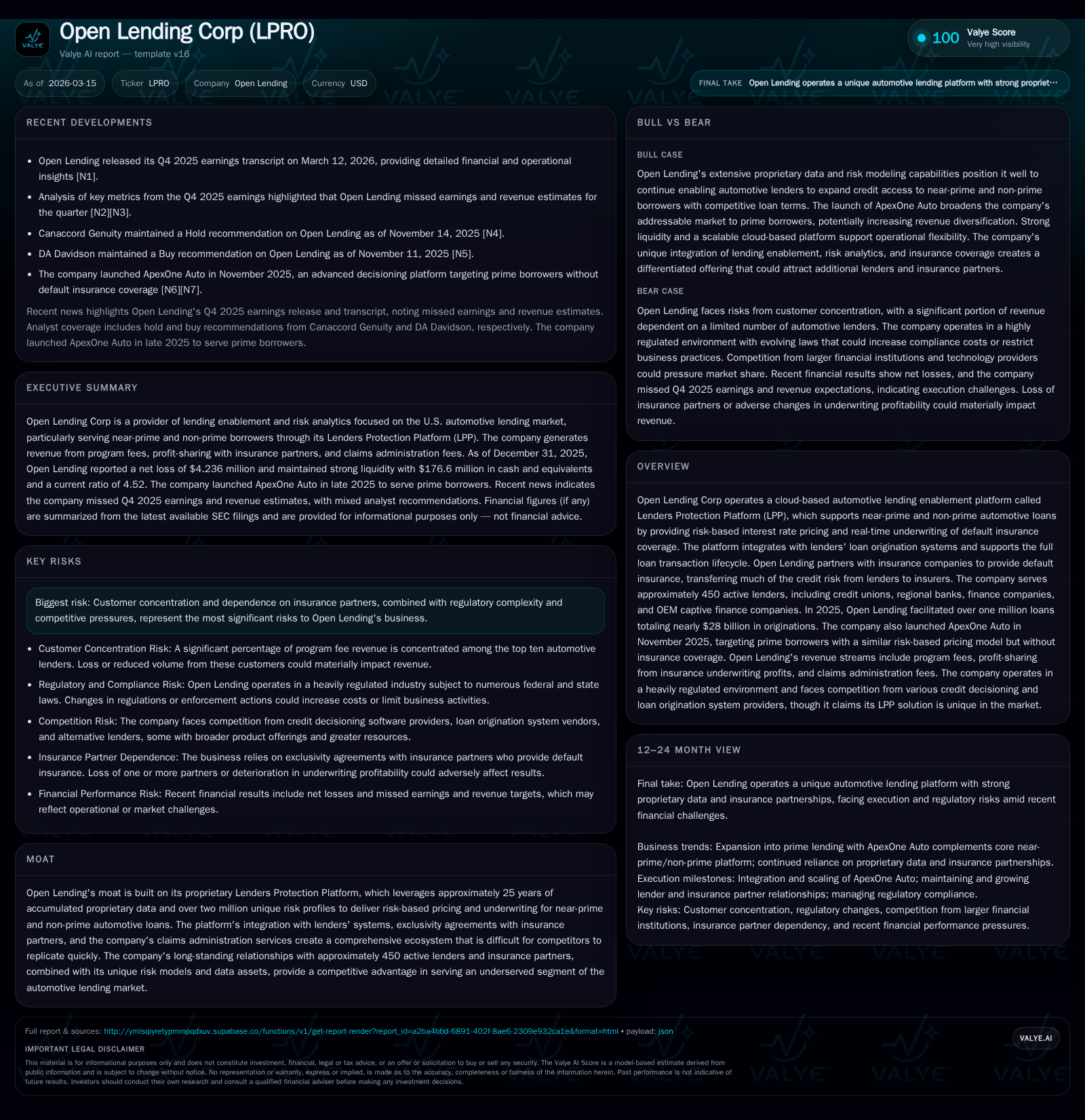
Open Lending Corp has established a data-driven foundation through its Lenders Protection Platform (LPP) to serve near-prime and non-prime auto loan markets, facilitating over one million loans totaling nearly $28 billion in originations by 2025. The recent introduction of ApexOne Auto expands its reach into prime borrowers with a risk-based pricing model sans default insurance. Fiscal year 2025 saw a marked improvement in operating results, narrowing losses significantly amid deteriorated cash flows, underscoring operational headwinds. Key risks include customer concentration, reliance on insurance partners, ongoing regulatory scrutiny, and cybersecurity threats that could constrain growth. Monitoring ApexOne Auto’s lender adoption, insurer relationships, and regulatory developments will be critical to assessing Open Lending’s future trajectory.
Legacy of Growth: Scale and Drivers Behind the Lenders Protection Platform
Open Lending Corp’s cornerstone business is its cloud-based Lenders Protection Platform (LPP), which uses proprietary risk-based pricing models to enable near-prime and non-prime automotive loans. Since its inception in 2000, LPP has certified over one million loans totaling close to USD 28 billion in originations through December 31, 2025 [S1]. This milestone underscores decades-long accumulation of approximately 25 years of proprietary data and creation of over two million unique risk profiles, establishing a rich dataset fundamental to the evolution of statistically robust credit decisioning.
LPP integrates directly into automotive lenders’ loan origination systems allowing real-time underwriting decisions that include default insurance coverage underwritten by partner carriers rated at least A- by A.M. Best [S23], [S13]. Using credit bureau scores combined with FCRA-compliant alternative consumer data, Open Lending’s proprietary score enables precise prediction of expected losses and prepayments on individual loans. This actuarial sophistication supports customized all-in interest rate recommendations calibrated to costs of capital, servicing expenses, recovery rates, and target asset returns [S19].
This platform has grown to support some 450 active lenders spanning credit unions, regional banks, finance companies, and OEM captive finance firms [S1], capturing an underserved segment characterized traditionally by higher risk loans where default insurance mitigates lenders’ credit exposures.
Emergence of ApexOne Auto: Expanding Into Prime Borrower Territory
In November 2025 Open Lending launched ApexOne Auto, designed explicitly for prime borrower segments [S7], [N1]. Unlike LPP-certified loans which bundle default insurance underwriting via insurer partners absorbing majority loan default risk, ApexOne Auto omits the insurance layer while maintaining the firm’s hallmark data-driven risk-based pricing methodology.
ApexOne Auto employs proprietary scoring akin to LPP’s approach — fusing bureau and alternative data — aiming to optimize loan pricing reflective of prime risk profiles but without coordinated insurance pricing or coverage [S7]. This product extension addresses a wider market spectrum to capture incremental revenue streams but introduces different risk dynamics absent the insurance backstop.
While forward revenue contributions from ApexOne Auto were not formally guided [N1], this expansion signifies strategic diversification beyond traditional near-prime/non-prime verticals into prime lending—a category typically characterized by higher loan volumes but substantially lower default frequencies compared with non-prime segments.
Financial Performance Review: Recovery Patterns and Operating Challenges in FY2025
Open Lending’s fiscal year 2025 results reveal meaningful recovery trends following a challenging FY2024 marked by large operating losses. Operating income improved sharply from a USD -65.4 million loss in FY2024 to a narrower USD -5.0 million deficit in FY2025—a YoY improvement exceeding 90% though still negative [F1]. Similarly, net income loss contracted substantially from USD -135.0 million in FY2024 down to USD -4.2 million in FY2025.
However, despite profitability improvements on an accounting basis, operating cash flow deteriorated markedly turning negative at approximately USD -3.2 million in FY2025 compared with positive USD 17.6 million prior-year inflows [F1]. Capital expenditures were tightly controlled at USD 56 thousand [F1]. These cash flow headwinds may reflect timing differences in profit recognition related to underwriting profit share estimates or working capital movements tied to loan volume cyclicality.
Liquidity remains robust; the current ratio stood at approximately 4.52 as of year-end reflecting comfortable asset coverage over short-term liabilities (USD 222.7 million current assets versus USD 49.3 million current liabilities) [F1]. Nonetheless restrictions embedded within the Credit Agreement limit dividend payments and mandate conservative debt covenants constraining aggressive capital returns [S6].
Historical performance (annual)
| FY | Net ($mm) | CFO ($mm) | OpInc ($mm) | Capex ($) | Net YoY |
|---|---|---|---|---|---|
| 2025 | -4 | -3 | -5 | 56000 | +96.9% |
| 2024 | -135 | 18 | -65 | 165000 | -711.7% |
| 2023 | 22 | 83 | 29 | 123000 | -66.9% |
| 2022 | 67 | 107 | 98 | 624000 |
Source: SEC companyfacts cache [F1].
Capital returns and efficiency (annual)
| FY | Buybacks ($mm) | FCF ($mm) | ROE% |
|---|---|---|---|
| 2025 | 5 | -3 | -5.7 |
| 2024 | 0 | 17 | -172.9 |
| 2023 | 37 | 83 | 10.7 |
| 2022 | 18 | 107 | 31.3 |
Source: SEC companyfacts cache [F1].
Operating income losses have narrowed significantly in FY2025 compared to FY2024 levels.
Navigating Risk: Regulatory Framework, Insurer Reliance, and Competitive Pressures
Operating within heavily regulated consumer finance and insurance sectors exposes Open Lending to evolving legal risks including heightened scrutiny under federal statutes like Dodd-Frank relating to UDAAP practices enforced by the CFPB as well as state-level licensing and lending statutes [S4], [S5], [S8], [S9]. The company faces potential civil money penalties or constraints on product offerings if found noncompliant or subject to adverse regulatory interpretations.
Significantly concentrated reliance on a small number of insurance partners—currently three active insurers underwriting default policies—with exclusivity agreements forms a critical dependency point; loss or inability to replace these partners could materially impact operations [S13], [S20]. These insurers maintain high ratings (A- or above), reflecting financial stability but also emphasizing counterparty concentration risk.
Cybersecurity breaches and fraudulent activities represent additional operational vulnerabilities given Open Lending’s extensive handling of sensitive consumer information across lender-insurer ecosystems. Despite controls aimed at mitigating cyber threats or fraud-induced losses these risks remain inherent to digital financial platforms [S20], [S25]. Intensifying competition from other fintech credit decisioning providers adds pressure on market share preservation amidst efforts to broaden services across automotive lender categories [S27].
Ecosystem Integration: Partner Relationships and Technology Edge
Open Lending’s platform architecture offers seamless electronic connectivity across diverse stakeholders—lenders’ existing origination systems interface directly with LPP enabling real-time interest rate decisioning combined with automatic default insurance approval workflows [S19], [S7].
The company’s wholly owned Insurance Administrative Services entity centralizes claims processing ensuring smooth insurer-lender service continuity which strengthens value proposition through superior client experience delivery while generating administrative fee revenues tied proportionally to insurance premiums earned by carriers [S26].
Technologically advanced actuarial refinements permit continual evolution of predictive models using granular origination-to-performance loan lifecycle data—a unique asset difficult for competitors lacking historical breadth or integration scope to replicate swiftly [S19]. Ongoing exclusive insurer contracts further reinforce this moat.
Capital Allocation Trends: Analyzing Cash Flows, Buybacks, and Return on Equity
While Open Lending reported negative free cash flow estimated at approximately USD -3.25 million for FY2025 (operating cash flow minus capex), it resumed opportunistic share repurchases totaling nearly USD 4.9 million after no buybacks in FY2024—indicating cautious return of capital amidst improving fundamentals yet constrained liquidity flexibility due to debt covenants under its $300M Credit Agreement expiring in September 2027 [F1], [S6].
Dividend distributions have been absent since FY2021; no dividends were declared amid prioritization of balance sheet repair post substantial operating losses incurred prior year(s) [F1]. Equity declined materially from USD ~213M end-FY22 down to around USD ~75M by end-FY25 tracking cumulative net losses during this period indicating negative approximate ROE near -5.7% for the latest annual period based on net income relative to equity base [F1]. Prudence warrants limited shareholder returns until sustainable profitability and cash generation are restored.
Forward Indicators and What to Monitor: Market Adoption, Insurance Partner Stability, and Financial Health
Looking ahead (analysis), key performance indicators will include the rate at which lenders adopt ApexOne Auto as they diversify lending strategies toward prime borrower segments absent default insurance protection—a metric not yet quantified publicly but potentially impactful on revenue mix dynamics.
Given insurance partner dependency risks highlighted above monitoring contract renewals or entry into new insurer collaborations will be vital for continued robust loan certification volumes within LPP programs.
Improvement trends in operating cash flow generation should be watched closely as they signal operational leverage gains beyond earnings improvements that currently mask underlying working capital pressures likely related to timing variances intrinsic in profit share revenue recognition methods described by management disclosures.
Regulatory developments merit ongoing vigilance—especially enforcement actions targeting compliance lapses or changing statutes impacting consumer loan origination terms—that may introduce unanticipated costs or product limitations restricting agility.
In sum: Open Lending occupies a niche serving near-prime/non-prime automotive lending with essential proprietary data assets underpinning differentiated analytics; recent corporate moves extend addressable markets but navigating regulatory complexity plus maintaining ecosystem partnerships remain paramount challenges shaping future prospects.
This analysis is intended solely for informational purposes synthesizing publicly available financial filings and news reports without offering investment recommendations.
Disclaimer: This is research-only, informational analysis and not investment advice. It may include AI-generated interpretation and general industry context. Always verify important details using primary sources.

Comments