
MariMed Inc. Confronts Federal Drug Policies While Cultivating Multi-State Growth
MariMed’s evolution into a vertically integrated cannabis operator demonstrates growth fueled by proprietary brands and retail expansion, offset by regulatory challenges and financial pressures.
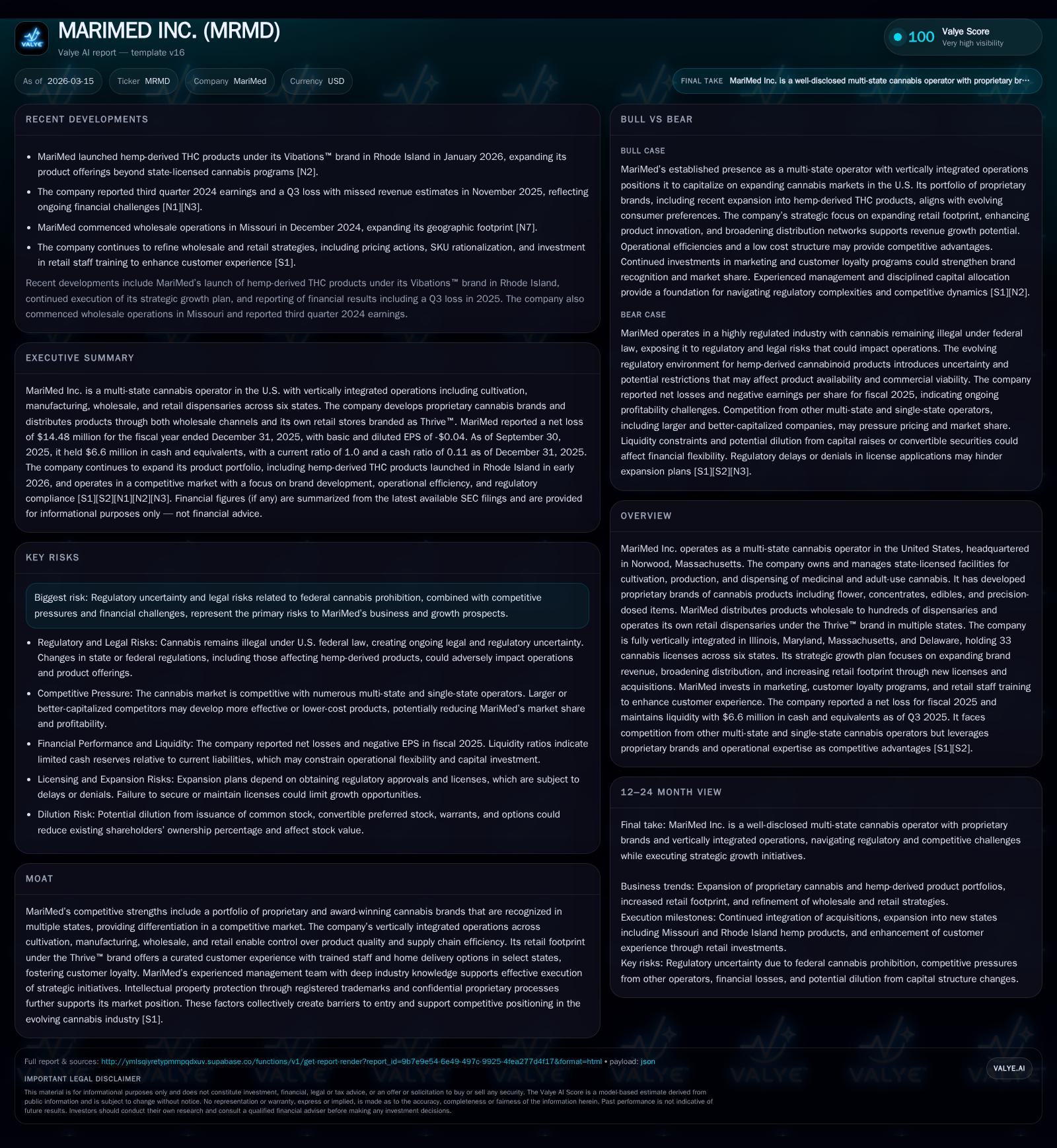
MariMed Inc. transitioned from an advisory firm to a multi-state vertically integrated cannabis operator with 33 licenses across six states, generating revenue growth averaging 11.6% through 2020. Its portfolio of proprietary brands underpins wholesale and retail expansion via its Thrive™ dispensaries, contributing to market differentiation amid fierce competition. However, persistent federal Schedule I classification imposes tax penalties and legal uncertainty, which alongside rising operating losses despite strong cash flow, tempers near-term profitability. The company’s capital deployment shows prudence with sharply reduced capex and robust operating cash flow supporting liquidity but no shareholder returns yet. Rescheduling efforts and licensing dynamics will be pivotal for future growth trajectories.
From Advisory Roots to Premier Multi-State Operator: Tracking Historical Growth
MariMed began as a cannabis advisory and real estate management firm focused on procuring licenses and developing physical facilities for clients [S19]. In 2018, it pivoted strategically toward becoming a direct owner-operator in key Eastern and Midwestern U.S. states by acquiring businesses it had helped establish [S1], culminating in significant consolidation activity through early 2025 [S19].
This transformation manifested in robust revenue expansion—from approximately $3.6 million in fiscal year (FY) 2016 to just over $50 million by FY2020—reflecting an average year-over-year (YoY) growth rate of approximately 11.6% as the company scaled its multi-state footprint [F1]. Such growth aligns with the broader pattern among multi-state operators (MSOs) asserting themselves amid fragmentary state-level legalization.
Operating income displayed marked volatility during this period; while positive margins were captured mid-decade (e.g., $20.4 million operating income in FY2022), growing competitive costs and regulatory compliance contributed to tightening profitability that culminated in an operating loss of $2.82 million reported for FY2025 [F1]. This inversion is emblematic of many expanding MSOs where compression emerges due to rapid investment outlays and pricing pressures.
Historical performance (annual)
| FY | Net ($mm) | CFO ($mm) | OpInc ($mm) | Capex ($mm) | Net YoY |
|---|---|---|---|---|---|
| 2025 | -14 | 8 | -3 | 1 | -19.1% |
| 2024 | -12 | 7 | 3 | 12 | +24.1% |
| 2023 | -16 | 8 | 14 | 20 | -219.0% |
| 2022 | 13 | 7 | 20 | 12 |
Source: SEC companyfacts cache [F1].
Capital returns and efficiency (annual)
| FY | FCF ($mm) |
|---|---|
| 2025 | 7 |
| 2024 | -5 |
| 2023 | -12 |
| 2022 | -5 |
Source: SEC companyfacts cache [F1].
Revenue figures for FY2019–FY2020 are noted but excluded here due to limited overlap with other financial data [F1].
Proprietary Brands as Cornerstones: How Unique Product Innovation Drives Market Differentiation
Central to MariMed's competitive framework is its portfolio of proprietary cannabis brands leveraging differentiated product innovation tailored to evolving consumer preferences [S5]. Signature trademarks include Nature’s Heritage™, positioned as a premium flower and concentrate brand; Betty’s Eddies™, offering functional edibles targeting sleep and pain relief; Bubby’s Baked™, known for confections; Vibations™, an infused hydration beverage optimized for discretion; and InHouse™, featuring value-oriented offerings [S5][S13].
By tightly controlling product effects via proprietary strains and precision formulations developed through ongoing R&D investments [S11], MariMed aims to address demand nuances unmet by commoditized products prevalent in the industry. This ‘effect-centric’ approach corresponds with sector insight that consumers increasingly seek purpose-driven cannabis offerings over generic bulk flower.
Award recognition further supplements consumer trust signals around quality standards implemented through confidential processing methods safeguarded by enforceable confidentiality agreements and trademark protections [S12]. The leveraging of these intellectual property assets acts as a tangible barrier for new entrants lacking established brand equity or proprietary know-how [S13].
Vertical Integration and Retail Strategy: Sustainably Scaling Cultivation Through Wholesale and Thrive™ Dispensaries
MariMed operates a vertically integrated model encompassing cultivation facilities certified for state compliance; manufacturing operations producing finished goods; wholesale channels distributing products to external dispensaries; and retail stores marketed under the Thrive™ brand umbrella [S5][S11].
Currently holding thirty-three cannabis licenses across six states—with full vertical integration achieved in Illinois, Maryland, Massachusetts, and Delaware—the company strategically benefits from supply chain control that stabilizes quality output while optimizing margins typical for a controlled production ecosystem [S15].
On the retail front—accounting for a significant revenue portion—Thrive™ dispensaries differentiate through sophisticated designs promoting shopper comfort combined with staff trained extensively on product knowledge ("budtenders"), enabling consultative sales approaches fostering repeat visits [S5]. Home delivery services supplement physical storefronts where permitted by regulation (e.g., Massachusetts and Delaware), broadening accessibility especially under adult-use frameworks.
The reciprocal wholesale-retail relationships underpinning this strategy exemplify canonical MSO dynamics whereby internal brands leverage captive retail locations for trial adoption while wholesale enables wider third-party penetration—producing synergistic growth feedback loops between channels [S5][S15].
Federal Law Shadow: Legal Risks and Their Multi-Faceted Impact on Operational Stability
Despite extensive legalization at state levels exceeding forty jurisdictions [S1], cannabis remains classified federally as a Schedule I substance under the Controlled Substances Act (CSA), exposing MariMed to risks including potential criminal prosecution albeit currently low enforcement priority [S4][S9][S14]. This classification triggers IRS Tax Code section 280E restrictions which disallow typical business expense deductions against revenue derived from Schedule I substances—imposing material incremental tax burdens estimated at several million dollars annually for MariMed [S24][S26].
Although administrative movements toward rescheduling marijuana to Schedule III have gathered political impetus—including recommendations from the Department of Health & Human Services (HHS) and executive orders directing the Department of Justice's expedited rulemaking—the Drug Enforcement Administration's (DEA) review remains pending beyond expected timelines [S1][N1]. If successful rescheduling occurs:
- Federal tax treatment improves by lifting section 280E constraints.
- Banking access expands as federal regulators reduce perceived illicit risk.
- Consumer confidence potentially rises given greater medical legitimacy.
Conversely absent rescheduling prolongs operational costs rooted in compliance complexity with overlapping state-federal dichotomies plus continuing limitations on interstate commerce within cannabis markets [S9][S14]. Moreover regulatory uncertainty complicates capital markets' enthusiasm impacting valuation stability.
Financial Trends Unpacked: Revenue Growth vs Increasing Operating Losses and Capex Retreat
MariMed exhibits the hallmark financial profile of maturing MSOs balancing growth ambition with increased cost absorption [F1]. While top-line momentum persisted through FY2020 with significant expansions since inception (~$3.6M in FY2016), profitability indicators have deteriorated since peaking around FY2022:
- Operating income plunged from positive $20.4 million in FY2022 to negative $2.82 million by FY2025 (-196.8% YoY change versus prior year).
- Net losses sustained consistently post-FY2022 with -$14.48 million recorded in FY2025 (-19.1% YoY) despite improving operating cash flows (+13.4% YoY).
- Capital expenditures declined sharply (-90.2%) from $11.96 million in FY2024 to just $1.17 million in FY2025 signaling conservative capex alignment possibly following major build-out phases completion.
Such trends imply elevated overhead costs linked to integration expenses or margin pressure scenarios common during scale transitions within narrowly regulated sectors where pricing competition compresses returns.
Capital Deployment and Shareholder Returns: Assessing Liquidity, Cash Flow Generation, and Equity Levels
At December 31st, 2025 MariMed maintained cash balances near $6.6 million complemented by current assets approximating parity with liabilities (current ratio 1), indicating balanced short-term liquidity management adequate for operational cycles without excess cushion [F1][S6][S12]. Robust operating cash flow over recent years ($7–8 million annually) has underpinned working capital requirements even amidst net losses.
No dividends or share repurchase programs have been announced consistent with reinvestment priorities common among MSOs scaling infrastructure or market presence rather than returning capital directly to investors [F1][S6]. Equity levels have absorbed negative earnings impacts but represent residual claims after accounting for debt holdings inclusive of preferred stock financing arrangements finalized recently that replace legacy instruments entailing restrictive covenants governing distributions [S25][S26]. The lack of capital return mechanisms reflects prevailing sector maturity stages prioritizing profitable pathfinding over yield enhancement.
Future-Forward: Regulatory Indicators, Market Expansion, and What to Watch Next
Upcoming catalysts hinge materially on the DEA’s final decisions regarding marijuana rescheduling—a development that could fundamentally recalibrate MariMed’s expense structures via Section 280E elimination while opening up better access to traditional financing avenues previously restricted due to federal illegality concerns [N1][S1][S5]. Monitoring state-level licensing environments will also be critical; MariMed signals intent toward expanding footprint via new license approvals or acquisitions evidencing an opportunistic approach balanced against regulatory approval unpredictability.
Moreover continuous innovation across its product lineup coupled with customer engagement enhancements like loyalty programs reflect adaptive strategies designed for sustaining consumer preference advantages within increasingly crowded markets subject to intensifying price competition from better-capitalized peers [S13][S17]. Investors should observe accompanying guidance updates focusing on earnings inflections correlating with regulatory shifts paired with execution pace on retail expansion plans.
Disclaimer: This analysis is intended solely as an informational overview based on available public filings dated early-March 2026 including SEC Form 10-Ks/Qs/8-Ks along with recent corporate communications. It does not constitute investment advice or recommendations regarding any securities or financial instruments related to MariMed Inc.
Disclaimer: This is research-only, informational analysis and not investment advice. It may include AI-generated interpretation and general industry context. Always verify important details using primary sources.

Comments