
Erasca Sharpening Focus on RAS/MAPK Pathway with Clinical Progress and Strategic Licensing
Erasca advances its pan-RAS targeted oncology pipeline while managing clinical and financial challenges inherent to its precision approach.
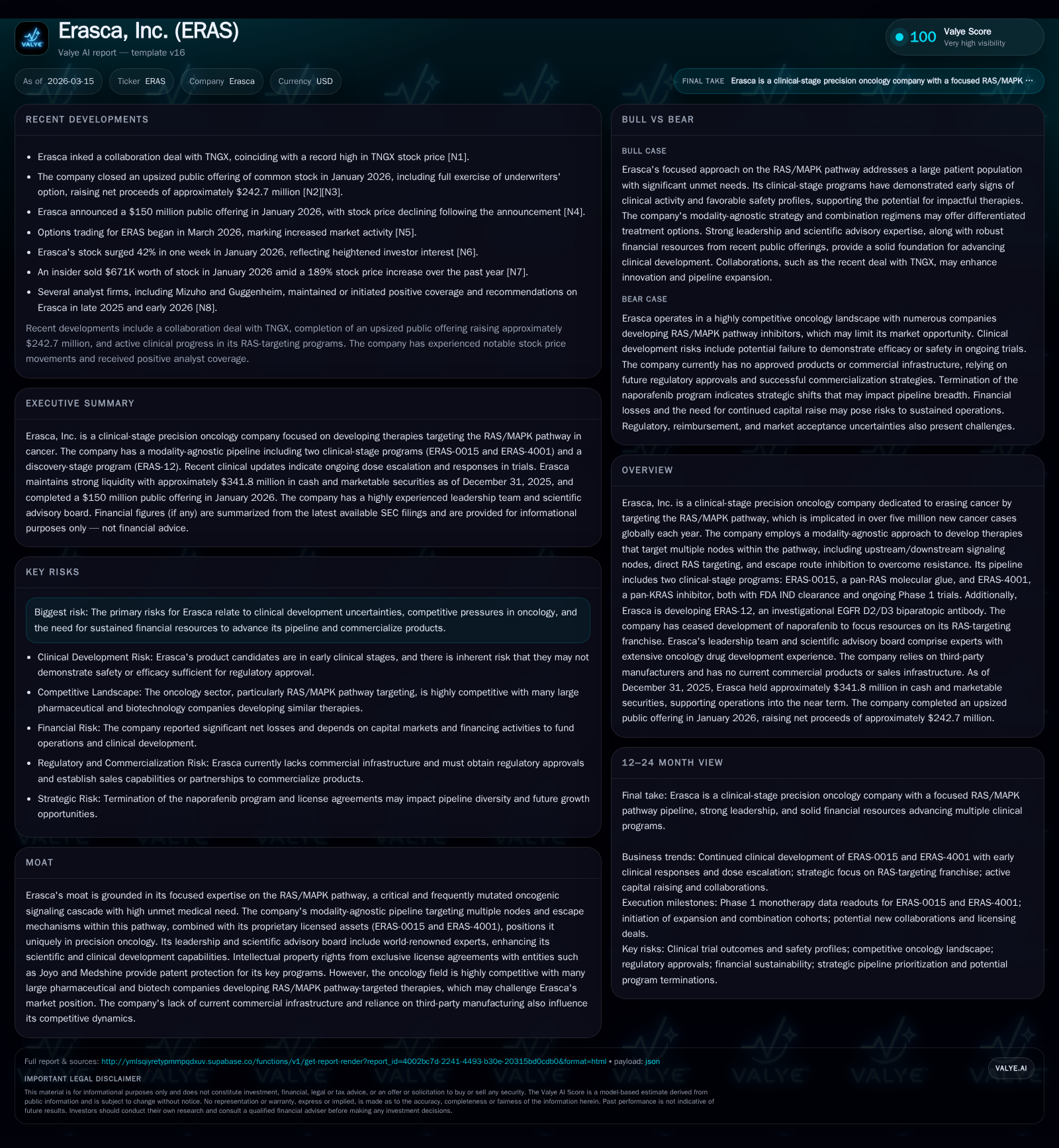
Erasca, Inc. pursues a modality-agnostic strategy targeting the RAS/MAPK pathway in cancers through its clinical-stage pipeline. The company’s two lead candidates, ERAS-0015 and ERAS-4001, are in Phase 1 studies supported by exclusive licensing agreements, notably with Joyo expanding territorial rights in early 2026. Despite consistent operating losses driven by R&D investments, Erasca’s financial position remains strong with significant cash reserves. Future growth hinges on clinical data readouts, execution of combination therapy strategies, and navigating a competitive landscape alongside regulatory hurdles typical of oncology drug development.
Company Overview and Strategic Focus
Erasca, Inc. is a clinical-stage precision oncology company founded with a mission to "erase cancer" by targeting the RAS/MAPK signaling cascade — one of the most commonly mutated oncogenic pathways implicated in over five million new cancer cases globally each year [S1]. The company pursues a modality-agnostic strategy leveraging small molecules, molecular glues, and biologics to simultaneously target multiple nodes within this pathway including upstream and downstream regulators as well as direct RAS targeting agents. Its portfolio reflects this integrated approach with clinical programs focused on pan-RAS inhibition (ERAS-0015) and pan-KRAS targeting (ERAS-4001), both cleared by FDA for Phase 1 studies.
In addition to these advanced candidates, Erasca is developing ERAS-12, an investigational EGFR D2/D3 biparatopic antibody derived through acquisition endeavors that enable targeting of ligand-dependent activation states, potentially expanding therapeutic reach [S1][S25]. Notably, the company has shifted resources away from naporafenib development to consolidate efforts on its proprietary RAS franchise.
This focus is underpinned by leadership comprising seasoned oncologists and researchers recognized for pioneering RAS biology, cementing Erasca's moat built on specialized scientific expertise coupled with exclusive intellectual property acquired via licenses from entities like Joyo (ERAS-0015) and Medshine (ERAS-4001) [S18][S19].
Historical Financial Performance
Like many clinical-stage biotech firms investing heavily in R&D without approved products, Erasca has reported consistent net losses accompanied by negative operating cash flow as it advances its pipeline. According to FY2025 results filed March 2026:
Historical performance (annual)
| FY | Net ($mm) | CFO ($mm) | OpInc ($mm) | Capex ($mm) | Net YoY |
|---|---|---|---|---|---|
| 2025 | -125 | -95 | -141 | 0 | +23.0% |
| 2024 | -162 | -109 | -180 | 0 | -29.3% |
| 2023 | -125 | -101 | -142 | 2 | +48.5% |
| 2022 | -243 | -103 | -247 | 15 |
Source: SEC companyfacts cache [F1].
Capital returns and efficiency (annual)
| FY | FCF ($mm) | ROE% |
|---|---|---|
| 2025 | -96 | -38.3 |
| 2024 | -109 | -38.2 |
| 2023 | -103 | -39.5 |
| 2022 | -118 | -59.0 |
Source: SEC companyfacts cache [F1].
Operating losses have narrowed since the peak in FY2022 primarily due to expense discipline even as clinical activities intensified. Capital expenditures have declined markedly relative to prior years indicating reliance on third-party manufacturing rather than internal facility investments [F1]. The company's approximate return on equity stands at negative 38.3%, reflecting typical pre-commercial biotech capital deployment [F1].
Cash balances of approximately $73.8 million combined with current assets of about $286 million versus liabilities near $28.5 million yield a current ratio above 10x at end-2025 — demonstrating strong liquidity positioning the company well for upcoming milestones absent major spending shifts or fundraising needs [F1].
Pipeline Progress and Growth Drivers
Clinical Programs
Erasca's growth trajectory centers on advancing its pan-RAS molecular glue ERAS-0015 and pan-KRAS inhibitor ERAS-4001 through early-stage clinical trials designed to evaluate safety profiles and initial efficacy signals across multiple tumor types characterized by RAS pathway mutations [S1]. Both agents have received FDA IND clearance enabling patient enrollment.
The third program ERAS-12 represents earlier stage innovation addressing EGFR-driven cancers via biparatopic antibodies that bind distinct receptor domains stabilizing inactive conformations—an approach designed to complement small molecule efforts [S1][S25].
Licensing Expansion
A key catalyst occurred in March 2026 when Erasca exercised an option under its Joyo License Agreement to expand rights into mainland China for ERAS-0015 following first patient dosing in a Phase 2 trial—triggering a substantial $150 million payment obligation and paving the way for global commercial outreach beyond U.S. exclusivity [S18][N1]. This move suggests promising early data or strategic prioritization leveraging the Asia-Pacific market disproportionately affected by RAS-driven cancers.
Targeting Resistance Mechanisms
Resistance has challenged prior MAPK pathway therapies. Erasca’s strategy includes targeting multiple nodes concurrently—upstream regulators like RTKs alongside downstream effectors such as RAF/MEK—in single agents or combinations aiming for synergistic blockade of escape routes tumors employ under selective pressure [S1][S23]. This portfolio-wide approach aligns with evolving precision oncology trial designs favoring adaptive basket studies filtered through biomarker stratification.
Competitive Positioning
While operating amid intense competition—including companies like Amgen and Roche pursuing various aspects of RAS inhibition—Erasca’s licensed assets combined with scientific stewardship offer differentiation. Their modality flexibility—from small molecules through biologics—facilitates tailoring treatments to diverse molecular subtypes where rigid single modalities have struggled [S23].
Regulatory Environment and Risks
Oncology drug development faces complex regulatory pathways globally. In the U.S., Erasca must navigate FDA processes including extensive preclinical studies followed by phased clinical trials culminating eventually in NDA/BLA submissions requiring demonstration of safety and efficacy [S14][S22]. Post-market commitments such as risk evaluation mitigation strategies may be imposed given class toxicities observed historically.
Outside the U.S., European Medicines Agency mandates similar rigor including compliance with Good Clinical Practices under EU Clinical Trials Regulation implemented recently [S6][S8]. Variations among country-specific requirements further complicate approvals.
Additional risks derive from reimbursement unpredictability driven by third-party payors’ inconsistent coverage policies dependent on cost-effectiveness evaluations versus existing therapies [S4][S9]. Federal initiatives aimed at drug price controls via Medicare negotiations under the Inflation Reduction Act alongside recent Medicaid funding cuts add pricing pressures potentially impacting commercial viability post-launch [S15][S16].
Intellectual property protection remains crucial but vulnerable given active patent challenges within this competitive pharma segment [S18][S19][S29].
Capital Allocation and Financial Outlook
As typical for pre-revenue biotechs focused on novel oncology therapeutics, Erasca prioritizes sustained investment in research and development activities underpinning pipeline advancement. FY2025 operating expenses drove net losses near $125 million but showed improvement over previous years indicative of operational efficiency gains [F1]. Free cash flow remained negative around $96 million after minimal capital expenditures reflecting ongoing burn related primarily to clinical trials expansion combined with licensing fees such as the recent Joyo payment. Equity declined relative to prior year reflecting accumulated deficits while liquidity metrics indicate adequate runway potentially obviating immediate dilution concerns absent unforeseen events or failed trials. Improving operating cash flow trends suggest prudent cash management though investments will need balancing against upcoming clinical inflection points that may require additional financing rounds. No dividends or share repurchases are present consistent with growth-phase priorities [F1].
Key Upcoming Milestones To Monitor
- Progression of Phase 1 trials for ERAS-0015 & ERAS-4001 into dose escalation/completion phases; interim safety & pharmacokinetic data releases could validate modality choice.
- Initiation or advancement of Phase 2 studies especially post-Joyo geographic expansion indicating wider patient inclusion.
- Preclinical or early clinical data maturation from discovery stage ERAS-12 advancing toward IND filing prospects.
- Potential strategic collaborations or licensing deals expanding financial resources or pipeline breadth akin to recently reported partner interactions triggering stock market interest [N1].
- Regulatory submissions or approvals remain critical; watch for updates from FDA or EMA regarding trial design changes or requests.
Conclusion: Balancing Scientific Promise Against Execution Risk
Erasca exemplifies precision oncology companies whose success depends heavily on translating cutting-edge science into patient outcomes promptly enough to sustain investor confidence amid costly development cycles. Their focused dedication targeting the historically undruggable RAS/MAPK axis is ambitious yet backed by strategically procured assets and expert teams integrating external innovations. Substantial risks remain tied to proof of clinical efficacy across heterogeneous tumor types exhibiting variable resistance compounded by complex regulatory approvals globally coupled with reimbursement uncertainties affecting commercial viability. Financially the company shows disciplined management evidenced by improved loss metrics alongside healthy liquidity though continued capital infusion will likely be necessary before product revenue emerges. The recently exercised option expanding territory into major Asian markets marks a pivotal commitment reflective either of encouraging early signals or strategic positioning relevant for future growth if milestones are met. Overall awareness of Erasca’s scientific progress alongside fiscal discipline and competitive positioning will be key indicators for stakeholders navigating this high-risk/high-reward biotech environment committed to addressing one of oncology’s most formidable molecular targets.
This analysis does not constitute investment advice nor recommendations but aims to provide an informed perspective grounded in publicly available filings dated up to March 15th, 2026.
Disclaimer: This is research-only, informational analysis and not investment advice. It may include AI-generated interpretation and general industry context. Always verify important details using primary sources.

Comments